
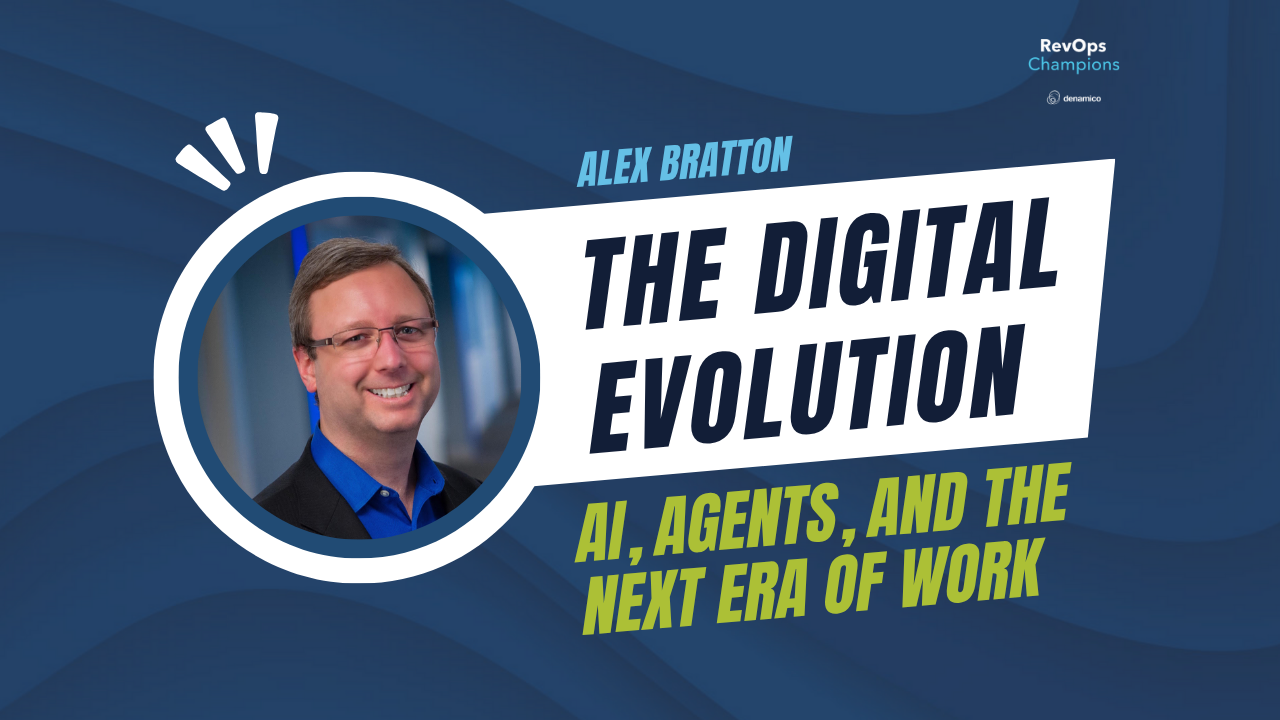
In this episode of RevOps Champions, we sit down with Alex Bratton, entrepreneur, technologist, and author of Practical AI for Leaders, to explore how AI is transforming the way businesses operate. From AI-powered sales coaching to digital team members and automation, Alex shares practical insights on leveraging AI to empower teams, streamline operations, and drive growth. We discuss the shift from traditional SaaS to AI-driven business models, the importance of AI readiness, and why the real competitive advantage lies in human and AI collaboration—not replacement.
Alex also shares insights from his latest book and his approach to helping leaders integrate AI into their organizations in a meaningful way. If you want to stay ahead of the curve in AI and RevOps, don’t forget to like, subscribe, and turn on notifications so you never miss an episode. You can also check out Alex’s book and his AI leadership community to dive deeper into these topics.
Listen
About the Host
|
|
Alex Bratton | CEO and Chief Geek, Lextech Global Services
Alex Bratton is the author of the books Practical AI for Leaders and Billion Dollar Apps, an adjunct professor of computer science and the CEO and Chief Geek of Lextech, an Apple enterprise partner that applies cutting edge tech to drive huge business results through tech powered employee experiences people love.
Alex helps teams adapt to the new world of work and create employee experi-ences that empower people to drive business results. Alex's superpower is his keen sixth sense to look around the corner of what's next with technology to empower people and help businesses thrive.
|
.png?width=209&height=209&name=HubSpot%20Profile%20(10).png)
Episode transcript
Welcome and the Apple Vision Pro Experience
Brendon Dennewill: You're listening to the Brendon Dennewill podcast, created for B2B leaders to help you align your people, streamline your processes, trust your data, and leverage technology in order to grow your business. Alex, how are you doing?
Alex Bratton: I am doing great. Excited to be jumping in with you. I just want to make sure the audio is okay and all of that.
Brendon Dennewill: The audio is great. I'm sure it's going to take people a while to get used to the view.
Alex Bratton: The virtual me. I get it. Totally get it.
Brendon Dennewill: So why don't we dive straight into that. How did you show up for this show as a virtual you, and how do we know when we're seeing the virtual you versus the real you?
Alex Bratton: I'm currently using my Apple Vision Pro. When you buy one of these, you scan yourself and it takes a couple of pictures and creates a three-dimensional version of you. You can use that when connecting via video, or if you're FaceTiming with people, they can actually see a 3D person standing there next to them. For me, connecting via flat screen has been useful, but it's time for us to start getting past that. I'm really excited to explore how we can make this more human.
Brendon Dennewill: So right now you're seeing yourself in 3D versus just a flat version?
Alex Bratton: Actually, I don't see myself at all. I've got this on my head. I can see my hands in front of me, and they're doing the same thing you see. I've got you in a window in front of me, some notes over there, my Mac screen over there. They're all just floating here in my office.
Brendon Dennewill: Very cool. Since we met about a year ago in Chicago, just a couple of months after you got the Apple Vision Pro, you were already all over it. It looks like that enthusiasm hasn't waned much.
Alex Bratton: Not at all. If anything, it's accelerating. I just got off an Apple partner call, and as a 15-year Apple partner, we've been able to really dive into this. When the iPhone first came out, nobody knew what to do with it, and eventually it changed the world. With the Vision Pro, Apple is foreshadowing in a way I've never seen them do before, which is just amazing.
What Is RevOps, and Why Does Technology Context Matter?
Brendon Dennewill: So, Alex, great to have you on the show. I heard a few weeks ago that people are starting to refer to you as the Dan Sullivan of tech. For those who don't know who Dan Sullivan is, that's one heck of a compliment.
Alex Bratton: It's absolutely super flattering. Dan Sullivan is a great simplifier who helps people through huge business challenges and business thinking, and that's what I try to do. I'm a geek who applies technology to help people thrive at work. How do we make that real and practical? Because otherwise, the tech doesn't matter.
Brendon Dennewill: I love that as a segue, because a lot of what we talk about on this show is the components of what makes a RevOps model successful in a business. For the folks who don't yet know what RevOps is, you're most likely already doing a lot of the things we talk about. We've just given it a name. Essentially, RevOps is about moving your marketing ops, your sales ops, and all the data, processes, and technology that run through that revenue team into one unified team that supports the entire customer journey.
Brendon Dennewill: We say the people, processes, data, and technology that run your customer-facing teams is what we call RevOps. I'm guessing a lot of what we'll discuss today will lean heavier on the technology side. But I know you understand, as a successful entrepreneur yourself, that without clear processes, clean data, and a strong culture, the technology really isn't going to do you much.
Alex Bratton: The tech doesn't matter if you don't have the fundamentals. It's all of that stuff coming together. When we lean in with folks, we look at the technology but also ask: what are the processes, where is the friction, what does a week in the life of this human being actually look like? Then we can weave the threads together, because without that, the tech is just shiny.
AI as the Next Electricity: A Shift as Fundamental as the Internet
Brendon Dennewill: At Denamico, we often reflect on why we started the company. The core of it was helping small and mid-sized businesses navigate evolving technology to stay connected to their customers and continue to grow. With all the hype around AI in the last year, that mission is still absolutely true. The technology focus has just shifted from CRM and integrated systems to AI. What are the key differences between AI as a technology and what came before it?
Alex Bratton: I was actually just giving a workshop yesterday and we covered this exact topic. Think back to the old icebox. Pre-electricity, ice had to be delivered to keep food cold. Then we got electricity, refrigerators, and it changed the entire supply chain and ecosystem. Fast forward: the Internet came along, and most businesses today can't imagine operating without it. That's the level of change AI is bringing.
Alex Bratton: I'm a big champion of AI being about giving our teams superpowers, not replacing them. And I think that's one of the key differences from previous technology waves. In the old days, we had the web person, the app person, the tech person. Now we can put AI in the hands of every single team member and they can run with it. That's different from saying, 'Here's Excel, everybody go use it.' This is fundamental. I can use it in every single task. But the only time we get those big changes is if we involve the whole team in thinking about it.
Building a Culture of AI Literacy: Where Leaders Should Start
Brendon Dennewill: What are your recommendations for business leaders trying to figure out how to build their communication, policy, and culture around their people using AI?
Alex Bratton: That one's easy for me, because I just published a book on it this week: Practical AI for Leaders. It's about our journey and learning out loud. Right now, it's not about the technology. It's about the culture shift necessary for our organizations to actually embrace it. We spent essentially Q2 and Q3 of last year experimenting. Every team member participated in weekly town hall meetings, where each person spent just four hours over an entire quarter trying a tool. Then every single person gave a three-minute presentation on what they tried, what worked, what didn't, and any recommendations for the team. One page, super simple. It didn't matter if you were in accounting, sales, or engineering.
Alex Bratton: That was followed by forming a team to start digging into how we embrace AI more broadly. But it was that first quarter of experimenting, celebrating the wins, and also celebrating when a tool didn't work, that was the key. As leaders, we can't just point at the IT person and say, 'Figure it out.'
Brendon Dennewill: That's very similar to what we've been doing here. We run on EOS, and I had a rock last quarter around AI and another one this quarter as well.
Alex Bratton: As should everybody.
Brendon Dennewill: For those who don't know, a rock is a 90-day initiative one person takes on to move a specific area of the business forward. We've been experimenting across all functions, and whether someone is in marketing, sales, or delivery, they're using different tools for different tasks. Which is exactly the point. We're just trying to learn.
Brendon Dennewill: One of the biggest challenges we help clients with is managing and avoiding tech bloat: paying for multiple tools that do the same thing. We realized quickly that AI isn't going to fix that problem. It's going to accelerate it.
Alex Bratton: It's a hundred times worse. There are a hundred new tools every day. The trap I keep seeing people fall into is asking, 'What's the best tool for X?' instead of getting really good at communicating with AI. Treat it like an intern who has the knowledge of the universe but doesn't know anything about your organization. If you just say, 'Go create a report,' it'll go about as well as you'd expect. We have to get better at talking to it and communicating clearly.
Data Readiness, Prompt Literacy, and Building Your AI Knowledge Base
Brendon Dennewill: One of the things we've noticed is that for any organization to be ready to embrace AI, the readiness component is critical. And the first thing we consistently see, which tracks with what we've been doing for ten-plus years in the CRM space, is that you have to have good, clean, organized, accurate data.
Alex Bratton: Completely agree. Especially when you're digging into processes that include access to customer data, like pulling from a CRM or running reports. But there are some opportunities where, even as you're cleaning up your data, individuals can start building personal AI literacy. I put together a prompt recently that I've shared with others: it allows you to recruit a virtual advisory board of giants. You can describe a challenge you're wrestling with, bring in the personality and general thinking of leaders like Steve Jobs or others, and have a real dialogue. I didn't need any core company data for that, but it was genuinely valuable as a thought partner while our team was working on cleaning up our data infrastructure.
Alex Bratton: To build that AI competency now, people can absolutely start leaning in. Look at your week. What could you automate? Where could you have superpowers? On the data side, we're a services firm. Our processes are documented, but a lot of our secret sauce lives in conversations. So we're now capturing transcripts of all internal project meetings and, where clients are comfortable, some sales conversations too. That's the data we've been missing. After a few months of transcripts, we can process and aggregate them to find common customer challenges, the language we use when describing spatial computing, and start building a knowledge set that doesn't exist today.
Brendon Dennewill: Does it really matter where you're archiving or storing that data?
Alex Bratton: As long as it's somewhere you control, you're in a good place. If you're using a virtual meeting tool that transcribes automatically, I wouldn't use that as your archive. We use Box as our file store. Whether you prefer Box, Dropbox, or Google Drive, keep it simple: get it on a file system you control. The same goes for a prompt library. Having those files makes it easy to drag them into whatever LLM you're working with. Having things as files is pretty important today.
Choosing the Right AI Tools and Building a Sustainable Tech Stack
Brendon Dennewill: For folks who are more advanced and want to understand the architecture of how to set this up, you mentioned Box as a way to collect unstructured data from conversations, and then eventually putting that into an LLM. What does the AI tech stack look like right now?
Alex Bratton: That is the question, because it changes daily. Which model is better? Which provider is better? We're going to see enormous change in the next year, with companies appearing and disappearing quickly. My general recommendation is to pick some tools you're comfortable with. On the LLM side, I typically start with ChatGPT because at the team level, it's easy to secure, easy to share things with your team, and has strong capabilities to get started with. But more importantly, the key isn't the tool. It's how we learn to talk to the AI. The prompts we're creating now, we'll take those and move them to whatever comes next. So it's really about: where do you start, and how do you invest six months in getting comfortable?
Alex Bratton: That said, I also use Claude and Gemini. For the book I just released, I brainstormed with ChatGPT, edited in Claude, and had graphics created in Midjourney. For meeting transcripts, we use Roam as our digital headquarters. It auto-transcribes meetings, and we then download those and put them into Box. On privacy: we set up a one-way depository where people can drop files into the appropriate folder, categorized by sales conversation or internal project meeting. No one in the company can see them except me, so I can craft prompts in aggregate, remove names, and pull insights without anyone feeling like Big Brother is watching.
Brendon Dennewill: That's a critical piece. Making sure client data is removed from whatever you're feeding into AI systems is essential, and it's something everyone leaning into this has to figure out early.
Alex Bratton: Exactly. And customers are getting more comfortable with it. The language matters: say 'AI note taker' instead of 'recording' and people respond very differently. On the sales side, we're working with someone right now who wants to run every call transcript through a set of rules based on the Sandler sales method, score the salesperson on a dozen parameters, and send them a personal coaching email by the time they've hung up the phone. Every salesperson can have a personal coach now.
Brendon Dennewill: I just came across another new product that does something similar for the Challenger sales process. It's interesting from an entrepreneurial perspective: every day, people are having lightbulb moments, realizing they have domain expertise and can now build something of real value with AI. But my advice for people who get hung up on security concerns and use that as an excuse not to start is this: you cannot see the opportunity until you're actually doing something. You have to have your line in the water if you're going to catch the fish.
Alex Bratton: Exactly. AI is not going to change the world overnight, but over the next 5, 10, 20 years it's going to change everything. That's why it's so important for the whole team to embrace it, rather than freaking out.
Managing Risk, Data Privacy, and the Right Subscriptions
Brendon Dennewill: There are obvious risks involved. People in business aren't sure whether to share a personal opinion on AI or a company-based one. It's a challenge. And it's interesting to see the difference between people who are more risk-averse and those so excited by the upside that the risks feel secondary.
Alex Bratton: Something important to keep in mind: if you're using a free AI product, you are the product. They're using your data. Stop using free tiers for anything company or client related. You have to research what subscription level protects your data, and some tools simply can't be made safe enough. Having a small, curated list of tools the team can use, with the right subscriptions, is the right move. Once we got through the experimentation stage, the number one concern from our team was no longer 'AI is going to take my job.' It was: 'What tools can we use that won't create problems for our customers?' So let's define a small group of approved tools, confirm we have the right subscriptions, and share clearly how to use them.
Brendon Dennewill: We're a Google shop, so when Gemini became available, we pointed the team there as a safe starting point. And I've also learned that Claude tends to be the favorite for marketers creating content, while ChatGPT is great for reasoning, brainstorming, and building prompts.
Alex Bratton: Stringing tools together like that is perfect. I frequently use ChatGPT to create the prompt I then feed into Midjourney for images. That core skill set, knowing how to talk to the AI, is what carries across tools. There will always be a new interesting tool someone on the team gravitates toward, and that's great.
AI Search, Perplexity, and Going Beyond Google
Brendon Dennewill: Someone we both know and respect recently asked about using Perplexity versus Google for search. How do you think about that?
Alex Bratton: Stepping back from Perplexity for a moment, one of my top recommendations for building personal executive AI fluency is to stop using Google. Anytime you'd type into Google, go to an AI tool instead, whether that's ChatGPT with web search or Perplexity. You'll get deeper, more interesting results. Unless you have the $200 ChatGPT Pro account, which I've been experimenting with and using to generate market research reports in about 30 minutes, I wouldn't recommend jumping straight to that. But Perplexity is great for research and sourcing information. You can then bring that into your preferred AI tool for further processing. I personally default to ChatGPT's built-in search out of convenience, but if I need to go deeper, the other tools are excellent.
AI Agents: Promise, Pitfalls, and the Road Ahead
Brendon Dennewill: Two months ago I wouldn't have wanted to bring this up yet, but I think it would be crazy not to talk about it now: agents. I follow Dharmesh, the co-founder of HubSpot, closely. You recently built an agent on Agent.ai, the platform he launched less than a year ago. There are now over half a million people using it. What's your advice for people exploring agents?
Alex Bratton: Agents are really what's going to reinvent businesses as we get deeper into them. The word 'agent' unfortunately means a lot of different things right now. Internally, we've started thinking about them in two categories: digital team members with significant autonomy, and trigger-based automations that take action when a specific event occurs. Agent.ai falls into that second category. For those familiar with Zapier for process automation, think of it as that, plus plus. The unique thing Dharmesh added is an ecosystem where you can hire someone else's agent to do a task.
Alex Bratton: The agent I published was a LinkedIn researcher: you give it a person's name and company, and it does the appropriate searches and builds a personality profile based on what they've posted. It was picked as agent of the week, and 12,000 people used it in the first week. But as you said, it's early. It's not as simple as 'take my money and give me a virtual employee.' We're not there yet. And we have to be cautious: if we're putting all of our AI energy into agents, are we leaving our team behind? Ideally, I'd like team members to be the ones suggesting where an AI agent could help, so they feel empowered rather than replaced.
Brendon Dennewill: So your suggestion is to focus on the fundamentals first?
Alex Bratton: The fundamentals, and your people. Start with people leaning in. There are some organizations having real success with AI-powered voice systems that replace outdated IVRs, and with intelligent email workflows. But the leaders of the future will be determined by the companies that bake AI into their culture, not just the ones that pick one great tool or agent and run with it.
Brendon Dennewill: That's always been our starting line: how do we solve for human plus AI. And it's worth repeating for anyone still worried about their job: AI is not going to take your job. But someone who knows AI will.
Alex Bratton: Yes. And what employees want to hear from their leaders is: what's our plan? If they're seeing evidence that the goal is to give them superpowers, not replace them, that makes people so much more comfortable. Whether you're an engineer, a marketer, or a senior leader, everyone is wondering when deep reasoning models might be able to do their job. But the human plus AI combination will always win.
Institutionalizing AI: From Experimentation to Organizational Transformation
Brendon Dennewill: What else is on your mind when it comes to tying AI and technology into a successfully scaling business?
Alex Bratton: Once people get comfortable and start experimenting, the next big phase is institutionalizing it. Not just saying, 'Hey, we gave you a new tool.' But actually saying, 'We expect you to use AI every day.' We implemented that at the end of last year. It's baked into our performance reviews and people are self-reporting. We ask: how is it going? Are we using the right tools? Do we need new ones? It's about building a culture of always learning, always growing, and helping each other. But we had to live it.
Alex Bratton: Once you get past automation, which is hugely valuable, you can get to transformation. That's when you start giving individuals true superpowers they never had before. Imagine a pharmaceutical sales rep who can practice their pitch with a virtual oncologist before a real call, and get real-time feedback on their messaging and process compliance. That's the Type 2 opportunity: the 10x leap for your organization when the whole team reaches superpower-level capabilities.
Brendon Dennewill: Is all of this covered in the book you just launched?
Alex Bratton: It is, as far as our journey to date. The title is Practical AI for Leaders. But the subtitle is the most important part: Save Your Team's Jobs and Rocket Your Business. It's the people and the business going hand in hand. I also believe most business books are too long, so this is a shorter, tight read. It was not written by AI. It was helped, edited, but not written by AI. As a simplifier, that's where I come in: practical, shareable, real. The folks that lean in and build this muscle over the next couple of years will be the ones thriving, not just surviving.
Brendon Dennewill: But you're launching a book into a landscape that changes every week. How do you handle that?
Alex Bratton: I'm already working on the second one. But the people part isn't going to change. That's why I started with it as the anchor. It's not about which tool. It's about the culture and the humans, and that hasn't fundamentally changed in a long time. How do we get people to embrace something new? How do we help remove their fears? That's the core. The second book goes into the 'how do we really do it' with specific business examples, use cases, and outcomes, not a list of 10,000 prompts. Our people can come up with their own prompts once they have the right mindset.
Brendon Dennewill: So the first book is about people, and the second is about process in business.
Alex Bratton: Exactly. And the content is coming from the transcripts of workshops I'm already teaching. I present to create content, not type. So this process is wonderful for me. Anyone who's a visual thinker, a talker, a presenter: record and transcribe everything. You've got your personal gold in there, whether it's marketing messages or methodology. Dan Sullivan is the master of this, turning presentations into a book a month. I'm not there yet, but I'd love to be.
The Leaders AI Edge Community and Alex's Workshops
Brendon Dennewill: You alluded to workshops you're currently running. Are those open to the public?
Alex Bratton: Yes and no. As part of doing all of this, I needed a repository for sample prompts and workshop materials. So I created an online community: the Leaders AI Edge. It's invite-only. If it makes sense, we can invite the folks listening to this show. I'm happy to get you the invite link.
Brendon Dennewill: Yes, please do that.
Alex Bratton: The idea is a peer group of leaders who want to build their own AI fluency and learn how to apply it with their teams. It's not a prompt library of 10,000 things. I made a commitment at our last Strategic Coach session to run 10 workshops in 10 weeks covering 10 different topics. The first one is the basics of prompt writing, specifically how to talk to an AI better. Then we'll move into building tools your whole team can use, creating graphics, and more. I'm bringing in some interesting industry leaders as guests too, so we can all learn together.
Brendon Dennewill: That's really cool. I totally believe the best way to learn is to teach.
Alex Bratton: Absolutely. I love the conversations it generates. This is who I am at my core: an applied technology geek who believes tech is supposed to help us thrive at work. That's my why, my unique ability. I'm still figuring out how to fully commercialize this, and I'll find collaborators to help. But that's the future expectation: it's going to take a few of us working together to figure out where to take this.
Brendon Dennewill: Which is something we're working toward too, combining our collective experience and learnings through partnerships and collaboration.
Alex Bratton: Absolutely. AI ends up being a great glue to bring that together. In the old days, connecting companies required APIs. AI might be the new connective tissue that brings us together around common messages and shared capabilities.
Is SaaS Dead? The Future of Software in an AI-First World
Brendon Dennewill: I want to ask a somewhat controversial question that some of the most senior CEOs of major SaaS companies are putting out there: SaaS is dead. The argument is that what SaaS was built to solve over the last 20-plus years is no longer needed in the same form. The most agile players will replace today's SaaS with what some are calling 'RaaS,' results as a service. How do you think about the future of SaaS, and what's a realistic timeline for this kind of disruption?
Alex Bratton: It's definitely a controversial topic, and I think it's freaking a lot of people out. If my whole team knows how to talk to AI and can describe a process clearly in plain language, English becomes the most common programming language very shortly. That said, if we look at what existed before SaaS, we had software installed on computers and servers in offices. Going to SaaS didn't kill that market. It absolutely forced every company in it to evolve. I think we're going to see the same thing here.
Alex Bratton: Do I need the HubSpot user interface exactly as it is today? Maybe not. But I need somewhere for the data to live. I need somewhere for common business rules to live, because two people on the same team need to be thinking about things the same way. So applications today, first and foremost, have to become more open. They need to be AI-accessible, so regardless of what AI platform I'm using, I can get to my HubSpot data, my CRM, my website analytics. A bunch of systems today simply aren't built that way.
Alex Bratton: I've been experimenting with ChatGPT's operator mode, where the AI controls a browser, logs into a CRM, and can work through a spreadsheet of records to create. It works, but it's an academic workaround. What we really need is a clean API the AI can call directly. The HubSpots of the world need to expose their data not just as a programmatic interface but as an AI interface. I think we will see new leaders emerge in every SaaS category within five years. It has to happen. And it will create enormous opportunity.
Leapfrogging Technology: Lessons from Africa and the Mobile Revolution
Brendon Dennewill: I spent most of my life in Africa, and one of the things you observe from a technology perspective there is that many African countries skip two or three rounds of technology rather than adopting each one as it comes. And there have been case studies on the benefits of that approach, not by choice but by necessity: they don't have the resources to keep up. Mobile technology is a perfect example. Half the continent never had access to an analog phone. When mobile came out, it completely transformed the landscape.
Alex Bratton: It let them leapfrog and skip all the legacy infrastructure.
Brendon Dennewill: Exactly. And I think that's happening at the other extreme with AI now. OpenAI didn't exist a few years ago, and they've leapfrogged the so-called incumbents because they were nimble, fast, and unencumbered. Is that essentially what you see happening?
Alex Bratton: Exactly. And it doesn't mean you need billions in funding. It means you're able to lean in. In OpenAI's case, attacking AI broadly is a big, challenging mission. For those of us focused on helping specific organizations, the question is: where can we lean in? I challenge my team daily: there is no business as usual anymore. We pivoted our entire organization in 2008. We used to do back-end development, embedded software, web systems, banking systems. As soon as I saw the iPhone, we switched to mobile because that was where people touched the technology, and we were always about the employee and user experience. I see the same thing happening now: who's going to be brave enough to pivot?
Brendon Dennewill: That same 2008 period, when Facebook had just become a thing and the first iPhone launched, is essentially where Denamico comes from. That's what led to the birth of our company.
Alex Bratton: It was such a huge wave of a different way to think about technology and how we approach it for people.
Brendon Dennewill: It was a complete leveling of the playing field. Suddenly people had the power of technology in their hands. One of my favorite African analogies: there was a front-page story about a sheep herder in Africa who now had more power in his hand with a mobile phone than Ronald Reagan had as President of the United States.
Alex Bratton: And that's exactly where AI comes in. It gets to every individual and truly democratizes access to technology. Mobile was huge in doing that. AI as software takes it to the next level.
Closing Thoughts: Final Advice for Business Leaders
Brendon Dennewill: Alex, any last words of advice?
Alex Bratton: The key is that we have to be literate with this ourselves. We can't delegate it to one person, and we have to start getting it into our teams.
Brendon Dennewill: That's awesome. Alex, thanks so much for calling in. You've literally been wearing the Apple Vision Pro the entire time.
Alex Bratton: I will. Some days I'll wear it for six or seven hours. The key is the strap across the top of the head. That takes the weight and you don't feel it.
Brendon Dennewill: Very cool. Alex, so good to catch up.
Subscribe