
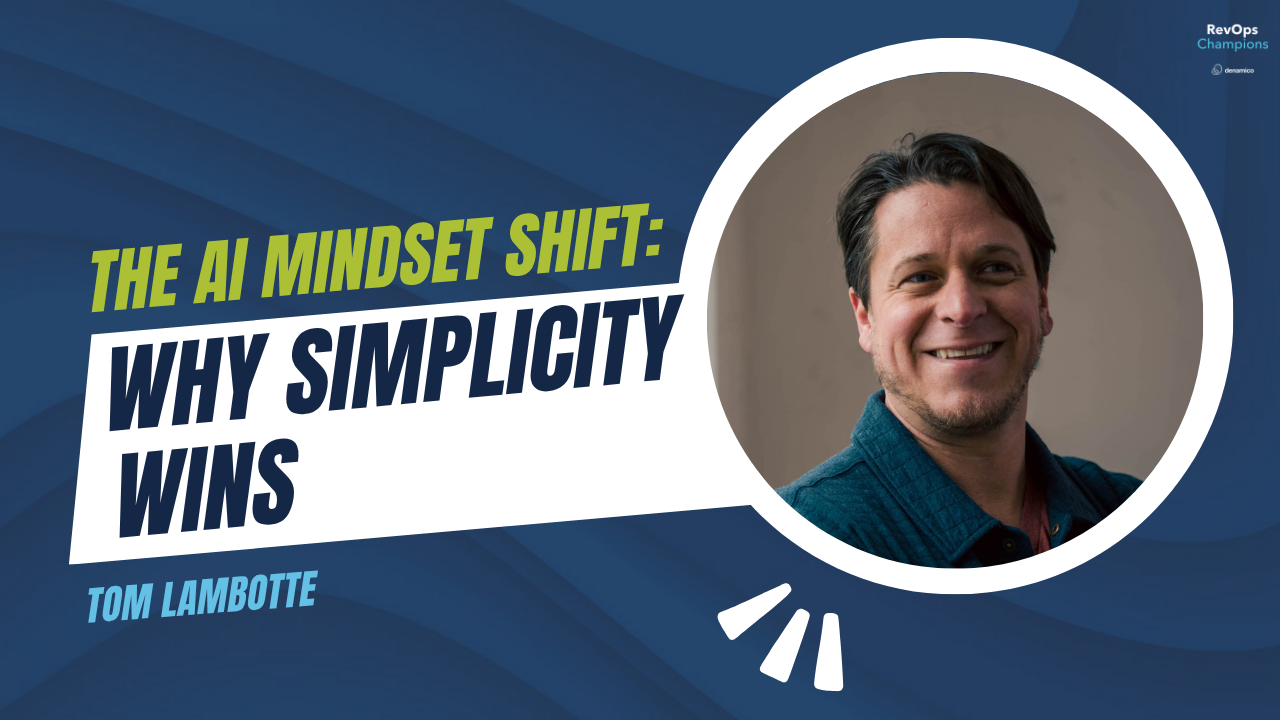
In this episode of RevOps Champions, Brendon Dennewill sits down with Tom Lambotte, Founder of AI Simplifier, to explore how leaders can shift their mindset and simplify AI adoption within their organizations. Tom introduces his framework of eight AI mindsets, designed to help business leaders integrate AI practically and strategically—without getting overwhelmed. The conversation covers why foundational knowledge is essential, how to avoid overcomplicating tools, and the importance of A players in scaling effective teams.
Key Takeaways
- AI integration should be simple, purposeful, and aligned with strategic goals.
- Foundational understanding leads to more confident, effective use of AI tools.
- Leaders need to guide teams through mindset shifts, not just technology shifts.
- Productivity grows when you focus on fewer, higher-value tasks.
- AI enhances human capabilities—it doesn't replace them.
Listen
About the Guest
|
|
Tom Lambotte | Founder and Chief AI Simplifier Tom Lambotte is a serial entrepreneur, AI strategist, and systems simplifier who helps growth-minded founders and teams unlock their next level of performance using practical, human-centered AI. He’s the Founder and CEO of AI Simplifier, where he works closely with entrepreneurs to streamline workflows, scale operations, and eliminate friction using smart, repeatable AI tools. Tom has personally trained influential leaders, including Tony Robbins, Blake Mycoskie (founder of TOMS Shoes and Shark Tank guest judge), and Peter Diamandis’s Abundance360 leadership team, on how to integrate AI into their businesses without the overwhelm or hype. Across his companies—including GlobalMac IT and Alignment Catalyst—Tom has built a reputation for turning complexity into clarity. He brings a rare blend of operational insight, creative problem-solving, and real-world coaching experience to every room he's in. When he’s not simplifying systems, you’ll find him behind the wheel enjoying a good drive or off in the woods foraging wild mushrooms with his five kids.
|

Episode transcript
The Problem with AI Gurus and Overwhelm
Brendon Dennewill: Tom Lambotte, thanks so much for joining me today.
Tom Lambotte: Thank you for having me. I'm doing outstanding. I just got back from Strategic Coach last night in Toronto, so I'm always on a high — clear, focused, with momentum. Doing really well.
Brendon Dennewill: I get it. I had that last week when I returned from Chicago. It's always so inspiring and gives you the energy for the next 90 days to really be bigger and better and move things along with more clarity.
Tom Lambotte: It's amazing how much can get done in one 90-day sprint when you're focused and clear. "Less is more" is my mantra. When you can really pinpoint the few levers and say no to all the things that pop up, the amount of progress and momentum you can build is remarkable.
Brendon Dennewill: You and many others at the forefront of guiding businesses in the AI space are talking about getting back to basics and keeping things simple. I've started using sticky notes on my computer again. One says "How can AI help me do this better?" and the other, which I learned last week, is asking myself: "Is this essential or just important?" That lens has been really useful for saying no and prioritizing, because something is either essential to my goals or it can wait.
So, Tom, let's dive right in. What inspired your eight AI mindsets, and how do they reshape AI adoption in business operations?
Tom Lambotte: I'm a simplifier, so it's eight mindsets, not ten. I had an interesting journey that took me to where I am today. My first company was a managed service provider, we outsourced IT for Mac-based businesses for 19 years. I still have it, but I work one hour a week in it now, which is incredible.
About two and a half years ago, I was starting something new with a collaboration partner who had an opportunity to present at Abundance360. He didn't have the bandwidth to sell anything, but I did. We decided: he'd present, I'd build and deliver. That led to some remarkable experiences, I got to go to Tony Robbins' home in Florida to work with him one-on-one on AI, and I did a leadership training for Peter Diamandis and his team at Abundance360.
From Fire Hose to Foundation: The Birth of the Eight Mindsets
Tom Lambotte: One thing led to another, and we created a 12-week AI training program called AI Accelerator. The quality was good, and I'm proud of it, but it was way too much — a 12-week course with one-and-a-half to two-hour sessions, packed with content. I ultimately walked away from it due to friction with my partner, and I actually retired from AI in March of last year to build a coaching practice, which is what I'd always wanted to do.
Slowly over the following year, people kept calling me asking for help. What I gradually stopped taking for granted was that my approach to AI was very different from the masses. I started seeing a big problem in the AI guru space. Personally, I believe the majority of AI experts and gurus are overcomplifying entertainers. They'll wow you with cool parlor tricks, but then you go home, go back to your business, and think: "What can I actually implement right now?" And there's pretty much always nothing.
Beyond that, there's the state of overwhelm many people are stuck in. They don't know where to start. It's immediately gap-inducing. Most attempts to bring AI into a business hit a wall of "Where do I even begin?"
Tom Lambotte: But then there's the other group — the ones using AI daily. What I've realized is that they're just scratching the surface, because they're using AI at a purely tactical level. They're getting results, but no one has taught them how to think about and approach AI.
When ChatGPT came out, everyone jumped to "How do you work with this thing?" Some smart engineers said: do prompt engineering. Prompt engineering is great if you're an engineer. But if you don't think that way, it's extremely paralyzing. I think prompt engineering is a retardant of flow. It's like: "I want to do this, but first I've got to get these seven pieces properly assembled and follow the formula." I've had people tell me it takes 20 minutes just to craft the first prompt.
And outside of prompt engineering, everyone else has been trying to keep up with the features coming out every other week. Is it Grok? Claude? ChatGPT? Gemini? My answer is: it doesn't matter. It's like a car — does it have four wheels, a drivetrain, a steering wheel, and brakes? They're all essentially the same thing, just a little different.
Brendon Dennewill: That seems to be your overarching message, and I think a lot of people are slowly arriving there. That's why I was so excited to have you on the show — for anyone still overthinking this, it helps to hear from someone working with hundreds of business leaders about approaching AI more strategically and simply, so you don't fall into the trap of thinking you're falling behind.
Tom Lambotte: Exactly. The eight mindsets were created from that same focus: what are the fewest shifts you need to make that will completely change the results and quality of your interactions?
My favorite quote, and my kids roll their eyes every time they hear it, is by Wayne Dyer: "When you change the way you look at things, the things you look at change." That's really what I'm after. It's not just AI training, it's AI transformation.
The tactical approach is those AI newsletters you sign up for that arrive once a week and only make you feel more stressed and behind. "Here are 74 new AI tools you must be using right now." It's impossible to keep up, and it's way too much. That's why I came back and said: there's no one out here breaking this down to the most basic building blocks. If you learn how to use these building blocks, you can build anything you want.
What Separates Teams That Scale with AI from Those That Don't
Brendon Dennewill: So let's go to the next level. You've worked with multiple fast-scaling teams, people thinking 10x, 100x, whatever metrics they use. What separates those who integrate AI effectively from those who get stuck in the noise?
Tom Lambotte: In my first two years, I saw a lot of things that didn't work. Two of the biggest failures stand out.
The first is CEOs and leadership teams delegating AI. They go to their team and say, "We've got to start using AI, I want all of you to do something with AI each day." It's broad, generic, and not specific. So everyone's running the asylum. They might be getting some wins, but just because you're getting value from AI doesn't mean you're good at using it. That's a really important distinction.
This analogy came to me a while back: when I was 16, I got my first car. A 1983 528E BMW. It was stick shift and I thought I was a little race car driver. I passed people on the road, so I thought I was a great driver.
Then at 19, I joined the BMW Car Club of America and went to my first driving event at Qualcomm Stadium in San Diego, with a cone course laid out in the parking lot. First lap around, the instructor in the passenger seat, I'm getting through the gears, chirping the tires, feeling really good about myself. Then we swap. My jaw hit the floor. I could not believe what my car was capable of. I'll never forget that visceral reaction: "My car can handle like this?"
That's what I do for clients who go through our course. There's a huge difference between using AI daily and using it strategically to truly get 10x insights, clarity, and decision-making.
Brendon Dennewill: I really love that analogy. I had a similar experience with my son at a BMW drive center in Southern California. The very first thing the instructor said, holding a brake pad from one of the cars, was: "If anyone can break this brake pedal today, you can keep the car." The whole point was: without being able to brake hard, you have no control. You have to brake before you turn, and then you accelerate.
It's the same in AI. If you don't hit the brake first and understand what the next curve is, you try to take it going 100 miles an hour. And tech people in particular are prone to thinking, "We've been doing tech for 20 years, we'll just keep going and change the wheels while driving at full speed" — which of course isn't possible.
The Two Biggest Failures in AI Adoption
Tom Lambotte: Exactly. That's the first failure. The second is related: not just delegating AI, but abdicating learning it entirely. Society is saying you have to "master AI." But you don't need to master AI. If you're a CEO with a full slate of responsibilities, how on earth would you go out and master AI? You don't need to, but you do need to get in the car and let the instructor drive, so you can see what's possible.
Because then you have the conviction and the language to talk about it credibly with your team.
There's also a third big failure point: companies rolling out advanced AI applications before the foundation is in place. They spend hundreds of thousands of dollars over six to eighteen months, roll it out, and it fails — because they don't have team buy-in. If the team doesn't understand conceptually what AI is and what it can do for them, they're stuck in fear mode: "Is this going to replace my job?"
My focus is the low-hanging fruit. How can you make AI a natural extension of how your team already works? If you need to send an email, you don't open Google and search for seven steps — you just open Outlook, click new, and send. That's the first level people need to reach with AI. And just getting there can unlock 20 to 40 percent real-world productivity gains in a short period of time.
Systems, Tools, and the 30-Day AI Sprint
Brendon Dennewill: Let's dig into that. Do you have systems or filters you use to decide whether an AI tool is worth adopting, and how do you measure success?
Tom Lambotte: When it comes to tools, we actually don't teach any tools in our core offering, at least not in our 30-day AI sprint. We have a sprint for CEOs and another for teams. The value of the team sprint is that everyone ends up speaking the same language: "Did you try the three experts framework? Did you try this approach?" Whether someone is highly technical or brand new, they now have shared terminology they can use comfortably.
In my very first course, we gave dozens and dozens of tools. It was too much. Dan Sullivan says he's a one-tool person and just uses Perplexity. I'm in the same camp. I was spending $500-plus a month trying all these different tools and making one millimeter of progress on actually understanding any of them. I think it's much more powerful to learn your basic arithmetic first. Learn how to truly wield an LLM before jumping into advanced tools.
I work mostly in ChatGPT. We have clients in Copilot and Gemini. It doesn't matter — everything we teach is platform-agnostic.
Tom Lambotte: The mindsets come first. There are big shifts that need to happen in how you interact with the technology. When you stack a few of these shifts — one multiplier times another multiplier times another — that's where the AI Simplified approach lives. It's four 90-minute sessions over one month. By the end, you have a new superpower, regardless of your role.
Tools come last. "What's the best tool for this and that?" doesn't matter until you learn your basics. Learn the foundations, and then we can point you to the good ones.
People, Process, Data, Technology: AI Is No Different
Brendon Dennewill: That's consistent with what we talk about a lot on this show. As a firm that does CRM implementation, we see clients making the same mistake constantly. We build RevOps systems on CRMs, and there are four components: people, process, data, and technology. Of those four, technology is the easiest one to grasp. "I can subscribe, it costs $1,000 or $2,000 a month." But they don't understand what the technology will actually do for their business unless they first have clarity on their data, their metrics, their OKRs, and whether their people are in a place to make it all happen.
So the soft stuff, the people stuff, is really the hard stuff. If that foundational component isn't addressed, the technology won't help. It might actually do more damage than good.
Tom Lambotte: A lot of people have a very hard time using technology, more than you'd think. In my IT company, we served lawyers exclusively for 11 years. Instead of CRMs, they use case management software. I started seeing a pattern: every one or two years, they'd hop to a different platform, pointing the finger at the software. But maybe they were pointing in the wrong direction.
You do a lot of work with HubSpot, and HubSpot has enormous feature depth and power. People are always attracted to the most advanced functionality. But in the first 90 days, we set up the most basic things and make sure they're dialed in and used properly. If you don't have that core foundation, none of the advanced features will hold.
Brendon Dennewill: It sounds like what you realized is that your coaching expertise, brought into the AI space, is a powerful combination. And we see something similar: we have to coach many of our prospects and clients — "No, this isn't how it's going to work. We have to do these other things first." We need to know the outcomes you're looking for, who's driving each outcome along the customer journey, and whether the handoffs between teams are clear and mapped. Because if they're not, what are we putting into the CRM?
And for many of our clients who are already investing in what a CRM can do, the next question is naturally: how can an AI-powered CRM drive even greater success?
Tom Lambotte: And that can't be done well without clear intention to begin with. Everything is "AI-powered" now. I've seen platforms take their old site with the same feature list — calendars, contacts, CRM — and just put "AI-powered" in front of everything. "Just because you can doesn't mean you should" is a big mantra of mine. Sticking AI into 15 places at once doesn't mean you should attempt all 15 simultaneously. If you could only do one, which would it be?
What Scales Teams: A Players, EOS, and the Right Foundation
Brendon Dennewill: I want to put you in the Wayback machine. Forget the last two years, what were the key elements, in your pre-AI world, that separated teams that scaled efficiently from those that didn't?
Tom Lambotte: One is a plug for EOS. Our company runs on EOS, and Minneapolis is really the heart of where it all started. We had one year where we grew 60 percent, and we were all celebrating. Then in the first quarter of the next year, we lost 40 percent because we didn't have the systems, the people, or the processes in place. We tried to self-implement EOS and were worse off at the end of that first day than we started. So that's what the credit line is for — we invested in working with an implementer, and it slowly turned the company around.
On the teams question: I think the single most impactful thing I ever did was raise the bar on talent. You get what you tolerate. And I have a slightly different take: B players cause far more harm to your company than C players. C players are obvious — you see them and hopefully move them out. But B players aren't doing horrible work. They're just not doing great work. They're not creating raving fan clients. They're not delivering great experiences, whether to their teammates or to clients.
When I decided to build an A-player team only — and really championed that message and stuck to it — that was the biggest shift we made. I always think of the blind baton handoff on the relay track: you trust the person behind you so completely that you hand it off without glancing back. Or Michael Jordan shooting and turning away before the ball hits the net, because you have complete certainty.
When you raise the bar, C and D players need to go right away — they're killing your culture and zapping the soul out of your best people. For B players, you champion the message: "You're a B right now. You're either moving up or moving out." It's not a bad thing. Think about championship teams — you're not winning the Super Bowl with a roster of B players.
When you do this, you retain better talent, get more from your team, and A players attract other A players, further reducing your cost of hiring.
Brendon Dennewill: Which confirms what we talk about with the four components. Your entire answer was about the people component. EOS brings in the process layer, the frameworks and operating systems that bring clarity. Data shows up as scorecards and metrics. And about three-quarters of our clients run on EOS, which makes our work so much easier. We can plan 90 days at a time: once they've done their quarterly planning, we ask, "How can we support your rocks for the next quarter?"
The 19-Year Overnight Success and the Inner Work That Made It Possible
Brendon Dennewill: What were some of the data and technology challenges you saw before AI, specifically around helping teams scale?
Tom Lambotte: To be honest, my IT company never scaled a ton. What we're experiencing now feels like the 19-year overnight success. The core challenge was always people. We had a hard time getting a consistent, high-quality help desk. We had the sales engine, but not the confidence in our ability to deliver the projects behind it. The single biggest shift came when we raised the bar and got A players in place. An A player doesn't just do 10 or 20 percent better work than a B player — they do significantly more, and most importantly, they come with batteries included. They don't just follow your processes; they improve them.
I never tolerated toxic clients either. If everyone cringes when a certain person calls, let that client go. The morale impact ripples across your entire team and affects your other clients.
Tom Lambotte: With AI Simplified, which we launched in January, we are scaling significantly. We're going to break a million dollars our first year, from a standing start. A lot of that came from doing the inner work: really getting clear on who I am, what I should be doing, and what I shouldn't be doing.
Reading "Rocket Fuel" was a light-bulb moment. I gave myself shingles at 32 from the stress of thinking I had to do everything in the business — including all the things I hated, was bad at, and delayed as long as humanly possible. When I finally separated the visionary from the integrator role and started doing more of what I loved, that's when things shifted.
Eventually I got my IT company to a place where I was working one day a week and the rest was largely self-managing. That freed me to start reinventing myself — which took a few years, a few failed launches, and some expensive lessons, including a cybersecurity venture with a business partner who turned out to be a con man. It hurt financially and emotionally. But I saw the same thing happening to peers all around me: you have your first success, you start attracting more opportunities, and the logical mind steps in. "I was successful doing this, so I can do that." But you forget to check in with the heart and with the alignment.
Getting clear on what you love doing and what you do best is crucial. That inner work, more than anything else, is what got me to where I am today.
Brendon Dennewill: Every entrepreneur listening can tell similar stories. And what we know is that after every low comes one of the biggest periods of growth — as predictable as the sun coming up. Your biggest growth periods, if you take the learnings and increase your capabilities, make it less likely you'll make the same mistake again.
Tom Lambotte: As long as you're in the right headspace. Ryan Holiday's "The Obstacle Is the Way" captures it well. The same year we went through the business partner situation, we also went through some very difficult things as a family — a real double whammy. And you quickly have to decide: is this happening for me, or to me?
There are people who go through hard times and stay in the victim mindset, stuck asking, "Why is this happening to me?" I believe all suffering is a result of not accepting what is. And the sooner you can shift to "this is happening for me," everything changes. We all have our own path and our own tragedies. For me, the past two years were extremely difficult. But I also grew more spiritually during that time than in my entire life before it, because I chose to enter the difficulty and do the work.
And now, when something difficult happens, the mindset is: at some point in the future, I'm going to look back on this and be grateful. Because that always happens if you look for it. If I know I'm going to get there eventually, why not bypass the time and say, "I'm not happy about this, but I'm going to be grateful for it"?
Brendon Dennewill: There's a gift in there somewhere.
Closing Advice: How to Think About AI Adoption Right Now
Brendon Dennewill: Tom, as we wrap up, AI adoption for businesses is a very similar parallel to CRM adoption, and it's potentially exponential because it will impact every part of the business and every person in it. What's your closing advice for leadership teams thinking about where to start?
Tom Lambotte: The biggest untapped resource is this: the single biggest goal for every company should be making AI a natural extension of how everyone works. We're going to look back on this the way we look back at the iPhone — we couldn't have imagined what it would be capable of when it first came out. AI is the same way.
But just because someone is using AI doesn't mean they're good at it. If they haven't been formally taught a better way to use it, they won't get there on their own. You've got two groups: those stuck and overwhelmed, and those using AI daily with a lot of false confidence. The second group knows they're ahead, but they're just barely scratching the surface.
I had one client who runs a 145-person team of AI software developers. He went through the program and a couple of weeks later told me: "Tom, I realized that just because we know how to build cars doesn't mean we know how to drive them." That distinction is crucial.
What we're doing right, when done well, is compressing time while increasing quality simultaneously. But 99 percent of people using AI right now don't know how to do that. If you doubt me, go on LinkedIn and read five posts. You'll know instantly which ones were written by AI. And the moment you see one, your mind subconsciously registers: "Inauthentic." That chips away at individual and company brand — especially when employees are using AI without guidance. The output from ChatGPT can and should sound exactly like you. But very few people have learned how to do that: how to clone their voice and remove the AI-sounding language you see everywhere.
Leadership teams need to learn this to protect their quality and empower their teams. It has to come from the top down. The CEO is not exempt. In fact, we won't let anyone sign up for our teams program until their CEO has either completed the course or is going through it concurrently. We believe in that requirement that strongly.
Brendon Dennewill: What can teams do today, between now and signing up, to start moving in the right direction?
Tom Lambotte: Follow the AI Simplified newsletter on LinkedIn — I share practical tips, mindsets, and lessons there regularly. But the biggest thing I tell people is to put time on your calendar. If you want to build muscle, you have to work out. Schedule a recurring one-hour block each week just to play with AI. Stick with one tool and spend that hour with the same platform week after week, rather than poking around with ten different apps for ten minutes each. Get the ChatGPT app installed on your phone and the native app on your computer so it's quick and easy to access.
Make AI part of your regular routine, and you'll keep getting better at it.
Brendon Dennewill: Make AI part of your atomic habits. Tom, thank you so much for joining me today. I really enjoyed the conversation and look forward to chatting again soon.
Tom Lambotte: Likewise. Thank you for having me.