
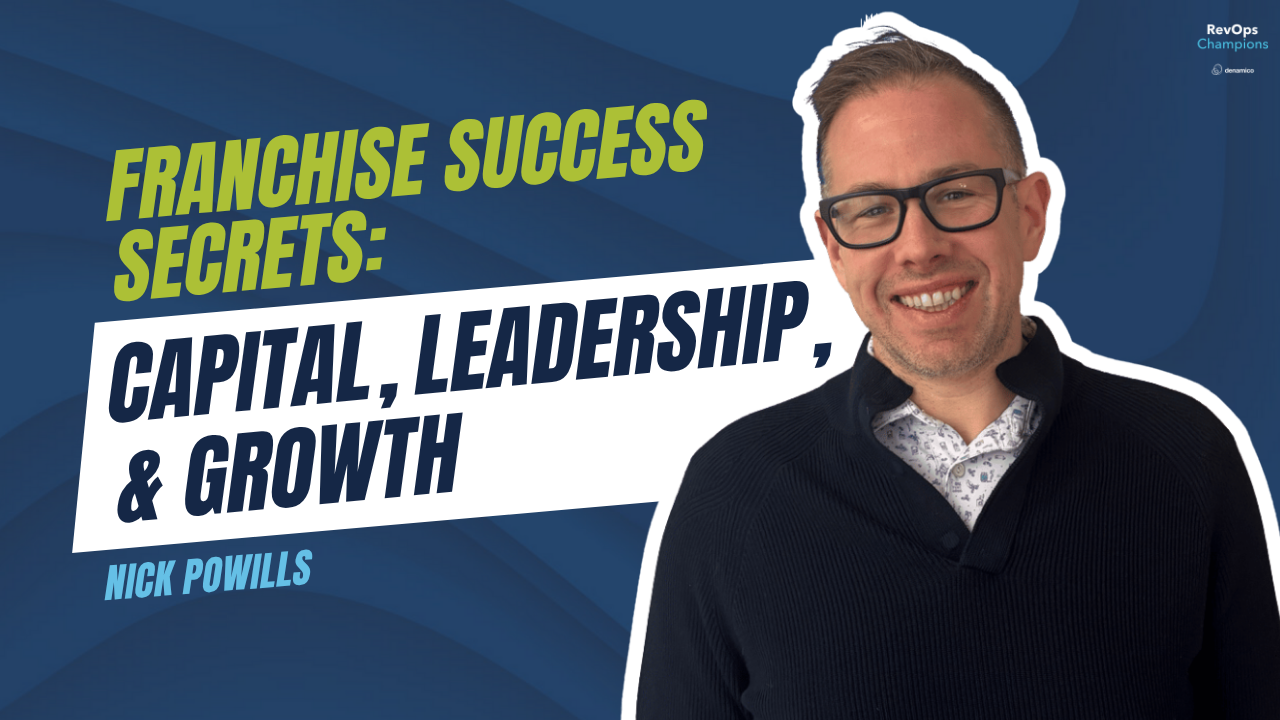
In this episode of RevOps Champions, Brendon Dennewill sits down with Nick Powills, CEO of Mainland and franchise marketing veteran, to unpack why many franchise brands struggle to scale. Nick breaks down the true cost of growth, the absence of RevOps thinking in franchising, and why critical metrics like LTV and CAC are often overlooked. He shares how integrating strategic CFOs, aligning operations, and rethinking technology can drive long-term value. Drawing from 20+ years of experience and his book Sticks and Stones, Nick offers a roadmap for building resilient, scalable businesses.
Key Takeaways:
-
Why capital and realistic expectations are make-or-break
-
The untapped role of strategic CFOs in franchise growth
-
Aligning people, process, data, and tech for enterprise value
-
How personal challenges can shape stronger business leaders
Listen
About the Guest
|
|
Nick Powills | CEO at Mainland Nick Powills is the CEO of Mainland, a content marketing technology company that brings together strategy, creative execution, and brand storytelling through its divisions: No Limit Agency, 1851 Franchise, and ESTATENVY. A former journalist and franchise PR expert, Nick is also the author of Sticks & Stones and a sought-after keynote speaker on transforming personal challenges into purpose-driven success. |

Episode transcript
The Real Reason Most Franchise Brands Stall
Brendon Dennewill: Nick Powills, thanks so much for joining me today on Brendon Dennewill. You've come highly recommended and I know you're very influential in the franchise space, which just happens to be one of the verticals that we support from a technology and CRM perspective. You've worked with 80-plus brands. What separates companies that scale well from those that stall?
Nick Powills: Thanks for having this conversation with me. Step one is capital. There are so many emerging brands that come to the table, a franchise consultant tells them it costs $100,000 to franchise their business, they spend it, they have the paperwork, they have an ops manual, and then they're like, "Now what?" And the consultant says, "Now you have to go spend to market your franchise." And they say, "I thought it was going to be $100,000."
When you really break down what it costs to get momentum, it is very expensive. The stat is that 87% of first-time franchisors don't sell a franchise in their first two years. That creates a wide gap of frustrated people.
I had a client, Big Blue Swim School. Well-capitalized, private equity-backed. They had about three units open and said they wanted 50 franchise agreements signed the next year. I said, "Off of three?" They said yes. I said, "Two and a half million dollars in marketing." They said done. The thinking was: if we get one deal at that spend, we'll get that back in royalty.
The second thing is understanding the value of the deal. So many franchisors say they want to spend $15,000 in marketing per deal, when that deal could be worth a tremendous amount. I did an assessment with a brand a few weeks ago. We looked at the royalty for three years and it was $200,000 on average. I said, "I have a check for $200,000 right now. What would you pay me?" The CEO said, "$195,000." So you're willing to write a check for $195,000, but when I tell you the cost to acquire a franchisee is going to be somewhere between $25,000 and $50,000 in marketing, you react like that's too high.
The third thing is aligned expectations. A lot of brands are trained to sell through Item 19 and these big, fancy numbers. But first-year sales is very different from year-five sales. If they sell on inflated numbers, the franchisee gets out of the gate undercapitalized, maybe signs a multi-unit agreement, opens one, pauses, and those other units never open. They've cannibalized the territory and the system doesn't grow. Too many businesses franchise without good P&Ls, without enough capital, without proper expectation-setting, and then blame everything else for why they're not growing. It's fairly simple math.
Growing Fatter Before Growing Taller
Brendon Dennewill: That's just about starting the franchise. We haven't even talked about how you get from 20 to 200. You've enlightened me about something foundational that I hadn't thought through enough. We've seen it in our own journey supporting franchises from a technology and data perspective. Franchisees would approach us to help set up their individual operation, but we knew that if the franchisor wasn't behind it, the whole thing was going to fall flat eventually. So we had to find franchisors who actually had the vision to grow a brand of increasing value over time, rather than just selling franchises and making money. That was a much longer journey than I expected.
Nick Powills: I sit on the board of a brand that came out with a big growth goal. I said, "Great, you can grow taller. But what if you grew fatter first?" They asked what I meant. I said, "What if we focused on driving profitability back to the franchisees? If we want to hit X in revenue, we can get there by making our franchisees a little more money, because we'll get it in royalty. Grow fat first, then grow tall."
That's the challenge. Bootstrapping gets brands stuck, and there's a real difference between selling franchises and developing franchisees.
We have a client, Slim Chickens. I was with their founders years ago when they had just a few units. I asked what was winning. He said, "We want 25 franchisees who each own five units." I said, "By when?" He said, "Whatever it takes. We're going to be protective of our culture. We're not looking for single-unit franchisees who stall out." Flash forward: they're a billion-dollar business.
It's not hard to do these things. But leadership mindsets often go too cheap, don't reinvest in the franchisees who could make them more royalty, and don't look at the holistic lifetime value of a single franchisee and what continuous investment in them could return.
Lifetime Value: The Metric the Franchise Industry Ignores
Brendon Dennewill: That makes a lot of sense. Lifetime value is a metric used in many industries. Does it exist in the franchise space?
Nick Powills: I wish it did. Lifetime value has two sides. We have a client who figured out the lifetime value of a customer was $3,000, and the cost of acquisition was about $75. So they also understood what the break-even point was for their franchisees.
When we evaluated viability, I looked at Item 7 and how much was being suggested for grand openings versus operating capital. They were recommending franchisees spend $10,000 on grand opening. If they recommended $42,500, the franchisee would break even in the first six months, actually make money, pay off their debt, and build a portfolio. Year one, we looked at the data: 30 out of the first 32 franchisees were not profitable. We changed that script and now all of them are finding break-even, because we understood the lifetime value of a customer.
On the franchisee side, I hear so many CEOs say the value of a franchisee is the franchise fee. That's backwards. It's the royalty. Just look at three years of it. If that franchisee buys another unit or opens three or five, imagine what they're worth to your system. You can build something exitable. Very few brands are doing this. It's a shame, because the opportunity to build tremendous enterprise value is right there.
Brendon Dennewill: As you were explaining the capitalization gap, the metric that popped into my mind was: have they figured out LTV at both the franchisor and franchisee level? And as you know, franchisees often look to the franchisor to guide them on which metrics to use. If the franchisor isn't making lifetime value part of the conversation from the very beginning, the chances of franchisees understanding required capitalization are probably not going to happen.
Nick Powills: You and I have a mutual client. I did a podcast yesterday with their CFO, and at the end of it I said: the CFO or the finance leader is actually one of the most critical pieces to franchise development that is never used. You have all the knowledge base. You know what the P&Ls look like, you know what the franchisor capitalization looks like, you know where the future is going. Why aren't CFOs integrated into the franchise sales process? That should build believability. That's how you build a tremendous business.
In that conversation, we talked not only about how you drive profitability for the franchisee, but how you measure the value of currency, grit, and hustle. He said he actually weighs that more than the financial bandwidth a prospect brings to the table. Our mutual client is a top-tier franchise brand. The reason they're top tier is because they have a top-tier mindset.
The Strategic CFO: An Underused Asset
Brendon Dennewill: That's a whole other topic in itself, but it makes perfect sense. A strategic CFO involved in advising everyone from the franchisor down clearly raises your chances of success with clear expectations at every step of the way. That was not where I expected this to go.
Nick Powills: One more thing on that: a scared CFO can be detrimental to business. A leader CFO can be deeply valuable. I've seen plenty of penny-pinching CFOs who don't get it. The ones with personality, vision, and collaboration are the ones who have tremendous impact.
Brendon Dennewill: Which is exactly why I called it a strategic CFO. There are CFOs, and then there are strategic CFOs. The ones I prefer to work with are the strategic ones, because that's when you really get the value of all their knowledge.
Nick Powills: I married one. I looked for the same thing.
Brendon Dennewill: I figured this out much later in life. Better late than never, I guess.
RevOps in Franchising: Why It's Almost Nonexistent
Brendon Dennewill: For the franchises that we work with, when they come to us to set up their CRM, most are not familiar with RevOps. You know a lot more about this industry than I do. Is RevOps even a thing in the franchise space?
Nick Powills: No, because of what we just talked about. The bulk of brands aren't thinking about enterprise value, and therefore RevOps isn't even on their radar, even though RevOps is exactly how you drive enterprise value and dollars to your bottom line.
I will say this: we had the benefit of doing a multi-year project with a bank's trust division, and I use that experience now when I think about the franchise side. Attribution scoring, understanding that the funnel has many different answers, having predictability. We built out the architecture to use HubSpot to predict when people with money would move assets under management. We created a scorecard: once someone hit 100 points in engagement score, the likelihood of them being ready to move assets was significantly higher.
Working with a well-capitalized bank with low pressure on the trust division, we found that from the point someone entered the pipeline to being ready for a conversation was two years. We got it down to a year and a half. There was no panic because the enterprise value of each customer was tremendous.
Now I look back at franchising and think: I have the roadmap. I understand how RevOps is going to impact your business. You will exit at some point. Life is going to exit you, or you're going to exit your business. Let's put the systems in place. But franchising starts out so entrepreneurial that some of this foundational stuff just gets skipped.
Brendon Dennewill: For those listening, RevOps stands for revenue operations. It's a model that started roughly 20 years ago in the SaaS and technology space, where leaders realized that aligning marketing, sales, and customer service made all the difference from a communication, alignment, and data perspective, as well as how you build technology to support all your customer-facing teams.
Franchises aren't the only industry that doesn't use the terminology, but the four components of revenue operations are people, process, data, and technology. Most businesses are doing parts of that. But if you want to increase enterprise value, the more aligned those four things are, the more value you create.
Nick Powills: I have a client where RevOps works well. Before they launch a new LTO, they look at food cost and profitability before they go to marketing. Another brand might say, "I have this crazy idea," without knowing whether it will drive revenue. When you market something that has built-in profit, you understand the ROI, you understand how much you can spend on marketing, and when it gets to the operational side, you already know how to deliver the customer experience you set up from the beginning.
It's rare that marketing thinks this way. They don't think through P&Ls. That's where the strategic CFO becomes so critical: putting RevOps into a system where all parts are talking to each other, and decisions made at the franchisor level actually drive dollars to the franchisee's bottom line. That has to be the goal in franchising.
Brendon Dennewill: And circling back on that: as more clients understand the value proposition of RevOps, the more we have the CFO as part of the buying group on the client side, the more successful the whole implementation is. They can explain to the rest of the leadership team exactly what the potential upside is and why the downside is minimal.
Nick Powills: You also end up paying for yourself in that scenario. You know the impact immediately, you can cover your expenses right away, and then the CFO says, "I like that you covered your cost. Now let's get into the business of making money."
The Bowtie Funnel and What Franchises Are Missing
Brendon Dennewill: Let's talk about funnels in the franchise space. If franchises aren't familiar with LTV and CAC, which is the second most important metric once you understand lifetime value, does the bowtie funnel even exist in the franchise industry?
Nick Powills: No. With customer acquisition cost, if the three-year lifetime value of a franchisee is $200,000, the number I recommend spending on acquisition is a third of that. A third for acquisition, a third for serviceable operations, and a third for profit. That ends up being the best-case scenario. At $200,000 LTV, you're looking at spending roughly $60,000 on customer acquisition, and the actual lifetime value will obviously be much larger than three years.
Out of 100 clients right now, maybe three understand that.
Circling to the funnel: I can give you one data point. It's 6.4 months from impression to inquiry right now. We got that from franchisees telling us how long it took from when they first learned about a franchise to when they bought, for investments under half a million dollars. We went that route because if I told them to invest in HubSpot and attribution scoring, they'd say no. They want an off-the-shelf CRM. They don't want to invest in it.
But even those who do invest, I tell them: it's going to take six months. You could spend a million dollars today and get nothing immediately, but six months from now things will start moving. The hardest part is marketing with entrepreneurial mindsets. The bank was great: "It's going to take two years, here's our budget, go spend it, just show us the indicators it's working." Franchisors say, "I hear you, but I spent $10,000 and got no leads this month." And it's like, those are going to turn six months from now. Franchising is so far behind the curve on how things actually work. The more you and I can help them understand it, the higher the chance we have of building great businesses for both franchisee and franchisor.
Brendon Dennewill: That's not unique to the franchise industry. There are a lot of industries still over-indexed on driving net-new, whether it's clients or customers. Even though everyone's heard some version of the adage that your most valuable customer is the one you already have, they don't run their businesses that way. It's just, "We need more leads."
For those who don't know what the bowtie funnel is: take the classic sales and marketing funnel, turn it on its side. That's one half of the value, maybe less. The other half is the expansion side, the value a customer creates for a business once they're already a customer. That continues to grow as long as you're providing value and taking care of them.
Nick Powills: That was the issue with Groupon. It was a tremendous idea, but Groupon discounted the product or service. The bowtie was supposed to look like this on the right side, but Groupon made it look like this. Customers came in because they wanted the discount, not because they genuinely wanted to be long-term customers. The lifetime value of those customers was low. Most brands couldn't understand why they got so many customers but weren't seeing the return.
I relate a lot of things to dating. It took me a long time to find my wife. In our marriage, we had to build toward kids, a house, and the family we wanted. That's the bowtie funnel. If you ask someone, "Did you get your spouse on the first try?" they say, "No, I dated." Okay, you understand how this works. Now apply that to business.
Brendon Dennewill: We use that analogy all the time. You walk into a bar and ask the first person you meet to marry you. That doesn't work. But that's still how so many of us think in business.
Nick Powills: Look at education. It's 12 years plus four for college, so a 16-year run of education, and then on the other side of that you build a career. At the end of the bowtie, you've retired with enough to sustain whatever you want to do. Everything in life has this structure. But because of the pressures of false expectations, we don't follow it, even when we know it's the right way to look at things. We're overwhelmed by false pressures from boards, private equity, or CEOs.
Brendon Dennewill: Absolutely. As business leaders, we get caught up in the wrong things and we don't realize it until we hit a wall. Something someone said six months or a year ago suddenly clicks. But that's just human nature.
How Franchises Evaluate Technology
Brendon Dennewill: In your experience, what goes into the decision-making process when franchises are evaluating new technology for their teams?
Nick Powills: I don't think you're going to like the answer, but it starts with cost, not outcome. I've been doing this for 20 years now, and it's about saving money at the front end, not what you can make on the back end. Level two is need. They have to arrive at the conclusion that they need this.
On the marketing side, step one is how do we get franchisees, step two is how do we help those franchisees find profit, and then it cycles back: how do we leverage that franchisee profit to go get another franchisee. But they want leads. I don't sell leads. I sell everything we've talked about. I can tell them what to expect, and they'll say, "Okay, where are my leads?"
On the technology side: cost first, need second, and then a small percentage actually get it and build infrastructure, or bring in a professional CEO from the outside who understands the tech stack as part of how you sell the franchise.
For the positive side, I think AI and ChatGPT are going to help shorten the sales cycle for technology, because entrepreneurs may listen to AI more readily than they listen to other humans. And the home services space, because it's exploded, has made the tech stack critical. What is the customer experience from the moment someone decides they want a service, all the way to how they pay for it? There's been tremendous technology built in that category. The more the fundamentals that impact the franchisee also impact the franchisor, the more it drives the decision.
Brendon Dennewill: Two things I love about that. You talked about customer experience, which is what we think about all day. So many franchises are stuck on lead generation when the most important thing to focus on is customer experience. Technology and customer experience are two sides of the same coin. You cannot scale customer experience beyond the people who are physically there to provide it, and most franchises can't scale that way. They have to use technology to scale.
The other thing you touched on is the cost-versus-investment framing. One of my mentors, Dharmesh Shah, the co-founder of HubSpot, posted something recently: what is the most important part of ROI? Of course the answer is the I. Without the investment, there is no return. If franchises are evaluating technology purely on cost without understanding the potential return, that is very limiting to their value.
The IOR Lesson: Invest on Return
Nick Powills: Time heals some wounds. I'll be honest about my own experience. As a founder of an agency, we had things held together with duct tape. My wife, who is also my business partner, said we needed to operationalize the business. I said, "That's a big cost." We were looking at a roughly quarter-million-dollar technology investment. I said, "That's a lot of money." She said, "Right, but the return will be less turnover on staff, which will mean less turnover on clients, and we'll actually have something operationalized that could be sellable."
I didn't think about it that way. I was probably so stuck in the weeds until I could zoom out and say, "I want you to make our business better. I've taken it as far as I can." Now, this year, turnover is low on both the employee and client sides. We've swung far the other way and still need to meet in the middle on expectations and KPIs, but we have a foundation.
I was blind to it in the early stages, so I can criticize franchisors because I was the same way as a founder. It should be IOR: invest on return. If I had thought about it that way early on, the great talent we may have lost, which impacted client experience, might not have left at the pace it did. I've owned this business since 2008. We did the technology investment last year. It took 13 years before I was even willing to have that discussion. Sometimes it just takes time for someone to arrive at, "Okay, now I get it."
Brendon Dennewill: You and I aren't here because we've done everything perfectly from day one. A big reason we're here is to share what we learned the hard way, so others can shortcut it and not make the same mistakes. Ninety percent of being a business leader is making decisions. We're all going to make poor decisions from time to time, but that beats not making decisions at all. And the more data you have, coming back to the strategic CFO component, the better your decisions will be. But you have to start by saying, "We want to grow the value of this business. What do we need to do?"
The value of any business ultimately comes down to two things: leadership and systems. Even for those who believe in building an evergreen business, eventually there is an end, and you need to be building something that has value whenever that end comes.
Nick Powills: The time you put into something carries value beyond your time on earth. That's why true entrepreneurs eventually think about legacy. Maybe not early on, but at some point life shifts toward legacy and impact. Did that idea you committed so much time away from your family actually have a sustainable impact beyond you? I think a lot of people go through that stage of asking what the point of all this is.
Sticks and Stones: Turning Pain into Fuel
Brendon Dennewill: We're going down this road now, and this feels like a good time to talk about your book, Sticks and Stones. Would you explain to listeners what it's about?
Nick Powills: The premise is that everyone who finds success in life, and success doesn't have to mean building a multimillion-dollar business, it could mean finishing a marathon, tends to follow the same equation: foundation plus momentum equals velocity. In that foundational element, there's usually some form of pain. For me, I weighed 305 pounds in high school. The bullying and everything that came with that was painful at the time. At some point I turned it into fuel. It's why I get up and exercise every day, why I watch what I eat, and it's part of why I do what I do in business.
Michael Jordan got cut from his basketball team. Walt Disney was told he wasn't creative. Einstein was told he was dumb. All of those people responded with, "Okay, now I'm going to show you." When I keynote franchise conferences, I speak to franchisees about this because they all have it too. Most of them went into business without taking the moment to recognize what was the fuel behind them, what was that chip on the shoulder, and how to use it to achieve the outcomes they want. When you can identify that, you can shift from half-empty to half-full. That's the premise of this version of the book.
Brendon Dennewill: So watch the space for more.
Nick Powills: We'll see if there's going to be another one.
Resilience, Rejection, and the Long Game
Brendon Dennewill: Bringing that back: was there a link between that foundational challenge and a high-growth phase in your business? What did it teach you?
Nick Powills: One hundred percent, and it only compounds. Here's the double-edged sword: I've been fired by so many clients. That can be seen as painful. But it's numbed me to the point where it doesn't affect me the way it used to. Now I understand: clients shift because new leadership comes in, or they run out of capital, or it's not a right fit. There are plenty of reasons, and it doesn't shake me anymore.
Early on, when a client fired us, I might have panicked and blamed my staff, blamed the process, blamed everyone else. Now it's: what do we learn from this? Let's take the findings and continue fine-tuning the customer experience. It happens every day. Someone quits your workplace, someone fires you, an outcome doesn't happen the way the data suggested it would. All those things now help me navigate life and business, because you're going to get thrown punches all day long. When you figure out how to navigate those things, it makes you stronger.
Brendon Dennewill: For those who can't relate, just pick your favorite quote from some of the most famous humans who've ever walked this earth. The message is consistent: you're judged not by how many times you've fallen, but how many times you've gotten up. Your biggest improvements in life typically follow some of your worst experiences. If you map your life back to being a kid, every low point tends to be followed by a higher high. Growth happens when you think you're in your most desperate times.
Nick Powills: The first time you ride a bike, I imagine maybe one in a million gets it on the first try. Most people fall, get a bump, and then comes the beauty and the goosebumps of actually knowing how to ride. That's the same thing that happens over and over again, and it's mindset. I have friends who have battled cancer, who fell off the bike hard but committed to the fight with everything they had. They ring the bell and feel pretty good. And I have friends who battled as long as they could and were ultimately defeated, but they don't say, "I got defeated in life." They say, "I gave it my best."
This is all training ground for business. When a franchisee is yelling about leads, I'll say: when we die, we're not going to be at that deathbed saying, "Man, I wish I got more franchise leads." We're going to say, "I did my best, I was a good person, I had integrity." When you zoom out on what this life really is, the pressures that feel so heavy tend not to matter as much. It's good to have that perspective sometimes.
The Blueprint for Scaling: People, Process, Data, Technology
Brendon Dennewill: One more thing, then one more question, and then we'll wrap. The four components of RevOps are also the four components of growth in any business: people, process, data, and technology. What it comes down to is that process, data, and technology are pretty much useless if the people component isn't handled first.
When we talk about people, we're talking about leadership, culture, values, and communication. Without those things, you can't scale anything except bad things. Once the foundational people pieces are in place, then you ask: what processes do we need? What key metrics do we need to track? And then last: how do we bring in technology, whether it's a CRM, CRM plus AI, or whatever the right tool is, to make data more accessible, processes more automated, and communication more aligned? Technology is always the last piece, not the first.
So, as we wrap up: what is one piece of advice you'd give to someone thinking about scaling, whether it's an individual franchise, a few franchises, or an entire brand?
Nick Powills: I'll keep it simple. What you just described is the magic. Founders so often value revenue above everything else. If we ask what was important in what you just said, it's the people piece: HR, culture, whoever is in charge of recruiting the right people. I got that right maybe one out of ten times because I was valuing revenue over it.
People comes first. Process comes second. It took me 13 years of running this business to truly understand that process impacts people and people impact revenue. And obviously technology has impact on both.
If I were starting over: hire one is whoever is going to manage my people. Hire two is the strategic CFO. Mixed with the founder, those three positions make a strong foundation. Cross-apply that for a franchisee: who's going to bring in your people and make it count? Sometimes you as the founder have that skill set. But too often, founders focus on revenue first, and revenue actually happens after you do those other critical pieces.
The advice is there. The blueprint is there. It's whether people want to follow it or not.
Brendon Dennewill: Really well said. Nick, thanks so much for being on the show. I look forward to chatting again soon.
Nick Powills: I love it. Thanks for the time.
Brendon Dennewill: Take care. Thanks for listening to Brendon Dennewill. If today's episode gave you a new idea for scaling smarter or helped you see your team, processes, or tech in a new light, be sure to subscribe so you don't miss the next insight. And if it hit home, share it with a colleague. Let's grow this community for forward-thinking leaders together.
Subscribe