
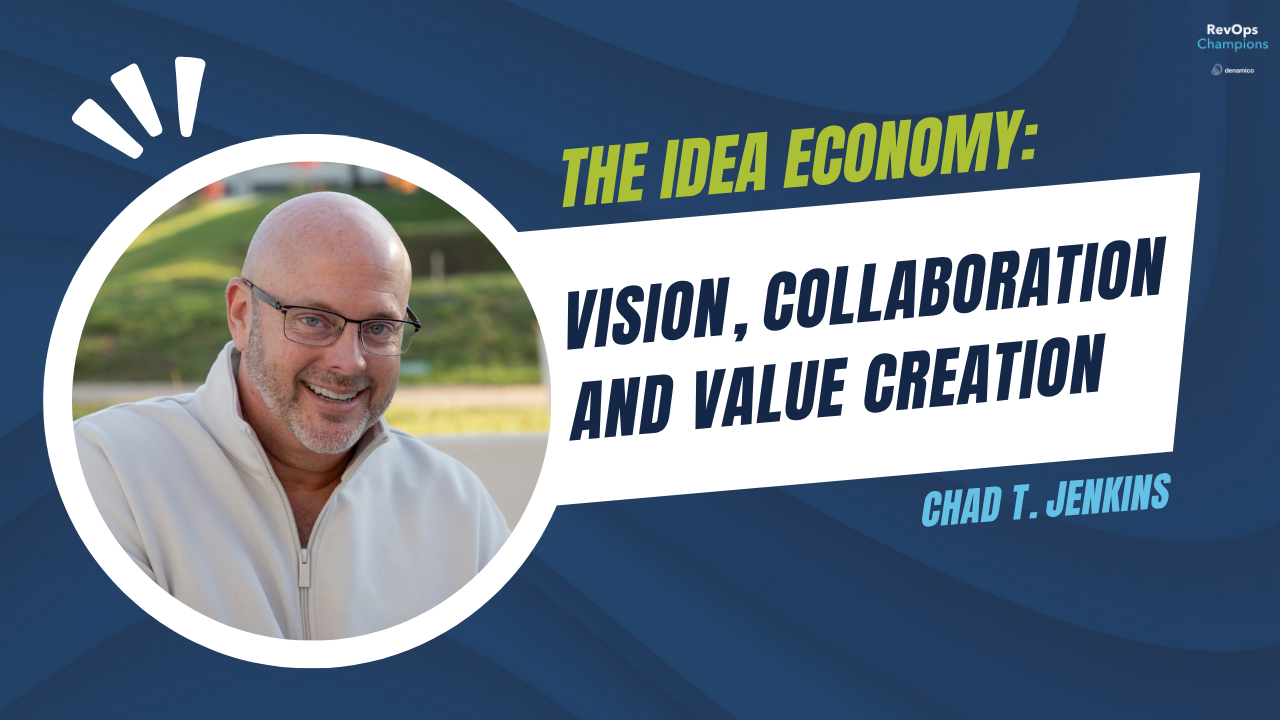
In this episode of RevOps Champions, Brendon Dennewill sits down with Chad T. Jenkins, entrepreneur, innovator, and founder of SEEDSPARK CoLAB Partners, for a deep dive into the evolving world of business innovation, structured growth, and the Idea Economy.
Chad shares insights from his journey launching over 50 ventures and helping companies across North America scale through intentional, systematized approaches. He unpacks his proprietary icVCR Growth Method—focused on Identifying, Clarifying, and Leveraging Vision, Capability, and Reach—and introduces the ISO framework (Identify, Structure, Optimize), which transforms collaboration into a sustainable competitive advantage.
Throughout the conversation, Chad emphasizes how friction can signal opportunity, how technology should amplify human connection, and why unique value contributions are key to thriving in today’s idea-driven economy. He also explores the opportunities and risks posed by AI, the importance of clear vision, and how to ensure that data and technology remain assets, not liabilities.
Listeners will gain practical insights on how to:
- Identify friction as a catalyst for innovation
- Leverage existing capabilities to unlock new value
- Expand reach through partnerships and networks
- Use tech to empower, not replace, human collaboration
Whether you're an entrepreneur, RevOps leader, or part of a larger organization, this episode delivers a fresh perspective on turning imagination into impact—and building systems that support sustainable, exponential growth.
Listen
About the Guest
.png?width=155&height=155&name=Chad%20T.%20Jenkins%20(1).png)
|
Chad T. Jenkins | Owner & CEO at SEEDSPARK CoLAB Chad T. Jenkins is a seasoned entrepreneur and innovation strategist with a proven track record of helping businesses scale through structured collaboration and strategic growth. As the founder of SEEDSPARK CoLAB Partners, he developed the icVCR Growth Method, which helps organizations unlock their potential by identifying, clarifying, and leveraging vision, capability, and reach. He also applies the ISO framework, Identify, Structure, Optimize, to turn collaboration into a competitive advantage. With over 50 ventures launched and recognition on the Inc. 5000, Chad has earned a reputation for guiding companies across North America to sustainable, scalable growth. |
Episode transcript
The Art of Collaboration: Where Every Innovation Begins
Chad Jenkins: If I really look at everything that I can see in my purview, it all started as an idea in somebody's imagination. Everyone who's listening to this, everything that they see right now, everything that they've ever seen, and everything that they're ever going to see started as an idea in someone's imagination. And I would also further guarantee that the person who came up with the idea wasn't the person who made it real.
It all started as an idea in someone's imagination. Why not yours? And to make it real and recur required the art of collaboration. One person had the idea and they shared that vision of a future, better state of reality, whether it be a tool, a technology, or a process. But they all had to give that idea away to someone else who had the capabilities, and they began to get into collaboration with each other. My idea plus your capabilities equaled this new change to our process, or this new website or landing page.
So, Mr. Idea Man, you've arrived. And everybody else listening to this has arrived as well. I spend a decent amount of time in a sauna, which gives me a lot of time to think. I do have a couple of ideas starting typically around 3, 3:30 in the morning. And one thing about an idea: we don't create ideas, we receive them. The only way that I've been able to receive the best ideas is to be quiet and to be still.
Brendon Dennewill: You're listening to Brendon Dennewill, a podcast created for B2B leaders to help you align your people, streamline your processes, trust your data, and leverage technology in order to grow your business.
Technology and Money: Enablers, Not Saviors
Chad Jenkins: One thing you mentioned earlier: when you apply technology, it's very similar to when you apply money. You're magnifying, and sometimes multiplying, the good or the bad of the individual. Technology is just like money to me. Technology can be an enabler. Cash can be too. In my world of venture collaboration, cash is nothing more than a capability. If I'm starting a business or we're starting a project and we had to go get the funding and budget approval, that's just cash. But what am I going to do with that cash?
The only thing you can do with money is buy someone else's vision, someone else's capability, and someone else's reach. When you do that, you're empowering them to be the best that they can be, or you're discovering they're not as good as they thought they were. But technology, to me, is just an enabler, just like cash.
Brendon Dennewill: Yeah, I totally agree.
Chad Jenkins: It all comes down to us, where it all started.
Brendon Dennewill: That's right. Some things stay the same.
Chad Jenkins: In the work that I do every day, it's become very clearly obvious how collaboration works and how someone can reach their business objective. I'm speaking specifically about entrepreneurs, but it goes well inside organizations too because we all have objectives. Oftentimes they're looking outside, looking for technology to be the savior, when we first have to start inside.
In my world, it's always with an entrepreneur, and the very first place we start is to identify who they are. We call it the Entrepreneurial Positioning System. Like GPS: if you have objectives, how would you ever know where to go if you didn't know where home was? So we start with what makes that individual unique. In my world, we call it Unique Value Contribution.
After that, we know exactly what they have. And here's something that might be a bit of a shocker: in order to get these objectives that we have, we have to give, not get. It's all in what I had to give, and when I gave it, what was the outcome? It could be good, it could be negative. In many instances, I'm fortunate it's been positive. The very next question, once I determine that giving what I've been given to someone, say Brendon, is how we're going to split the outcome. I expect there's going to be an outcome. When it arrives, how are we going to split it?
Taking that approach is a little different than the convention we see in business today. And it runs throughout organizations, not just at the entrepreneur level.
Brendon Dennewill: So you're suggesting that the successful entrepreneurial businesses you're working with through SEEDSPARK are using that same framework with their key people. In Strategic Coach, we call them key "who's." They're using that same mindset as if they were collaborating with another entrepreneur.
Chad Jenkins: Bingo. When you begin to look at the world through the eyes of collaboration, what you have to give rather than what you're looking to get, it changes the entire game. It's truly a mindset shift, and it takes a while. Even with very high-performing entrepreneurs, they understand it verbally when it's given to them. It's a very different practice to actually live it. So it is a journey.
Oftentimes, when things are going great, they fall back into not leveraging the art of collaboration and revert to current conventions. I would argue many of those strategies are solely based upon competition, where collaboration is not. Collaboration is the awareness that we've all been given unique and special gifts, and if we approach the world by asking how we can give those gifts to someone else, there's going to be an outcome. How could we split that outcome?
That's very different from today's convention, where at the end of page three there's a proposal with a lot of bullet points, a place to sign, and a monetary value associated with creating the outcome. I understand that that's a point in time and an amount of money being traded for, hopefully, an outcome we're both aligned with. But the reality is, the second the ink dries, everything changes: the market, the team, a vendor can't ship in time, interest rates shift. There is going to be change.
So it puts each party at a little bit of a disadvantage, even though it is the convention today. In my world, I want everyone to win at the beginning, the middle, and the end. That's one reason I've constructed all of these mechanisms of engagement around the art of collaboration where everybody wins in the outcome.
Brendon Dennewill: So to confirm, you're doing that at every level, whether it's business to business or entrepreneur to team member?
Chad Jenkins: Yes. Starting first with what makes that team member unique, independent of their title, independent of where they graduated, and what roles they've held elsewhere, because those locations were different. Their interpretation of the role, even if it has the same name we use in our organization, is different.
Let's first start at the very beginning: what makes this person unique? Both their experiences, and this is significant for me after dealing with so many wonderful people. I began to ask questions about when they became aware of the way they were uniquely designed to create value in the world. And it's between seven and nine years old, very, very consistently.
I've coined what I call your "constant question." I'm very interested in knowing, for everyone on any team I'm involved with, what is their constant question? What did they receive between seven and nine years old, that they began to apply to every environment they've ever been in? They've been asking that same question for a very long time, and they've gotten really, really good at it.
That's one reason I believe we all truly do see things differently and we all have something to contribute. I don't have the dimensional vision awareness that you do. We could wake up in the same house, eat the same breakfast, ride in the same car to work, sit in the same meetings, be on the same podcast. At the end of the day, your recount would be wildly different than mine.
Brendon Dennewill: Right.
Chad Jenkins: And that's a wonderful thing. So we give proper consideration to that, both on our teams and with the managers of those teams. We really dig deeper to understand: what's our constant question? What can I count on that person for, in terms of looking at any and all situations from something they uniquely possess? Their experiences, their education, where they went to school, all of that only enhances their constant question and ultimately their Unique Value Contribution.
Collaboration Plus Friction Equals Acceleration
Brendon Dennewill: So, Chad, when I think about you, two words come to mind. As a bestselling author, you've probably helped me figure this out from your books "Just Add Zero" and "Friction Fuel." Those two words are collaboration and friction. And if I had to turn that into an equation, it would be: collaboration plus friction equals acceleration and growth.
Chad Jenkins: Absolutely right. Without a doubt.
Brendon Dennewill: I think a lot of people listening would say, "Oh, collaboration makes a lot of sense." I talk about collaboration and teamwork a lot. But I've never been as comfortable talking about friction. I think a lot of people would say, "Oh, friction, that's not good."
In our HubSpot ecosystem, the founders of HubSpot probably 10 years ago started talking about the flywheel effect of a business from a sales, marketing, and customer service perspective, specifically about how to remove friction for the most part. But they also talked about where to add friction into the flywheel, because sometimes you need to slow things down to make sure the value exchange is going to be correct. So explain a little bit about where your relationship with friction starts and why it's become such a gift to you.
Chad Jenkins: Friction for me started quite a long time ago. I started in business so young that there's no way I could ever work in an industry for ten years, come up with a better mousetrap, decide to leave, and do it on my own. I just started from the end.
I really wanted to unpack where the ability to see how to create unique value in all these different industries came from. In the first book, I gave insights into a methodology I've used starting back at eight years old, which is friction identification. I call it "Leverage the Market," and it stands for removing the film.
I presume most of us have gotten a new iPhone, Android, TV, or even a new car. It looked vibrant until you peeled the film off. You're like, "Wow, that screen is nice. That TV is better than the one I have at home." So when I look at industries, that's how I first look at them. When I look at projects or existing processes, I'm keying in on where the friction is.
Once I identify friction, a couple of other questions come into play. The original version of "leverage the market" was: if I create this unique value, if I start a company doing this, how many people can it serve? I was gauging depth of market. The newer version, and you mentioned collaboration earlier, is when I gauge the leveraging of the market. The second portion of it kicks into high gear: who already possesses the skills, the wisdom, maybe the reach? Who already has everyone's credit card number on file that I can collaborate with? Instead of going to those 10,000 people and going from them not knowing me to knowing me, then liking me, then trusting me, I can use collaboration and they can know me, like me, and trust me in a matter of days.
It all started with identifying friction in industries, projects, or even companies I own. This continues every day inside the Friction Operating System, which I outline in the book "Friction Fuel." It empowers everyone on all our teams, including our clients and vendors and suppliers, to submit frictions in the easiest way possible. And there's not a wrong way to capture friction. The next one someone comes up with is the right one if anybody uses it.
Exhaust all measures to capture friction when it's happening from any and all team members, because they all see it from a different perspective. When we empower them to submit the frictions, we begin to see them in commonality. You can identify trend lines, and that helps with value creation.
Brendon Dennewill: So if you were to rewrite the equation I created for you, would you put friction first and then collaboration, if you wanted to be really technical?
Chad Jenkins: If you want to get super technical, I deal with emergence. The emergent is what happens when two or more people, places, and things are combined. A friction is the result of an emergent. So collaboration, starting way down deep, is causing the friction that helps put you in the catbird seat of identifying how you could bring more value, either by removing that friction completely or modifying what's causing it.
How are you going to do it? Because I'll be honest, I don't have very many skills. I have a lot of vision and I'm wired with a lot of curiosity. For me, it's easy to understand how something is happening and identify the components that are causing that friction. But when it's time to resolve it, even though I come up with the idea, I'm going to leverage collaboration to create the value and ultimately remove or embrace that friction. So it's more of a flywheel for me.
Navigating Change: The Mindset for the Idea Economy
Brendon Dennewill: Another thing you and I have talked about in the past that I wanted to dig into a bit more: I think a lot of the chaos and uncertainty that exists in businesses right now is being blamed on the breakneck acceleration in technology driven by AI. It's another push away from how things worked, as we talked about, in the 1900s, which is now just over 25 years ago.
A lot of people listening will have been influenced by what they learned, or what their teachers learned, or what their parents and grandparents learned, all of which happened in the 1900s or earlier. Some of that stuff will stay the same, but a lot of it has to change. We're at this pivotal moment. How do you think about thinking differently? What is the mindset you advise people to take moving forward, and how do you let go of the things in the past that are holding them back?
Chad Jenkins: I think it's a wonderful question and one I've given a lot of thought to. The approach I take is: what's not going to change? What is always going to be the same? I think it's more empowering and more fruitful to start there, because we can't control whatsoever the ideas that someone else has, the friction they've identified, or the way they're leveraging the market to create a new and better way. What we can control is the way we are uniquely designed to create value in the world, and identifying the things that will never change.
A couple of things have become very apparent to me. Value creation is not going anywhere. You could go back pre-1900s, and I haven't been able to go back far enough to dispel that. Value creation is what it's all about.
I mentioned earlier that the idea that value is created when a task is completed is very 1900s thinking, even earlier. I think we've moved well beyond it. In my world, we've coined a term: we've moved into the idea economy. Value is no longer interpreted as being created simply when a task is completed. The good thing is we were all factory installed with what we needed to thrive in the idea economy.
Everyone listening, no matter what position you hold in your organization, you woke up this morning with some ideas. And you have them in unlimited supply. Not capturing them, not taking action by sharing them, may be keeping you from reaching your absolute full potential. Your ideas are different from my ideas and different from everyone else's because we don't have the same context. That in itself is empowering.
So if I had some polite suggestions: breathe. You have what you need. We've moved into the idea economy, and the rudimentary things you're worried about AI coming to take from you, a lot of us were already complaining about those things before AI. We'd love to be paid for what happens between our ears, not what's holding up our backs.
A lot of folks are still trading time for money in the old way. As AI proliferates, yes, there's going to be a lot that changes and we have no control over it. The genie has left the bottle. What we do have control over is the way that we react. I'd start with identifying things that are not going to change, and affirming that you have all you need to succeed. Then ask: how can I begin to capture these ideas that come to me on a daily basis, or a minute-by-minute basis for some of us? How do you capture them and begin to share them with the people on your team who can really embrace them, leverage that friction, and turn it into a competitive advantage?
Brendon Dennewill: You mentioned Strategic Coach earlier. Dan Sullivan wrote a book in 1994 called "The Great Crossover." Are you familiar with it?
Chad Jenkins: It's not printed any longer. I have a book report on it I'd be happy to share, and I probably have a copy somewhere I could send you. But even at that time, which was the beginning of that hideous sound when you hit dial-up for your internet, there were a lot of concerning questions.
He shares in that book that there were 37 layers in GM from the top to the bottom. You ever told somebody one thing and let them tell it to 36 other people and had it come back remotely close to what you said? It doesn't take that long for blue to turn into pink. Yet that was the way you built companies back then.
I think that has also changed. Everyone listening to this podcast has the same opportunity to change the way their business or project continues to evolve, if they would begin to share those ideas they have, the insight that no one else possesses. A lot of times they feel not empowered to do so. I would encourage them to really focus on their ideas from a standpoint of value creation, stay aware of what's not going to change, and stop holding it all in. That would be a big deal.
The Idea Economy: From Task-Based to Imagination-Based Value
Brendon Dennewill: Just coming back to your idea economy concept, I do agree with you. But I think this is part of the struggle, especially for people like myself who are idea people. For over 50 years I've been told, "We don't need any more ideas. What we need is action. Get the task done."
And you're essentially saying that value creation in the last century and before was task based. When you do the task, you'll be paid for the task. There's a very deep cultural expectation, and across the many continents and countries I've lived in, this doesn't change, because all those places were built on the industrial revolution, which is a task-based economy. So for visionary, idea-type people, we've been told pretty much our entire lives to stop coming up with ideas and just do something.
How do you help folks who are more idea-focused become more action-focused? I believe AI is going to be a huge release for people like that, because before, I couldn't really do anything without others since I'm not driven to action in the same way. Whereas now, with AI, I can suddenly start fulfilling tasks. I'm able to collaborate with AI.
Chad Jenkins: I think it's about us all. In my context, the lion's share of what I talk about is centered around entrepreneurs, but the work that we do is way more human than that.
If you look at the things you can see directly in your purview right now, I have a microphone in front of me, a camera on a pedestal, an 80-inch TV behind it, a couple of lights making me feel like I'm on Fox News. But if I really look at everything in my purview, it all started as an idea in somebody's imagination. I would put a lot of money on it. Everything that everyone listening to this has ever seen, and everything they're ever going to see, started as an idea in someone's imagination. And I would further guarantee that the person who came up with the idea wasn't the person who made it real, nor were they the person who made it recur, made it into a business, made it into something you can now buy at the grocery store or the hardware store.
If you track any of those things backwards, it all started as an idea in someone's imagination. Why not yours?
To make it real and recur required the art of collaboration. One person had the idea and shared that vision of a future, better state of reality: a tool, a technology, a process, an improvement to a process. They had to give that idea away to someone else who had the capabilities, and they began to get into collaboration. My idea plus your capabilities equaled this new change to our process, or this new website or landing page, or an email template that gets so much engagement or conversion. It all started as an idea in someone's imagination and it didn't come to fruition without leveraging the art of collaboration.
So Mr. Idea Man, you've arrived. And everybody else listening has arrived as well. I'm the exact same way. I spend a decent amount of time in a sauna, I have ideas starting around 3, 3:30 in the morning, and we don't create ideas, we receive them. The only way I've been able to receive the best ideas is to be quiet, to be still, and to be very present.
The evolution for me today is that after my workout and in the sauna, I have access to my phone, which will overheat at about 22 minutes, but it seems to hang in there. I'm able to take an idea and leverage something like GenSpark AI. Not only will it converse back and forth with me, but GenSpark empowers me to make it real. A scope document for a new app, right there in the sauna. Back and forth, and before I get into the steam room or take a cold shower, I have a document I can send to the team at my software development company and they have very few questions for me. That's a capability I didn't have before.
What's not going to change: I'm going to wake up between 3 and 3:30 with a lot of ideas and I want to share them with someone to make them real and recur. Therefore, I have to leverage the art of collaboration. And I'd dare say there's no difference between me and everyone else listening. So it's actually going to give us the ability to be more authentically human.
Why Some Companies Scale and Others Don't
Brendon Dennewill: So, Chad, let's bring it back to something people are dealing with and back to the thesis of this show. Why do some companies scale when they seemingly have access to the same talent pool, the same funding, the same technology? Why do some teams scale better than others?
Chad Jenkins: To me, it's all about motion, and motion is directly tied to vision clarity. When you have true vision clarity, you know exactly who you need to share an idea with to get it in motion.
Organizations that scale have a ton of vision clarity around the way they uniquely create value. When I meet with any of the organizations I own, and there are quite a few that are unique and different from each other, I can tell they have complete vision clarity throughout the organization, independent of the technology they're using or the pricing they're competing on, even in the most competitive markets. When you get all those people aligned with clarity of vision and how they come together to create unique value, technology can absolutely be an enabler to let them do even more at a much faster pace. But the motion they are putting toward creating that value far exceeds what any of their competitors are doing.
You have everyone in alignment. It starts with who we are collectively and individually, making sure we have vision clarity around the way we came together to create new and unique value. And a lot of times the sign on the door looks the same as the guy down the street. Your invoices look the same too. But that's not true at all. You're giving away your secret sauce.
If we as a collective group get alignment around the way we uniquely deliver value to those we serve, give that a name, and let the rest of the world know they can buy that from us specifically, that solves a lot of problems. There are many organizations spending a ton of money making their landing pages look like the competition because that's what everyone else is doing, and they're missing the point entirely. Getting back to the way you create value, and then leveraging collaboration: that's going to be the needle mover that separates the ones that scale from the ones that don't.
Keeping Data and Technology as Assets, Not Liabilities
Brendon Dennewill: In your past experience, in all the organizations you've built and been involved in growing and scaling, how do you ensure that data and technology are assets and not liabilities? We see this all the time. As technology has been evolving at an exponential rate, companies end up with tech debt or tech liabilities. The same thing happens with data. If you have a lot of data but haven't organized it, it can very quickly move from being an asset to a liability. With AI coming into play, data accuracy and readiness is becoming even more important. So in your experience, how do you ensure that data and technology remain assets and don't become liabilities?
Chad Jenkins: It's a series of things we do, because the organizations I own are pretty different: cybersecurity, general construction, HVAC, software. The way they create value is very different, and today they're stacked upon layers of technology utilized along the way.
Sometimes we will take a piece or part away. A lot of times this happens in a leadership meeting where we're inspecting all the different ways we create value and the systems and software we rely on, and we just ask questions: if that were not here, how would we do it? Sometimes the answer is manual. We'd have to go back to manual and that would slow the process down considerably. But sometimes a light bulb goes off in two or three people's heads and we realize we don't even need to do it that way anymore.
Many organizations I see are not taking the time to reflect on the things that never change. We've talked about this a couple of times. How are we leveraging the tools and resources, including the talent on our teams, to create the outcome? And if they were not here, how would we do it? It's a simple exercise to start, but it's a wonderful exercise, and what it really uncovers are the opportunities to remove things, including technical debt or components that are now really becoming a liability.
If we could accomplish the value creation without that piece of technology or that entire process, then we're being horribly inefficient, and we're the ones who caused it. So part of our process in any organization is to ask: what can we remove? What pieces and parts of the process don't add value anymore? They're not driving efficiency. They're taking it away.
Brendon Dennewill: We've actually heard that multiple times from leaders on this show. They've all said a version of the same thing: if you aren't able to map it out manually, don't expect any technology to make your processes move efficiently.
Chad Jenkins: There are no silver bullets, even with AI. It's an enabler. It's an enabler.
Brendon Dennewill: Yeah.
Chad Jenkins: There are studies coming out now, and you're starting to see them, though they're driving a lot of fear. If you go to ChatGPT and ask for something that gives you a series of bullet points on how to complete a task, the places of your brain are not lighting up the way they would if you were asking the question yourself. AI is very impactful, but it's not a human. It doesn't think at the same rate we do. It has access to a lot of information and can do the same task many times over, but it can't account for all the nuances that you and I process in the first minute we wake up in the morning. So how do we leverage the things that are most vital to us and remove the things that just don't make sense anymore?
What Drives Technology Investment Decisions
Brendon Dennewill: What drives your decision to implement new technology? What is typically happening when you, or your team, says, "Okay, it's time to implement something new"?
Chad Jenkins: What's driving all of our investments these days is how we can get back to being more authentically human, to leveraging what makes us unique and different, which is our people. Because of societal norms, we've focused so much on task completion that we've gotten away from the secret sauce everybody shows up with in the morning. We're just doing tasks instead of using that unique perspective to shape outcomes.
Whenever we look at investing in technology today, and with the level of curiosity I have, I explore a lot of tools, it's all predicated on this: if we implement this, what are we going to do with the time it saves us? We call it our "AI Time" inside our organizations. We're going to use the two hours a week a new technology creates for us to give that team time to just be with each other, to identify those frictions and find ways to create more value tomorrow than we did yesterday, without doing the same rudimentary tasks.
That's what drives our interpretation of which technologies will make the biggest impact: what's actually going to allow us to get back to being what we authentically are.
There is not currently a piece of software that can do what my team does in our cybersecurity company, where they've been dealing with some of the same clients for the last 20 years. Understanding all those nuances and personalities, the good and the bad along the way: I have not found anything to recreate that yet. So empowering them to look at those relationships and identify how to create more value from the frictions they've been noticing for a long time, but never had time to act on, that's the way we use our investment strategy.
Driving Technology Adoption Inside Your Organization
Brendon Dennewill: When you are investing in new technology that frees up time for your various teams, what systems and processes help drive adoption? And how long does it typically take for your teams to fully embrace both the technology and the processes impacted by it?
Chad Jenkins: It takes a little bit. It all starts as a team identifying the components that are going to make us more efficient and give us more time to talk with each other. We're not different from any other organization today: a lot of teams are remote, so we don't have that human connection in the traditional sense we did prior to COVID.
Getting them involved is key. I mentioned the Friction Operating System earlier. Implementing that has been a huge catalyst, and fortunately we've been running it for years. Giving everyone a voice, empowering them to submit anything they see. AI has been very helpful there, because previously we tried to spot trends as humans and we're honestly not that great at it. AI has been huge for that.
Many of the organizations I own use EOS, the Entrepreneurial Operating System, which a lot of people listening are probably familiar with. It really helps us identify our top IDS items because they come from the voice of all team members, vendors, suppliers, and clients. Capturing them in a central repository, enabling prioritization, identifying the commonalities: letting the team get involved with their ideas.
It's not a chain of command they have to go through. We're all connected to each other now. It's a network. We have the capability to affect change. You've got to give people a voice.
The Friction Operating System does that. It brings it to the top ten IDS items. We explore solutions ourselves. We try our very best to understand how the impact is going to affect our legacy processes and get in front of it. Because when we establish AI Time, everybody gets to participate in the time they helped create. I just want access to their brains. I want access to all those supercomputers, not just doing tasks.
Taking that approach, the AI Time concept is absolutely a catalyst for embracing process change, because they know what it means to them. They're going to have two hours to really think, get out all those ideas, make them real and recur, and make a big difference in the way we're creating value.
One Piece of Advice for Thriving in the Idea Economy
Brendon Dennewill: To wrap up, I'm going to leave you with one question for the listeners. What one piece of advice would you give right now to folks who are trying to figure out how to change the way they're doing things to move into the actual idea economy?
Chad Jenkins: You came factory installed with what you need to thrive. Your imagination, your ability to dream, your ability to receive ideas: that is a lion's share of how you create value and certainly how you're going to create value as you move into the idea economy. Don't hold it inside.
Everything that we see, have seen, and will see all started as an idea in somebody's imagination. I would argue: why can't it be yours? And I know why it can't be yours. It's because you don't leverage the art of collaboration. Whether intentionally or reactively, nothing becomes real and nothing starts to recur without it. So leverage your imagination. Get time to think. Try to spot those frictions.
In "Friction Fuel," I outline three different types of friction. The first type, you're clearly aware of because you have to respond to it. If you get a cut right now and begin to bleed, that's a friction you must address or you're going to suffer for it. There are many frictions like that: running out of cash, accounts receivable issues, a vendor missing a shipment for the sixth time. These are frictions that typically result in a complaint.
But there's a key friction that I feel is the best one. Think of it like a gas pump: regular, mid-grade, and premium.
Regular frictions are the ones you're absolutely responding to today. You're out of money, you have to do something about it. You're very aware of those.
Mid-grade frictions are the complaints you receive. They're actually nuggets of gold, because when you embrace them, you increase the amount of value you create for the person who complained, and they continue to pay you money. Seems like exactly why we're here.
And then there's premium. Just like the highest grade at the pump, these are the frictions that no one is having a direct behavioral response to right now, but you can sense them. If you were to embrace them and create value from this awareness, it would absolutely become a competitive advantage. Those are the ideas you want to share going forward. They're the ideas you already have.
Is it a regular friction? We have to do something about it, maybe today. Is it a mid-grade friction? If we react to this, we might not lose a client and we might improve the way we do something. Or is it a premium friction? The really exciting ones: no one is screaming about them, there's no behavioral response, but you know from your own dimensional vision awareness that if you were to really embrace them, the ideas that come to you could create a new competitive advantage for your organization, or potentially for your industry, and evolve you well beyond the rest of the competition.
These are the ideas that will help you thrive in the idea economy. And the one wonderful thing is we all came factory installed with an imagination. So good luck. You're a winner.
Brendon Dennewill: That's awesome. Chad, thanks so much for joining us. It's been really good having you on the show, and I look forward to chatting with you again soon and learning more from you.
Chad Jenkins: Absolutely, Brendon. I really enjoyed it. Thanks for having me today.
Brendon Dennewill: Absolutely. Thanks for listening to Brendon Dennewill. If today's episode gave you a new idea for scaling smarter, or helped you see your team, processes, or technology in a new light, be sure to subscribe so you don't miss the next insight. And if it hit home, share it with a colleague. Let's grow this community for forward-thinking leaders together.
Subscribe