
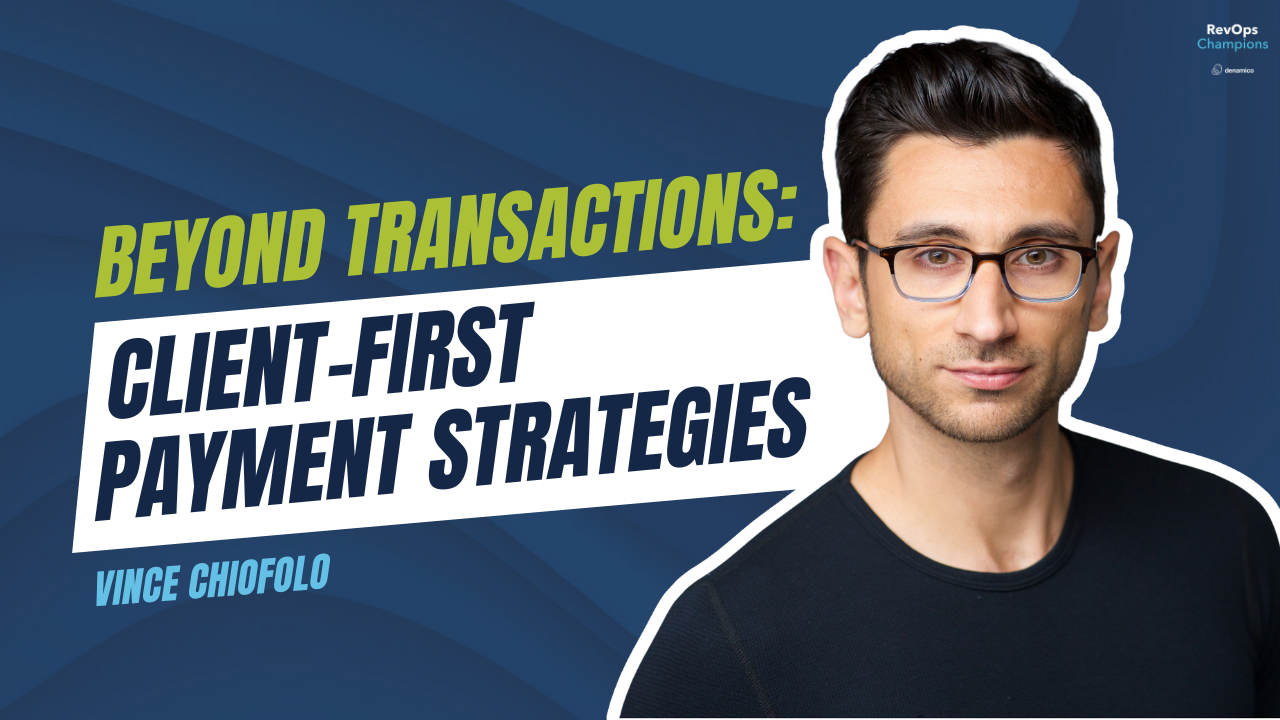
In this episode of RevOps Champions, host Brendon Dennewill interviews Vince Chiofolo, SVP of Revenue Strategy at Dash Solutions and President of the Incentive and Engagement Solutions Providers (IESP). The conversation explores the critical but often overlooked connection between payment experiences and customer retention. Vince reveals that 76% of customer churn can be traced back to poor payment experiences, whether inbound or outbound.
The discussion dives deep into how RevOps teams can drive alignment across organizations by focusing on shared metrics like lifetime value (LTV), net revenue retention (NRR), and customer health. Vince shares practical insights on building loyalty through three key pillars: emotional, structural, and behavioral loyalty. The episode provides actionable frameworks for reducing churn, improving customer experience, and creating sustainable revenue growth through better operational alignment.
What You'll Learn
- Why 76% of customer churn relates to payment experience failures and how to address them
- The three-pillar framework for customer loyalty: emotional, structural, and behavioral
- How to align entire organizations around shared revenue metrics and outcomes
- The surprising ROI of retention: how a 1-2% drop in churn can increase company valuation by 12%
- Practical strategies for moving beyond "new logo obsession" to focus on customer expansion
- Communication frameworks that scale with business growth: metrics, rhythms, and strategic focus
- How outbound payment solutions can transform from cost centers to revenue drivers
Resources Mentioned
Listen
About the Guest
|
|
Vince Chiofolo | SVP Revenue Strategy at Dash Solutions Vince Chiofolo is the Senior Vice President of Revenue Strategy at Dash Solutions, a leading fintech organization, where he oversees go-to-market strategy and revenue operations. With a RevOps background rooted in behavioral engagement and loyalty, he brings a sharp lens to optimizing performance, aligning revenue teams, and scaling growth. He also contributes to broader strategic efforts through leadership and board roles in professional associations. |

Episode transcript
The Hidden Role of Payments in Customer Churn
Brendon Dennewill: Vince, thanks so much for joining me on the Brendon Dennewill podcast this morning. How are you?
Vince Chiofolo: Hey, Brendon. I'm great. It's still summer here, although fleeting. I'm on the South Shore of Long Island in New York, hoping to get one or two more beach days in before the season ends.
Brendon Dennewill: Well, good luck. We typically go up to Massachusetts this time of year, but the HubSpot Inbound conference is in San Francisco this year instead. Who knows, we might get a beach day in.
Vince Chiofolo: San Francisco. Can't complain about that.
Brendon Dennewill: So Vince, you're the SVP of Revenue Strategy at Dash, or Dash Solutions as people might see online. You're also President of the IESP, the Incentive and Engagement Solutions Providers. I'd love to touch on both of those as we go, but maybe to kick things off, can you share who your target customer is at Dash?
Vince Chiofolo: Sure. A little background on what Dash does. I like to say we're a thirty-year-old startup, in a good way. We've got almost three decades of experience managing payment solutions for companies. Any company that makes an outbound payment to an individual, whether it's a customer, an employee, an award or reward incentive, or a partner, we're in the business of making those payments easier and more efficient.
The startup piece is that we're constantly innovating and staying nimble, adjusting to how payment culture is changing and how people like to get paid. We're making some significant innovations in the markets we serve.
There's real concentration in areas where fast, engaging payments matter most, such as healthcare and product manufacturing, where loyalty is very important. Paying things like rebates, credit balance adjustments, or refunds quickly is critical. What I like to say is that Dash kills the paper check with a faster, better, more cost-effective way to pay. It helps bolster those industries in an area not a lot of people think about. Payments are usually inbound or B2B, and we're really in the business-to-person payment space: business to consumer, or business to employee. What we create is a smoother experience for both the company and the customer.
Connecting Loyalty Experience to Payment Operations
Brendon Dennewill: That's really interesting. I think for a lot of leaders who think about payments, they don't necessarily put payments together with loyalty and engagement in the same sentence. You obviously have a lot of background in loyalty. How did those two things come together for you?
Vince Chiofolo: I think it's a great point, and I'm almost the embodiment of them coming together, on the revenue operations focus with loyalty experience and then payments.
The best way to illustrate it is with a stat: about seventy-six percent of churn at any company can be related somehow to a payment experience going bad. Whether it's an inbound payment that's clunky, or one that doesn't support the payment type a customer prefers, or an outbound payment where the whole customer experience was great right up until the last few feet that people don't think about. I was owed a refund from a company, and it took six months to come, and then it was a clunky process that didn't work.
We're in the business of payments, but we're really in the business of solutions. The solutions we bring to the table help with churn reduction and create more loyalty by making the payment experience a real, meaningful part of the overall customer experience. My background with IESP and the Incentive Marketing Association connects directly to the payment side of the business because of how much they come together. We're solving problems to help bolster all of that for companies.
Brendon Dennewill: And those are areas where the customer experience component is often an afterthought, and companies typically learn the hard way. They provided a great customer experience for months, and then something in the payment process undid all of it. It sounds like the core of what you're solving for is that companies lost customers, or even employees, because of a poor payment experience.
Vince Chiofolo: Definitely. And it's relevant to RevOps because everybody has skin in the game when it comes to churn. You can't delegate something as important as churn to one group. Historically, churn has been seen as a finance problem because it reduces revenues, but solving for churn is really a group exercise. You've got RevOps involved to help with customer experience, marketing managing the user interfaces and tools around the payment process, and sales with skin in the game. That coalition helps drive the identification that churn is a problem where payments can often be the culprit, and then they work together to solve it.
It could be something in the inbound payment experience, maybe not enough options for customers to choose from, or perhaps they prefer to split payments rather than paying all upfront. In that way, the solution is mitigating a problem at the same time it's creating a new revenue lever and opportunity. If you expand access to more people who can pay in an easier way, or you retain a customer longer and turn them into an advocate by giving them a refund experience that's actually engaging, you start to not only save lost revenue but drive new revenue you wouldn't have added otherwise.
Common Challenges That Bring Companies to Dash
Brendon Dennewill: So let's dig a little deeper. What are the most common obstacles or challenges that companies bring to Dash?
Vince Chiofolo: Almost all of them have an outbound payment challenge that traces back to the root cause of cutting checks. We're seeing this everywhere. Even governments are getting out of the business of writing checks because it's inefficient and costly, and if governments have come to that conclusion, businesses definitely should too.
Whatever a company has to pay an individual, cutting a check means there's the cost of the check itself. A lot of people don't realize how much it costs to cut a business check because of all the processing involved. It can run over sixteen dollars every time, even if the check is for one dollar. Face value doesn't matter. Then there are back-of-house costs: finance teams administering those checks, labor and time for shipment, and if a check is lost or stolen, you have to replace it. There's just so much management involved in pushing out outbound payments.
So companies come to Dash wanting to get out of that business. They want a better, faster, more efficient method that they don't have to manage themselves. They want automation and a trusted team handling it so their people can focus on what's core to their business. We put solutions in the name because that's what we're really doing. We're not selling a commodity product for everybody. It's not just a prepaid card or digital payment. We're creating advanced integrations and solutions that surround those payments to solve real problems that businesses are having that not a lot of people out there are solving.
Integrations and the Technology Stack
Brendon Dennewill: You mentioned integrations. When a customer decides to incorporate Dash Solutions into their tech stack, what are the most common integrations you have?
Vince Chiofolo: Those integrations can be literal. We work with a lot of platforms that are technically in the business of paying out on behalf of their clients. Think of a restaurant software where part of the workforce management involves paying rewards and incentives to employees or customers, or similarly in agriculture. We can integrate with those platforms so you don't have to come to a separate dashboard to manage a payment. It lives within the suite of tools you're already using today.
Then there's integrating within the workflow of the customer: adhering to the rhythms of how they already operate instead of creating a whole new process. Dash works with their teams to use our tools in a way that fits how they already work. We like to bind ourselves to the customers and make it a natural fit so that we're solving a problem in a really smooth way.
Brendon Dennewill: Because it is very much person-focused and often employee-focused, does it integrate with HR or CRM platforms?
Vince Chiofolo: Yes. There are so many different use cases for how companies pay individuals. In the pay card use case, for example, a surprising number of people in the US are unbanked or underbanked. They don't have a bank account, so they get a paycheck and have to figure out how to cash it. We offer a pay card where they're paid directly on the card, can spend from it, and take cash at an ATM. That involves an integration with a workforce management solution or HR tool that runs payroll.
Instead of managing payroll in one place and Dash in another, the two talk to each other. Employees get the option to be paid by ACH, check, or a Dash card, and as the administrator, if it's a Dash card, they're just pushing those funds through the same portal they already use to manage payroll for other payment types. We've got a great team that makes Dash live within the tools and workflows you already have rather than adding another layer onto the stack you're managing.
Brendon Dennewill: Just not adding more complexity. So who are the roles you work most closely with inside an organization?
Vince Chiofolo: Much like we said before, everybody has skin in the game when it comes to payments. For use cases involving rewards or incentives to employees, the decision typically lives in HR. It could be a SPIF program for the sales team or an employee recognition program. Others will be involved by committee, but HR leads that charge.
For paying things like refunds in a better way, credit balance adjustments, or core payments, it typically lives in finance with operational roles around it. Finance is involved in every decision, and more and more, there's ops and revenue operations involved, because it's adding into existing workflows and processes. It's not just a financial exercise or an HR exercise. It's operational in nature.
RevOps, Churn, and the Role of Payments in Revenue Health
Brendon Dennewill: Could you dig into that a little more? An example of how it works in the RevOps space?
Vince Chiofolo: Sure. Take a large manufacturer. If their pain point is that they overpaid employees, or they owe funds back, or there's a recall and they need to pay individuals, their operational challenge is how to push those funds out efficiently in a way that adheres to systems and processes that involve revenue.
I've been in RevOps now for about ten years, and what I've seen is a real progression. Revenue operations started as managing the outbound tool stack, and now it's becoming more broadly operational, but very central to revenue. If funds are coming in through sales, yes, that's a centerpiece of the tool stack. But RevOps is increasingly getting involved in other areas that affect the flow of revenue, and sometimes that's outbound.
Getting involved at those product manufacturers might mean saying: we're going to sabotage loyalty if we don't have a great, engaging payment experience. You may be in finance running the initiative, but RevOps comes in to make sure it works within existing systems, that people are getting paid well, that it's integrated properly, and that we're not creating poor payment experiences, half of which affect the overall consumer experience and lead to churn. Great revenue operations people are starting to get involved in these projects, and it's helping them reduce churn and create new revenue levers and more opportunity for businesses.
Brendon Dennewill: We're seeing the same thing. When we started calling it RevOps around seven years ago, we were working with marketing ops, sales ops, and service ops. The alignment model just made so much sense. But we've seen an organic shift where that alignment is now happening with what we call the back office. It's really just operational efficiency across the board.
Vince Chiofolo: Revenue is everywhere, and as it's highly pervasive in the business, so is RevOps. If you have a team leaning into sales ops, marketing ops, customer success ops, and financial ops, that's a big bulk of the whole business. You're RevOps that's everywhere, helping to lift operations across the whole business, and because it all comes back to revenue, that's the gig.
Organizational Alignment: Metrics, Rhythms, and Communication
Brendon Dennewill: So we've started talking about alignment. From a strategic leadership perspective, how do you think about alignment at the highest level? Whether it's pure RevOps or the broader operational function we've been describing?
Vince Chiofolo: I think of alignment as both a huge opportunity and a huge threat. The joint in a company can really be public enemy number one when it comes to growth and scaling. There's a McKinsey study that found sixty-four percent of executives say organizational silos are the number one barrier to scaling growth at their companies.
When growth starts to accelerate, especially at growth-stage companies, there's a natural tendency for teams to run faster in their own lanes. That's where misalignment creeps in and results in different departments chasing their own strategies, their own roles, their own metrics. So it's important to operate from a shared set of truths and outcomes throughout the business.
Really, it comes down to three factors: metrics, operating rhythms, and communication.
On metrics, at a practical level, that could mean one unified scorecard for the whole organization where functions like marketing, sales, and customer success are all measured under similar, and in some cases the same, factors. They all have some investment in pipeline creation, conversion, retention, and expansion, with shared visibility and accountability on the results.
Rhythms means building consistent, shared operational moments throughout the business so everyone is playing the same tempo: joint forecasting that involves more than just sales, cross-functional pipeline visibility, deal reviews so everyone sees the meaningful deals coming in, and shared planning or strategy sessions. These are all moments where people can see how their individual piece impacts the larger picture.
And then communication, which brings it all together. Communication has to scale as the business scales. Early on, companies communicate verbally because you can. You have all the information, all the people, and it's very close. But with scale, that starts to fall apart because there's more to communicate and more people to communicate it to. If you try to do it the same way, you find yourself in meetings all day with no time to actually act on what you came up with. The ways of communicating valuable information need to evolve.
When you bring all three of those things together, you have a trifecta of scale fundamentals that creates a strong engine for clean and scalable growth.
Brendon Dennewill: Metrics, rhythms, and communication. I think if you look at all the different business operating systems out there, they all say some version of that. A lot of our clients run on a business operating system like EOS, and those three things map directly to EOS's six components. So let's dig into metrics for a second. What are examples of metrics that actually tie an entire organization together, whether you're in sales, marketing, service, operations, HR, or finance?
Vince Chiofolo: We just talked about churn, so I think retention and net revenue retention is something every single group should care about. Not just finance, not just sales, but everybody is in their own way affecting the customer experience, and customer experience drives whether a customer stays or grows. Looking at those numbers broadly, tracking key customer health metrics, and generating ideas to retain and grow existing customers is something everyone should have a stake in.
When you can grow your existing customers and retain them, that takes pressure off new business development and constantly having to find new logos. So retention and customer growth are two big ones. And then for new logos, everybody in the organization, even if they're not salespeople, should think like salespeople and marketers. Find opportunities to create new connections, new channels, and ask whether you're chasing the right customers or whether there are new pockets of market to consider.
Those great conversations happen when you start to look at metrics. When numbers are great, you ask how do we keep this going. When numbers aren't so great, you ask where can we find new opportunities. Metrics become a North Star when you bring the big revenue-related numbers to all these different teams and everyone starts thinking in terms of revenue. That's good for everybody, good for the customer, and everybody wins.
LTV, NRR, and the Economics of Loyalty
Brendon Dennewill: One metric that keeps coming up on this podcast is LTV, lifetime value, typically followed at some point by CAC, cost to acquire a customer. You mentioned net revenue retention. Do you have thoughts on the connection between NRR and LTV?
Vince Chiofolo: There's a finite number of levers you can pull to raise LTV. You can increase revenue by finding new things to sell, which is always the endeavor and it's hard. But I think people underestimate the value of retention. If your monthly churn rate is five percent, you're wiping out almost half the business annually. You have to make that up just to get even, and then find new logos on top of that to grow.
Focusing on loyalty that drives retention is what really raises LTV in a meaningful way. The lifetime value of a customer involves the amount of dollars, but it also involves the lifespan: the length of the customer relationship. If a customer is happy, they're spending more and not churning. But length is also incredibly impactful. A customer who stays five years instead of three is going to be enormously valuable to the business.
Investors are increasingly looking at LTV and what you're doing to ensure it's strong, and at what LTV is relative to customer acquisition costs, because if unit economics are healthy, the whole business is healthy. It's not just the dollars the customer is paying. It's how long they're staying, how happy they are, and how much they're growing.
Brendon Dennewill: If you forget all the acronyms for a moment, it really comes down to value creation. If you keep a customer for five, six, seven, or eight years instead of one or two, that's a much higher lifetime value, and your customer acquisition cost is also lower because you already have them. That reduces the pressure on your sales and marketing spend.
Vince Chiofolo: Exactly. And there was a study I saw recently where a one to two percent drop in annual churn in an ongoing business, like a SaaS company, can increase that company's valuation by twelve percent over five years. Just drop churn one percent and you get a meaningful valuation boost. That would take forever to achieve through chasing new logos and a lot of investment. But if you invest time and resources into a small change that boosts retention, you get a big payoff over time.
Why Leaders Default to New Logos Over Retention
Brendon Dennewill: Why do you think more leaders don't focus on expanding existing customers? Across every industry, there still seems to be a disproportionate amount of energy going toward net new logos instead of growing existing relationships.
Vince Chiofolo: I think it's cultural. Business culture tells the people who should be focused on retention and churn reduction to go chase new logos instead. Part of what creates that culture and tempo is the investor community. For a long time, new logos and top-line revenue were what investors rewarded, so everyone followed that pace. Companies chased new logos, tried to get great brand names on their website, and focused on top-line growth. That mindshare invested in one area naturally takes away from the other.
It makes headlines when you win a big customer, but nobody publishes headlines about retaining a great customer. There's less cache in retention work.
That said, I do think the pendulum is starting to swing. Investors care a lot more about NRR today, and companies are following suit. They're thinking more about loyalty and coming to Dash to enhance the payment experience, retain customers longer, and get better LTV. I see it starting to change, but it's still largely cultural, where this work lives in finance as one person's area rather than spreading through an organization and becoming a committed, cross-functional focus.
Brendon Dennewill: The way you connected that to culture was really important. If the culture, the "main thing," is net new logos, then everyone across the organization from marketing to finance is going to orient toward that North Star, whether it's explicit or just implied. Nobody is going to be thinking about retention.
Vince Chiofolo: Exactly. When you start a meeting asking "we've got a revenue problem, how do we grow quickly?" everybody's mindset shifts to chasing new markets, spending new money, running new campaigns. But more and more, we're seeing people focus on retaining customers and identifying upsell opportunities. Your next best customers are your existing customers. Find the ways to help them, add value, and earn revenue as a result. It becomes one revenue engine as customer success infuses further with sales.
Brendon Dennewill: We see this in the franchise space too. Franchise development teams are always chasing and trying to sign franchisees to take multiple units upfront, instead of getting them onboard successfully with one unit and letting them grow organically because success speaks for itself.
Vince Chiofolo: You don't even have to ask. It just invites them to lean in further.
Communication as a Scale Fundamental
Brendon Dennewill: So what about the communication piece? Is there any low-hanging fruit that a lot of leaders are missing?
Vince Chiofolo: Broadly speaking, it's really important to stick to the fundamentals. There's so much that can be communicated that the most important thing is to prioritize what's actually tied to the strategy of what you're trying to do, whether it's the company's overall strategy or a quarterly focus. How does what you're communicating fit into that? It's easy to get paralyzed with so many things that need to be dispersed throughout an organization, but staying grounded means asking: what's the core strategy we committed to, and what do people need to know to help foster it? You can't communicate everything, so distill it to the impactful pieces that help people play their part.
A lot of it also has to do with problem solving. A mantra I like when it comes to communication and problem solving is that a problem well stated is half solved. When a challenge comes in, really make sure you're communicating the problem well, not just naming what the problem is. The tendency is to jump into solutions without a full understanding of the challenges, and that's where you go wrong.
There's a quote from Einstein I keep in mind: "If I had an hour to solve a problem, I'd spend fifty-five minutes thinking about the problem and five minutes thinking about the solutions." That's a great lesson for business. Really communicate the challenges and objectives well before jumping to answers, because the answers will organically flow once you have a well-defined, well-stated problem with the right people in the room to hear it.
Brendon Dennewill: That's a really good message. If I could go back to my younger self, that would be on the list of things I'd tell myself in my twenties. If you really understand the problem, creating the solution becomes so much easier.
Vince Chiofolo: That's the easy part.
Brendon Dennewill: Which is somewhat related to what a former president said: if you have eight hours to chop down a tree, spend the first seven sharpening the ax.
Vince Chiofolo: Very similar. That makes sense.
The Three Pillars of Loyalty: Emotional, Structural, and Behavioral
Brendon Dennewill: As we begin to wrap up, is there one thing you'd want to leave our listeners with? You have a front-row seat through IESP on how loyalty drives business, and we've been talking about what companies can do to retain customers.
Vince Chiofolo: Loyalty involves a few different pillars, and a lot of people tend to think of it as a monolith of emotional loyalty: run ads, tap into emotions, and you're done. That's important, but loyalty has to have structure, otherwise it comes apart at the seams.
I think about aligning emotional loyalty with two other concepts: behavioral loyalty and structural loyalty. Make sure you're not just creating love with customers, because customers can love a company and still leave. Blockbuster is a great example, and so is Radio Shack. These are companies people romanticize, but they're gone because there weren't structural, behavioral habit loops that kept people hooked in.
Emotional loyalty is the heart. Structural loyalty is the hooks: make it hard for people to leave, make yourself the default option. And behavioral loyalty is the habit: make sure you're part of everyone's everyday.
Blockbuster is a great example there too, because it once was part of the habit loop. Friday night, done with work, you go to Blockbuster, browse for a movie, bring it home. That was a real habit. But as the consumer market changed, people didn't want to go out. They wanted to stay home, to have it fast and easy. The adaptation of that habit loop is what would have made a difference.
So as you think about how to retain customers for the long journey: think about how to emotionally connect with them, think about how to structure things so it's hard for them to leave (not trapping them, but making yourself a no-brainer to stay with), and really adhere to how their day is conducted. Form a habit loop, make it seamless and simple. If you have all three of those things, you don't have to work very hard to keep them. They're just going to want to stay. Then you can focus your time on how to grow them and how to sell more things that provide real value.
Brendon Dennewill: I really like that. As you were saying that, I was thinking about CRM: customer relationship management. Fifteen or twenty years ago, it was essentially seen as a prospecting tool, but if you think about what CRM actually stands for, it's talking about all the things we've just been discussing: how do you manage all these behaviors through structure to improve and continuously create value, with a place to track it all. I really like how you made that connection.
So thank you very much, Vince. I wish we could continue, but I know we're out of time. Hopefully we can have you back another time and dig further into value creation as businesses continue to navigate the changing landscape of technology.
Vince Chiofolo: I would love that. I love the podcast and appreciate you having me. Thanks.
Brendon Dennewill: Thanks, Vince.
Subscribe