
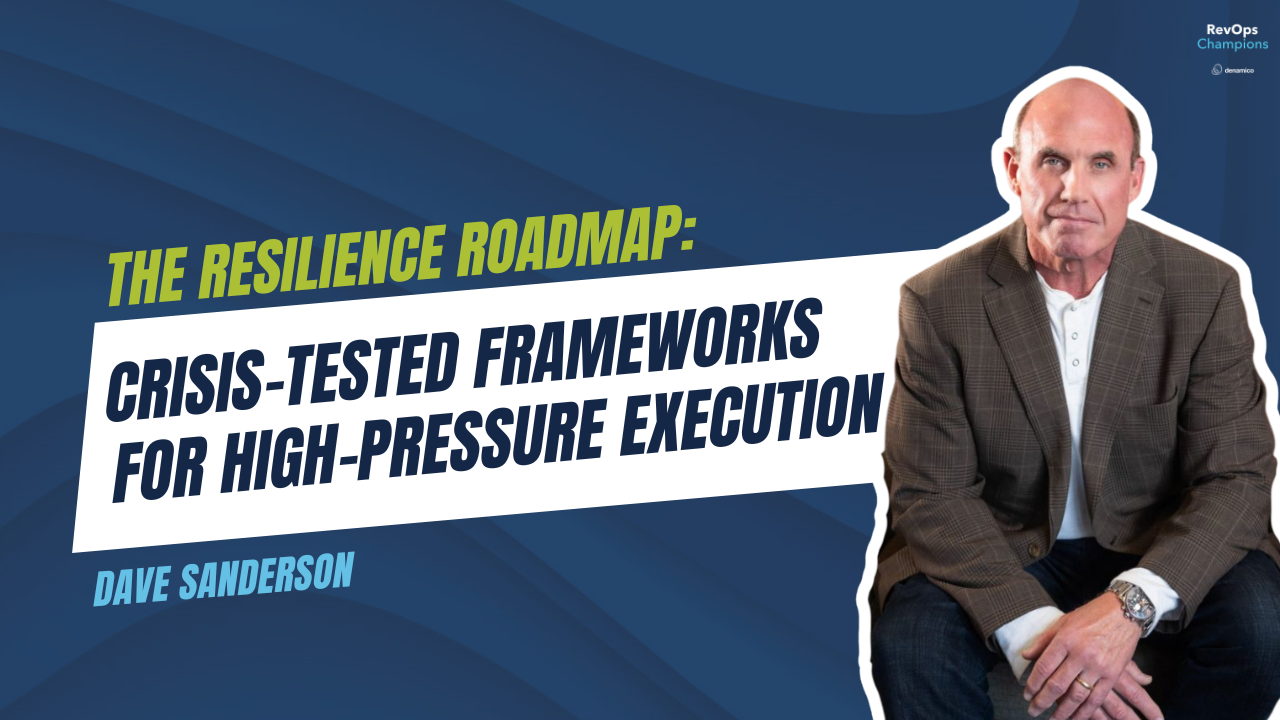
Dave Sanderson, the last passenger off US Airways Flight 1549, known as the Miracle on the Hudson, brings 37 years of sales leadership and hard-earned crisis experience to a conversation with Brendon Dennewill about what it actually takes to build resilient teams and make decisions under pressure. From the ASSESS Framework and the A-to-I Affinity Model to the VCR leadership structure developed with Chad Jenkins, Dave unpacks the systems that separate leaders who hold the line from those who collapse when pressure compounds. If your organization is navigating uncertainty, low trust, or execution breakdown, this episode is the blueprint you didn't know you needed.
What You'll Learn
- Why trust outranks competence in high-stakes hiring
- The three levers for managing your mental state under pressure
- Captain Sullenberger's unique ability, and what it means for your team
- The VCR Framework: Vision, Capability, Reach
- How the ASSESS Framework works in real-time crisis decisions
- The A-to-I model: Access to Influence to Affinity
- Why "proximity is power" is your fastest path to growth
Resources Mentioned
Listen
About the Guest
|
|
Dave Sanderson | President at Dave Sanderson Speaks International LLC & Founder at Resilience Partners Group
Dave Sanderson is an Inc.com Top 100 Leadership Speaker, author, and resilience expert best known as the last passenger to exit US Airways Flight 1549, the legendary “Miracle on the Hudson.” Drawing on a 38-year career as a top sales producer and his firsthand experience surviving a life-or-death crisis, Dave founded the Resilience Partners Group to help leaders and elite teams navigate uncertainty and high-stakes change. Through his corporate keynotes, executive coaching, and his book Moments Matter, he equips professionals with practical frameworks to stay calm, make high-velocity decisions, and build operational resilience under pressure without waiting for perfect clarity or a formal title. |
Episode Transcript
Opening: What Resilience Really Means
Dave Sanderson: I think resilience comes down to a couple of major things. Number one, the ability to make a decision when you have to. And second, resourcefulness. Because as an entrepreneur and you're one, and I'm trying to be thriving when I'm in my building process, if things are not always pixie dust and sunshine, as we know, there's a lot of stuff and it's easy to give up. But every time I try to get to that point, and you've probably been there too: is it really worth all this? I think, you know what, if I would do this, how could I do it? And if somebody else has done this, all I gotta do, like you and I do is go to somebody who has done it. And it goes back to what Dan Sullivan taught us: find your whos for your hows.
Introduction
Brendon Dennewill: Welcome back, everybody. Today I'm joined by Dave Sanderson, a resilience expert and nationally recognized leadership speaker, best known as the last passenger of US Airways Flight 1549, known as the Miracle on the Hudson. On January 15th, 2009, Dave survived what should have been a tragedy, emerging from the icy Hudson River alive and forever changed. Dave has since dedicated his life to sharing his lessons learned.
He brings a unique perspective on leadership and performance shaped by both his 37-year career in sales and his real-life experience in a high-stakes crisis. Following the emergency landing on the Hudson River, he became widely recognized for his actions during the evacuation, helping others to safety before exiting the aircraft himself. Dave's worked with Fortune 500 companies, elite teams including military and high-performance organizations, and leadership groups to translate crisis-tested lessons into practical frameworks for resilience, decision-making, and accountability. That all became real very recently, Dave, when you launched Resilience Partners Group. I'm very excited to hear more about that. Welcome to the RevOps Champions podcast.
Dave Sanderson: Thank you very much for having me. I'm really honored to be here. Thank you.
How Crisis Reveals True Human Performance
Brendon Dennewill: Dave, you lived through a real-life crisis, and you and I have talked about this a little bit. In the U.S. especially, people didn't really think of crises other than from what they saw in movies. But now, with recent history, the financial crisis and then COVID, I think people can relate to crisis a little more than they could before. What is the biggest lesson that moment of Flight 1549 taught you about how people actually perform under pressure?
Dave Sanderson: Thank you for that question, and you're exactly correct. Even in the last 16 or 17 years, as you and I were discussing, this happened in 2009 and we were going through a pretty significant recession in the United States. Then we had the Miracle on the Hudson. And then COVID and other things happened. So I think this upcoming generation has really, for the first time, had to see what a crisis can actually do and how it impacts somebody's life.
That day on the Hudson River, one of the things you realize is that people fall back on the moments of their preparation. Fortunately for us, we had a captain and crew who were very prepared. I talk about state management, how to manage your mind. They had to manage their minds before anybody else had to, because they had to exhibit that mindset, which I think was a very big contributing factor to the outcome.
If you had seen the crew panic, that would have translated. But one of the things I learned that day, and I really talk about this, is that people fall back on their moments of preparation. That's what happened to me and to many other people that day. And that's how people responded, and why it went from a tragedy to a miracle.
What Separates Those Who Stay Effective Under Pressure
Brendon Dennewill: In your experience, what separates individuals and teams who stay effective under pressure from those who break down?
Dave Sanderson: The first thing is understanding how to manage your state, how to manage your mind. It really comes down to three different ways: either moving your body through physiology, the questions you ask yourself, or your area of focus. So I think one of the distinguishing factors is people who can manage their minds quickly through one of those three ways.
Second, they're able to address what's needed immediately. Things come down to six primary areas in my world. Does this situation need certainty? Does it need a different way, resourcefulness or variety? Does it need connection? Does someone just have to step up and manage it? Is it calling for a growth mindset? Or what can you contribute to it? People who can manage these situations have put in enough reps to quickly manage their mind, understand what the situation calls for, and then, as I talked about in my TED Talk, attach the right meaning to it.
The meaning you attach to something produces the emotion, and emotion is everything. A lot of people that day attached devastation to it. A plane crash, how could you even get through it? Where some people, the meaning they attached was that this turned out to be a blessing, something that brought people together in a very challenging time. Those three things distinguish the people and the leaders who can help others manage through a crisis and make decisions based on that.
Captain Sully: Preparation, Focus, and the Power of Unique Ability
Brendon Dennewill: So if we bring it back to that day on the Hudson, what prepared Captain Sully? I know it was just a couple of minutes, maybe three, that he had to make a decision. What led him and prepared him to make the right one?
Dave Sanderson: I've had a couple of discussions with the captain and have done a lot of reading about him. Number one, his 20,000 hours of flight experience, definitely. But second, he was an Air Force pilot during the Vietnam era. I don't know if he was ever in battle, but just being in that era and environment shaped him. And going back to his early days, reading his biography, when he was flying smaller planes in Texas, he was having to make decisions very quickly and learning how to glide planes. That was a skill set he had to rely on.
But what it comes down to, and this is my belief, is his unique ability: the ability to focus immediately. Clear the decks, prioritize. What can I do best right now? And the ability to focus in on a problem and then make a decision based on that. He made that decision within seconds. When it happened, he had four options. He could go into the ocean, not a good option. He could go to Teterboro, right there, but too many big buildings. He could try to get back to LaGuardia, probably would have made it based on some things we've learned. Or fourth, he had the river. Within seconds, he went through all four of those. Think about how to do that and then execute it. That's his unique ability: to focus and make a decision.
Brendon Dennewill: Right. Just as a reminder for folks who might have forgotten: both engines were knocked out simultaneously by a bird strike. Both engines were gone immediately. So he knew he had no power and the only option was to glide to whatever his options were. I think I read somewhere that, apart from the thousands of hours of flying and the likely training during the Vietnam era, he may have been a crop sprayer in Texas at one point, which requires gliding at very low altitude. So he had that specific experience. It's incredible to see how those moments, after years and thousands of hours of training and practice, with neural pathways being formed, prepared him for that moment and that decision: landing on the Hudson was going to be the safest option.
Dave Sanderson: That's one of the reasons I named my first book Moments Matter. When I went through this experience, I realized that all the moments in my life led up to that momen, things that happened when I was 12 years old, learning to swim, being in the Boy Scouts. Those served me that day. Everyone on that plane: all the moments in their lives led up to that one significant moment. Even look at the first officer, Skiles — he had 20,000 hours of flight experience. Between them, they had 40,000-plus hours. How often do you get on a plane with two pilots who have that kind of combined experience? It doesn't happen too often.
Resilience Is Built Through Preparation, Not Just Reaction
Brendon Dennewill: Right. And these are all, to your point, moments. It's a little like what we talk about in business leadership: a lot of the people we surround ourselves with have already been incredibly successful, and many of them talk about luck. But we all know luck often comes from being prepared. I often quote Gary Player, the South African golfer — still one of the greatest of all time. When a journalist came up to him after he won the U.S. Open and said, "You're so lucky, you go into the bunker and still get it in or close to the hole," his response was: "It's funny, the more I practice, the luckier I get."
Dave Sanderson: Right. The more preparation I have, the more opportunities I have. That's why I started our group, Resilience Partners Group, because part of being resilient is organizations that put that preparation in beforehand. Right now, with what's going on in the world, you better be prepared. You better have a backup plan for your supply chain — getting out of China or wherever — which we learned from COVID. I was focused in the consumer packaged goods arena at that point. What was their biggest challenge? Supply chain. Nobody talked about supply chain before that. Now it's one of the top issues. You better have some resiliency there.
Resilience is built because of the reps you put in. And some of the losses and things you learn along the way. The people we know around us are not always 100% successful.
What Resilience Actually Looks Like in Day-to-Day Execution
Brendon Dennewill: So let's dig into that a little. A lot of leaders are familiar with resilience — they talk about it. But what does resilience actually look like in day-to-day execution, and not just in extreme situations?
Dave Sanderson: A lot of people think resilience is the ability to bounce back, and I think that is part of it. But more importantly, it's the mindset that we're going to get through this. One thing my mother taught me years ago, which I talk about a lot, is: you're not the first person to go through this. That one mindset means: if I've got a problem, I'm probably not the first person to have it. So what do I have to do? Find someone who's solved it before. That builds my resiliency. I've got resources and I'm resourceful enough to get through this.
So I think resilience comes down to a couple of major things. Number one, the ability to make a decision when you have to. And second, resourcefulness. Because as an entrepreneur, if things are not always pixie dust and sunshine, it's easy to give up. But every time I try to get to that point, I think: if somebody else has done this, all I gotta do is go to somebody who has done it. And it goes back to what Dan Sullivan taught us: find your whos for your hows.
Where Execution Breaks Down Under Pressure
Brendon Dennewill: Where do you most often see execution break down in organizations when pressure increases?
Dave Sanderson: The ability to communicate effectively. And if you look back at the 1549 experience — people ask me all the time, what was the captain saying to you? He only said what he had to say. He communicated very effectively: "Brace for impact." That's it. So I think part of being a resilient leader is being able to communicate the message effectively, which ties back to the mission, which hopefully ties to your value set. Because when push comes to shove, if you can't fall back on your value set and what you stand for in your mission, no one will actually believe you. Which goes back to one central theme: trust.
Brendon Dennewill: Absolutely. Most people are familiar with the five dysfunctions of a team — or if not the book, then the model. The foundation of Lencioni's triangle is trust. Without trust, you cannot get to the next level, and ultimately, if you want results, it all starts with trust.
Dave Sanderson: I agree. A little bit of my background: I swim with Navy SEALs and special operations to raise money and awareness for what they're going through. When I speak and in our Resilience Partners Group, our resiliency framework is: how do you build a high-performance team? After speaking to these special ops and Navy SEALs, they're all high performers, so I asked what it takes to be one. Every single person I talked to — probably a dozen to two dozen of them — said the same two things: trust and competence.
And the next question I asked was: if you had to fill a spot and someone had high competence but lower trust, versus high trust but less competence, which do you choose? All of them said they'd rather have somebody they can trust, because you can teach competence. You've got to have some competence — you can't be completely inexperienced — but they're looking for people they can trust.
When I talk to organizations about building a high-performance team, build it based on trust first, then competence. Every interview I've been part of over 40-plus years focuses on competence — your background and your résumé. That's important. But I think more important is: can I trust you when all the stuff hits the fan? That's part of resilience. In a sales organization, if I can't give you trust at that moment, you're not going to trust me to produce the number. And can they trust who they're going to call at two o'clock in the morning when everything's breaking loose?
The bottom line — and if you see it, you got it — is trust. If you can't do that, the rest of the pyramid falls down.
Building Accountability Without Fear: The VCR Framework
Brendon Dennewill: From a leadership perspective, how do you build accountability and ownership without creating fear or friction within teams?
Dave Sanderson: One of the things I've learned from our mutual friend Chad Jenkins is the VCR framework, which he's allowed me to really talk about. When you're building these things, you need a leader who has a vision, understands the capabilities, and knows how to reach. The VCR framework — vision, capabilities, reach. That is the target. Everything starts with that.
What I've realized after researching this over the last year, working through it with Chad, is that everything else I do falls underneath that. I can't help a leader without first helping them understand their vision and where they're going, their value sets, what capabilities they have and don't have, and who the best people are to help them get that reach or those resources. So everything starts with the VCR framework. Once that's in place, all the other frameworks start building in — the execution part. But this is the target.
Brendon Dennewill: Right. Everything that exists today started with someone who had a vision — whether it was a year ago, ten years ago, or a hundred years ago. But that vision didn't become a reality until they found people who had the capability to make it real. And someone else — typically it's not the same people who do all three — who had the reach to bring that capability and that vision to the people who could derive value from it.
Dave Sanderson: Steve Jobs and Elon Musk are ideal examples. Steve Jobs had the vision for the iPhone — take a phone and put an iPod into it. He didn't have the capability to build it himself, so he had to assemble that. And then how do you get it into the marketplace when nobody's ever seen anything like it? It's usually not the same person. But someone has to start with the vision. What I call the big unbelievable goal — our three-year vision. People ask me all the time, how are you going to do that? I don't know how yet, but I've got the vision, which means I've got to change everything we're doing: ask different questions, bring different people into our world.
Brendon Dennewill: And once you have a team working toward the vision, the importance of shared values and principles becomes critical. Everyone is being held to those same standards. And it comes back to what you said earlier about communication: that continuous beating of the drum. Remember, this is where we're going. This is why we're doing it. Is everybody still on the bus?
Dave Sanderson: The best leaders can quickly and simply remind people of the vision and the mission. One of the things we changed at Resilience Partners Group — ResiliencePartnersGroup.com — is we put our values right on the front page so people can see what we stand for before they ever work with us. These are the standards we play at. If you don't want to play at these standards, we may not be the right organization for you.
This goes back to something I learned when I was head of security for Tony Robbins: it's all about raising your standards. Leaders with vision can raise the standard. And as you said, remind people why we're doing this and what the vision really is.
The Resilience Assessment and the A-to-I Equals Affinity Framework
Brendon Dennewill: You've got decades of experience and vision that have led to launching Resilience Partners Group. Part of what made that possible were the frameworks you've developed over time. I think you mentioned a matrix that functions as a self-diagnostic tool?
Dave Sanderson: Yes. We're building a 30-question assessment you can take in five or ten minutes. It will produce a heat map showing 36 different leadership attributes — where your strengths are, where you need help, and where the gaps are. Then the question becomes: how do we fill those gaps? That's when I bring in the different frameworks, depending on where the challenge is.
One of the things I've built over the last 30 years — which I never had a name for until recently, and Chad gets the credit for pushing me to name it — is called A to I Equals Affinity. Access to Influence equals Affinity. How do you get access, build a connection, build a relationship, and develop influence to create an affinity relationship?
All I did was take the framework I used in sales over 37 years. People always asked me: how did you get to the CFO suite when everyone else was playing in the IT suite? So I'm now sharing that framework. How do you move from access to connection to relationship to influence, and ultimately to affinity? That's also part of building organizational resilience. You need the right relationships to do these things. You can't skip a step. Most people want to jump straight to influence. But influence comes from trust, and trust takes time. You build the connection, then the relationship, then influence — and then the affinity relationship. Who are you going to call at two o'clock in the morning? That's affinity. And that's actually the first framework we built under Resilience Partners Group.
Trust as a Sales Strategy: The Oracle Story
Brendon Dennewill: That makes total sense. In every organization, how long it takes to build trust differs — and if that's one of the hurdles you have to clear, are you being realistic about building it into your sales cycle measurement? Because of course it's different in different contexts.
Dave Sanderson: When I started with Oracle many years ago, I had this A-to-I mindset, but I hadn't articulated it. My manager at that point did not buy into it. His mindset was: Oracle has a process, follow the process. So here's Dave going outside that process. He wanted to rein me in.
Here's what happened. On January 15th, I was visiting a company in Brooklyn — I was sitting in their C-suite with the COO, CFO, and CIO. Then the plane crash happened. My manager's first response when I returned — I went by the office in old sweats because I had lost everything in the crash — was: "You're going to Michigan next week, right?" That was the moment I realized, Brendon, number one, I didn't have my four freedoms. And second, he didn't understand what I had built. The client I had been working with told him never to come back, because they knew what he didn't: I had built relationships and trust at that level. When I went through a plane crash, those people were taking care of me. My manager only worried about the dollars.
A few years later, I was working on probably the second or third largest pursuit at Oracle that year. I told my senior vice president Gene: "I'm going to go outside the box again. I'm not going to follow this process completely — I'll do everything you need me to do, but I'm going for the big relationship." He gave me a year of runway, which was completely abnormal. My manager wanted to cut me off at six months — "he's not making progress." A year later, we were sitting with the COO and CFO on a $58 million engagement. And we won it, not because we had the best software, but because they trusted us. And that's the point where my senior vice president realized what was missing in others: the willingness to invest the time in building trust. Most people at Oracle wanted to cut that short. They needed a number. The A-to-I framework is how you build that trust. And you're right — it's not overnight.
Brendon Dennewill: Which is kind of like: the soft stuff is the hard stuff. If you're making all decisions based on data that isn't informed by the relational context — the trust, the relationships — especially in B2B services where someone has to be convinced they're making the right decision, that trust often isn't built into the model. And it really should be.
Dave Sanderson: That's one of the first things we teach, because part of resiliency is knowing who you can trust when everything falls apart. The person making a $58 million decision has their job on the line. If they can't trust you, you're not getting that engagement. Companies need to build in that time to help build trust, not just rush in thinking you can skip the foundation. It requires patience and a different perspective.
My mentor Bill, back in 1984, taught me this. He put me in environments with his peer group — CEOs around Charlotte, North Carolina — when I was 24 years old, thinking I knew everything. He gave me the comfort and exposure to be around those people and understand how they think. Most people don't put that time in. They think they can walk right into the CFO's office and have a relationship. No — you've got a connection. A relationship is something very different.
Emotional Intelligence and Empathetic Listening
Brendon Dennewill: We often talk about emotional intelligence here at Denamico. Where does that come into this? That example you gave — learning at 24 and 25 to be in the presence of CEOs and senior leaders — was clearly foundational to your later success. Where does emotional intelligence fit in?
Dave Sanderson: It took me a little time to figure this out. The moment it really came to me was an interaction I had with the state comptroller of South Carolina — essentially the CFO of the state. I had built a relationship with the largest bank in South Carolina, which led to the introduction. I thought I was in the game, that I had it going on. Then during one conversation, he looked at me and said, "Son — I knew I was in trouble when he said 'son' — I'm beginning to start thinking about doing something like that." And I said, "Sir, we're ten years away." He said, "Son, you have no idea what you're doing."
That's when the emotional intelligence starts. I could have all the access and tactics, but I had to be able to sense what was really going on, and have what Chris Voss calls an empathetic conversation — understanding, with emotional awareness, how to have that interaction. That moment in 1991 woke me up and made me take it seriously. Really learn empathetic listening. And that's when everything started coming together.
Brendon Dennewill: For those who may not know, Chris Voss wrote Never Split the Difference — he's famous for his negotiation work in real crisis situations. And one of his key ideas, which relates to what you're describing: instead of being on opposite sides of the table, if you can move yourself around and sit next to the other person — we're going to solve this together. It's not "I'm trying to sell you something." It's collaborative.
Dave Sanderson: And you said it correctly, and Chris did say that. I had dinner with him a few weeks ago in Vegas and we had these deeper discussions. But it goes back to what we talked about earlier: until they trust you, you'll never get around that table. You have to have built enough trust that they know you're in it for their win, not just yours. If they sense that, they'll allow you to walk around the table and sit next to them. If they don't, it stays adversarial and you never get to the real promise.
And in a lot of the situations Chris was dealing with, someone was most likely going to die. Whereas in sales, you can move on to the next deal. But the underlying skills — trust, empathetic listening, asking the right questions — are consistent across both worlds.
Dave Sanderson: That's one of the challenges for a lot of companies: you're expected to hit the number, so they'll push you to keep going regardless. And it took me a long time to figure out how to elegantly back out of a situation that isn't a good fit. I think people actually have more respect for you when you say: I'll be your friend, I'll help you advise, but we're not the right fit. My friend Larry Levine launched his book last year — I was honored to write the foreword — Selling in a Post-Trust World. How do you sell when nobody trusts anybody anymore? That's one of the things I'm really focused on. And the answer keeps coming back to the A-to-I framework — how do you really go from access to building influence and affinity? There are steps, and it's not overnight.
Preparing Teams for High-Pressure Moments: The ASSESS Framework
Brendon Dennewill: We'll add links to all your tools and resources in the show notes. As we start to wrap up: how should teams prepare for high-pressure moments before they happen? Are there specific systems, habits, or behaviors that actually make a difference when those moments arrive?
Dave Sanderson: I'll go back to 1549, because what came out of that was the ultimate high-pressure situation. Even after the captain got it down successfully, we had water coming in and 150-plus people to get out. So I identified every step that happened that day, and it came down to decision-making. I call it the ASSESS framework.
Number one: accept reality. Acknowledge where you actually are. Number two: scan your options. That day, I thought I was locked into the aisle. But when I looked up and saw people climbing over seats, it gave me another reference point — I realized there were more ways out than I thought. Resourcefulness is about scanning for options beyond the obvious. And step three: select the best next step. Not a perfect plan, just the best available option.
One thing I learned from Tony Robbins that I include here: if you think you have one way to do something, you don't have a choice. If you have two, you have an option — but three gives you a real choice. So when you scan for options, you're looking for three.
And the key in a crisis — or in a fast-moving business environment — is that you don't have time to make a five-year plan. Things are changing every fifteen minutes. What's the lowest risk and highest possibility for reward right now? That's the ASSESS framework. If you understand it step by step, you have a way to move forward.
Brendon Dennewill: And to bring it back to that day: most people see photos of the plane on the Hudson and assume it just floated there until everyone was off. But you knew it was sinking. How long did it take?
Dave Sanderson: From the time of impact, the back of the plane was actually underwater immediately. Within 24 minutes, the plane was nose-up. That's how fast it went. And I give a lot of credit to the crew members who got those exit doors open, because those doors are 42 pounds, plus you have water pressure working against you, while managing your own mind in the middle of a crisis. Things start compounding: one challenge on top of another, stacking.
And from an emotional intelligence standpoint, the more you stack in your head and your body, the harder it becomes to act. The people who struggle most are the ones cycling through the same fear over and over. Stack, stack, stack — and all of a sudden you can't move. That's why managing your state is so critical.
How Leaders Must Rethink Resilience in a Complex, Low-Trust World
Brendon Dennewill: Looking ahead, as environments become more complex and fast-paced — and we're living in a very low-trust society right now — how should leaders rethink performance, resilience, and decision-making?
Dave Sanderson: Leaders right now have to start asking different questions. One of the great things I've learned through our coaching world is having tools to get clarity on the vision and on how to move forward. When I coach people, I talk about the strategy circle, the experience transformer. If you're a leader and you can spend 15 minutes identifying your obstacles, your wins, and what you want out of this, that's how I find leaders getting things handled much more quickly and effectively.
The ability to have clarity and then articulate that clarity to the right people and the right whos is going to be critical. I'm reading a book right now by Ram Charan about how to extricate your business from China. It's a fascinating read because while I was in consumer packaged goods, supply chain was something we talked about extensively. And COVID identified quickly: our supply chains are broken. So many companies are tied to China now. Leaders right now better be able to put those resilience plans together: what other options exist? India? Central America?
I'll leave you with the biggest lesson I learned from Tony Robbins: proximity is power. Put yourself around people who've actually done something, and that will compress the decades it takes to get there down to days. All of a sudden you're advancing your cause and getting closer to what we call your unbelievable goal.
Brendon Dennewill: That's really good advice. And it reminds me of similar advice from a lot of successful people: join peer groups. Surround yourself with people who've most likely had a similar experience to the one you're currently trying to figure out how to get through. Trying to do it in isolation is really hard.
Dave Sanderson: That's exactly what COVID showed us — we were all in isolation. And even though Zoom was a great tool, I keep going back to something I learned in 1987 from Tom Hopkins: it will always be a belly-to-belly business. Even with AI, which is just a tool, it will always come down to relationships. Can I trust you, Brendon? Can you trust me? If that's the case, then we can build on something. Like you said, two people — we can start building on something.
Final Words: Pass It On
Brendon Dennewill: Dave, any last words of advice?
Dave Sanderson: I really appreciate the opportunity, because this is such an important topic right now, especially for entrepreneurs. We're all going through challenges. My coach told me — and she was right — that you're really not an entrepreneur until you start facing challenges like making payroll. I never thought of it that way until I had that challenge a few months ago. That was the resilience thing that had to come out. And fortunately, I've been able to put myself around people who've been through it or can at least educate me.
My last message is: find somebody like a Brendon or myself who, when you're in a challenging situation — whether in your business world or personal world — can give you their wisdom. Because the last thing my first mentor, Bill, told me before he passed away in 1997 was this: do not let what I taught you die with you. That is the reason I do what I do. Everything that you and I have, we need to give it away. We need to mentor somebody else. We need to make sure we pass it on, with gratitude.
Brendon Dennewill: I love that. And it goes right back to the thing you were saying before that, which essentially comes back to the same advice your mother gave you: if you're going through something, it's likely many other people have gone through that same thing before. So find them, and they'll help you figure out how to get through it.
Dave Sanderson: You're not special. That was my mom's term. You're not special.
Brendon Dennewill: Yes. Really good. Dave, thank you so much for joining me today. It was great to catch up, and best of luck with RPG. I look forward to following along and diving into that more.
Dave Sanderson: Thank you. I look forward to having conversations with you about what you do in your world as well. Thank you.
Brendon Dennewill: Thanks, Dave.
Subscribe