
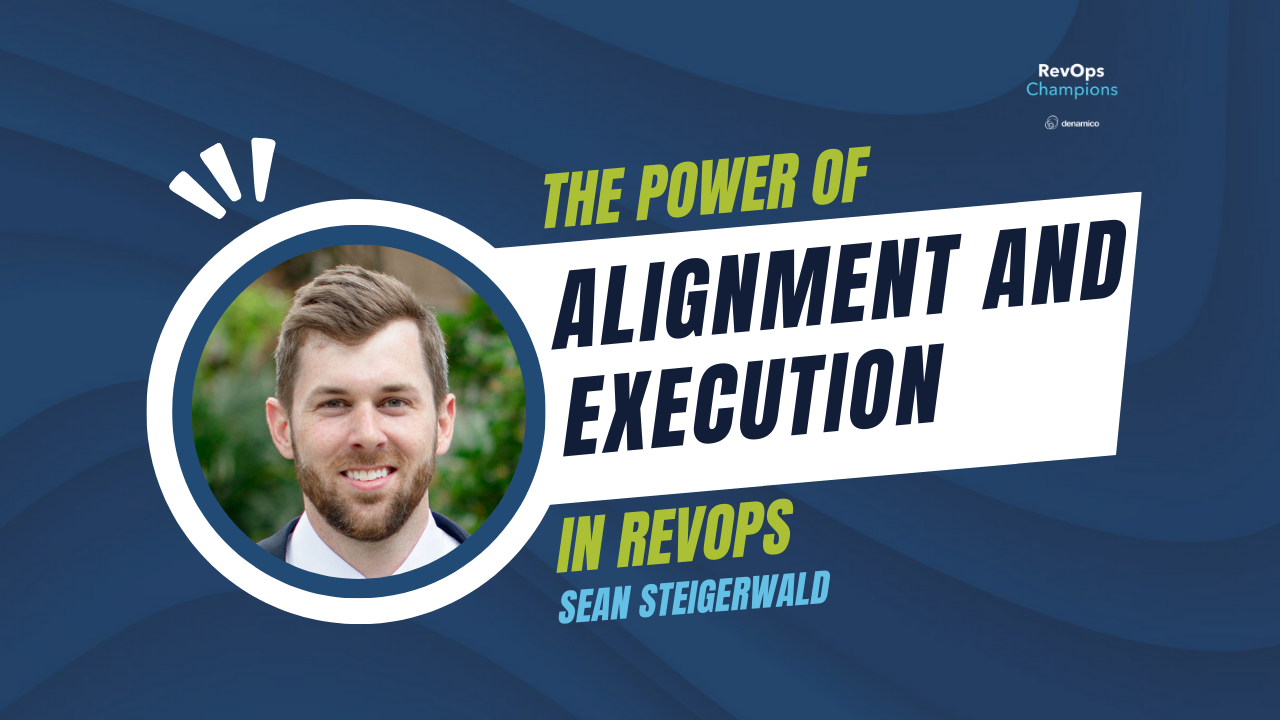
In this episode of RevOps Champions, Brendon Dennewill sits down with Sean Steigerwald, a serial entrepreneur and the CEO of CustomerIQ. Sean brings a wealth of experience from founding and growing SaaS and analytics companies, with deep expertise in business development, sales, and RevOps strategy. The conversation kicks off with Sean introducing CustomerIQ—a platform designed to automate and enrich CRM data entry while simplifying email automation for companies with complex sales cycles, particularly those using HubSpot or Salesforce.
The discussion dives into the operational challenges of B2B companies, especially those in enterprise SaaS, professional services, and manufacturing. Sean emphasizes that the main pain point for sales and revenue teams is updating and leveraging the CRM efficiently. He stresses the importance of removing tedious manual tasks, and automating processes only after they've been validated manually. Both Sean and Brendon highlight the need for strong RevOps leadership to ensure cross-team alignment and operational efficiency, and share their appreciation for business operating systems like EOS to help teams remain focused and empowered during growth phases.
Throughout the episode, Sean champions the value of consistent execution (“lead bullets” over “silver bullets”) and warns against overcomplicating tech stacks with unnecessary tools. They agree that alignment—across people, process, data, and technology—is key to scaling and customer retention. Sean concludes with practical advice: focus on process clarity before automation, use your CRM as a central hub for alignment, and keep things simple. For further learning, he recommends business books like “The Hard Thing About Hard Things” and entrepreneurial podcasts such as “Invest Like the Best” and “Founders.”
Listen
About the Guest
|
|
Sean Steigerwald | Founder & CEO, CustomerIQ
Sean Steigerwald is Cofounder and CEO of CustomerIQ, a company transforming how revenue teams operate by embedding AI agents into their daily workflows. By automating CRM data entry, drafting personalized email follow-ups, and automating admin workflows, CustomerIQ helps sales, customer success, and RevOps teams close deals faster—with less administrative drag and more strategic firepower. |
-1.png?width=209&height=209&name=HubSpot%20Profile%20(10)-1.png)
Episode transcript
Introducing Customer IQ: Who It's Built For
Brendon Dennewill: Sean Steigerwald, thanks so much for joining us today on the podcast. You're the CEO of Customer IQ, which may be of great interest to our listeners, many of whom are either using HubSpot or are very interested in using HubSpot. Customer IQ is an integration with HubSpot. You're on the HubSpot App Marketplace. And HubSpot is the leading CRM you integrate with currently, even though you also integrate with Salesforce. Would that be correct?
Sean Steigerwald: Yep, exactly.
Brendon Dennewill: Tell us a little bit about Customer IQ. Let's start with industry, because that always seems to be helpful for our audience. What are the industries currently using Customer IQ, and why do certain industries use it while others don't?
Sean Steigerwald: Sure. Our main industries right now, we broadly bucket as complex sales. That can mean anything from enterprise SaaS, which is our largest, to professional services, manufacturing, or anyone that has many touches in a sales process and captures a lot of detail in the CRM. The two main things we do are CRM data entry to a really deep degree, and email automation, helping sales reps get emails organized and replies and follow-ups out quickly.
Brendon Dennewill: So complexity is really the common denominator in your ICP. They have a complex sales situation with complex needs from the seller's perspective.
Sean Steigerwald: Yeah, they're capturing a lot of context in their sales process. We do a lot of email drafting to speed things up. Our whole goal is to compress what is usually a long, complicated cycle. To draft the right emails, the AI needs specific knowledge and domain expertise layered in. There are a lot of cool things around that.
Brendon Dennewill: That's very similar to our own experience. Our focus is more on manufacturing and franchises, and one of the reasons for that is the complexity. In those spaces, businesses need more help, and the value of figuring it out is that much higher. So what would you say is the main driver for companies adding Customer IQ to their HubSpot CRM?
Sean Steigerwald: The main one is certainly CRM enrichment. Universally, it's a pain to update fields in the CRM, especially after calls and emails as a busy sales rep. In complex sales, or really any sale that requires precision, there's a lot to update. The CRM is a wonderful thing, especially HubSpot with all its workflows. On the Salesforce side too, when you have the whole ecosystem of things you can plug in, they're all powered from that data. You can't get around it.
There's a new wave of AI note takers and tools that record conversations and put summaries in the CRM, and that's a great start. But what Customer IQ does is go to the nth degree. We actually populate any property: dropdowns, open-ended text, multi-selects. Any property you need to update to build lists or power workflows. That's the main reason people come to us.
Brendon Dennewill: So essentially, are you saying that people could replace Fathom, which is what we use, or other AI note takers, and actually get more than what those tools provide?
Sean Steigerwald: They could, yes, especially on the sales side. And I shouldn't just say sales: the revenue team broadly, including customer success, people talking to prospects or customers where it's important to capture detail and update the CRM with something more than just summary notes. That's really where the key is.
Brendon Dennewill: So what I'm hearing is that a lot of it comes down to saving sellers time.
Sean Steigerwald: Yeah. The whole goal is to compress the sales cycle. One of the things I've learned over my career is that the best sales teams just do the hard work really well, over and over. We're not trying to reinvent a sales process. We've just looked at the small, annoying, tedious things that happen in a traditional process: after a meeting, writing a great follow-up, finding helpful content that was asked about on the call, staying on someone's radar with follow-ups, updating the CRM with good concise detail, updating all the properties so your marketing team can nurture effectively. We've broken those down brick by brick. If we automate them, the result is a compressed sales cycle, and you can still run the same process. You don't have to learn a new methodology or a whole new technology that changes how your sellers go to market.
The Origin Story: From Large Language Models to Sales Automation
Brendon Dennewill: Was lengthening sales cycles the problem you were really setting out to solve when you started Customer IQ?
Sean Steigerwald: To be honest, this is my third company, and the biggest motivator was really playing with new large language models. I would love to say I was sitting there thinking about sales cycles and how to disrupt everything, but that would be a better story than the truth. This was a rare case of a hammer in search of a nail. The first thing I noticed was that you could take a ton of text and parse it in almost any way you wanted, with almost no setup.
The deeper we went, the more we realized you can do incredible things if you add the right context. That led us to working in sales, because my whole career I had been doing some version of sales, marketing, or product as a founder. We just looked at what everyone hates: typing into the CRM. Data entry is something almost no one wants to do. And then what is AI uniquely good at? It's generative, it can type things in and parse text, and it never forgets. We put those two things together, gathered a lot of customer feedback, and landed here.
Brendon Dennewill: That's helpful context. Let's go back as far as you'd like. What's your background, and how does it connect to where you are today?
Sean Steigerwald: I'm a serial entrepreneur. This is my third company, the second one I've been the founder of. I started my first company right out of undergrad at NC State in Raleigh. That company went through many iterations. At one point we were doing early-stage investment syndicates, which let me work with a lot of early-stage companies and learn almost from an investor perspective what it's like to support different businesses at different stages.
That evolved into an SMB and mid-market analytics tool. We did a lot of business intelligence and financial reporting for small businesses and their advisors. We sold that in 2021 to a commercial finance firm, and that's where I spent the last three-plus years, learning a lot about how the commercial finance world works, particularly equipment finance. We built a platform to originate loans and manage a lot around that. Throughout both of those experiences, I was doing most of the business development, taking things to market, and working with development teams. I learned a lot about revenue operations through those different stages, and that informs everything we've done at Customer IQ.
RevOps Roots: Learning from HubSpot's Early Days
Brendon Dennewill: How far back do you go with RevOps? About 60% of our audience runs RevOps day-to-day, and another 40% are either not aware of it or not yet using it as a model in their business.
Sean Steigerwald: I don't know if this makes me an OG, but I remember when HubSpot introduced the CRM. I was one of the first adopters. They hooked me with the free CRM as a small startup. Ever since then, I've obsessed over how we can use tools more efficiently. HubSpot has honestly taught me most of what I know about inbound content marketing. I went through the school of hard knocks on the RevOps side. I don't know that anyone has any sort of formal training in that, but I learned it mostly through that ecosystem. That was easily 10 years ago.
Brendon Dennewill: The very first simple version of the HubSpot CRM was launched in 2014, which is 11 years ago. It was a few months after we became HubSpot partners. When we first became a partner, the focus was very much on enabling marketers to generate leads for sales. But as HubSpot built out into CRM, sales, and service, we realized that's where we needed to be. You want a completely aligned system if you want to be truly successful.
Sean Steigerwald: Exactly.
Identifying the Internal Champion for Customer IQ
Brendon Dennewill: Who is typically your ideal internal champion for Customer IQ? Most likely your customer is using HubSpot or Salesforce, and they're implementing Customer IQ to compress the sales cycle and help salespeople spend more time on strategic selling. So who's the champion?
Sean Steigerwald: It's certainly the leader of RevOps. Whether that's a VP, a COO at a smaller company, or someone else who's building the connections between revenue teams, account management, and customer success. One of the bigger benefits of automating CRM data entry is not just lifecycle marketing, but also how you hand off a customer once it's closed to customer success. So anyone concerned with that intersection of teams is our number one.
Brendon Dennewill: In SaaS, everybody knows what RevOps is. That's obviously where it started, and then it moved across industries. Professional services has some understanding of it. But in manufacturing, we've found we're often having to educate clients about how RevOps sits on top of the CRM and the broader tech stack. What have you found? Are your manufacturing customers already familiar with RevOps?
Sean Steigerwald: You're exactly right, and I have to be careful with this. I'm in the RevOps mindset, but in other contexts it might be called sales operations or sales enablement. In manufacturing, it could even be someone in accounting, where the people who feel the pains we solve are responding to quotes or requests for quotes. That's where data has to come together quickly and get sent back out to the salespeople. There's often a high volume of that. Luckily, if you start from the pain of CRM data entry, there are a lot of people involved, so we can find our way.
Brendon Dennewill: We see very similar things. In manufacturing companies or large professional services firms, like a 500- or 1,000-person architecture or engineering firm, we're often dealing with a CFO, CTO, or CIO, because it all comes down to operational efficiency. That seems to be owned by different people in different organizations. In some cases it's the revenue leader; in others it spans the entire org. Both work well as long as the focus is on operational efficiency.
Sean Steigerwald: Definitely. We often say we work with salespeople, or people who do sales. In professional services, especially smaller firms, those are partners and managing directors: whoever's leading the charge. They have a unique challenge in that sales might be only 20% of their job, with the rest focused on fulfilling the service they're selling. They use other tools and processes in addition to us, and the more we can automate of that, the better.
What Separates High-Performing Teams from the Rest
Brendon Dennewill: Let's switch gears. One of the reasons we started this show is that we've seen, across industries, some businesses or teams wildly outperform others who, from the outside, look like they have all the same things: the same headcount, capital, talent, operating systems, CRMs. What differentiates teams that scale better than others?
Sean Steigerwald: Most of my companies have been smaller, and I've experienced great growth and plenty of failure. On the investment side, I also got to watch a lot of companies scale to a very large degree. I would say every business is different, but the thing I've taken away from all of those lessons is that there are no silver bullets, but there are lead bullets, and the best teams just do the hard work over and over again.
They've often found product-market fit: something that was a genuine, significant need and they're solving it really well. But they don't have some crazy hack to drive traffic at the top of the funnel. It's really that they're taking the blocking and tackling that has worked for 20 to 30 years and executing on it with focus. I'm always surprised when I ask friends at some of the fastest-growing companies what they're doing from a go-to-market standpoint, and the answer is cold calls and cold emails. These things are declared dead every two weeks, but the best companies just ignore the noise, focus, and keep executing.
Brendon Dennewill: So execution is king.
Sean Steigerwald: Definitely. Strategy is important, and having a system is really important. But it's also easy to hide behind that work. The teams I've seen that struggle are way over-indexing on strategy and operations. You almost always have a growth problem, a revenue problem. Revenue solves everything. When you're not experiencing that, it's easy to fall into thinking you need a better system or better tooling. Often, you just need better execution.
Brendon Dennewill: So let's say a company is executing well, but eventually hits a ceiling. What do they do differently to break through to the next level?
Sean Steigerwald: That is where operational excellence comes in. I don't think it's as complicated as people make it out to be. I've been a fan of EOS for a long time. I got really lucky when I was probably 23 or 24, and an advisor said, "Just read this book and run this system. Don't think about anything else. This is what you need to know about running a business." That's been so true, having worked with 10 or 15 other companies closely around it.
EOS has always been the thing that gets teams unstuck when they hit plateaus. A lot of it comes from just being really clear about what each person's role is, what they're going to do on a daily, weekly, and quarterly basis, and how that ties to the broader vision and goals. Often teams are stuck because they're spinning their wheels toward a big hairy audacious goal without a daily or weekly scorecard to answer: what should we be doing, and who's doing it?
Brendon Dennewill: That makes a lot of sense. Even within EOS, the six components are always very similar regardless of the operating system: people, data, execution or traction, and process. You're saying that focusing on each of those components, keeping them balanced, and moving them all forward will essentially drive growth.
Sean Steigerwald: Yes. In my experience, whenever we hit plateaus, it was always that we needed to do more of what was working and less of what was not. You're always running experiments, and just being honest about what you thought might be a golden goose that didn't pan out, while recognizing that customers still love this other thing you do. Maybe your problem is you just haven't been loud enough about that success. EOS has helped me identify that by looking at what we're doing on a weekly basis and asking: is that actually changing our quarterly objectives? If not, maybe we're doing the wrong things. It's a great system to identify that before you're in a desperate place.
Shiny Object Syndrome and the Four Pillars of RevOps
Brendon Dennewill: It sounds like you don't suffer from shiny object syndrome.
Sean Steigerwald: I do. That's why I know so much about this. [laughs] You could ask my co-founder and CTO; he was probably getting a lot of shiny object messages from me earlier today. I at least know where I'm going astray. It might take me a day or two to come back, but I'm as bad as anybody.
Brendon Dennewill: That is the struggle, especially for visionaries who are typically founders or co-founders. We have too many ideas. We need people who can make our ideas real.
Sean Steigerwald: It's as hard as ever right now with AI. Not just the capabilities that change every day, which is a whole bucket of craziness, but also watching how fast some companies are growing. We're early stage, and comparison is the thief of joy. It's hard to ignore how amazing some of these companies are being built. You're always questioning: are we on the right path? And then a week goes by and Sam Altman tweets something new and everything changes. It's a wild time.
Brendon Dennewill: It is wild, but also very exciting. When we talk about RevOps, we break it into four pillars: people, process, data, and technology, in that order. It definitely starts with people and ends with technology. We see shiny object syndrome all too often, and we're guilty of it ourselves. When you're trying to solve a problem, it's tempting to think there's a tech solution for that and just go buy it, without thinking through what KPIs you're driving, how it impacts your processes, or whether you've even mapped your processes manually first. Does that gel with how you think about RevOps?
Sean Steigerwald: Absolutely. I've learned this lesson time and again: you need to build the process first, and it can be painful. You need to make sure it works before you automate anything. That even applies to something as simple as workflows in HubSpot. You can burn a lot of time building an automation only to turn it on and find it didn't deliver what you wanted. I've spent more time building an automation than it would have taken me to just do the thing manually a hundred times.
Spreadsheets are the best software ever created. Start there. You can probably solve most things in a spreadsheet first. Doing the workflow manually also helps you learn what's actually valuable about it. If it continues to work, then you automate.
Brendon Dennewill: That's really solid advice, and it seems somewhat ironic coming from someone who sells a technology solution. But it's because you know your technology will never be successful if your customers haven't thought through their processes and confirmed they're tracking the right data.
Sean Steigerwald: Exactly. It's an interesting place to be. Because of where we sit, we help parse conversations and also have a good understanding of what happens after a conversation: what tasks someone needs to go do. We actually run an in-depth analysis on those tasks, and that's essentially how we set our product roadmap. The benefit is we have data to support decisions like, "This is a part of the process we should automate because people do it every time, many times." We don't have all the answers, but we have pretty good data that we never could have had in any other type of business.
Implementing Technology the Right Way
Brendon Dennewill: What goes into your decision to implement new technology? How do you think about how long it should take teams to adopt technology and automate otherwise manual processes?
Sean Steigerwald: I try to prioritize by what we're doing on a daily basis, and this is what I tell our customers during implementation. We've invested a lot of time in making it as simple as possible. We try to stick to solving things that happen every day. My first company did a lot of high-level analytics, which has real value, but it's done monthly or quarterly, not daily. Going into my next venture, I wanted to make sure we were focused on daily workflow. Is it useful? Is it something people should automate? Do they do it every day? If so, then yes. We know we can compress the overall time if we help someone save a couple of minutes or hours daily.
We always recommend looking at what you're already doing and working to improve that, not trying to reinvent a process because a new tool has its own way of doing things. That might be a hot take, but some great tools are very opinionated; they come with a new framework and methodology. That can be dangerous because you're learning two things at once: a new system and a new technology.
Brendon Dennewill: And you know your business better than any tool vendor does.
Sean Steigerwald: Yeah, if it's working, don't change it.
Brendon Dennewill: I love the way you talked about workflow as a manual concept. In the work we all do every day, workflows have become synonymous with automation. But you have to understand the workflow manually, whether on a spreadsheet or a whiteboard, before you start automating. It's just interesting how the word "workflow" now means something technological rather than something operational.
Sean Steigerwald: Right. Because we've never before been able to automate so many things so easily, it's actually really difficult for people to identify what the tedious parts of their day are. Once you see something automated, it's easy to look back and say, "Yeah, that was really helpful." But even talking to users and walking them through their day, it's hard for anyone to identify it in the moment. "Yeah, I do open that spreadsheet every morning and it takes forever to load, and it takes me five minutes to get that one number." But it's just what they do. It's a fun place to learn.
Data Strategy: Tracking What Actually Matters
Brendon Dennewill: We've talked on this show about data and technology being either assets or liabilities. If you don't think about it the right way, they can quickly become liabilities. You've made the investment for the wrong reason, or you haven't confirmed that your manual workflow is the right one before automating. Let's talk about the data component. When you're working with a new customer, how often do you need to ensure they're actually tracking the right data?
Sean Steigerwald: I love this question. CRM is the epitome of this challenge. You'll have executives saying, "We need data, and we need it now." But it's really hard for some teams to articulate why and what they should be tracking. So they just track everything, and then nobody uses the CRM. You've spent all this money and time and the system is either empty or a total mess.
We spend time helping people identify what the most important things to track actually are. It comes back to what I said earlier: if you have a sales process and you win the sale and want to hand it off to customer success, retention is really how you win the game in subscription businesses. You might've spent a lot of money to acquire that customer, so now you need to retain them for more than one renewal cycle. Customer success is critical for that.
CRM is a huge part of it. How do you not just repeat your sales process, but actually hand off the context about what problems that customer is trying to solve to the CS team? Helping teams think through what the most important properties to capture on a deal are, what you need to know about a contact and an account, is exactly what Customer IQ listens for, parses out of conversations, packages up, and hands to the CS team.
The Bow Tie Funnel and Growing Existing Customers
Brendon Dennewill: As you're thinking about sales teams handing off customers to CS teams, are you familiar with the bow tie funnel concept?
Sean Steigerwald: No, I'm not familiar with that.
Brendon Dennewill: HubSpot talks about this a lot, and we do too. At the end of the day, the most valuable customer is the one you already have. This has been changing pretty dramatically, accelerated by COVID, but before that, too many businesses were still focused exclusively on net new sales, not realizing that existing customers are actually their best evangelists. If CS does an excellent job, they can hand that customer relationship back to marketing, growing existing customers rather than just chasing new ones.
The bow tie funnel essentially takes the original sales funnel, turns it on its side, and recognizes that the customer becomes the center of the bow tie. The real value is in how you keep that customer and grow them over time. The value of that customer is far bigger than what the sales funnel alone would suggest.
Sean Steigerwald: I love it. Thank you, I needed to learn that. It certainly aligns with what we've seen. Two-thirds of our customers expand in the first 90 days, so it's really important for us to nail it with the first team. We almost always start with sales, then move to customer success, or sometimes it's vice versa. We see it live every day.
Brendon Dennewill: Across all three verticals you mentioned: SaaS, professional services, and manufacturing, all of them could most likely do a better job growing existing customers. The return on investing in existing customers is always higher than chasing new ones. That comes back to the importance of alignment within RevOps: aligning marketing, sales, and customer success so that the whole thing becomes a flywheel. And it's really hard to do without that alignment across those three teams.
Sean Steigerwald: Exactly. That's why RevOps is so important. From a sales perspective, you've got your quotas and a tremendous amount of activity to manage. It's not even in your job description to think about long-term retention. On the customer success side, you're kind of left holding the bag if the handoff doesn't go well. It's so important to have the RevOps team connecting those dots, making the systems work, and moving the data through.
Alignment as the Foundation of Scalable Growth
Brendon Dennewill: Alignment is a word we talk about a lot, but maybe not enough. How important is alignment to you, whether in running EOS, your own business, or your customers' businesses? How does it impact scalability and growth?
Sean Steigerwald: I think it's almost everything. The most important part is the people you're working with, and alignment is what empowers everyone. People don't burn out from working hard. They burn out from working hard and not seeing any return from that effort. Any effort around alignment helps to illustrate that connection. EOS has been the number one way I've found to drive this.
It's really about transparency: what the work we're doing on a weekly basis is translating to in terms of the overall business. In every case I've seen, that empowers people. That thing I worked my butt off on last week is actually moving the needle on these metrics that impact everyone in the company. On the RevOps side, the extra effort put into the sales process to make life easier for customer success, and vice versa, customer success getting involved in sales to help close deals: that's always a challenge. I don't have a clear solution. It always comes down to how you design incentives to really align those two teams. I'm sure that's a topic for a whole episode with people smarter than me.
Brendon Dennewill: It doesn't come up often enough, and once you start peeling back the onion, that's often the core issue. Especially as teams grow from 10 to 50, or 50 to 500, one of the things you don't realize over time is what had to change and what still needs to change. A system, whether it's RevOps, EOS, or any kind of framework, is there to help you avoid reinventing the wheel every time you go through a change. And if you want to grow, you have to change.
Sean Steigerwald: Absolutely. And giving a purposeful platform to bring those issues up makes all the difference. The L10 meeting in EOS is great for this: the vast majority of your weekly meeting is spent just discussing issues. It gives your team at any level the platform to say, "We have a churn issue and I don't think it's a service problem. It's a product or marketing issue. These are bad-fit customers." It could be any number of things, and alignment is somewhere in there. But the first step is getting the issues on the table.
Brendon Dennewill: You've talked about the people alignment piece, and EOS is a fantastic solve for that. But how do you think about the alignment of processes across teams, or the alignment of data as marketing hands off to sales, sales hands off to CS, and CS hands it back to marketing? They're each tracking different data, and incentives change as team mix changes. What we see at a lot of companies is that you can't change incentives in one team without impacting the others. You really have to change them all at the same time, which is incredibly hard. EOS is helpful there because it removes emotion from those decisions.
On the alignment of process, data, and ultimately technology across the organization: in manufacturing, for example, we're integrating with the ERP because the more aligned you are, the more successful you'll be. The data flows and is available to everyone regardless of where they sit in the organization.
Sean Steigerwald: Yeah, absolutely. That's why CRM is so incredibly important. It's the gift and the curse. You can and should align by having everything revolve around that central point. It's why HubSpot introducing the CRM was so brilliant. All the data needs to be in the same place, with teams working from the same data set. You'll see teams start stitching together a lot of different technologies because they get one feature here and another there. Sometimes you have to ask yourself at what cost, and it's usually alignment over technology and data.
The CRM has really become a customer data platform now, not just what it was 20 years ago as a sales tool. It's how we understand every touch point with a prospect or customer, and we all have to revolve around that.
Brendon Dennewill: The terminology isn't helpful. CRM is sort of getting back to its original meaning: customer relationship management. If you're taking care of the customer, everything flows from there. But there was a period of 10 to 15 years where a CRM was really just being used as a prospecting tool, which is not what it was originally designed to do. It's nice to see it come back to its roots, even if it's still dragging some of that baggage.
Sean Steigerwald: I'm really fascinated by this. The dawn of AI has introduced this idea that we could reimagine the CRM. A current challenge is that because the CRM is the nucleus of an entire company, it doesn't fit well with the lean startup model that much of software has been built around over the last 10 to 20 years. The CRM is just a beast of a tool for any company, regardless of size. I'm very interested to see how things change over the next couple of years. Both HubSpot and Salesforce are making a lot of innovative moves, and it seems like there will be something meaningfully different coming. I don't know what it looks like yet, but we'll see.
Practical Advice on Tech Stack Discipline and AI-Driven Workflows
Brendon Dennewill: As we wrap up, do you have any thoughts or advice for our audience? You're integrating into bigger tech stacks and you probably see tech bloat as often as we do. You alluded to this earlier: 90% of the time, companies are just buying additional technology without getting rid of anything. Maybe talk a little bit about that, and share any other advice you'd offer.
Sean Steigerwald: I don't want this to be self-serving, so I'll explain why we focus on workflow. Moving forward, AI and these new tools are doing something genuinely new for the first time: they can actually work for us. A lot of what SaaS was over the last couple of decades was about how to organize data better and then act on it. Now the software can actually do the work.
So think critically about what your team does on a daily basis and how you can support that. It seems like a travesty to see AI tools that are just helping you build reports and organize structured data. Report tools still have a place and still do a better job than a chatbot when you want to look at how the organization is performing. But what you can do now, that you couldn't do before, is actually move the needle on those metrics. Ask: what are we doing to make them go up or down, and how can AI help us do it better?
If you think in that lens, you can narrow the very broad base of go-to-market tools and RevOps tools down to things that are genuinely more useful: things you will use every day, that help you do work that actually matters.
Brendon Dennewill: I love that. It gels really well with where you started: just keep things simple. I always think of the analogy of a pilot. The first time you walk onto a jet and look left into the cockpit, you see all these dials and think, "My gosh, how do pilots know which buttons to push?" And of course they're smart. But if you talk to a pilot, they apparently think about just three things: three metrics, three data points. Only if those are off do they start digging into why. That fits well with what you're saying. Keep it simple. Know what data you're tracking. If you don't, you're flying blind, and you're making it really difficult for yourself and your team to know which buttons to push.
Sean Steigerwald: Definitely. I love that analogy. I'll have to learn more about flying a plane, but I feel like I'm close.
Brendon Dennewill: Someone can definitely do a better job explaining it than I can. It just helps me when people like you remind me of the importance of simplicity, because I can overcomplicate things too. Thanks for that.
Recommended Resources: Books and Podcasts
Brendon Dennewill: One last thing, Sean: any books or podcasts you're currently listening to or reading that you'd recommend to our audience?
Sean Steigerwald: I usually trend toward the higher-level entrepreneurial podcasts. Invest Like the Best is one I love. Acquired is another. I geek out over the history of different businesses, so Founders is a great one. David Senra, the guy who runs Founders, is inspirational in how passionate he is about what he does. If anybody is interested in business history, I'd recommend that one.
Brendon Dennewill: Any go-to leadership or business books?
Sean Steigerwald: I've been pretty voracious on the podcast front lately. But my favorite business book is probably The Hard Thing About Hard Things. That's when it clicked for me that the hard thing is almost always the right thing to do. What your gut is telling you to do, you should go do it, and then be really transparent about it. People get inspired by knowing what's going on, why the work matters, and what it impacts.
Brendon Dennewill: That's really good. One thing I wish I'd learned earlier in life is that I always avoided doing the hard things, and then I realized those are exactly the things that help you grow.
Sean Steigerwald: Definitely. Very stoic of us. If I'm not listening to business podcasts, I'm listening to The Daily Stoic. A recent believer.
Brendon Dennewill: Very good. Well Sean, thanks so much for joining us. I really enjoyed meeting you and I look forward to future conversations.
Sean Steigerwald: Absolutely, thanks for having me. This was a lot of fun.
Brendon Dennewill: Great stuff.