
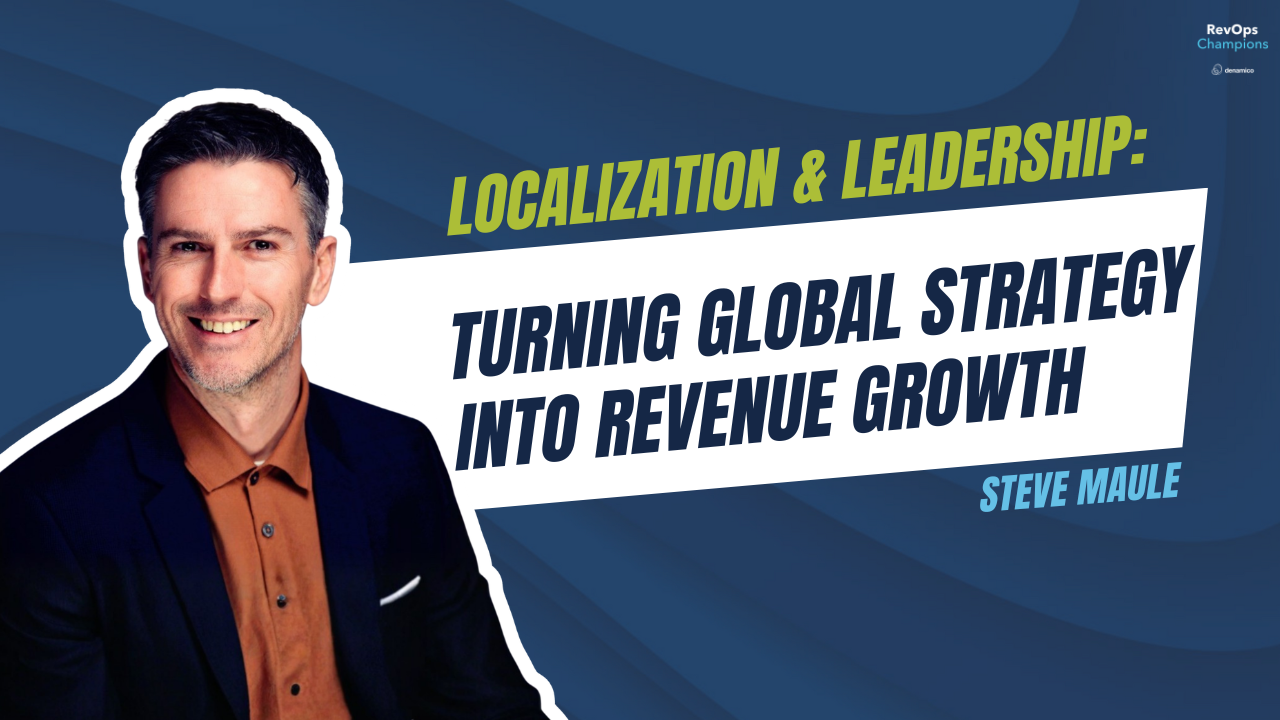
Steve Maule, Vice President of Global Sales at Acclaro, joins host Brendon Dennewill to explore what happens to revenue teams when growth accelerates, and why clarity and communication are the difference between scaling successfully and exposing misalignment. With over 14 years in the localization and language services industry and a track record that includes onboarding brands like Spotify, IKEA, Nvidia, and Disney, Steve brings a uniquely global lens to challenges every RevOps leader faces.
From defining what "qualified pipeline" actually means to knowing when to add structure without killing agility, Steve shares hard-won lessons on building aligned go-to-market teams. The conversation also dives into AI's role in reshaping sales and marketing, and why the localization industry offers a compelling preview of how people's roles evolve rather than disappear.
This episode is essential listening for RevOps professionals, sales leaders, and executives navigating growth at scale.
What You’ll Learn
- The two essential levers leaders must use to maintain team alignment and clarity as growth accelerates.
- How to design a structured 'go/no-go' framework for sales qualification that ensures cross-functional alignment across go-to-market teams.
- Recognizing and avoiding the risks of fundamentally misaligned Sales and Operations KPIs.
- The necessary building blocks for an organization to successfully move from simply tracking data to fully operating with it.
- Localization as a growth engine: understanding the difference between simple translation and driving global scale through cultural nuance.
- Why new technology like AI becomes 'table stakes' quickly, and where the real people's competitive advantage will lie in the near future.
Resources Mentioned
Listen
About the Guest
 |
Steve Maule | Vice President of Global Sales of Acclaro
Steve Maule is VP of Global Sales at Acclaro, an AI-powered Language Service Provider serving some of the world's largest enterprises. With 25+ years of B2B sales and leadership experience, Steve has built sales engines that drove $100M+ in new logo revenue at Welocalize, landing clients like Atlassian, FedEx, IKEA, Spotify, and Disney. Before moving into localization, he held full P&L responsibility across multi-location operations at TEKsystems and Allegis Group, managing teams of 30+ across the UK, Ireland, and Central Europe. Steve brings operator-level insight into what it actually takes to build repeatable, scalable revenue systems, and the scars to prove it. |
Episode Transcript
Welcome and Guest Introduction
Brendon Dennewill: Welcome back. I'm excited to be joined today by Steve Maule, Vice President of Global Sales at Acclaro and a senior leader in the localization and language services industry. For those of you who don't know much about that space, this is one of the reasons we have Steve here: to help folks learn more about what localization and language services actually are.
Steve has more than 14 years of experience helping global enterprises grow through translation, localization, and culturally relevant content. He has led global sales teams, onboarded blue-chip brands including Spotify, IKEA, Nvidia, and Disney, and contributed to over $100 million in revenue growth. Steve is a frequent speaker at Localization World and is known for his thoughtful approach to alignment, data-driven decision-making, and the balance between structure and agility as organizations scale globally.
Steve, welcome to the RevOps Champions Podcast.
Steve Maule: Thank you very much. It's a pleasure to be here.
Brendon Dennewill: A lot of the things you're passionate about are central themes on this podcast. I'm especially looking forward to digging into your perspective on sales, go-to-market strategy, and the importance of language as brands grow globally. I think this is going to be a very interesting and unique episode for our audience who are exploring multilingual or global growth.
The First Signs of Alignment: When Growth Accelerates
Brendon Dennewill: Steve, when growth really started to accelerate at Aclaro, what were the first signs that alignment across teams would either be a strength or a breaking point?
Steve Maule: It's a good question. What I've noticed is that when growth accelerates, you quickly see whether different functions and teams are truly aligned. When things are fairly steady, it can actually hide a multitude of misalignments.
I'll be honest: I've been here two years and I haven't noticed a significant amount of misalignment. But I can speak to what we've tried to do to ensure alignment exists, and to make sure that our accelerated growth doesn't expose any cracks. The things we've focused on are clarity, first and foremost, and what I'd call over-communication.
When I talk about clarity, I mean clarity around the outcomes the business needs to achieve. Each department is managed in slightly different ways, with different OKRs and KPIs. But the key for us is being really clear about what those are. For my team, it might be the value of deals we close or the revenue we generate. For other teams, it might be customer satisfaction outcomes, CSAT scores, that sort of thing.
Absolute clarity on those metrics and on the source of truth behind them is critical. One of the things we've done here is build very clear, accessible, and shareable dashboards. The reporting is transparent. Everyone knows what each other is talking about and where we are collectively versus the goal. That's been a real driver of alignment, because not one of the leaders on our team can achieve their own goals in isolation.
The Power of Over-Communication and the "Why"
Brendon Dennewill: You mentioned over-communication, which can sound like either a good thing or a bad thing depending on context. What does that actually look like in practice? Is it about repetition?
Steve Maule: It's repetition, but it's more than that. Repetition is important because if something isn't spoken about often, the assumption becomes that it isn't important. We need to keep the main things the main thing. But I actually think it's equally important to talk about the why, not just the what.
In my experience, especially with sales and business development professionals, it's rarely a great outcome if you simply dictate: "Here's the goal, here's what we need to do." Ideally, everyone understands and buys into why we're doing it. And ideally, as a sales professional myself, I want to help shape the what. I want to provide input into what the goal or target should be. Unless we're inviting that kind of input from the team, we're missing out on a wealth of opinion and experience.
Brendon Dennewill: That reminds me of a book I recently read called Primal Intelligence by Angus Fletcher. He talks about the difference between internal and external communication, and one of his key points is that internal communication is most effective when you start with a very clear why, followed by one clear how. Anything beyond that dilutes the impact. It sounds like you're very much on the same page.
Steve Maule: Absolutely. And it's so important because even if the what changes over time, if everyone understands the why, they can contribute to finding a new path forward.
Actually, in what we do as a business, we spend a lot of time talking about why with our customers too. What Aclaro does is provide outsourced language services to medium and large enterprises. But we're always interested in the deeper question: why do you need this content translated into 25 languages? What's your growth goal? If we can understand that as true business partners and true consultants, it gives our customers an advantage in building their language programs.
When Lack of Clarity Causes Friction
Brendon Dennewill: Can you think of any examples where a lack of clarity caused real friction, whether at Acclaro or earlier in your career?
Steve Maule: Absolutely. Not at this company, but at a previous one in the same industry. We used to have quite a lot of friction between the sales and business development teams and the operational teams. And when I look back, it was because the what was genuinely conflicting.
The sales team was targeted to bring in, say, 20 new customers in a calendar year. Meanwhile, the operational team's goal was actually to reduce the number of customers. It sounds ridiculous when you say it like that. But there were legitimate reasons behind both positions: one was about operational efficiency and servicing existing customers exceptionally well, while my team was focused on expanding the customer base. The result was that everyone was working hard but pulling in different directions. That's a shame, and it's a good example from our industry of what misalignment actually costs.
Evolving as a Leader: From Having All the Answers to Asking Better Questions
Brendon Dennewill: Early in your career, you believed strong leadership meant having all the answers. What changed your perspective, and how did that shift affect how your teams operate today?
Steve Maule: That's absolutely right, and I put it down to a couple of things: the culture of the organization where I first became a sales leader, and honestly, some immaturity on my part.
I thought my job was to be decisive, to remove uncertainty by telling people what to do rather than explaining the outcomes, the why, and then inviting them to contribute to the how. This was a company with a certain culture, and we all joined as keen twenty-somethings who wanted to be taught and to learn. But as the business becomes more complex and everyone matures, you realize that if all decisions have to be made or ratified by one person, it creates a massive bottleneck. And from a personal standpoint, it puts enormous stress on the leader. You end up trying to control the uncontrollable.
Brendon Dennewill: I think that's a common realization, and it often gets traced back to the education system. Whether you were educated in Europe, North America, or South Africa like me, the systems were largely built on an industrial-revolution model where you were rewarded for having all the answers yourself. Collaboration wasn't really taught. I'm hoping that's changing now.
Steve Maule: I think it is. When I look at my kids now in the latter stages of secondary school, the collaborative and group work they do is very different from what I remember. And it makes sense: the ability to store and memorize facts is becoming less critical when AI can retrieve them for you, as long as you know how to ask the right questions. That's actually a parallel to leadership. The skills I've developed most over the last 15 years are asking better questions and creating a space where people feel comfortable both answering and asking questions in return.
There's also an interesting dynamic specific to sales. Very often, the top individual contributor gets promoted to lead the sales team. But the very qualities that make someone a great individual contributor, that drive, that relentless push through every barrier, are often the qualities you need to dial back as a people leader.
Brendon Dennewill: Absolutely. It's probably one of the most well-known transitions that goes wrong. It's a completely different skill set.
Steve Maule: My current boss, who I've worked with for about six or seven years, always jokes that it took him roughly five attempts before I agreed to take a sales leadership role under him. After a decade of sales leadership in my previous industry, I was genuinely happy being an individual contributor here. He never lets me forget that.
Balancing Structure and Flexibility as You Scale
Brendon Dennewill: As the business has scaled, how did you decide where structure was essential and where flexibility mattered more, especially in your sales and RevOps processes?
Steve Maule: I'm not sure I've come to a definitive conclusion. I think it always needs reviewing and calibrating, because there's a real tension between structure and speed, especially when the goal is growth.
When I joined Acclaro two years ago, one of my first impressions was: "Wow, these folks are really flexible." Almost too flexible. Very agile, but where's the best practice? Where's the repeatable structure? It was there, but lighter than I was used to. One of the things we've worked on since then is putting more structure in place around the things that need to scale: clearer processes, clearer handoffs, clearer templates.
A good example is what we call the "sales handshake." It's a structured go/no-go decision framework for qualifying new revenue opportunities. The idea is that we can't be everything to everybody, so we want to focus our time on the deals where we can add the most value and have the best chance of success. The handshake is a consistent template for presenting that information to the operations, engineering, and solutions teams so there are no surprises and we make better collective decisions.
That said, we're very careful not to over-structure. A lot of our competitors are very rigid, which works for some use cases. But we're an outsourced business process, and each client program is different. Our agility is actually part of our value proposition. The feedback we hear consistently is that we're far more responsive than some of the larger players in our space. We never want to give that up, but some structure really does help when you're on a growth path.
What Localization and Language Services Actually Mean
Brendon Dennewill: Let's dig into that a bit more, Steve, because I think for a lot of US-based businesses operating in a largely single-language market, localization is almost a foreign concept. Tell us more about what localization and language services actually look like for a client.
Steve Maule: Someone who would be interested in working with a company like Acclaro would recognize that there's a market much larger than English-speaking audiences, even domestically. There are millions of Spanish speakers in America alone.
A good recent example: one of our newest customers is a purely domestic edtech company with a significant requirement for Spanish-language content to serve their US customers. That includes the user interface of their platform, all surrounding documentation, online help content, knowledge-base articles, and a huge amount of training and educational material. And it's not just written content. It's video, audio, and graphical content as well. To reach the market they want to reach, English alone won't do it.
Very commonly, our customers ask us to localize content into 50 or 60 different languages for global markets. They want it done in a structured, consistent, and efficient way. Often they don't have boots on the ground in all those markets. And even if they do, this is an outsourced business process. They're great software companies. They're not language specialists, and they prefer to focus on what they do best.
Brendon Dennewill: I think Spanish is also a great example of the difference between translation and localization. Not all Spanish is the same, just as not all English is the same globally. From what I understand, localization goes a step further: it tailors the content to the specific audience in a specific geography so that it actually resonates, rather than feeling foreign.
Steve Maule: Absolutely, 100%. It goes way beyond language. It's not just swapping American English spelling conventions for British ones. It's the reference points, the examples, the cultural context. We handle a lot of marketing content localization, and the sporting analogies are a perfect example. "Hitting it out of the park" means nothing to someone in the UK. But it goes even further than language: imagery and color choices matter too. In different markets and cultures, certain images or colors can be seen as offensive or highly appealing. We consult and advise on all of those dimensions.
From Reporting Data to Running the Business on It
Brendon Dennewill: You've emphasized simplifying metrics, agreeing on shared definitions, and aligning on KPIs and OKRs. How do you help teams move from just reporting data to actually running the business on it?
Steve Maule: I think we're still on that journey here. It's also something we help a lot of our customers with.
In our industry, you can get lost in translation-specific metrics like quality scores, editing distance, and error rates. But businesses don't care about those. If you're trying to expand globally, you care about conversion rates for e-commerce or dropout rates in a buying process. So part of the journey is agreeing on which metrics actually matter.
The other critical piece is trust in the data. What's the source of truth? Which system are we pulling from: our project management tool, our invoicing system, our CRM? In my first year here, we invested significant time into simply defining what we meant by certain terms. What counts as pipeline? What does each stage of a deal actually mean? What is a qualified lead? These sound like basic questions, but they had never been formally agreed upon and written down across the company. That's foundational, because until you do it, you can't truly be a data-driven company. If half your time is spent debating whether you trust the data, you miss the opportunity to make better decisions from it.
If data is simple, trusted, and shared clearly, it becomes quite powerful.
Brendon Dennewill: And I'd add: that complexity is compounded significantly when you consider that Acclaro was formed from the merger of two similarly sized companies from two different continents. Two different systems, two different ways of working.
Steve Maule: Absolutely. A lot of moving parts. When you're trying to bring clarity to a single growing company, that's complex enough. When you have two groups of people who have operated in entirely different systems and processes, it's a whole other level.
Brendon Dennewill: Coming back to what you said at the start about clarity and communication, and the importance of starting with the why, I think what you're describing now is potentially a third element: this is how we're going to measure it.
Steve Maule: Yes, exactly. This is how we're going to measure it, this is the system it will be measured in, and this is what each of these measurements actually means. That's the journey we're on right now.
Brendon Dennewill: I think what we all have in common in business, as in sport, is that people want to know how to keep score. As leaders, our job is to figure out what the scoreboard looks like for the particular game we're playing. The KPIs for sales are different from those for marketing, which are different from customer service. But everyone needs to know what their scoreboard looks like. And the stronger the connection between the scoreboard and the why, the more clarity you'll have.
Steve Maule: Absolutely. And don't change the scoreboard every two weeks. People need consistency to see that they're making progress.
Brendon Dennewill: Right. And as businesses scale, the metrics do evolve. NRR, for instance, became a major theme in 2025. Many businesses at an earlier stage won't even know what NRR is. But it signals a maturity shift: as the business grows, so does the sophistication of what you're measuring.
AI, Localization, and the Future of Go-to-Market Teams
Brendon Dennewill: Localization has been one of the earliest industries to adopt AI, and you work closely with marketing, sales, and revenue teams helping them connect better with their customers. From both an internal leadership and a customer perspective, how do you see AI reshaping go-to-market teams over the next year or two?
Steve Maule: My honest answer is: I don't know. But it absolutely will, and it already is. And you're right that our industry was one of the early adopters. The way large language models developed was largely driven by applications like machine translation, which has actually been around for 40 to 50 years. We've only been calling it AI for the last two or three years.
What I can say is that it's already changing the day-to-day. The CRM platforms, LinkedIn, third-party data tools we all use: they're now AI-native. Research that used to take an hour takes minutes. If I'm preparing for a meeting and want to understand a company, their market, their competitors, and Acclaro's prior relationship with them, I can get a detailed, AI-driven briefing with a single click. That's a real time-saver.
But I think that's probably just scratching the surface of what's possible. What I can say from our industry is that AI hasn't replaced the human. It's changed the role of the human. It's actually elevated it in many ways.
When I joined this industry about 15 years ago, the core job of a translator was to work through large printed manuals for software or industrial equipment. Now, if humans are involved in that work, they're more likely to be post-editing and improving AI output, or acting as cultural consultants, brand guardians in specific markets. The work has become significantly more interesting.
I'm hoping that's what happens for salespeople and marketers too. We use AI to handle the things that used to be time-consuming and manual, and we focus our human energy on deepening relationships and delivering better service. That's what I'm hoping for.
There's also an important market dynamics point here: pretty soon, everyone will have access to the same AI tools. It becomes table stakes, not competitive advantage. So what will be the competitive advantage of a sales professional in 2026? Not that they can use the same CRM or social tool as all their competitors. It's the human qualities, ironically, that will differentiate. That was a very long way of saying: I don't know.
Brendon Dennewill: I think what I heard is that across industries, as with localization, we all have to reposition our value as AI handles more of the time-consuming tasks. The parallel to the 1980s introduction of computers is apt: for a period, "we use computers" was a differentiator. Now no one says that. The same will be true of AI.
Steve Maule: Exactly. And I actually think the term "AI" will stop being used as frequently in the near future, because it simply won't be a differentiator anymore. People will get a bit tired of it.
The other thing I'd add: it's so tempting, and if I had unlimited time I'd experiment with every new tool. But you don't have that bandwidth. So what I try to do, and I'm not always successful, is pause and ask: why am I considering this tool? Is it just because it's AI and I find it interesting? Or have I actually thought about the why? What outcome am I trying to achieve? This is advice we give our customers constantly: be clear about the outcome you're hoping for, because otherwise you won't know whether the experiment worked.
Brendon Dennewill: And that's where shiny object syndrome gets us all. The discipline is to ask: if this doesn't address a specific business outcome we already identified, let's move on.
Closing Thoughts: One Practical Step for Leaders Right Now
Brendon Dennewill: As we wrap up, Steve, for leaders facing uncertainty right now, what is one practical step they can take this quarter to create better alignment, trust, and momentum across their teams?
Steve Maule: In an environment with this much experimentation and change happening all at once, I'd say: don't try to have all the answers. Invite opinions and suggestions from the team.
"I don't know" is such a powerful phrase. I try to use it as much as I honestly can. Don't feel pressured to always come up with the answer. In most teams, the answer or the suggestion for improvement is somewhere in the room, whether it's a process improvement, a workflow change, a technology decision, or even a better definition of the outcome itself. Say "I don't know" and invite that input from those around you. That's what I've been trying to do, and it's what I'll continue to do. There's no way I knew all the answers back then, and there's certainly no way I want to pretend to know them now.
Brendon Dennewill: That's really good advice. Any final message for the audience before we close out?
Steve Maule: Just this: for anyone who hasn't considered localizing their content into other languages, make sure they track me down. My LinkedIn is out there somewhere.
Brendon Dennewill: Absolutely. We'll put the links in the show notes. And for those listening, you can find them at acclaro.com, A-C-C-L-A-R-O. I'm guessing that name is rooted in the Latin for "to clarify," which is of course exactly what they do.
Steve Maule: Right, absolutely.
Brendon Dennewill: I actually love that connection. Our company name, Dynamico, came from a very similar process. When we were starting in Spain and going through naming, the question kept being asked: what are you helping your clients navigate? The answer was the continuous change in technology and how to stay connected with customers as their behavior shifts. The idea of something dynamic and continuous kept coming up, and the Spanish word dinámico floated to the top. And it also happens to be an Italian word, so I suspect it's closely related to the Latin as well.
Steve Maule: That whole group of languages is very similar. But yes, Aclaro: bringing clarity. That's what we try to help our customers do.
Brendon Dennewill: Awesome. Steve, thanks so much for joining me today.
Steve Maule: Thanks, Brendon. Really enjoyed it. Thank you.
Subscribe