
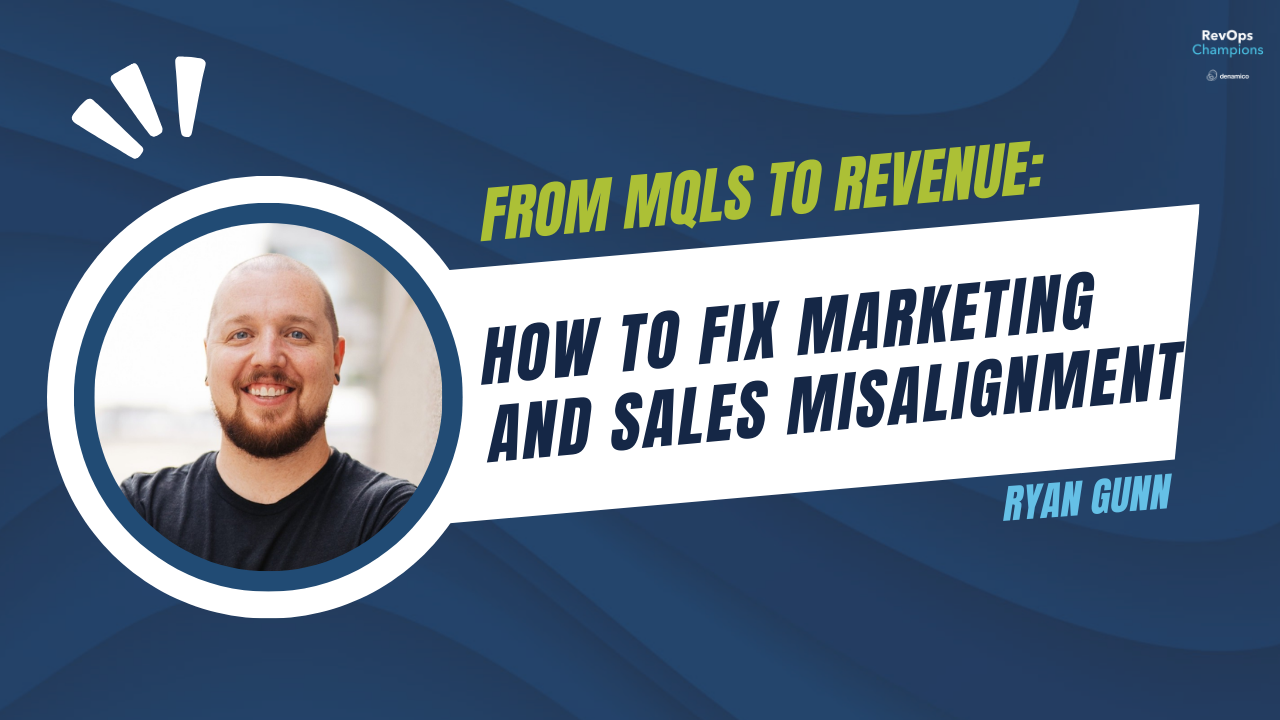
Ryan Gunn, Founder and Chief Education Officer of Attribution Academy and co-host of the Partner Playbook podcast, joins host Brendon Dennewill to unpack why most companies are still getting attribution wrong, and what to do about it. With over a decade in B2B marketing and revenue operations, Ryan brings a hard-won perspective on what it actually takes to connect marketing activity to real revenue outcomes.
The conversation covers the cultural and structural roots of sales and marketing misalignment, why chasing MQLs can work against company goals, and how to build an attribution system that informs decision-making rather than sparking interdepartmental turf wars. Ryan also shares how AI-powered call transcripts are becoming one of the most underutilized tools in a modern RevOps stack.
Whether you're a founder, revenue leader, or marketing ops professional, this episode delivers a practical roadmap for building trust in your data and finally getting your go-to-market teams pulling in the same direction.
What You’ll Learn
- Why attribution should create clarity, not competition between teams
- The shift from vanity metrics to revenue-based thinking
- How incentives quietly shape (or sabotage) alignment
- The role leadership plays in unifying go-to-market teams
- Why simple attribution often outperforms complex models
- How AI and clean data are reshaping revenue decision-making
- Attribution Academy
- Attribution Mastery Certification
- Hubsessed.io
- Partner Playbook Podcast
- HubSpot Breeze
- Ask Elephant
- Fathom
- HubSpot
Listen
About the Guest
|
|
Ryan Gunn | Founder & Chief Education Officer at Attribution Academy
Ryan Gunn is the Founder & Chief Education Officer of Attribution Academy, a learning platform helping HubSpot marketers prove their impact on revenue. With over a decade leading marketing and revenue operations at high-growth B2B companies and HubSpot Elite partners, Ryan has helped teams scale from $3M to $10M, close massive attribution gaps, and build go-to-market systems that actually connect activity to dollars. He's also a HubSpot Academy Bootcamp Instructor, co-host of the Partner Playbook podcast, and moderator of the 15,000+ member r/HubSpot community. His Attribution Mastery Certification has enrolled over 200 students, and his weekly newsletter reaches 4,000+ subscribers. Ryan believes most companies are measuring the wrong things, and he's on a mission to change that, one HubSpot marketer at a time. |

Episode Transcript
Introductions
Brendon Dennewill: Welcome back to the RevOps Champions podcast. Today's guest is Ryan Gunn, a B2B marketing and revenue operations leader and the founder and chief education officer of Attribution Academy. Ryan has spent more than a decade helping companies connect marketing activity to real revenue outcomes through better attribution, clean data, and HubSpot strategy.
He has led demand generation and marketing operations for high-growth companies and HubSpot Elite partners, and has built practical attribution frameworks as the co-host of the Partner Playbook podcast. Ryan is widely known for helping teams align marketing and sales around revenue and making smarter decisions with data. Ryan, welcome to the RevOps Champions podcast.
Ryan Gunn: Thank you so much. This is exciting.
Brendon Dennewill: Yeah, looking forward to diving in with you. This has been long overdue.
Ryan Gunn: Yeah, I got the recommendation that I should reach out to you, checked out some of your back catalog, and I was like, how have I not met this guy yet?
Brendon Dennewill: It is crazy how you and I have just sort of been like ships passing in the night for, I don't know, at least four or five years. So good to have you here.
Why Marketing and Sales Alignment Is a Culture Problem, Not a Tools Problem
Brendon Dennewill: Ryan, what originally made you realize that marketing and sales alignment was a bigger problem than tools or tactics?
Ryan Gunn: I've been in marketing for ten-plus years and I've always had close relationships with sales. Early in my career, I learned quickly that alignment was very important, and that if you didn't have it, marketing was the one that suffered. Working on that side of it really opened my eyes.
At some of the early companies I worked for, we were driving a lot of vanity metrics: website visitors, eBook downloads, and so on. We just weren't seeing those convert on the sales side. A big part of that was we had totally separate processes. There was no structured handoff, no closing of the loop. Things kind of dropped off a cliff after marketing, and sales would catch a few here and there, but mostly they were doing their own thing. That had worked for years, but in order to scale quickly, you need both teams working together.
After those experiences, I became much more intentional about creating those relationships and building the processes that connect the two. It's been much more successful that way.
Brendon Dennewill: There are certain things you just can't overcome when a client has a culture where marketing is the stepchild: "What is marketing doing to serve sales?" versus marketing and sales working together. If you've experienced that, what has been successful in that type of situation?
Ryan Gunn: That is one of the more difficult situations. If marketing is reporting up through sales or is seen as just sales enablement, that is a culture problem. It's less about process and more about how these two teams are positioned to work together, or against each other. Oftentimes you have to push back, and if you don't have the authority to do that, your ability to create that alignment is really limited. It really comes down to leadership decisions.
I worked for a company that had been in operation for about 15 years before I got there. They brought me on to start a marketing program. They had been doing really well with word of mouth, inbound referrals, and a sales-led motion. They had dominated their category, but they were looking to expand into a new sector where they didn't have those relationships. That's where marketing comes in.
But some of the sales team had been there since the beginning, 15 years in, and they had a way of doing things they liked. They weren't too eager to change. I was reporting up through sales, so there wasn't a ton I could do on my own. But I did sit down with the CEO and outlined the problem: the sales team was not open to adopting new ways of doing things in order to expand into the new sector.
Fortunately, I had a close relationship with the CEO and he took that feedback seriously. There were some pretty big changes on the sales side. But what it started with, and what I think other companies can replicate, is doing a pilot: finding one sales rep who is willing to play ball with marketing and creating a really close relationship with just that one rep.
Very quickly, if marketing is doing its job well, you start to see in the reporting that rep is closing deals faster, closing more deals, the time between a marketing touch and a closed customer is sped up, and their pipeline and commissions are bigger than everybody else's. Suddenly the motivation to work with marketing becomes a lot more attractive than if you just have all of sales doing things the same way they always have, and you're presenting this abstract idea of, "Don't you guys want to work with marketing?"
It's very different once it's actually proven to work.
Brendon Dennewill: That's been our experience too. Those pilots are very effective, especially when you start by saying, "We're just looking for two volunteers." That already gets the competitive juices flowing. And all you need, to your point, is one or two to say yes, and then everyone else is watching to see what happens.
Ryan Gunn: Yeah, competitive is a good word, because salespeople are naturally competitive. That's a very good way of thinking about it: how do I incentivize that competitive spirit to work in favor of the teams working together?
The Chicken-and-Egg Problem of Marketing Budget and Attribution
Brendon Dennewill: This misalignment between sales and marketing has been going on forever, but it does seem to be heading in the right direction. A lot of that started in SaaS and technology, where companies saw the benefits of aligning marketing, sales, and later customer service under one support function: RevOps. The benefits of companies that have adopted that model are incredible, and yet it's amazing to see how many companies are still leaving money on the table by not doing it.
How do you think about connecting marketing activity to revenue, and how do you roll that out to an organization in a meaningful way so it becomes part of everyday practice?
Ryan Gunn: It comes down to how the organization thinks about marketing's contribution to revenue. Most of the time, if you can't measure it, marketing is looked at as a cost center. When it's time to reallocate budgets, marketing gets the short end of the stick. You don't necessarily see the long-term effects on pipeline and sales because you don't have the reporting to show that marketing activity is meaningfully contributing.
It's kind of a chicken-and-the-egg scenario: you need the reporting in order to prove that marketing can do it, but you need resources to build the system that will prove it, and you can't get the resources without the budget you've already lost because you couldn't measure it in the first place.
At some point you just need to bite the bullet. The better option is to have a RevOps team lead the charge in building that attribution and creating that alignment, where everybody realizes this is important and agrees that marketing is being successful. We just need to show it.
When Misaligned Goals Create Real Tension: The MQL vs. Pipeline Story
Brendon Dennewill: Can you tell us a story of when misaligned goals between marketing and sales created real tension or unintended consequences?
Ryan Gunn: I have a great example. I was working for a company where we were trying to move up market, going after bigger customers and bigger deal sizes. We had always based marketing's goals around MQLs: the industry standard that everybody hates, but we all put up with.
We would do the math: this is our revenue goal, this is the number of deals we need based on our average deal size, this is the number of leads we need based on conversion rates, and you get to an MQL number you expect will help you reach your revenue goal.
The problem in our situation was that the company was actively pursuing bigger deals. That average deal size was expected to change, and I argued very hard that marketing should be held to a dollars-of-pipeline-generated metric instead of MQLs, because I thought it was more aligned with the goal of moving up market.
The CEO was new, having just taken over from another CEO, and I'm sure he was dealing with change all over the place. For whatever reason, we ended up going with the MQL number.
Throughout that quarter, we were actually very successful at the shift up market. We were actively pursuing marketing strategies designed to attract bigger deals. We ended up blowing our revenue number out of the water. The bad news was that our average deal size went up eight times what it was at the beginning of the quarter, and I missed my MQL goal by a mile, because we needed fewer MQLs for the conversion rates to work out to hit the revenue goal.
I didn't get my bonus that quarter. But I stand by the decision to pursue the marketing strategies that attracted bigger deals. There are probably marketers out there who would have taken a different route and said, "I can hit that MQL number," and pursued strategies that attracted smaller deal sizes at higher volume. That wasn't aligned with overall company goals. It ended up working really well, but there was definitely some tension come bonus time when I felt like I had done everything right and it just wasn't reflected in how the goals were set.
Brendon Dennewill: So even though you agreed to MQLs being the measurement, you were actually managing toward dollars of pipeline generated.
Ryan Gunn: Yeah, I was definitely leading the marketing team in a way that was aligned with revenue, pipeline, and dollars rather than volume of leads.
Brendon Dennewill: You were doing what you thought was right for the company, even knowing you weren't being incentivized that way. That's an awesome story. I'm sorry you didn't get your bonus that time, but I'm sure there were good lessons learned.
Ryan Gunn: After that, we implemented a dollars-of-pipeline goal for the next quarter. So it won out.
Measuring Activity vs. Measuring Impact
Brendon Dennewill: Ryan, what changed for you when you saw revenue grow even though traditional marketing metrics like MQLs were missed?
Ryan Gunn: It really just validated something I had felt for my whole career: that marketing was bigger than these numbers. Historically, marketing has been held to a lot of vanity metrics, and when you do that, you're measuring activity, not impact.
You need marketing, sales, and customer success aligned under a unified goal, and I think that goal is revenue. It should touch everything you're doing. You're bringing in more leads because you want them to turn into dollars. So why are we putting this middleman in there and relying on conversion rates?
On the services side, you're talking about retention, reducing churn, upselling: all of that is tied to revenue. It's keeping revenue and growing revenue. Somehow, at some point, companies decided that sales was the only department responsible for revenue. I'm happy to see that expanding.
Part of what's driving it is that systems are being unified. It used to be that marketing uses HubSpot, sales uses Salesforce, service uses Zendesk. We're seeing more and more platforms support multiple teams. Salesforce has been doing it for years. HubSpot now has really robust support for sales and service. I've even been seeing finance teams and people ops start doing more inside of HubSpot. That helps unify teams. It becomes cultural when you're all working on the same platforms and you can see what other people are doing.
Brendon Dennewill: And really, what you're talking about is just the level of sophistication of a business. As we work with larger and larger companies, pipeline as a metric starts to become less important, and net revenue retention becomes the new north star. The entire go-to-market team is working toward what drives the overall value of the company. It's interesting to see these as signals of the sophistication of the leadership team. Eventually they hit that ceiling and realize something needs to shift.
Ryan Gunn: Yeah, it's not just, "How many things did we sell?" It becomes, "Is that sustainable and scalable?" You see a lot of companies trying to make the transition from transactional sales to more of a recurring subscription or recurring revenue model.
Brendon Dennewill: And when you flip that funnel and create that bowtie model, the whole go-to-market team from marketing, sales, and customer service is there to retain the customers you already have, because they're already there and a lot less expensive to keep. It's interesting to see how certain leadership teams take longer to see the value of making that investment. It ultimately seems to come down to a lack of creativity, or an unwillingness to take the risk of doing things differently.
Ryan Gunn: Risk is definitely a huge part of that. When you have the hindsight to say it was successful, it seems so obvious. When I joined that company that had been around 15 years, I'm sure hiring a person to start a marketing department felt like a big risk: hiring a marketer instead of another sales rep. That has to feel risky at the time. Thankfully it paid off.
Attribution as Clarity, Not Credit
Brendon Dennewill: So what we've been touching on here is attribution: what drives revenue and what drives value. Ryan, how do you help teams reframe attribution so it supports alignment instead of becoming another source of conflict?
Ryan Gunn: That's a great question. I think there's a fundamental mistake a lot of companies make when thinking about attribution: they look at it as a scoreboard. They want to see how many deals marketing is responsible for versus how many sales is responsible for. Ultimately, that creates division. You get infighting where marketing and sales are arguing over who gets credit for a deal, and it creates a division that is really detrimental to the ultimate goal of attribution, which is getting everybody on the same page.
I like to say that attribution is about clarity, not credit. It should be something you use to guide decision-making, not assign credit to a department or campaign for a certain amount of revenue. It's an imperfect system, but one that can help you make more informed decisions. Ultimately, you just want to understand how you can best allocate your budget and adjust your channel mix to better serve the overall revenue number.
Brendon Dennewill: It reminds me of negotiation. One of the things I've read about in books like Never Split the Difference is that you're already off to a bad start when two parties are sitting on opposite sides of the table. The idea is to move around the table and sit next to the other person and figure out how you win together. That's essentially what marketing and sales should do: come sit next to each other and say, "Look what we did together."
Ryan Gunn: Yeah, I would love it if, when sales saw a lead come from marketing, instead of thinking, "There's a 50-50 chance this isn't a fit," they thought, "This person has looked at some of our marketing. I can see what they've looked at. That tells me something about what they're interested in, and I can make more informed outreach and design the rest of the sales process around what I know about them."
Unfortunately, because of the explosion of inbound marketing in the 2010s, a lot of salespeople default to the first way of thinking. There's also work that marketing needs to do to repair that relationship: better understanding the ICP, knowing what makes a good deal, and better qualifying before the handoff to sales.
Brendon Dennewill: Which ultimately comes back to leadership. The four pillars we talk about are people, process, data, and technology. The people component is absolutely foundational. Leadership has to see and simplify. For their teams to be successful, they need to remove complexity instead of watching friction between sales and marketing play out week after week as if it were entertainment.
Ryan Gunn: I love that people is the first pillar in RevOps that you mentioned. It's 100% true. I've worked with CEOs who understand the art versus the science of marketing, and those who don't, and it makes an enormous difference.
When I was working at Aptitude 8 under Connor Jeffers, Connor was a firm believer that there are parts of marketing we're not going to be able to measure, no matter how good our attribution is, and we just have to go off gut feel on whether something is the right move. When you give marketing that agency and autonomy, you can test things, fail fast, replicate what works, and that's a huge advantage over companies that optimize for what's easy to measure versus what actually works.
I see that all the time: companies say, "We can see the results of lead gen, so we're going to do more lead gen," and ignore branding entirely, because branding is so hard to tie to revenue.
Brendon Dennewill: That reminds me of Peter Drucker: "We know that half of our marketing is working. We're just not sure which half." It takes a leader to say, "That's just the way it is." What's the alternative?
Ryan Gunn: At Aptitude 8, we saw the results not through traditional attribution reporting, but in the conversations we had with customers. This actually became a lot easier once we implemented AI note-takers and started seeing transcripts. Marketing could go into a sales call and actually review what was said, rather than having to be invited, which salespeople don't always want.
What we were seeing was that people were actually talking about our brand and our reputation as a partner. That's not stuff you're going to see in an attribution report. Those are the kind of intangible, soft marketing outcomes.
What a Practical Attribution Setup Actually Looks Like
Brendon Dennewill: For leaders listening who feel overwhelmed, what does a practical, realistic attribution setup actually look like at different stages of growth?
Ryan Gunn: It's going to look very different at pretty much every company, but my guiding principle is to build the attribution model that you have the resources to support. You need the minimum viable version.
Early in my career, I had this idea that everybody should be striving for perfect multi-touch attribution where you see a literal map of the customer journey and every stop along the way. Frankly, it's a pipe dream. There is so much that happens in the customer journey that is not and will never be measurable.
Rather than spending a ton of time and resources building a complex multi-touch attribution system, think about it this way: how many people do you have on your team? How much time do you want them dedicating to maintaining the processes you have to follow to keep data consistent?
Take UTM tracking links, for example. They are incredibly helpful and can give you so much information. But you need consistent naming conventions, a place to store all the links, standardized data structure for all UTM parameters, and your marketing team to consistently use those links in every single place they post, 100% of the time. That is an enormous process lift, and unless you have really strict checks on process adherence, it quickly falls through the cracks.
What most companies really need is some simple level of influence tracking, not even pure attribution. You don't need to assign credit to a specific campaign or individual ad. You just need to understand how much of your revenue passed through LinkedIn as a channel, or whether a particular effort is actually working at some point in the funnel.
You can get more granular than channel and do specific campaigns. But ultimately what you're looking for is: is what we're doing working? Is it influencing revenue in a positive way? That's not as hard as multi-touch attribution, it takes fewer resources, and it's easier for your team to maintain.
Attribution Academy: The Mastery-Free Certification
Brendon Dennewill: You've actually created an attribution mastery certification that people can use to work through this in more detail. Is that right?
Ryan Gunn: Yes, it launched in November of last year, so it's been about three months now. We've had over 200 students enroll, which blew my expectations out of the water. It's designed to take somebody from knowing the ins and outs of HubSpot into specifically how to develop an attribution system.
And that system isn't just the workflows, custom properties, and technical mechanics. It covers everything from how do you talk about it with sales and leadership, to how do you report on it, to how do you make decisions based on the data you've collected. We want to make sure it's not just a technical process, it's a people process. It's strategy informed by data, enabled by technology, not defined by it.
Brendon Dennewill: How big a lift is it for people who are interested?
Ryan Gunn: It takes about three to four hours to complete. There are five modules. I've seen people go through it faster, but for the average student, three to four hours is about right. At the end, you walk away with a full framework, plus a bunch of templates, outlines, and resources you can take away to actually implement at your own company.
Brendon Dennewill: That's awesome. Where can people go to find it?
Ryan Gunn: That's at attribution.academy. And if you're not quite ready to pull the trigger on a course, I also write a newsletter at hubsest.io. I actually just acquired Stuart Balcom's Connected GTM newsletter, so all of the content from both has been merged into one place. There are years of really good content and resources there that you can subscribe to.
Brendon Dennewill: And that's free. Great.
How AI Is Changing Attribution and Alignment
Brendon Dennewill: We have a few minutes before we wrap up. Ryan, how do you see alignment and attribution evolving as AI becomes more embedded in revenue teams and decision-making?
Ryan Gunn: This is a really interesting one. I've already been experimenting with how to get AI involved in the process. We're going to see massive advancements in how AI can analyze CRM data and tell you what is and isn't working. But in the shorter term, there are some more tactical implementations worth paying attention to.
I've been doing a lot of work using AI call transcripts as a way to capture unstructured information, standardize it with AI, and then report on it for attribution. Think of the "How did you hear about us?" question that people put on demo and contact forms, but on steroids.
If you have close alignment with your sales team and can get them to include a question in their discovery call playbook, like "What made you decide to reach out?" or "How did you first hear about us?", that can be enormously beneficial. You get the transcript, it shows up in HubSpot, and you can use a Breeze workflow action to filter through all of that data and pull the answer you're looking for.
You can surface mentions of events, webinars, specific pieces of content, and, in my case because I'm so active on LinkedIn, a lot of mentions of LinkedIn in sales calls. You can pull that out and say LinkedIn influenced this deal, even if it isn't a measurable first or last touch. Someone might say, "I follow your CEO on LinkedIn," and that tells you something meaningful about how marketing is shaping how people think, even if it's not a trackable touchpoint.
Brendon Dennewill: And I think we've already alluded to this a couple of times: technology is not the solution. It's what supports what you're building. As a point of interest for folks listening, which AI note-taking tools are you using to do the AI piece of this?
Ryan Gunn: I've started using an AI note-taker called Ask Elephant, which has a really robust HubSpot integration. What really set it apart, at least when I started using it, was that it's the only one I had tried that allowed you to chat with multiple meetings at once. You can select an entire call history with one sales prospect or client and, using a natural language interface like ChatGPT, just ask it questions.
When you can do that across all active deals or all closed-won deals, you can pull trends and information you'd never get by looking at a single call transcript. Their HubSpot integration pushes a lot of that data into HubSpot itself, which made everything a lot easier.
Brendon Dennewill: Cool. I've actually been checking that out, so I'll continue digging.
Ryan Gunn: Yeah, they're good people over there. They've done a lot of really good work. I've done some partnership stuff with them and they're genuinely kind and cool people.
Practical Advice for Revenue Leaders: Where to Start This Quarter
Brendon Dennewill: Ryan, to wrap up: if a founder or revenue leader could take just one step this quarter to improve alignment and trust in their data, what would you recommend?
Ryan Gunn: I'd recommend getting everybody on the same page when it comes to terminology definitions. I would bet that your marketing team and your sales team have different definitions of what the ICP is, different definitions of what qualifies as a sales-qualified lead or an MQL.
Just having everybody aligned under a single set of definitions can be hugely beneficial. It's going to unlock a lot for your marketing team specifically. Early in my career, I felt like I was flying blind on a lot of that stuff, making a lot of assumptions and guesses. Once you dedicate time to putting everybody in a room together and aligning on it, it clears everything up and allows you to sprint together instead of pulling in opposite directions.
Brendon Dennewill: That's a really interesting one, because terminology becomes such an obstacle when people get used to using certain words that others aren't familiar with. It's essentially speaking different languages.
Ryan Gunn: Absolutely. You're saying something and they're hearing something else. That is the first step I would take. And there are really no limitations to it other than: can you get everybody who needs to be in the meeting scheduled at the same time?
Brendon Dennewill: Do you have any resource recommendations for doing that?
Ryan Gunn: There's tons of content out there about how to structure that and how to think about what qualifies as an MQL or what to include in an ICP definition. But I think what's more important is to agree on it internally, document it, and make sure that documentation lives somewhere accessible to everybody. New hires get it when they're onboarded. If there are any disagreements, you can refer back to it. That documentation is the key deliverable coming out of that meeting.
Final Thoughts: Don't Forget Data Hygiene
Brendon Dennewill: Ryan, any last words of advice before we wrap?
Ryan Gunn: The one thing we didn't talk about that I think is crucial to everything we've discussed is data hygiene. It's a problem at every single company. I've never seen a HubSpot portal that doesn't have messy or duplicate data, and I've been in about 30 of them. It's always a problem, and it's never going away.
But you should prioritize it, especially with AI becoming so much more important. AI doesn't know the difference between good and bad data. It's garbage in, garbage out. If it's trained on bad data, it's going to give you bad results.
Brendon Dennewill: That's really good advice. Ryan, thank you so much for joining me today.
Ryan Gunn: Thank you so much. This was a pleasure.
Brendon Dennewill: Absolutely. Thanks again.
Subscribe