
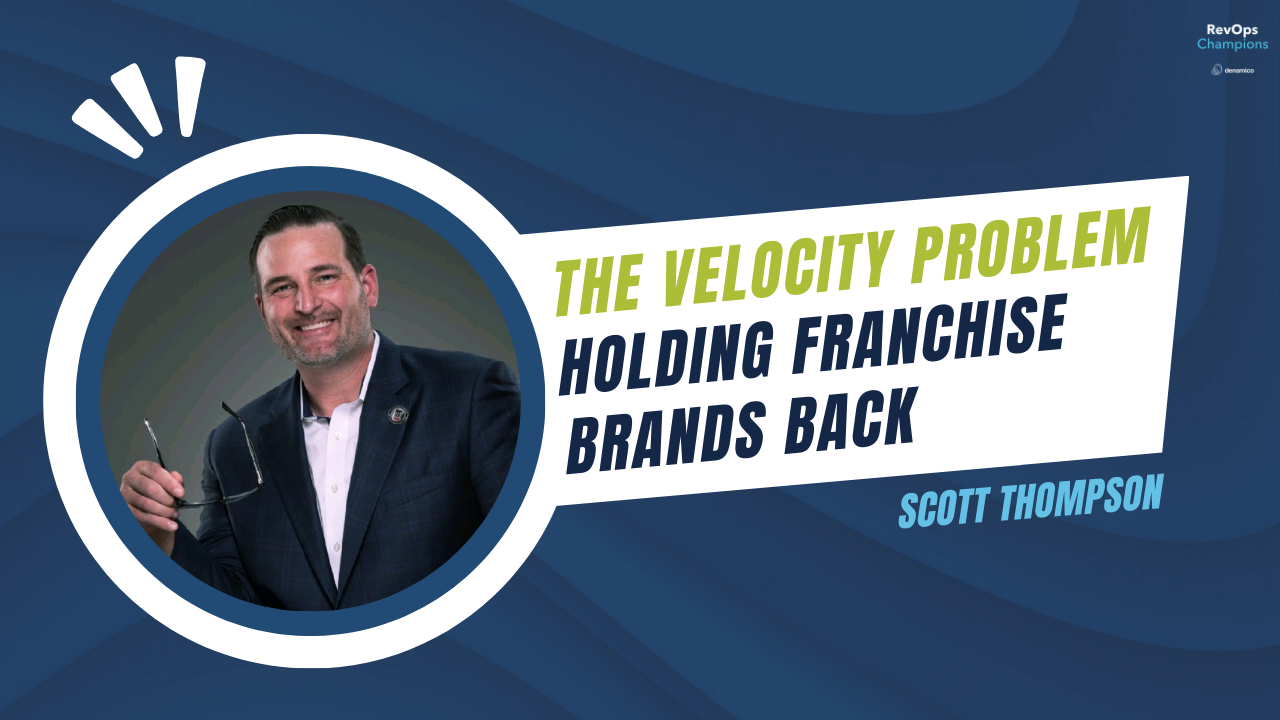
In this episode of the RevOps Champions Podcast, host Brendon Dennewill sits down with Scott Thompson, a 23-year veteran of the franchise industry and Founder & CEO of Your Future Franchise. Scott shares his unconventional journey from first-time franchisee to executive leader across private equity-backed franchise brands, offering a rare inside look at what actually drives sustainable franchise growth.
Together, they explore why most franchise brands never make it past 100 open units, how people and systems, not technology alone, determine scalability, and what franchise leaders must rethink heading into 2026. Scott also breaks down how AI is reshaping franchise operations, development, and unit economics, while reinforcing why alignment, discipline, and leadership mindset remain the real growth constraints. This episode is essential listening for franchise executives, operators, investors, and founders navigating growth, technology adoption, and long-term brand value.
What You’ll Learn
- Why people alignment, not technology, is the biggest constraint to franchise growth.
- How franchise brands stall between 20 and 100 units and what separates those that scale past it.
- Why technology accelerates behavior but never fixes broken processes or leadership gaps.
- How AI and agentic workflows are changing franchise operations, support, and unit economics.
- What franchisors must have in place before attracting multi-unit operators or family offices.
- How to evaluate franchise opportunities based on skills, capital, and personal goals—not passion alone.
- Why leaders must evolve their mindset and systems as brands move from founder-led to scalable enterprises.
Resources Mentioned
Listen
About the Guest
|
|
Scott Thompson is the Founder and CEO of Your Future Franchise, where he helps executives, investors, and entrepreneurs build and preserve wealth through franchising. With 23+ years of experience across franchise ownership, development, and private equity–backed growth, he has scaled brands from $25M to $500M+ and advised hundreds of units nationwide. Scott also serves as a Board Advisor at Poolwerx and an Adjunct Professor at the University of Georgia, bringing a disciplined, people-first approach to franchise growth. |
Episode Trancript
From Exercise Physiology to Franchise Entrepreneur
Brendon Dennewill: Scott Thompson is a veteran of the franchise industry with over 23 years of experience across franchise ownership, development, and private equity-backed brand growth. He has held senior roles with companies such as Level 5 Capital, Premier Martial Arts, Made Right, Tudor Doctor, and Jan Pro. Today he is the founder and CEO of Your Future Franchise, where he advises executives, multi-unit operators, family offices, and aspiring entrepreneurs on selecting and scaling the right franchise opportunities. Scott, welcome to the podcast.
Scott Thompson: Thanks, Brendon. I appreciate it. Looking forward to being here with you.
Brendon Dennewill: I'm really looking forward to this conversation. I'm so excited about the changes coming in 2026 in the franchise space. Let's dig in. You began your franchising career more than 23 years ago and have worked as a franchisee, executive, and consultant. What first brought you into franchising?
Scott Thompson: Nobody ever gets into franchising on purpose. There's no moment where someone says, "One day I want to be a franchise executive." It just doesn't work that way. My career in franchising started right after I graduated school. My degree was in exercise physiology and sports medicine. I thought I was going to be a cardiac rehab specialist at Brigham and Women's Hospital in Boston. That didn't happen.
So I had to pivot and I found this company called Fitness Together. It was a small one-on-one private personal training franchise in West Newton, Massachusetts. I met this guy, Brian Cook, who was the area director for the brand. What was beautiful about the business was that it was salaried, it had benefits, and I could work one-on-one with clients. They also had a program where I could earn my franchise fee after working there and learning the systems, and then become a franchisee myself. I was 22 years old when I opened my location in Dedham, Massachusetts on Route 1. It was an incredibly humbling experience. I had no business experience, no business owning a business. And I met some wonderful clients who helped me along the way. Someone was certainly looking over me.
Growing up, my mother's advice to me was, "Scott, if you fail, you can come back and live on my couch." I really didn't want to do that. So the goal was to be successful. And ultimately I was. It was challenging. I had lots of debt, high-interest debt, equipment debt. I was pretty capital constrained. Most of my customers were grown through word of mouth and community networking.
There were people along the way who helped me. Don Quiznell helped me with people management. Kevin Hallinan helped me with sales coaching. Bruce Patz helped me with financials. These are people I still talk to 23 years later. I opened a couple more locations and was putting together a plan to open 25 locations along the East Coast. Then Rick Sikorski, the founder, flew out and said, "We need a leader in New York." I raised my hand. We sold the units in Boston, and I moved to New York in 2005 without knowing anyone. I lived in Yonkers, in Westchester County, and started to develop the market. Within three years, we had opened 35 locations.
Then the Great Recession hit. I spent most of my time renegotiating leases to reduce costs and running royalty assistance programs to help franchisees get back on their feet. Eventually I saw the writing on the wall. A lot of people were failing, our cash flow was getting crimped, and we decided to sell back to Enhanced Capital, the private equity group that ended up buying the brand. I worked for them for about six months and then was laid off. That was a shock. Ten years of my young life, and then suddenly I was let go for the first time.
Building a Global Franchise Career: From Paris to Private Equity
Scott Thompson: I took a brief pause. I was in Stamford, Connecticut at the time and was trying to figure out what was next. I met a recruiter in New York City and really hit it off connecting with a French company. The founder was looking for a leader in the U.S. The next thing I knew, my fiancée and I were being flown to Paris for a dinner. They asked, "Did we seduce you?" My wife said, "Do you want the job?" And I said, yes, absolutely. We relocated to Atlanta, and I set up the subsidiary for the French company in Roswell on Highway 9.
The goal was to build and scale the brand, but they really only wanted to stay with the single-unit model. I love brand building and helping brands scale, so that didn't check the boxes for me long term. I ended up joining Premium Franchise Brands, which is now part of Empower Brands, overseeing Jan Pro and Made Right. That was a great experience. I met wonderful people, including Eddie Curry, Rick Cassane, and Catherine Rooks, and we sold that company three times through private equity. It was my first real deep experience in board meetings and running an entire development department.
When I left that company, I was recruited to Tudor Doctor, a Toronto-based education company scaling globally. They had teams in the UK, Latin America, South Africa, and Australia. I was the CPO of global development. During my time there, we had 160 locations, which was a great experience in large-scale expansion.
Then I got a call from Barry Falcon at the iFranchise Group, who introduced me to Chris Kenny, who was looking for a chief development officer for Big Blue Swim School. My wife said, "You've never been the guy that takes the safe route. Go take the risk." So I did. I became the CDO and managing director for Level 5 Capital, and we built Big Blue Swim School. From there, we launched Heyday Skincare and Restore Hyper Wellness, acquired 112 Orange Theory locations, and worked with brands like Go Dog, Kid Strong, and Wanderlab. We went from five employees to 125 and managed a half-billion-dollar fund.
During that time I also went back and got my MBA at the University of Georgia, and I still teach principles of franchising there. I've been doing it for four years. I get a lot of joy out of it because, again, I didn't know what franchising was when I went to college. It really is a great personal wealth-building vehicle where you're in business for yourself, but not by yourself.
After Level 5, I became brand president at Premier Martial Arts, then chief development officer for Radiance. Toward the end of that run, I started to recognize that a lot of companies aren't willing to embrace technology. I'm continually testing AI, doing agentic work, and really exploring what's possible. I felt like I had reached a great point in my career to go out on my own. I joined FranChoice and launched Your Future Franchise in September of this year.
Brendon Dennewill: Wow, so it's still pretty fresh.
Scott Thompson: Yeah, but I've already got some wonderful clients and have placed two people in business, with a few more placing in the new year. I get up every day excited to talk to people. I'm not doing board meetings with PE groups anymore. I'm spending most of my time using my talents and skills to help and empower other people to be successful.
The Biggest Challenge Across All Franchise Categories: People and Alignment
Brendon Dennewill: You've now worked across many industries and sectors within franchising. Your journey was definitely not a straight line. What is one challenge you had to navigate while moving across these diverse categories?
Scott Thompson: Honestly, I think the biggest challenge for any organization is people. It's gaining alignment on the strategic direction. All the project management, sales, and marketing work is fairly consistent regardless of what brand you're in. The hardest thing is taking the time as a leader to give people the space to be open to change and evolve with it.
My biggest personal learning was going too fast. I work at a velocity that most people don't, and I have to recognize that. It impacts others who don't operate at that speed. Taking the time to bring people along for the ride is critically important as a leader, whatever organization you're in. That's the number one challenge.
Brendon Dennewill: That's not surprising. We've done over a hundred episodes of this podcast across all kinds of industries, and every great leader ultimately agrees on this. It's actually central to our RevOps framework: people first, process second, data third, and technology fourth. When a franchise brand comes to us looking to solve technology issues, we have to slow them down and make sure the foundations are in place before we implement anything.
What do you see as the most common disconnect between technology and a franchise brand's growth goals?
Scott Thompson: Before I answer that, let me offer your audience a framework. People, process, metrics and data, and then technology is exactly the right order. I think of it as a staircase to operational excellence. Velocity doesn't happen unless you have the right people in the right seats, the right systems and processes, and clear metrics tied to sales and marketing growth. Technology is a wrapper around all of that to help accelerate it. It doesn't replace people. It doesn't fix problems that already exist with people and process.
The big mistake a lot of people make is thinking technology will solve the problem. It won't. Technology won't instill the discipline and the daily behaviors that need to happen. It may help you accelerate those behaviors, but if you're doing the wrong things today, it won't fix that tomorrow. In fact, if the foundational things aren't solid, you end up accelerating bad things instead of good ones.
Why AI Is the Biggest Opportunity for Franchise Brands in 2026
Scott Thompson: Franchising is a massive industry with a relatively small pool of leaders managing it. When you're part of a large organization with many franchisees, and you didn't build in a technology fee from the start or haven't had the resources to invest in it, going back to franchisees and asking them to pay more creates significant resistance. Gaining alignment with franchisees and their advisory boards on technology investment is one of the hardest things to do.
Here's the reality: if a brand isn't investing in technology, the franchisee's asset becomes vulnerable. Someone else will come into the space with the technology infrastructure and eat their lunch. AI is the thing all brands need to be looking at right now. Things that used to take days and weeks from a human being can now be solved in minutes and hours with AI, especially content creation, building processes, building manuals, and creating tools for franchisees.
And then one step further: agentic AI. Repetitive, redundant tasks that a franchisee used to hire labor to do, like follow-up, prospecting, sending emails, can now be handled by a tool that costs $100 a month. That saves them hours and labor costs, which goes straight to their bottom line.
Brendon Dennewill: I totally agree. One of the big learnings in 2025 was that we're now doing things we weren't even attempting before because they seemed like too much of a lift. A CRM audit, for example, used to take 40 to 60 hours. Now we can do it in three to four hours using AI, and then have human experts review and validate the output. So many companies weren't auditing their CRMs at all because it felt too expensive in terms of time.
Scott Thompson: Exactly. Have it do the deep analysis, come back with a report, and then ask: what's the low-hanging fruit? What can we implement tomorrow for the highest lift? All of a sudden you have incredible strategic nuggets ready to act on.
Think about closing the financial books. Some companies have seven or eight people doing that every month. You don't need that anymore. AI can handle the reconciliation, and one person reviews the work. You've effectively cut staff by six for that function. I don't want to be dismissive of people losing jobs, because humans matter deeply. But in specialized roles, including high-skill areas like finance and legal, one attorney can manage three digital employees and get the same work done at a fraction of the cost.
Brendon Dennewill: You're right. And the place where leaders are stuck is they just don't know what's possible. The mindset shift has to happen at the very top. The founder or CEO has to be fully bought in to how AI will increase the value of their business over the next one, two, five, ten years. Because until they are, the rest of the leadership team won't follow. And if they don't lead on it, their best performers will leave for companies where leaders are going deep on AI.
Scott Thompson: Your A performers are always looking to be more efficient and move at a high pace. They're leveraging AI whether you like it or not. Leaders have to be curious and ask how their people are using it rather than telling them to stop.
One important caveat: brands need to make sure their proprietary information isn't going into a public learning model. The same way we had to put security protocols in place when we moved everything to the cloud, you need guardrails to protect brand assets. But when you do that, the AI becomes more proprietary because the learning model is now specific to your brand. As all your employees work inside it, it learns everything from marketing to sales to accounting. It becomes your most powerful tool.
Brendon Dennewill: And the impact is a hundred or a thousand times what we've seen from fixing one internal efficiency. This is about changing everything about how the business operates. That's exactly why leaders have to go through this mindset shift first.
Scott Thompson: I sat in on a session led by a Microsoft engineer on the Co-Pilot project. He said we're not 10 or 15 years away from digital employees. We're probably a year or two away. The generalist, the person who's good at managing people and seeing a vision, will be incredibly successful because they'll use digital employees to advantage. "I don't need a human being to do this part of the process. I'll have a digital employee handle it." That's where we're headed.
What Makes Franchising Unique as a Business Scaling Model
Brendon Dennewill: When you zoom all the way out and look back down on the franchise industry, what is the one thing all franchise brands have in common? What is the common fabric that makes franchising unique from other business scaling models?
Scott Thompson: In a good franchise system, the leaders understand that the business does not exist without the success of the franchisees. The most common thread is that the franchisor has to be an educational arm, a resource arm, and a training arm for franchisees. They have to support them where they're weak, because every franchisee has a weakness. These aren't entrepreneurs in the Elon Musk mold. They're people buying into a proven unit model to get a return, a lifestyle, financial freedom, and time freedom.
Brands have to understand the franchisee's personal reason for getting into the business, where their transferable skills are, and where they need support. If they're not marketing people, give them a solid go-to-market playbook and a CRM tool that handles prospecting and puts appointments in their calendar automatically. The franchisee needs to understand their funnel: I put a dollar in, I get three dollars out. That coin-operated clarity is what good brands build consistently.
How Scott Matches Franchisees to the Right Brand
Brendon Dennewill: You've created some kind of evaluation profile to do this matching, right?
Scott Thompson: I'd call it a system we follow. Most people fill out a standard confidential questionnaire as a baseline. Then I spend two to two and a half hours with them digging into who they are. Everyone has a story. I want to understand what they truly want and where their roadblocks are in life, because everyone has self-limiting beliefs. Once I understand those factors, I can determine their risk tolerance, how quickly they need a return on investment, whether their spouse is working or not, and build a thorough business model from there, usually four or five pages long.
That business model becomes the filtering tool I use to evaluate brands before I present them. I typically present three to four brands from different industries based on what the client is genuinely curious or excited about. Then they do due diligence. I meet with them on a regular cadence, ask questions, and filter again based on the business model and their personal compelling reason. The goal is to get them to a place of full clarity with no surprises. They can validate with existing franchisees, review the pro forma, and work with funding consultants I connect them with.
By the time they reach confirmation day, they've done all the work. The brand says yes, the client says yes, and then we move into final legal review. I try to make it as easy as possible and never force anyone into anything. I'm always asking questions and peeling back the onion. If someone is making assumptions, that's usually fear manifesting. Fear shows up in strange ways, and I work through that with people. As the old saying goes: fear is false evidence appearing real.
Single-Unit vs. Multi-Unit Franchisees: What the Data Shows
Brendon Dennewill: Every franchisor hopes to attract multi-unit franchisees who will take five or more units in a metro area. But the smart ones know that most first-timers will start with one unit. How does that play out in reality? And what is the typical timeline for a multi-unit operator versus someone who will only ever own one unit?
Scott Thompson: There are certainly multi-unit operators who come in with the confidence and capability to execute at scale right away. But to attract family offices or small private equity groups, the unit model has to be incredibly dialed in. No guesswork. Every playbook in place. A repeatable, documented track record showing that if you put a hundred thousand dollars in, you get paid back within a certain timeframe.
For the average franchisee, buying a market with three to five territories gives them the white space to grow. And white space matters if you ever want to exit, because the next investor coming in can open that third or fourth location and generate a higher return. That said, I never push clients to buy a ten-pack. There will always be units available if you want to grow. Even if they say territories are sold out, someone will eventually want out and that's your opportunity.
The most important thing is to truly master the unit model and understand the levers you need to pull as a franchisee. Until you've built a consistent team and are reliably executing, don't buy more than three units. Most consultants will disagree with me on that because they want to maximize their return. But if you can't prove out the model and you go buy ten units and only get one open, that's bad for the franchisor and terrible for you.
Brendon Dennewill: And we see this constantly. Someone commits to five units and wipes out an entire metro area, but if the first unit fails, the other four never happen. The brand has zero presence in that market for the duration of the agreement.
Scott Thompson: And it handcuffs the brand, and also the franchisee's cash. The money they put in franchise fees for those additional units could have gone into marketing programs or hiring the right general manager to actually scale the business. Once you get the unit model performing, the next opportunity will always be there. That was true for me too. I had a plan to open 25 units, but someone came to me and showed me a more passive income path that made more sense at the time. Once you're successful, opportunities present themselves.
What Separates Brands That Scale Past 100 Units from Those That Don't
Brendon Dennewill: What is different between a brand with 20 units and one with 100 or more? When you're advising a client, are you even looking at brands with fewer than 20 or 30 units?
Scott Thompson: A brand with 50 or more open units, sometimes even 25, has usually established a consistent unit model across multiple markets, not just one region. They've proven it in suburban markets, metro markets. They know what it takes.
From a franchisor perspective, it really comes down to support infrastructure. Many emerging brands aren't yet royalty-sufficient, meaning they don't have enough royalty cash flow to support a scalable team. They're still funding operations through franchise fees or investor capital. Once they reach royalty sufficiency, the machine starts to run itself, and they can make strategic investments in technology, marketing programs, and growing same-store sales.
That's also why large multi-brand platforms work. Senior leadership costs are split across multiple brands. You get access to a CMO, a CFO, a CDO at a fraction of what any single brand would pay. It's 25% of a CMO across four brands, and all four benefit.
Brendon Dennewill: How many franchise brands never make it to 100 units?
Scott Thompson: The hundred-unit open mark is the real metric. And I believe less than 5% of franchise brands ever get there. Note that I'm talking about open units, not sold units. There are plenty of brands that sell 200 or 300 units and never get them open. That's its own problem.
Emerging brands tend to do things through brute force, relying on one great store-opening person to get each location going. That doesn't scale. If you want to do that 10 or 15 times a month, you need systems in place and teams running the same playbook in each market. That's the major shift from 25 units to 500: the unit model has to be sound, and your internal systems for going to market with new locations have to be thoroughly thought out, from staffing to training to marketing to franchisee support.
Brendon Dennewill: So essentially, most brands don't get to 100 because of the lack of the right people and the right systems, which comes back to a lack of strategic thinking and planning.
Scott Thompson: Yes. And the people who got you to 100 units may not be the people who get you to 500. There's a great book called "What Got You Here Won't Get You There." As your business grows, you have to make strategic changes and investments in people, systems, and technology to reach the next level. Most founders are cowboys or cowgirls charging hard on their vision without always thinking about the organizational infrastructure behind them. Until the leader is willing to move themselves out of the way, the business won't scale beyond their personal capability.
First Steps for Aspiring Franchisees and Advice for Franchise Brands in 2026
Brendon Dennewill: For someone exploring franchising for the first time, what is the most important first step in making a smart investment decision?
Scott Thompson: The first thing is understanding yourself. Don't focus on the widget. Ask yourself: what are my skills, what is my capital situation, who are my advisors, and what kind of business will serve me well and get me to where I want to go? Once you can answer those questions, then you can start looking at businesses.
So many people do the opposite. They have a passion for pets or kids or food, and they chase that because they've seen someone else do it. But just because someone else succeeded in a type of business doesn't mean you will. That's why what we do at Your Future Franchise is such a valuable resource: we help people pause, go through a process, truly understand their goals and desires, and then work toward them. And if someone doesn't have the resources to open a large investment, I'll tell them directly. Don't do it. It's not the right time.
Brendon Dennewill: That's great advice. It loops back to what you said earlier about fear and anxiety. One of the biggest mistakes we make as humans is comparing ourselves to others instead of becoming the best version of ourselves.
Scott Thompson: There are breadcrumbs that successful people leave that you can certainly learn from. But the most important thing is to go inward, understand your purpose, and then figure out what comes next. If you can nail that, everything else becomes transactional. That personal compelling reason, that's the unlock. Once we find that, matching the right brand becomes much easier.
Brendon Dennewill: Now let's flip that around. What advice would you give to franchise brands in 2026 to make them more successful, so that you're better able to match them with the right franchisees?
Scott Thompson: The biggest thing is understanding your ideal franchisee profile. Be very precise on what you're looking for. Don't make exceptions because someone has the money but doesn't check the other boxes. Chick-fil-A won't let you in unless you meet specific criteria, and that's why they have 10,000 people in line every month wanting to become franchisees. Do the same for your business.
You will make mistakes. You'll bring someone on and wonder how you missed the signs. Learn from it quickly, help them exit the system, and refine your criteria. Know the tangible and intangible skills and experiences that someone absolutely must have to be truly successful with your brand. Build out two or three franchisee avatars. And when you've done that, call us and we'll go find them for you.
Brendon Dennewill: Scott, thank you so much for joining me today. This was incredibly valuable for anyone thinking about the future of franchising and for franchise brands focused on what they need to prioritize in 2026. Thanks again.
Scott Thompson: Appreciate the opportunity. Thanks.
Subscribe