
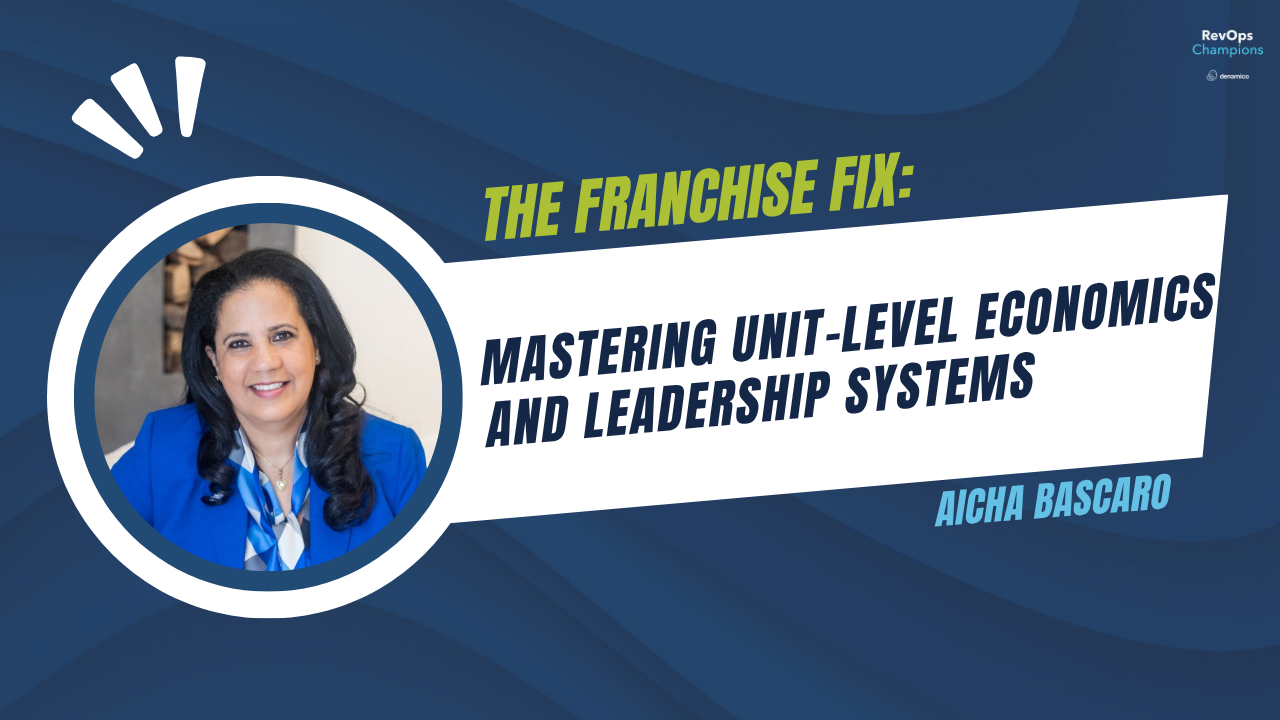
Aicha Bascaro, CEO and Founder of the American Franchise Academy, joins host Brendon Dennewill to challenge the assumption that a successful single-unit operator is ready to scale. Drawing on 35+ years across Domino's, Popeyes, and Olive Garden, Aicha breaks down the four business systems every franchisee must build before adding a second location, and why skipping them creates what she calls "the hell zone." From unit economics and P&L literacy to the pod-based growth model and the CRM gap in service-based franchises, this conversation is a masterclass in operational architecture for anyone building a multi-unit enterprise.
What You'll Learn
- Transition from operator "doer" to visionary "leader" skills.
- Navigate the "Hell Zone" of multi-unit scaling successfully.
- Master the four critical buckets of business systems.
- Understand joint employer liability’s impact on franchise training.
- Optimize unit economics through rigorous weekly KPI dashboards.
- Leverage AI agents to enhance 24/7 lead management.
Resources Mentioned
- The Franchise Fix by Aicha Bascaro
- American Franchise Academy (AFA)
- International Franchise Association (IFA)
- HubSpot CRM
Listen
About the Guest
|
|
Aicha Bascaro | Founder & CEO of American Franchise Academy
Aicha Bascaro is the CEO and Founder of the American Franchise Academy, an education and coaching organization dedicated to helping franchisees build scalable, profitable multi-unit enterprises. With over 35 years of experience spanning Domino's Pizza, Popeyes, and Olive Garden across 26+ countries, she has held roles as a franchise operator, corporate executive, and brand president. Aicha is a certified IFA instructor for the CFE program and author of the Amazon bestseller "The Franchise Fix," now used by franchisors as part of their franchisee onboarding. She brings a rare practitioner's perspective that bridges operational execution, leadership development, and unit-level financial management. |
Episode Transcript
Introduction
Brendon Dennewill: Hello and welcome back to the RevOps Champions podcast. Today I'm joined by Aicha Bascaro, CEO and founder of the American Franchise Academy, which I will be referring to for the next 45 minutes or so as AFA. AFA is a franchise operator, educator, and strategist focused on helping businesses scale through structured, repeatable systems, which of course here at Denamico we love.
With over 35 years of experience in franchising, Aicha has held leadership roles across globally recognized brands like Domino's Pizza, Popeyes, Olive Garden, and Pretzel Maker, supporting operations across more than 26 countries. Aicha brings a rare combination of perspectives as a franchise operator, franchise executive, and founder, which shapes her practical, execution-first approach to scaling businesses.
Through the AFA, Aicha has trained thousands of franchise owners, unit managers, and district leaders using structured programs designed to improve operational consistency, leadership capability, and multi-unit performance. Her work centers on building scalable systems that enable long-term, sustainable growth rather than short-term wins. Aicha, welcome to the RevOps Champions podcast.
Aicha Bascaro: Thank you for having me here. What a great introduction.
Brendon Dennewill: Well, you have a lot of decades of experience. It was all worthwhile and sets us up for a great conversation.
Aicha Bascaro: Sometimes I feel pretty old when I look back at all the things I've done, but at the same time I don't feel that old. It's kind of neat.
Brendon Dennewill: We're just getting started, Aicha. We're just getting started.
What Revenue Leaders Can Learn From Franchise Models
Brendon Dennewill: Aicha, you've spent decades in franchising. What can revenue leaders learn from franchise models when it comes to building repeatable revenue systems?
Aicha Bascaro: So much. One of the wonderful things about the franchise model, which I fell in love with when I first started as a temporary job, is that it's really a set of systems and processes. Once you figure out what works, if you repeat that consistently, you're going to have predictable results.
We always said marketing brings the sales and operations keeps it. But one of the things I teach is that operators must also own sales. It should be a partnership. Do we need a great marketing team with amazing strategy, tactics, innovation, and products? Definitely. But I still believe that operations can own sales because they are the ones providing the experience to customers. And it's a lot cheaper to bring people back than it is to try to get new ones all the time.
I think it's a great partnership between both sides, and we both need to own the sales so that we can have year-over-year growth, ongoing and sustainably. I don't think it's one side or the other. I think it's both.
The Origin of the American Franchise Academy
Brendon Dennewill: I'm guessing one of the reasons you started AFA was because you felt there was something missing, a support system that was missing for franchisees where they needed education. Tell us a little more about how and why you started the AFA.
Aicha Bascaro: I had over a 25-year career at that point when I left my last job as president of the Pretzel Maker brand. I was taking a sabbatical, or so I thought. My kids were going into high school and my husband would say, let's take a break and try to figure out what's next for me.
Literally in the middle of that sabbatical, I started getting phone calls from franchisees I'd known in my career, asking me to do special projects. What was interesting is the questions they were asking were not about how to do the product, how to improve the marketing, or how to improve the image. The questions they were asking were business management questions: How do I hire and retain the best people? How do I truly control costs in my business? How do I reduce the break-even point or make more profit? How do I grow a multi-unit enterprise? How do I supervise, and how many units per district manager?
I was able to answer those questions because I was actually an operator. I had run over 60 corporate stores for Domino's, the Atlanta region for Popeyes, and the Georgia and Alabama area for Olive Garden. I'm a true operator, and my education had been in business management systems. So I was able to help them create those processes and procedures to scale.
As they were asking me questions, one of them actually said, 'Aicha, I cannot ask you all the questions. Can you please write a book?' So I wrote The Franchise Fix, dedicated to Mr. Philip who inspired me to write it.
Brendon Dennewill: We'll put a link to that in the show notes. That's great.
Aicha Bascaro: It became an Amazon bestseller when it was launched and it's still there. People love it. We now have franchisors buying that book for their franchisees as part of their welcome package when they first join the brand.
I became the accidental consultant first, and I had never been a consultant before. I worked for corporations. I even ran a franchise on behalf of a franchisee in the Bahamas: Domino's and Dairy Queen for three years. From there, I started doing personalized coaching, then turned it into group coaching, which became a mastermind, and it just grew. Now what we do is dedicate ourselves to helping franchisees implement the business management systems that complement the brand systems so that they can have profitable, scalable, successful enterprises.
Then they started asking me, 'Aicha, I hired a district manager like you told me to. What do they do?' I realized many franchisees who grow multi-unit have never been a district manager and have never been trained on being one. So we created a program to train their district managers. Then they asked about unit managers, and so two years ago we launched the unit management program. We're literally now an education organization dedicated to supporting franchisees in going multi-unit successfully. We're celebrating our 10th anniversary this July.
Brendon Dennewill: Wow, congratulations.
Aicha Bascaro: We're super excited. We've grown slowly but surely, just by word of mouth and our social media presence. But after our 10th anniversary, we are planning to go big.
Brendon Dennewill: It's taken you 10 years to become an overnight success.
Aicha Bascaro: Exactly. People say, 'Where have you been? I never heard of you. Where have you been all my life?' We've been around, but you're right. We're one of those 10-year overnight successes. People are starting to hear about us and know about us.
Unit Level Economics: The Franchisor and Franchisee Partnership
Brendon Dennewill: You and I were connected because you ran the unit level economics session the day before IFA '26, just a couple of months ago. Within the franchise space, unit economics has a slightly different meaning: each individual franchise unit has to be profitable on its own. How do you connect unit level economics to the education so many franchise owners and franchisees are coming to you for?
Aicha Bascaro: That particular session was from the perspective of a franchisor. The IFA reached out to me about three years ago, and I'm now an instructor for the IFA for the CFE certification. That session was franchisor-focused, and what I was teaching were all the line items that affect the franchise business.
I share how franchisors have both the power and the responsibility to work through the business model to ensure it's as profitable as possible. A franchisor can create a very positive unit economics model, but it's up to the franchisee to manage the business to match that profitable model. It is not rare to see a very successful, proven brand where the franchisee still fails. McDonald's franchisees fail. Subway franchisees fail. Dairy Queen franchisees fail. A lot of the time, it's not that the brand model is wrong, but that the franchisee did not have the proper business acumen or financial understanding to manage the business according to the model.
On the franchisee side, everything you do to manage against that model, controlling your costs, understanding the ideal cost of goods, target labor cost, and the right range for rent and utilities: all of that affects your profitability. Unit economics is truly a partnership between the franchisor creating a profitable model and the franchisee understanding how to manage against it to maximize profitability.
We teach profitability from the franchisee perspective all day, every day, to the franchisees, the district managers, and the unit managers. Our goal is a mindset shift, especially for the franchisee's employees. A lot of them come in, run a shift, and run their day, but because they don't have the full picture, they don't understand they're running a million- or multi-million-dollar business. That's what we teach: approach what you do every day as a business, not just a shift.
Why Most Franchise Brands Don't Teach Business Management
Brendon Dennewill: Why do you think so many franchise brands don't teach what you do?
Aicha Bascaro: There are two reasons. The first is legal. There is something called joint employer liability that has been around for a long time, but in 2015 it really came to the forefront through litigation where franchise stores became responsible for what franchisee employees were doing. The law would tie the franchisee employee to the franchisor, making the franchisor responsible.
What happened was that franchisors were told: if you get involved in how the franchisee manages their people, recruiting, interviewing, hiring, onboarding, motivating, all the people management activities, then you automatically become a joint employer of those employees. From 2015 on, franchisors said: the way we avoid liability is by not teaching franchisees how to manage people. And from that point, they stopped teaching inventory management, scheduling, and all the other managerial tasks. It really started with joint employer concerns.
The second reason is money and resources. It takes significant investment to create a training department that not only teaches product, service, and image, but also provides a business degree in franchise management. If you go to college, a business degree in management is four years and tens of thousands of dollars. Franchisees are not paying for that. They're paying a specific amount of royalties for the right to use the brand. So those are the two reasons.
What I tell franchisees is: you are responsible for your business management. The franchisor is responsible for giving you a proven brand, a product, service, image, and marketing that works. It is your responsibility to learn the business acumen necessary to turn that amazing proven brand into profitability. Nowhere in your franchise agreement does it say they will give you a business degree. Nowhere does it guarantee profits, because profits depend not only on the business model but on how the franchisee implements that business.
Now the joint employer piece may change. The IFA is working hard with the government and the American Franchise Act to try to reduce that liability so that franchisors can start providing this knowledge and support without the legal risk. I think it's going to pass. I hope it does, because that means more franchisors will be free to teach this. We just hope we become one of the resources to help them do that teaching.
Brendon Dennewill: That's really interesting. When we were at IFA in February, a franchisor came up to our booth and said they have 180 units, and an increasing number of their franchisees are using or adopting the HubSpot CRM, but they cannot get involved. I couldn't understand why a franchisor would not be able to use the same CRM system their franchisees are using. Is that connected somehow?
Aicha Bascaro: Is that platform being used specifically for lead management and sales, or is it also being used to manage employee activities in any other ways, like scheduling?
Brendon Dennewill: No, it's really marketing, sales, and customer service.
Aicha Bascaro: Then the answer is money and resources, not law. There's this concept called royalty sufficiency: how many units do I need as a franchisor to have enough revenue to break even with my business expenses? That means I'm not going to have a lot of specialized employees on my roster until I can afford them, including trainers, marketing people, and technology specialists.
Mature, legacy brands have huge departments because they have thousands of units. But for an emerging franchisor, they have to be very careful to reach break-even as quickly as possible. For some, that might be 50 units. For others, 100. Until they get there, they have to be very careful about where they invest money and resources on internal support for franchisees. That's why they're not getting involved in something that isn't a legal issue: it's simply money and resources.
Core Systems Every Multi-Unit Franchisee Needs Before Scaling
Brendon Dennewill: Most franchises are dependent on their franchisees being successful with their first unit so that they become multi-unit owners. What are the core systems that every franchisee needs before attempting to scale across multiple locations or teams?
Aicha Bascaro: One of our franchisor clients found us because their franchisees going through our programs told them about us. This particular franchisor was an emerging brand that had experienced several failures in the multi-unit world. Once people go from one unit to two, it's a completely different business. They had acquired the brand and experienced a lot of multi-unit failures because franchisees were not prepared. So they came to us, and now they do not allow franchisees to go multi-unit unless they go through our program first.
There are several things a franchisee needs to put in place to scale successfully. The first is understanding the business model very well. I love it when franchisees are initially the operators themselves: opening the unit, running shifts, doing schedules, managing inventory. If you have that level of detailed understanding, you're setting yourself up for success.
But that's not enough when you go multi-unit, because one unit works when you're there all the time. You open, you close, you're shoulder-to-shoulder with your employees, and if something goes wrong, you can step in. Once you go to two units, there are still only 24 hours in a day. You have to be able to empower people.
This is where it changes. You need to take the same discipline of defining systems and processes and apply it to your business systems, not just the brand systems. Brand systems are product, service, image, and marketing. Business systems are how to hire and retain great people, how to capture and increase revenue year over year, how to control costs to maximize profitability, and how to scale beyond one unit successfully and consistently. Those are the four buckets.
Take hiring as an example. There are four phases in the employee lifecycle for hiring: recruiting, interviewing, the job offer, and onboarding. This is how we group everything into clear, specific steps and processes. Now, what's your ultimate goal? Do you want 25 units? 50? You have to build the systems to that scale.
If you want 10 units, can you personally hire everybody? No. So you need to define, document, and then train people to do it exactly the way you want. Once you document it, you can train people to do it consistently and in alignment with your values and your experience. Once they're trained, you need to delegate and empower them, not micromanage them. You need to be focusing on the next location, the next access to capital, and the next leaders.
If you've been a franchisee for a long time, through the school of hard knocks you'll eventually figure it out, but it will take years. People who are more systematic are the ones who achieve that dramatic, explosive growth. Those who are not systematic are the ones who struggle and get stuck.
So the four buckets are: team, how do you hire and retain great people; revenue, how do you capture and increase it year over year; cost control, maximizing profitability; and scaling, how do you create the structure and infrastructure to grow multi-unit. These are the business systems every franchisee must create.
Where Multi-Unit Expansion Most Often Breaks Down
Brendon Dennewill: Where do you see breakdowns most often when a franchisee is trying to replicate success across other units or regions?
Aicha Bascaro: The breakdown happens when the business owner thinks they're going to manage two or three units the same way they managed one. It's a completely different job. When you're a single-unit franchisee, you are a doer. You open the unit, do the schedules, do the inventory, take care of customers, hire the people. The moment you become a multi-unit franchisee, you're now inspiring others to do. Completely different job. Completely different set of skills. Completely different perspective.
That's the first breakdown: thinking you're going to manage the business the same way you did with one unit. It's even worse if you don't have anything defined or documented. And sometimes people think it should be easy. It is easy; it's just not simple. You have to go through the hard work, or else learn through years of hard knocks. If you're not a systematic person, it's going to be very hard. You're going to burn out. You really need help.
Brendon Dennewill: So it's making that shift from one type of leadership to a different type of leadership.
Aicha Bascaro: It's an immediate mindset shift the moment you go to two units. If you think you're going to be the manager of both because you want to save that salary, you'll be working seven days a week, 24/7, and it just doesn't work. You have to have that mindset shift.
If you're going to stay with two units, you can survive the chaos and eventually find a stable new normal. But if you want to grow beyond that, it's simply not possible without the shift.
This is also very important for franchisors doing unit economics analysis: the model needs to include a manager salary, so the franchisee has enough profitability after paying a manager to get an adequate return on investment. If a manager's salary consumes so much that there's not enough profit left over, it's not a scalable model.
It's also more beneficial for the franchisor to encourage multi-unit owners. If you have a lot of single-unit franchisees, your franchise business consultants can support fewer units because each franchisee represents only one unit. But if you have successful multi-unit franchisees, each FBC can oversee more units because each franchisee represents more. It's a win-win-win: good for the franchisor's economics, good for the franchisee who can scale profitability, and good for employees who now have a path to become district managers or even a director of operations.
Balancing Standardization With Flexibility as You Grow
Brendon Dennewill: Is there a struggle in balancing all this standardization with the flexibility you also need as the organization grows?
Aicha Bascaro: If you create a system, there should be one way to do it. No flexibility. It's like saying you're going to make a Big Mac one way, but we need to be flexible and make it another way. If you really want consistent results, it needs to be done one way.
In business systems, the flexibility comes in the way you approach some things. Take scheduling: we teach a very clear, specific process. Every brand is different, every model is different, every volume is different, but the way you should think about building the most effective and efficient schedule is the same. The first step should always be sales projections. What are my sales, and depending on the business, I need to know it not just by the week but by the day and even by the hour.
The policies around that schedule need to be consistent: Are you offering paid or unpaid breaks? Do people come in every 15, 30, or 60 minutes? Do they have a minimum number of days they must be available? These policies need to be firm. The flexibility comes in fitting people's individual availability to your business needs, and ensuring when you hire, the people you bring on have the availability your schedule requires.
All the systems are intertwined. Turnover is another example. There needs to be a process to measure turnover in your organization because turnover is the biggest, most expensive hidden item in your P&L. It shows up in almost every line item and most franchisees don't even know it. Turnover tells you stories about your business: by unit, by district. That's why clear, defined processes matter so that everybody knows how to go from A to B to C on all business systems.
The flexibility comes in how to think about them and how to make smart decisions to adapt. If it's going to be a rainy day, what does that mean for your business? At Domino's, it means you're going to get very busy. At other businesses, volume might be cut in half. Managers and franchisees need the ability to think and react to protect profitability. You need the knowledge and training to make that thinking process work correctly.
Brendon Dennewill: And I guess the flexibility really comes back to leadership. Any business that's growing is changing, and anything that's changing needs flexibility. What's standardizing is the systems themselves. Whether you're going from one unit to two, or from 100 units to 300, things break. So you need that flexibility to get ahead of what's going to change and how to support people along the way.
Aicha Bascaro: Absolutely. I always see it this way from the franchisee perspective: you should grow in pods of a district manager area. Don't go from one to four unless four units generate enough cash flow to pay for a district manager and deliver a good ROI. The growth shouldn't be from one to three or four. The goal is one unit to a full district manager area, minimum.
Do not stay in the middle, because the middle is what we call the hell zone. Going from two units up to hiring your first district manager is hell. You need to get out of hell as quickly as possible. Ideally, promote that district manager from within rather than hiring from outside. The moment you have a district manager, you have time freedom. You can delegate operations and focus on growing.
How many district manager areas do you need before you need the next layer, what I call the director of operations? In pods of six stores per district manager. Don't grow to 10 without getting to 12 to bring in another district manager. Otherwise, who oversees those units? You'll burn your existing district manager. Growth in multi-unit should be in those pods.
A lot of the decisions need to be driven by: how many units can this market support, and can I get to a full district manager area? How many units before I need another district manager area? If not enough, don't do it, because it's going to be hell. This is something we try to influence franchisors on as well, so that when they're selling market areas, they're thinking about it this way. That's how they set their franchisees up for success.
There's a study from Harvard that says the ideal number of direct reports is four to six. So as a franchisee, you might have four district managers, a bookkeeper, and a maintenance person. That's six. At some point you need to grow that infrastructure, but you have to do it smartly so that cash flow supports it. There is a lot of science behind multi-unit growth, and it all goes back to systems.
Food Service vs. Personal Service: Key Operational Differences
Brendon Dennewill: A lot of your experience was on the food side, QSR specifically. But now, celebrating 10 years of AFA, you've worked extensively with service brands: martial arts, gyms, cleaning services, wellness. Are there meaningful differences between those two worlds from an operational perspective?
Aicha Bascaro: Right now about 60% of our clients are food service and 40% are personal service. People think, you were at Domino's for 20 years, but I don't even cook. We were not in the food business; we were in the assembly line business. Domino's was the most perfect assembly line. Tom Monaghan, the founder, was amazing. One of the rules for building units was that the next step needed to be no more than one step away. From the phones to the dough, the sauce, the toppings: everything was within three steps. Then the oven was one step behind you. The most effective, efficient assembly line ever. Because we focus on management and leadership principles, it doesn't really matter what industry we're in.
Now, there are a couple of real differences. In food service, your biggest expense is cost of goods. In service businesses, cost of goods is often much smaller, typically between 5 and 17% of sales. For some, like schools that aren't serving food, it's almost nothing. That's the first difference.
The second is labor. In a service-based business, labor is the biggest expense, while in food service it's typically second. Interestingly, when you combine cost of goods and labor in food service, the total percentage is often similar to the combined labor and cost-of-goods percentage in service businesses. The difference is just in how the weight is distributed between those two line items.
The third difference is the time horizon. In food service, if you're a good operator, you manage that business by the hour. Every hour you're looking at volume and staffing. In personal service, health, and wellness, you might look at your business by the day, or by the week, and for membership-based businesses, by the month. We highly encourage everybody to do weekly dashboards, but we've found that for membership-based service businesses, the numbers don't change that much week to week. It's more of a month-to-month view.
From a workforce perspective, food service is often a first job. People might be in high school, going through college. It's frequently viewed as a temporary job, though I want to encourage everyone to think of food service as more than that. There are all kinds of opportunities: district managers, directors of operations, marketing, finance. I joined as a temporary job and am still here 35-plus years later.
In personal service and health and wellness, you're often dealing with career-oriented people who need certifications. Veterinarians and nurses for pet businesses, certified trainers for fitness, credentialed instructors for education. How you lead, motivate, find, and retain those people is completely different from managing someone right out of high school. It's a significant operational difference.
Capturing and Retaining Customers: Service vs. Retail Models
Brendon Dennewill: Is there a difference between food service and personal service when it comes to capturing customers?
Aicha Bascaro: Very different. In food service and retail, you're in a high-volume, low-ticket business. In service businesses, especially membership-based ones, it's the opposite: lower volume, higher ticket, higher touch.
In high-volume retail, you rely on broad marketing: social media, reach-out, promotions, and so on. In service-based businesses, especially membership models, you need to build funnels, follow-up processes, and CRM systems. We don't have a CRM in food service. Our CRM was: do a great job, deliver a great product, and people will come back. But when you're selling a membership that might be a thousand dollars for the year, you need actual sales skills and a robust follow-up process.
That's one of the most significant differences between high-volume retail and personal service, education, and health and wellness. How you handle customer acquisition and retention is completely different.
How AI and Modern Go-to-Market Strategies Are Evolving Franchise Operations
Brendon Dennewill: Looking ahead, how do you see operational systems evolving alongside AI and modern go-to-market strategies for franchises?
Aicha Bascaro: In the last four years, we've gone from 'this is a new thing called AI' to sessions this year that aren't about what it is, but how it's actually being used in tactical, practical ways in the industry.
For food service and retail specifically, I think the immediate operational impact will be modest. I see AI being implemented more in above-store office processes. In personal service and health and wellness, it's being adopted more quickly, particularly through AI agents in CRM workflows, allowing businesses to reach out to more people more consistently regardless of the hour.
We have an AI agent on our own website. If anyone visits, they can talk to our agent, Frank, and ask anything about our academy until they get the information they need. I also had a multi-unit franchisee mention they have cameras observing operations and generating management recommendations. They were the exception though: an equally large franchisee in the same conversation said they weren't doing anything like that yet.
So I think adoption will be slower in retail and food service, while in personal service the funnel and CRM version of AI is being implemented more rapidly for efficiency. I love technology. I had my first laptop in 1993, a 12-pound IBM. I'm all in. One of my personal development priorities is learning how to better implement AI in our academy. For anyone thinking about it: get in there, start using it, implement it, see how it makes you better. It's here to stay and it will only become more ingrained in what we do every day.
Brendon Dennewill: That's great. And the example of Frank is actually the perfect one for a lot of franchisors listening. A statistic I read recently: most new prospective franchisees do their research between 8 p.m. and 6 a.m. There's not a lot of franchise development staff working at those hours. If you can have your AI agent on your website answering all the questions, because this is a huge decision for first-time franchisees, you could do yourself a huge favor. When the FranDev team switches on their computers at 8 a.m., they might already have a meeting booked with a potential franchisee.
Aicha Bascaro: 100%. Your franchise AI agent should have links to promo videos explaining your business, links to your website, your menu or your services. It should have all of that information available so it can take care of prospective franchisees around the clock. They're doing their research at night because they have a full-time job. Having your agent available 24/7 is super important. And that's just the beginning of it.
Closing Thoughts
Brendon Dennewill: Aicha, thanks so much. I know we could talk for another hour, but thanks so much for joining me today. I really enjoyed the conversation and I'm sure the listeners did too.
Aicha Bascaro: Thank you. I appreciate the invitation and the opportunity to share my message.
Subscribe