
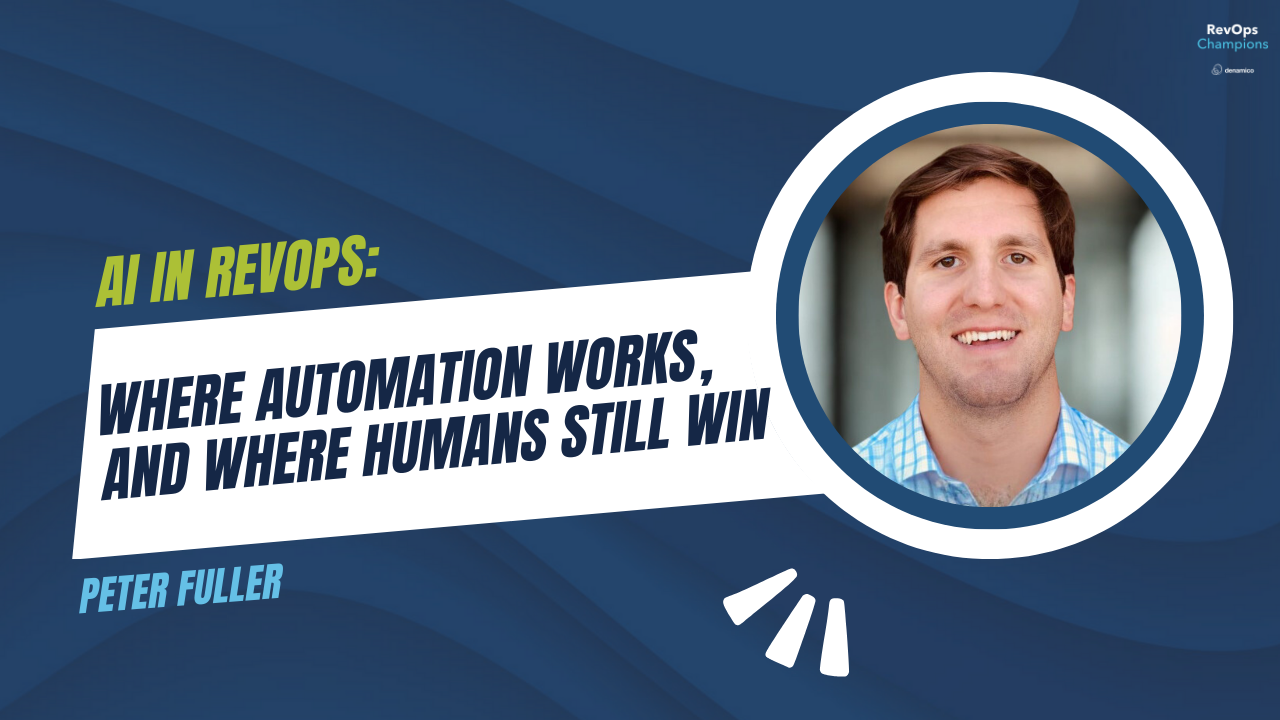
In this episode of RevOps Champions, host Brendon Dennewill sits down with Peter Fuller, Founder of Workflow Academy and a leading expert in revenue operations, CRM systems, and workflow automation. Peter shares his unconventional path from studying Russian literature to building a RevOps consultancy and training ecosystem, and why the “human” side of RevOps will only become more important as AI adoption accelerates.
Peter breaks down the three pillars he teaches (ask better questions in plain English, “measure twice cut once” with clear scoping, and only then build), and explains why most AI initiatives fail: not because the tools don’t work, but because leaders chase hype instead of focused, high-ROI use cases. He offers a practical approach for 2026: empower your internal tinkerer, carve out time, and prove ROI on one micro-solution before turning AI into a company-wide strategy. The conversation is a grounded, refreshingly contrarian take on where AI actually helps RevOps teams today, especially in reporting, dashboards, SQL, and automation, without sacrificing relationships, trust, and real human context.
This episode is essential listening for RevOps leaders, operators, and executives who want to cut through AI noise, prioritize what matters, and deploy automation in ways that genuinely improve performance without distracting the business.
What You’ll Learn
- Where AI is creating real leverage in RevOps today, and where it quietly falls short
- Why the most critical parts of RevOps still depend on human judgment and trust
- A simple framework for approaching RevOps work without jumping straight to tools
- How to experiment with AI in a way that minimizes risk and maximizes learning
- How to separate real opportunity from AI hype and vendor-driven urgency
- What leaders should prioritize in 2026 to explore AI without derailing core operations
Resources Mentioned
Listen
About the Guest
|
|
Peter Fuller | Founder of The Workflow Academy
Peter Fuller is the founder of The Workflow Academy, a leading Zoho and RevOps consulting firm helping high-growth companies scale through better systems, workflows, and automation. He also built a RevOps career education platform acquired by Aspireship and now serves as an adjunct instructor at Utah Tech University and Dixie Technical College, where he created one of the first accredited CRM/RevOps programs. |
Episode Transcript
Introduction
Brendon Dennewill: Welcome back to the Brendon Dennewill podcast. Today I'm joined by Peter Fuller. He is the founder of the Workflow Academy and a recognized expert in revenue operations, CRM systems, and workflow automation. Peter has built a consulting practice that has optimized revenue workflows for clients transacting over $500 million.
His education division was acquired by Aspireship to scale career training in RevOps. Peter also teaches as an adjunct professor at Utah Tech University and Dixie Technical College, where he develops programs that bridge the gap between academic preparation and real-world business operations. His expertise in systemizing workflows and operational leverage makes him a valuable voice for entrepreneurs, executives, and operations leaders. Peter, welcome to the show.
Peter Fuller: Thanks, Brendon. I feel like I should be prepared with a self-deprecating comment after hearing you brag about me. But every single one of the beautiful things you said about me is true, and I am that amazing.
Brendon Dennewill: Well, I could add another one I just recently found out: you've been anointed the Greek god of RevOps?
Peter Fuller: Yes. Olympus is generally stingy with such designations, but some political maneuvering landed me that.
From Russian Literature to Revenue Operations: An Unlikely Path
Brendon Dennewill: Awesome. Well, Peter, so good to have you here. Can you share your journey from studying Russian literature to becoming a RevOps and CRM expert?
Peter Fuller: If we did a straw poll of most people in this RevOps space, whether you call them HubSpot admins, Salesforce admins, or Salesforce developers, I swear at least half of us have liberal arts degrees. We emerged from our bachelor's programs terrified, thinking, "I have nothing of value to contribute to capitalism." I thought I was going to be a Russian Lit professor. I realized pretty late that there were only four or five jobs that matched what I thought I wanted, and nobody in those positions was close to retiring.
I think everyone in the 2010s who found themselves in that position Googled something like, "What careers are relatively easy to get into if you watch some YouTube videos?" We all landed in some combination of HubSpot Academy certifications, Udemy, Coursera, digital marketing, all in this realm of figuring out how to help businesses make more money.
That was the inciting event. There was a layoff in there too. I started down that path in digital marketing, got laid off around Christmas about eight years ago. Then a high school debate teammate had gotten into Zoho. Smallest pond imaginable, weird big-fish situation. He introduced me to some freelance work that turned into a consultancy, and I've done everything from there.
Brendon Dennewill: It's another data point for how we all have very unique gifts to give the world. Every experience we've had, whether official or unofficial education, makes us who we are and lands us where we land.
Peter Fuller: Absolutely. In our education work, we always tell people: do everything you can to take your past experience and frame it as if it was all leading toward this moment in your new career. I have a student right now who has worked at a welding shop and been a shop manager for years. I told him, "Let's go set up Trello boards and a CRM and a job management system for welding shops." Now every welding shop he talks to, he's not saying he's been doing RevOps for two months. He's saying, "I've been doing this for years. I know what I'm talking about. You should hire me."
Building a Consulting Practice: The Real Challenge Is Retaining Talent
Brendon Dennewill: You've touched on the fact that this wasn't a straight line to the success you've had. What were the biggest challenges you faced in shifting from education to consulting while doing both?
Peter Fuller: I'll give you an unorthodox answer. Consulting, billing hours at some hourly rate, is really hard to build a sustainable practice around. And I'm going to focus not on acquiring customers or margins. I'm going to focus on keeping talent.
When you grow a consultancy, you reach a point where you have a finite amount of time. You start hiring someone to do what you consider grunt work, but to them it's interesting. You teach someone how to do something, they assimilate it, they get good at it, they think, "I can do more than this." And eventually, your junior consultants reach a point where they think, "There's nothing Peter knows how to do that I don't. I could probably do this on my own."
A lot of consultancies approach that retention problem with non-competes, non-solicits, and incremental small raises. My partner Ashton and I really approached it from: how do we build a culture that nobody ever wants to leave because they can never find anything like it anywhere else? Because when people leave, it's not just a revenue thing. There's a psychic toll. It's like, it's Halloween and I need to take my kids trick-or-treating, but I can't because someone who was going to write SQL queries for a client left a couple of weeks ago.
We approached it two ways. First, we started building an education component. We would constantly be teaching our coworkers something new so there was never any stagnation. They would always feel like they were growing.
Second, we treat everyone like peers. We have significant profit sharing, up to about 60%. Plus what I've heard described as a results-oriented work environment: we don't care how many hours you work. I'm pretty sure a few of my coworkers work 20 to 30 hours a week some weeks, and we're proud of that. One of my coworkers will say in his check-in, "I'll be delayed today because I'm rebuilding the sunroom at my in-laws' house," and I'm just like, all power to you. I want you to be able to do that.
The education component helped us recruit, helped us retain, and helped us have a soul. My coworkers really love that there's always this flow of learning and mentoring. Then we show everyone our finances openly. We have three or four months of expenses sitting in a bank account ready to use if times get hard. As a result, we're able to treat this very special group of 13 people like peers and adults, and they all feel responsibility for each other.
Brendon Dennewill: It sounds like a really incredible company culture.
Peter Fuller: "Culture" is an annoying LinkedIn buzzword until it isn't, until you're actually describing sacrifices that the employer is willing to make on behalf of the employed. We've always been bootstrapped, and as a result of how we operate, our whole team feels this mutual responsibility for each other that feels really special.
The Three-Pillar RevOps Framework: Questions, Scope, Then Build
Brendon Dennewill: What is the framework or model you use in the training you've created?
Peter Fuller: We tell everyone there are three pillars. Pillar one: obsessively ask questions in plain English about the customer's business goals, life, everything they want to do. Questions, questions, questions. I always add the qualifier "in English," because you're not talking about Zoho or HubSpot or Salesforce. You're asking them questions in the language they understand.
And this applies whether you're an external consultant or an internal admin. If you're internal, you have customers just the same. The VP of Sales is your customer. The VP of Marketing is your customer. The CFO. Someone is always some version of a customer: a human with dreams and goals and desires, most often connected to growing their business. Your job in revenue operations is to figure out the linkage between their goals and their existing customer life cycle, then identify the bottlenecks. Where is their customer's experience being negatively impacted in a way that, if fixed, would help them find more customers or generate more revenue?
Pillar two: measure twice, cut once. Repeat back everything you've heard in a scope document and a flowchart. This sounds basic, but across hundreds of alumni it just keeps proving true. You repeat it back to the client and they inevitably say, "I forgot to tell you about that," or, "Actually, reprioritize this." It happens every time.
Only in pillar three do you actually build something in software. Only then, after you've asked all the questions and scoped everything out, do you say: "I'm now going to set up HubSpot. I'm going to make you an app in Lovable. I'm going to build something in Salesforce."
Brendon Dennewill: love it. Our framework has four pillars: people, process, data, and technology. They seem to be saying essentially the same thing. You have to understand the people you're serving, where they are and where they're trying to get. How the processes they're using map to those goals. What data they're using to measure success. And then what technology makes it all better and faster.
Peter Fuller:: I love your framework. Ours is almost purposely more reductive and simplistic because that's literally unit one, lesson one in our curriculum. I have parents reentering the workforce and immigrants who just moved to the U.S. We try to teach it even before we teach them what a CRM is. But I really like yours. Maybe I'll plagiarize it, Brendon. *[laughs]*
Brendon Dennewill: What I love about yours is the specificity. Our four pillars still require explanation: what do we mean by people, by process, by data, by technology? What you've done is explained it in concrete, actionable terms. The best part is that they completely support and overlap with each other.
How the Workflow Academy Model Evolved: Consulting, Education, and Knowing When to Sell
Brendon Dennewill: How did you develop the Workflow Academy's unique model that blends consulting, training, and client outcomes?
Peter Fuller: I'll be very literal and attempt to be succinct. Remember, literature major. We started with just consulting. Scaled to a certain point and needed education both for retention of existing employees and for recruitment. A lot of our initial training materials were things we'd give to interns on a two-month internship where they could go learn Zoho and decide whether they liked it.
Then we thought, this is working really well, let's teach everyone. Did that for two years. It went incredibly well from a personal fulfillment standpoint. There are eight or nine agencies that have spun out of our various education programs, hundreds of alumni, people starting companies hiring other alumni. I also got really good at niche government training subsidies.
But at a certain point I realized: this is hard to scale. We were losing some of the individual relationships as we grew to hundreds of students. Then we found Aspireship, who had figured out how to scale to thousands of students without losing the personal touch. We ended up selling the education part of the business to them, and it's gone amazingly well. They've been able to take and grow that side of it, and I still see students come through.
I took the education piece and brought it local. My thesis was: I have the curriculum, I know what I'm doing, I love doing it, but I wanted to be intensely personal. So I went to local universities and said, let's do this for 30 kids a year. What you lose in scalability, you gain in joy. I have students calling me about their cap tables, things like that. It's not scalable with thousands of students, but you can do it with 30.
The moment we divested the scaled education and kept just the local program, our consultancy really started to take off. We still offer education, but now we offer it as a differentiator for our consulting product. We'll only take a client if they have an admin on staff. We won't consider taking you as a customer if someone won't be there to maintain the system. And assuming that person exists, we promise you won't find a better group to train that person into a great admin.
Brendon Dennewill: Congratulations. That's amazing. And it makes total sense: realizing you couldn't be great at both and scale both effectively. It's great when you can find a home for both sides where they can continue to grow and add value.
Half Human, Half Robot: How AI Is Actually Changing RevOps Work
Brendon Dennewill: Your expertise is rooted in a deep belief in workflow as a business superpower. But how are RevOps professionals and their agentic AI tools going to be working together in the future?
Peter Fuller: Hot take number one: "AI RevOps" is the worst job title ever. Awful. Anyone who says it with a straight face, I don't get it.
Hot take number two: did I blink and my Russian-literature-loving self somehow became one of the best people to ask about careers in revenue operations plus AI? I've been doing so much work at the intersection of both that I may have weirdly become the expert. So listen when I say this.
The human part of doing our job will never go away. There's a reason our pillar number one of teaching revenue operations has more to do with Crime and Punishment and The Brothers Karamazov, understanding someone's deepest core identity and desires and goals, than it does with CSV imports and field mapping. It's not just that AI is bad at it today and will be better in two years. Relationships genuinely don't exist as a series of text or voice-based chats with an AI.
I say that as someone who literally wears a tech support headset while pushing my baby in a stroller around the neighborhood, chatting with ChatGPT. And still, that's not a relationship. AI is so bad at truly understanding what someone is trying to accomplish, why this business is a prism of their individual dreams and desires. It is just very bad at that.
Now, here's what AI is already incredible at and will increasingly dominate. Reporting: Zoho Analytics, Tableau, Power BI, a lot of that reporting work. AI is very good at writing SQL, building visualizations from it, writing it fast. Data visualization is going to take a real hit. Scripting and automations, what I'd call our pillar three work, building zaps, workflows, Zoho Deluge scripts, custom applications. What my team built five years ago in Zoho Creator, Lovable can often do better right now.
I'd say my team is currently 20 to 30% more efficient at building things than they were two years ago because of AI. Specifically, the tools doing the heaviest lifting for us are Cerebro Analytics for dashboards, Lovable for custom apps, and a platform called MoonKnox as our wrapper for ChatGPT and Claude: look at this function, why is it erroring out? That's where AI is already changing things.
But in pillars one and two, other than AI note takers writing first drafts of scope documents, it all still comes down to: are we talking with our clients every week? Are we asking good questions? Do we care about their hopes, dreams, and desires? It's just human. It's the cop part of RoboCop.
The 95% Failure Rate: Why AI Adoption Is a Leadership Problem, Not a Technology Problem
Brendon Dennewill: Companies coming to us most frequently start with, "What is the technology solution?" But as you and I both know, this is not a technology problem. It's a strategic leadership issue. When you see statistics about the 95% AI adoption failure rate, that's 95% of leadership teams in 95% of boardrooms. That's where the failure is happening. It's the people component: the strategic leadership component that's missing. Until they go through the mindset shift and start prioritizing pillars one and two, pillar three, where AI really has an impact, isn't going to matter.
Peter Fuller: I couldn't agree more. Hot take number three: every single person talking about AI on your LinkedIn feed right now is, at bottom, a scared person with various investments tied to the idea that AI is going to fundamentally change everything, and they are selling you something. I can admit I also sell some AI-related things, so let's not have the pot call the kettle black. But I am deeply annoyed at how insufficiently allergic to hype we all are.
I say this for the entire class of white-collar workers addicted to LinkedIn, who derive too much of their identity from a platform that reflects their professional identity. We are all a little too hyped about this, trying too hard to sell each other something that is way more of a niche tool than most of us would like to admit. Many of us have placed bets that it'll be bigger than it currently is, and that's frustrating.
Brendon Dennewill: Are you saying part of this is about timing? The impact is real, but the urgency is misinformed? You hear comparisons to when fire was created or electricity became widespread: the adoption, as significant as it is, takes time.
Peter Fuller: Yes. We are being sold a false urgency. The idea that "if you don't implement this, your competitors will" is patently false, because for most businesses it's not a competitive emergency. Apple was criticized in 2023 and 2024 for being slow to move on AI. The same people are now saying Apple showed remarkable poise in not being distracted by the hype. That's exactly it. The 95% failure rate means 95% of the time it's not necessarily the technology itself failing. It's leadership's inability to choose specific initiatives and carve out small, targeted chunks of things that AI can actually serve.
Among my staff and across our various projects, we find AI to be applicable and genuinely useful in its current form about 6 to 8% of the time when a problem comes up. 6 to 8%. But when it applies, it can apply really, really well.
Here's a concrete example. We have a customer that does daily customer scoring using Cerebro. Every day, Cerebro runs through their 150,000-plus customers, looks at recent activity, and tells their inside salespeople: here are 20 accounts we think are worth following up with today. That workflow took months to set up and dial in. It does make them money. Everyone is pleased. But think about the 10 billion other things that business does. That's one workflow that took a lot of work, and now it runs with a good return on investment. That's the kind of thing I mean. So I tell everyone: call me when you're getting ready to implement AI, not because I necessarily have something to sell you, but because I will tell you whether it's actually worth it or not.
Advice for 2026: Start Small, Empower Your Tinker, and Resist the Macro Play
Brendon Dennewill: As we kick off 2026: many companies have a bigger AI budget this year than last. What advice would you give to business leaders on how to actually use it?
Peter Fuller: If you care about AI, you almost certainly have a single employee who has been tinkering more than most: spending personal money on subscriptions, experimenting on their own time. Empower that person. Carve out, say, 10 hours a week of their time. Buy them some bandwidth. And tell them: pick one specific thing. Don't spread out across all the quadrants of the business with "imagine if" scenarios. In my experience, the devil is always in the details with these things. You think an end-to-end workflow works, and then you run it and the model can't parse a company ID from a specific field, and the whole thing breaks.
Give that person carte blanche to take the first quarter or first six months and go prove a return on investment on one thing. It might be a customer scoring system for your inside sales team. It might be a Cerebro dashboard that flags the 10 at-risk customers your customer success team should call each day. It might be something small in a pilot group. But one thing.
If that person can't figure it out, try again in 2027. But it should not be part of some giant macro 2026 strategy. Everything I propose is a micro solution. Go to your employees, go to the people who see the actual problems day to day, and let them identify whether there's something worth solving. Because if you go to an outside agency, and I'll be honest, even I am a somewhat corrupted source since I sell AI-related services, they will always have something to sell you. If you go to a provider, they will tell you yes, it will change your business, it will only cost $20,000. And I fret for the people who hear that.
Brendon Dennewill: Even if there might be an ROI, it may not be the right first investment. That is a really good point and a great way to wrap this up. Peter, thank you so much for being on the show. Anything else you'd like to share as we close?
Peter Fuller: Do you have enough distribution on this podcast that my various old-man-yelling-at-cloud anger about AI will be disseminated to tens of millions of people? Will I single-handedly be the one to bring everyone back to earth? Perfect. That makes this worth the time. Bring me back anytime, or let's get some other guests together and just be old men yelling at clouds about AI. That's such good content.
Brendon Dennewill: You mentioned Cerebro Analytics, and for anyone listening who isn't aware of what they do, you should definitely check them out. I totally agree with Peter: that's a really good place to start with a very specific fix for some potentially acute issues in your business.
Peter Fuller: I would agree. Andrew and I argue about this stuff quite a bit since my views on AI aren't always his, but I can't deny that the specific Cerebro implementations we do are the ones that end up showing real ROI.
Brendon Dennewill: Awesome. Peter, thanks again and best wishes for a successful 2026.
Peter Fuller: Right back at you. Go Team Capitalism. Thanks, Brendon.
Subscribe