
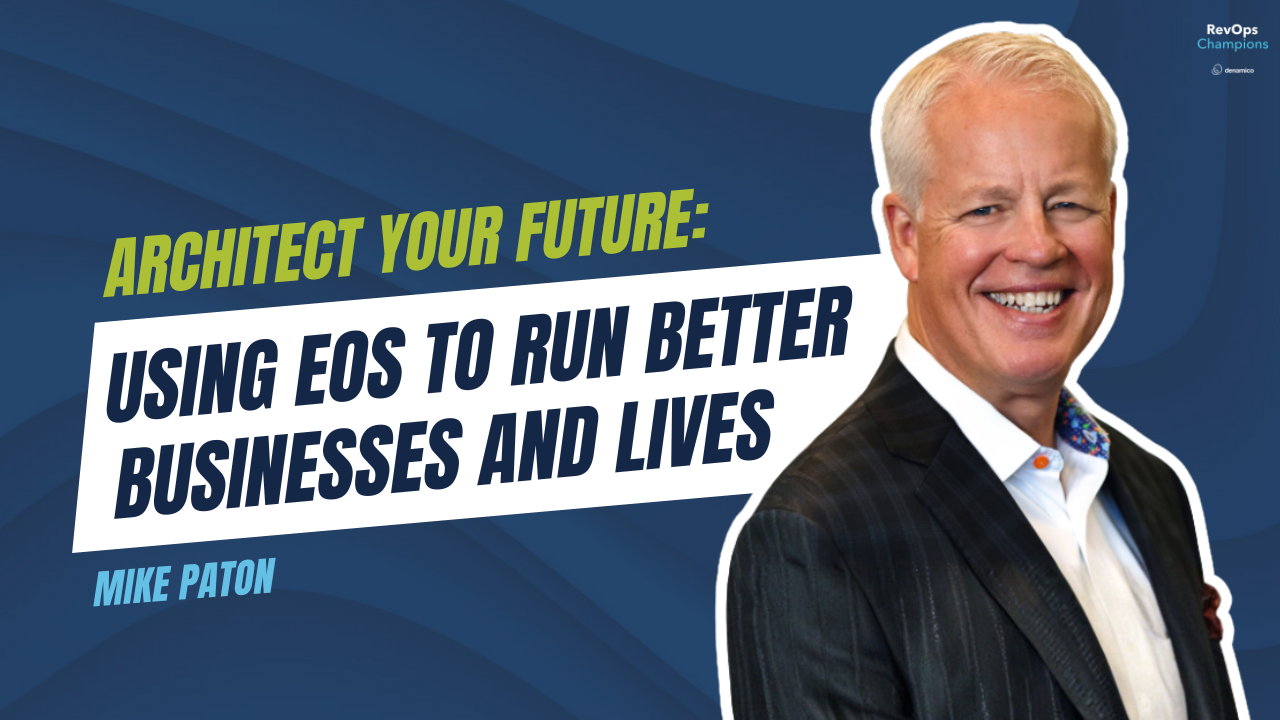
In this episode of RevOps Champions, Brendon Dennewill sits down with Mike Paton, longtime EOS Implementer, author, and host of The EOS Leader Podcast, to explore how organizations can scale effectively using the Entrepreneurial Operating System (EOS) framework.
With over 18 years of experience delivering 2,000+ full-day EOS sessions across more than 150 companies, Mike shares battle-tested lessons on leadership, process, and accountability. He breaks down why Vision and Traction are non-negotiable in times of uncertainty, how the 20/80 process documentation method drives efficiency, and why radical honesty is the ultimate form of leadership care.
Whether you’re leading a fast-growing startup or scaling a 250-person company, this conversation delivers practical frameworks for building systems, managing change, and creating scalable growth, without sacrificing your entrepreneurial DNA.
What You’ll Learn
- Why Vision and Traction matter most in uncertain times
- The three biggest challenges holding growing companies back
- The 20/80 approach to process documentation
- How Process and Data work together
- Why radical honesty is a form of care
- Why technology is an accelerant, not a solution
- The real reason change initiatives fail
Resources Mentioned
- Get a Grip
- Process
- Traction by Gino Wickman
- Radical Candor by Kim Scott
- The EOS Leader Podcast
- EOS Worldwide
- 90-Minute EOS Meeting
- EOS Tools
Listen
About the Guest
|
|
Mike Paton | EOS Implementer, Author, Speaker, and Host of the EOS Leader Podcast
Mike Paton is an EOS Implementer, best-selling author, and sought-after keynote speaker who’s spent the last 18 years helping thousands of business owners and leaders around the globe run better businesses and live better lives.
The product of an entrepreneurial household, Paton began his career in banking before embarking on his own entrepreneurial journey. He ran (or helped run) four entrepreneurial companies before discovering EOS in 2007.
Since then, Paton has conducted nearly 2,000 talks, workshops and session days. Gino Wickman’s successor as EOS Worldwide’s Visionary, Paton trained several hundred professional EOS Implementers, co-wrote two books in the Traction Library (which have been translated into a dozen languages), and hosted the top-rated EOS Leader Podcast.
Today he's grateful to be living his ideal life - helping people achieve their vision by mastering the timeless disciplines and practical tools of the Entrepreneurial Operating System.
|
Episode transcript
Introducing Mike Paton and the EOS Framework
Brendon Dennewill: I'm very excited to be joined today by Mike Paton. I'll be referring to him as both Mike and Paton because that's just how he rolls. Mike has spent a lifetime learning from entrepreneurs. Today, he's grateful for the opportunity to give back as an author, speaker, host of the EOS Leader Podcast, and an EOS Implementer.
In the last 17 years, he's delivered over 150 keynote talks and workshops around the globe, conducted nearly 2,000 full-day EOS sessions with leadership teams of over 150 companies, co-authored two books, Get a Grip and Process, both in the Traction Library, and spent five years as EOS Worldwide's Visionary.
He now spends all his time helping entrepreneurs run better businesses and lives by mastering the simple concepts and practical tools he'll be sharing with us today. Mike Paton, welcome to the RevOps Champions Podcast.
Mike Paton: Thanks, Brendon. I appreciate you having me.
Brendon Dennewill: Mike, let's dive right in. I want to talk about a few of the simple EOS concepts you're known for, specifically the ones you believe are still relevant, or maybe more relevant right now, as we're all focused on finishing 2025 strong and starting what's looking like a very exciting 2026 even stronger.
The Six Key Components of EOS
Mike Paton: For any viewers or listeners who aren't familiar with EOS, it's an operating system for an entrepreneurial company. EOS stands for Entrepreneurial Operating System. It's a set of simple concepts and practical tools, things that have been around for thousands of years and will be around for thousands more.
What Gino Wickman, the creator of EOS, discovered a long time ago is that when a leadership team or a business is struggling, it's usually due to weakness in one or more of six key components that we believe all businesses have and need to strengthen. Those components are: the vision component, the people component, the data component, the issues component, the process component, and the traction component: the ability to bring a vision down to the ground and execute on it.
I think the vision and traction components are what we end up talking about most in times of risk and uncertainty. What becomes more difficult when there's a lot of unpredictability in the world, which there seems to be right now, is making decisions using the same model you used when things were more predictable. I started implementing EOS in 2007, right before the financial meltdown. I've been through COVID, and now we're going through another tumultuous period.
What we've found really helps is when the vision for an organization is clearly defined: the cultural norms, its core values, its core focus, what the people in that organization were put on the planet to do well, and what it stands for. When those things are crystal clear and you can rely on them as the basis for making decisions, it becomes an anchor, a rock, and a calm place to dock your boat in a storm. You find the right answer to a lot of the tough questions and you're able to make decisions, knowing full well they may not always be right, but knowing you're relying on things you decided before any period of crisis or uncertainty.
Aligning EOS with Revenue Operations
Brendon Dennewill: I really like the way you anchored that. In our day-to-day at Denamico and in the work we do on this RevOps Champions Podcast, we talk a lot about the four pillars of revenue operations: people, process, data, and technology. You might recognize the first three.
It was a great reminder when you were talking about the six components of EOS, starting with vision and ending with traction. We focus heavily on the people, process, and data components in between. It often throws businesses off when they come to us. They typically come looking to set up a new CRM or make updates to their existing one, so they're coming to us for the technology component. And we say great, but first, let's look at how your people are aligned. Then we move on to the processes: your marketing process, your sales process, your customer service process. Then we talk about the data across each of those and how it feeds up to the scorecard. What are the metrics each team is accountable for?
It often throws people off. They say, why do you need to know all that when we just want a CRM? I'd love to get your take on this, because you've been in that room nearly 2,000 times with over 150 clients. Systems often become an issue, and I know this is part of the tumultuous time we're in.
Mike Paton: Often systems are getting blamed for problems caused by other things, or they're looked to as the solution to a problem that really isn't solvable by the system. That's definitely true.
Brendon Dennewill: Exactly. And as we've learned since we started using EOS in 2014, thanks to you and an event put on by Bridgewater Bank at the Marriott Southwest...
Mike Paton: One of the original Traction Days in Minnesota. That was a lot of fun.
Brendon Dennewill: It was. You were awesome, awesome enough to get us hooked. Since then, I'd say probably three quarters of the people we work with run on EOS. But for those who are less familiar, one of the first lessons we learned, especially when working with an implementer, is to start with process. Is this a process issue? Start there.
Mike Paton: Or a people issue, or a lack of data. The sales function is full of so many potential root causes, it's not even funny. That was the part of the world I grew up in. Little known fact: I was running sales and marketing for a sales and service training company in Columbus, Ohio, when Salesforce.com first started marketing itself. This is so long ago that their logo was actually the word "software" with the Ghostbusters symbol over the top of it.
I actually think the vision component is critically important to a successful sales function. Who are we as an organization at the core? What do we love to do at our best? Who is our target market? What kind of organization or person is a perfect fit for the value proposition we've built? When I talk about those things being an anchor for the way you make decisions and implement software and change processes, I think that context is absolutely critical.
If people don't know why they're supposed to hand-deliver a proposal to a client a couple of days before the RFP deadline, they're sitting there thinking, well, everybody else is emailing it at the last minute, why shouldn't I? One of the things your viewers and listeners need to hear is that you can't run a great organization by focusing on one or two or even five of those six key components. They're all interdependent. They work together in harmony to strengthen the way your business consistently executes.
Systems are embedded in those six key components. If there were a seventh, technology or infrastructure might be it. But certainly you can't have data, and most companies today can't have process, without great technology and infrastructure. It's a fascinating subject, one I could talk about for hours, but I know your viewers won't tolerate that.
Brendon Dennewill: Before we continue, I have a confession to make: I was not interested in process for far too long. I wish I'd seen the power of it much earlier in my entrepreneurial journey. I've since figured it out, but I just wish I'd understood and adopted it earlier. You probably wrote this book for people like me.
The Process Book: From Bottleneck to Scalability
MIke Paton: I wrote the book for exactly the same reason, Brendon. I discovered that part of the reason my clients were struggling with process was that I wasn't particularly enthusiastic about teaching it either. I'm a visionary entrepreneur. I believe you hire great people and let them figure out how to do things. Why do I need all that structure?
What you miss is that an eight-person organization is very different from an 80-person organization. If you really want to grow and scale, you need infrastructure that allows multiple layers of people to do a great job of onboarding and training. If you, as the founder, are the linchpin for all of that, you're the bottleneck for everything.
One of the people we quote in the book is a visionary entrepreneur from Houston, Texas, who said that when they first started implementing EOS, it did feel a little bit like they were "being hit with the process stick," which is one of my favorite statements ever. But his aha moment came when he realized they'd fixed a real problem. He described their process before EOS like this: Step one, ask me what to do. Step two, go do it. Step three, ask me what to do next. Step four, go do it.
Strengthening the process component is all about getting the most experienced people out of the middle of the day-to-day repetitive workflows so your leadership team and managers can elevate into more critical problem-solving, strategic thinking, creativity, and innovation.
Brendon Dennewill: I have no idea what you're talking about because I've never felt that way.
Mike Paton: Your team members are welcome to email, text, or call me to let me know that's poppycock, by the way.
Brendon Dennewill: This is why I love these conversations. We're all here to learn together. So Mike, looking back at your time as Visionary at EOS Worldwide and since then, what were and are the biggest challenges entrepreneurs face in scaling and growing?
The Biggest Challenges Entrepreneurs Face
Mike Paton: I would always put people as my top answer. Gino Wickman used to say that when businesses are owned and staffed by robots, we're out of business. It's just really hard to find and keep great talent. When we survey the EOS ecosystem and ask people what their most pressing challenge is, the answer is almost always people.
My number two answer would be matching the pace of internal growth to external growth, and there are so many layers to that it's probably numbers two through ten. Sometimes we've invested in all this infrastructure, these systems, these people, these facilities to fuel growth, but we're not capturing the market share needed to make those investments pay off. And sometimes it's the opposite: our sales and marketing team is killing it, but we can't keep up with the volume, so we're losing customers out the back door while the sales team has to run on a treadmill just to keep up.
Brendon Dennewill: I have no idea what you're talking about.
Mike Paton: The third thing is the knowledge that what got you here isn't going to get you there. There's a premium placed on loyalty to today's superstars that can hamstring aggressively growing companies. I wish more people on leadership teams of companies that have grown from 10 to 50, 75, or 100 people would feel comfortable raising their hand and saying, listen, I'm out over my skis here. You keep asking me perfectly reasonable questions about how to grow from 15 salespeople to 75, and the honest answer is: I have no earthly idea.
Sometimes I'm in a session room with people who've been growing so quickly. They're fabulous, hardworking, smart people who've learned a lot along the way, but it's clear they're running out of steam.
Brendon Dennewill: Definitely. It actually reminds me of something Gino shared a few days ago, an excerpt from a presentation at an EO event where he called you out and asked what was the one thing he did right. The whole piece was about how critical it is to be open and honest, starting with yourself as a leader. Because as you were explaining those three big challenges, that's probably where the solution starts: sitting down with the team as it evolves from 10 to 15 to 75 to 100 to 250 people, and saying, I'm over my skis, how do we figure this out together?
Honesty, Self-Awareness, and the Right Seat
Mike Paton: That's right. It starts with the ability to look in the mirror. It helps when you have a stable family life. When I was running EOS Worldwide and starting to feel like I might not be the right person for the job, I teach this stuff for a living, and it still took my wife sitting me down and saying, you appear to be miserable right now. You're not happy. You're working around the clock. You keep saying things are going to get better after this or that, and they're not.
It's a tough thing to do when you're passionate about the organization you lead and you believe in your own ability to keep developing. It is hard to raise your hand and say, hey, I might be the issue here. But part of life's journey is learning how to do that.
Brendon Dennewill: So with those three issues you mentioned, Mark O'Donnell wrote the People book. That's probably a good place to start for anyone trying to figure out the people component.
Mike Paton: It's a great place to start. Mark was the person Kelly Knight, the current Integrator and my Integrator at the time, and I tapped to be the next-generation Visionary. Mark is a much better fit for the last five years of growth and innovation and change in the organization than I ever would have been.
He was also willing to step away from his EOS Implementer practice to become a full-time Visionary, which is something the company needed and something I wasn't willing to do. I love being in the session room with my clients. I actually think I'm far better at that than I was at being Visionary for EOS Worldwide. At some point you just have to take a real inventory of what's working and not working, and pick the right path for your organization without dismissing what's best for the company, your family, and all the other stakeholders involved.
Brendon Dennewill: And not to mention yourself.
Mike Paton: Correct. I'm a happy, content person doing what I'm doing now. I'm a big fan of the leadership team at EOS Worldwide and rooting for the organization and community to continue growing and thriving. But I much prefer doing it as a professional EOS Implementer than running the show.
Brendon Dennewill: It reminds me of how we all want a bigger and better future, but it looks different for each of us. Your definition of success is different from mine.
Radical Candor and Building a Culture of Honest Feedback
Mike Paton: That's right. I want to come back to this open and honest idea for a second. Nobody shows up to a conversation with a colleague or a direct report wanting to withhold what's on their mind. Nobody has the intention to be less than fully transparent. I rarely see that. Every once in a while there's a difficult person on a leadership team, but that's the rare exception.
The truth is we mistake kindness with avoiding meanness. We view constructive feedback and honest communication as somehow unkind, and that comes from a great place. We care deeply about the people around us. If you've grown an entrepreneurial company, people are super committed. They're rarely working 40 hours and going home to a full life outside the business. You get really, really close, and the idea of letting one another down because you're observing that someone is struggling feels wrong.
That's where the motivation to hold back comes from. The switch I'm trying to flip when I'm helping leadership teams work through this inevitable human condition is this: if I want to be a superstar in my organization and you're not honest with me about the gaps between what the company needs and where I'm performing, there is no way I'm capable of becoming a superstar. The first step for me knowing I have a ladder to climb is you helping me locate the ladder. That's the motivation I want people to employ when being brutally open and honest with one another, not because they don't care, but precisely because they do.
Brendon Dennewill: A lot of what you just said sounds very similar to Kim Scott's Radical Candor.
Mike Paton: 100%. I'm a huge fan. Demonstrate that you genuinely care, and be brutally open and honest in an even measure of praise and constructive feedback. The easy people issues to resolve are when someone doesn't share the company's core values and also isn't great at their job. Those aren't what keep most leaders awake at night. It's when one of those things is true but the other isn't. Those are the conversations we avoid, and that's where you have to lean into radical candor.
Brendon Dennewill: And from a leadership perspective, that starts with how you recruit and hire the team and set the rules in the beginning. Another lesson I'm still learning, but definitely wish I'd learned earlier.
Hiring with Core Values and the GWC Framework
Mike Paton: This is actually a conversation I had with a client yesterday who has been running on EOS for a long time. It was about not waiting until someone has been with the company a year before you start using the core values, the People Analyzer, and a tool we teach called GWC: Gets It, Wants It, Capacity to Do It. Why not start at the hiring stage?
What if we're clear upfront that our expectations are that you consistently exhibit our core values and you're good at the five key roles in your seat? We're going to evaluate you on those criteria. If you feel comfortable you can meet those expectations, and we feel comfortable too, we'll extend an offer. And if not, don't accept.
What I've seen with clients who are really good at that upfront is that within a week of someone starting, if you've had that forthright conversation and you notice gaps, you'll be comfortable addressing it immediately. But if you weren't that clear, you tend to watch and wonder. You take notes and save up commentary for their first performance review. By then the problem has festered. One of the things we preach: early and often, positive and constructive feedback.
Brendon Dennewill: Which is one of the reasons, from our revenue operations perspective, we lead with people, process, data, and technology in that order. There's very little we can do to directly impact the people component, which for us includes vision, leadership, and good recruiting, hiring, and onboarding practices. When our clients are on EOS and using all the tools you just mentioned, it definitely makes our work easier. But we're often seeing the issues in real time and many of them we simply can't help with, which is frustrating.
So Mike, the 20/80 approach to process. Do you ever get tired of talking about that?
Mike Paton: Not anymore.
The 20/80 Approach to Process Documentation
Brendon Dennewill: For the folks listening who might not be familiar, this was a major breakthrough for me. Why don't you explain it?
Mike Paton: This comes from self-examination, to be perfectly candid with you. Once I realized I wasn't enthusiastic about teaching process and my clients weren't enthusiastic about learning it, I did a lot of research to find the root cause. One thing I discovered was that if I got clients to talk about process at all, their immediate reaction was: I need a 700-page SOP manual and a rigid compliance culture where nobody's allowed to think for themselves or diverge from the process. And they'd say, I don't want to run my company that way. I started my company to be free.
That's what motivated the entire book. We want to help people understand there are a lot of misconceptions about process work. What we're focused on is a high-level 20/80 approach. In some cases it's just to get started. In others, clients do the 20/80 work, they do 20% of the work and get 80% of the results you'd get from a full documentation and simplification initiative, and that's all they need.
The 20/80 approach says: let's only document processes that truly need to happen the same way every time. We don't need people inventing their own way of making a bed in a hotel. There should be a process that's efficient, effective, and produces a consistent result whether you're in Phuket or Toronto.
Then, instead of documenting 100% of the steps in 100% of the processes to get 100% compliance, what if we only documented the major steps: the five to seven things we want our people to do the right way every time, not all 57 things?
An analogy: what we do is teach every employee to play T-ball first. How do you hold the bat? Where do you put your feet? What are the fundamentals of a decent swing? Where do you run once you've made contact? That's the 20/80 approach. Someday you might be teaching your best salesperson how to hit a split-finger fastball on a 3-2 count in the bottom of the ninth to win the playoffs. But let's start by teaching everybody on the team how to play T-ball, so you as a manager never have to explain the functional equivalent of holding a baseball bat again. That's what 20/80 means.
Brendon Dennewill: Thank you for sharing that in your own words. It's such a powerful system that worked really well for us. I was caught on the idea that processes would mean pages and pages of 57 steps that no one could remember. The power of simplifying to 20/80 is that people can actually think about the five to seven key things. More than that and you start complicating their lives.
Mike Paton: Here's a real-world example that crystallized for me just in the last 24 hours what we were hoping to accomplish with the book. We have a couple of light fixtures in our master bathroom, and one of them went out. My wife called the place and they sent a new one. Then the other went out, and she looked at me and said, do you think we could try to repair these ourselves? My first reaction was, it's electrician stuff. I'm going to electrocute myself and burn the house down.
Then I stopped and Googled "how do you replace a light fixture," and a four-minute video came up with about five steps: turn off the power, test the wire, do this, do that, hook these up, screw those on, done. And I thought, I can do that. If you have any electricians listening, I apologize. But that's what we're trying to do: help people understand this might be a little easier than you think, you're going to save a lot of time and money, and it's going to create scalability and consistency in your business.
The Inextricable Link Between Process and Data
Brendon Dennewill: Which reminds me, as I think about all the time we've spent with our implementer, the people component, especially in leadership, includes simplifying systems so employees can succeed. And the data component shows them in numbers what success looks like for their particular role.
Mike Paton: Since you're familiar with the book, we make a very strong case that the process and data components are inextricably linked. You can't be strong in the data component if you're not strong in the process component, because you may not be measuring the right activities to get the results you want.
Brendon Dennewill: I love that. I'm going to use that. Mike, everything has kind of led me to this moment. I cannot help wondering about your next book. Any chance you want to share what you're working on?
What's Next: Future Books and AI's Role in Process
Mike Paton: I've got a couple of thoughts. I'm formulating some outlines around the topic of alignment: why it's so valuable and so rare, from a business book standpoint. And then another confession for what has turned into a true confessions conversation: I'm a huge fan of fiction. I've started outlining a couple of fiction series. I loved writing Get a Grip because creating characters and weaving them in and out of drama toward a conclusion is a fun experiment.
But to be honest with you, those are side projects compared to what I love doing every day, which is helping entrepreneurs get what they want from their businesses. I love my life as an EOS Implementer. I'm in the middle of probably the fullest year of session work, talks, and workshops I've had in 17 years. I'll slow down someday, but when you love the work you do and the people you do it with, it's just really fun to get up every day and go at it.
Brendon Dennewill: Congratulations. Because you wouldn't be the first person to say it doesn't really feel like work when you're doing what you love.
Mike Paton: Correct. Though if you see our friends at Bridgewater Bank, please tell them when I'm in the room with them, it does feel like work. I'm already getting enough flack from them about what I get paid.
Brendon Dennewill: [laughs] I'll send Jerry a text. Mike, the reason I was asking is that you ended your last answer with the correlation between process and data, which we see every single day. We cannot do our job from a systems perspective without alignment in process and data. But there's something else happening right now that I know you're aware of: how processes and data are going to be impacted in ways we've never thought about before, because we're already doing it in our own business and advising clients on how to incorporate AI agents and assistants into their processes. And there are already some interesting questions floating around about how you manage AI agents the way you'd manage the people who run processes.
Mike Paton: There's going to be a lot of discovery happening. Even the smartest, most cutting-edge people developing the tools are learning surprising lessons along the way, which is what's so fun and exciting about innovation. I've already seen that you can use an AI chatbot to create a draft process, but then you have to go personalize it. None of you started your businesses to be generic providers of an average service. But when you ask technology to mine all the data and content that exists out there and come up with a process for, say, making an ice cream cone with 30 flavors in front of a customer, it's going to be generic and average. If you want to run a great business, you can start there, but step two is: how do we make it rich and full and uniquely ours?
Gino, long before AI was anything more than a scientific fantasy, would always say: technology is an accelerant, not the be-all and end-all. You've got to be clear on what technology is accelerating and make sure you're harnessing it for that outcome rather than just letting the technology do the work itself. I'm also prepared to be wrong about that, because I'm by no means an expert on the subject.
Brendon Dennewill: No, I think that's spot on. And many of the smart people we've had on this show, people who have run and scaled very successful businesses or departments, all say the same thing: if you cannot map your processes manually, on a whiteboard or whatever you use, and understand what needs to happen in each step and at each handoff, and what the data outcome of that process is, then don't even think about technology. Shiny object syndrome is a real thing. And as you mentioned early on, a lot of businesses go in thinking that buying the software will solve their process and data issues. In fact, it just accelerates chaos instead of accelerating something good.
Change Management and Adoption
Mike Paton: What a lot of people doing process work and system integration are really doing is changing the habits of long-time people who have a track record of being successful with their old habits. A CRM implementation is a concerted effort to change and improve habits in people who aren't even fully aware of that, and who would honestly rather not change habits. You'd better be changing those habits to a process you're confident will get them immediately better results.
Or the natural fear of adoption we all have when confronted with a process initiative or a CRM implementation will get worse every day. I've seen in my 17-year career as an EOS Implementer a lot of change initiatives fail specifically because the proponents underestimated the amount of non-intentional pushback they would get from their people around habit change.
Brendon Dennewill: It's the single biggest contributor. One of the biggest reasons technology implementations aren't successful is because they aren't adopted. And the reason they aren't adopted is because the change management, the training, and most importantly, explaining to people why we're doing this and how their lives and our business will be better because of it, was often missing.
Mike Paton: One of my favorite analogies: having a treadmill in your basement doesn't fix anything. Using the treadmill in your basement does. So you decide.
Brendon Dennewill: We actually use that analogy in a group I'm part of that talks a lot about capability. Whether it's a treadmill or a piano, having it available gives you the capability to do something. The question is whether you have the ability, and whether you're actually going to do something with it.
Mike Paton: To use the tool. That's right.
Failing Fast and Moving Forward
Brendon Dennewill: Mike, I have two more questions after this one. You mentioned earlier the third big challenge: the knowledge that what got you here isn't going to get you there. Do you ever see the flip side of that, where people say, we tried that last year or two years ago and it didn't work, so we don't think it'll work now?
Mike Paton: Yes, the flavor-of-the-month condition. We were dealing with this problem. We tried this, this, and this for two weeks each. None of them fixed it in two weeks. So we're just going to be stuck with this problem for the rest of our careers. I see that a lot.
One of the things we encourage when we're facilitating the solving of issues with leadership teams is: take a shot. Failing fast is a superpower. If you're stuck and there are three things you could do, there's also a fourth option: do none of them. The problem is, if you choose that option, 90 days from now you're still going to be stuck with the same three options. Whereas if you tried one of them and were wrong, you've eliminated one and can move to attempt number two. Part of the psychology of this facilitation work is weighing the potential negative impacts of mistakes carefully, but man, if teams would just move themselves forward a little bit faster and do what they think will solve the problem without waiting until they're absolutely sure they're right, a lot of things would change for the better.
Taking Back Control: Where to Start
Brendon Dennewill: So Mike, as we start to wrap up, for the leaders listening who feel their business is running them instead of the other way around, asking for a friend, what is the first step you recommend in taking back control?
Mike Paton: The first step is realizing that this is not your lot in life. You are the architect of your own future. I talk to so many people who just think that if you've decided to run your own company, you're going to be overwhelmed and your family's going to resent you for the rest of your life. It doesn't matter whether you're young or old, male or female, tall or short: that is not true. So please don't give up on the idea that you can run a great business and live a great life at the same time. That's step one.
Step two is find a system like EOS that helps you assemble the right leadership team, create the right set of priorities, and get everybody on the same page with what you're trying to accomplish. Find something that will gradually get you out of the day-to-day, out of the weeds, out of the mess cleanups and the frustrating conversations with people who don't seem to ever get it. Find something that will help you wiggle your way out of that muck and get to the place where you deserve to be.
Brendon Dennewill: Love that. Really, really good. Mike, and to wrap up: looking ahead, what excites you most about the future of entrepreneurship, and maybe EOS specifically?
The Future of Entrepreneurship and EOS
Mike Paton: I've become more and more clear that the thing that is going to make a big difference in this country, and I think around the globe, isn't big governments and big corporations. It's good, hardworking people who have an idea or a passion for something and are willing to do the hard work of assembling a great team of people they take great care of, and who want to serve their customers well.
Entrepreneurship is going to become more and more important in the future of the world. Access to technology, AI, systems, infrastructure, and knowledge is expanding at such an exponential rate that it's actually going to level the playing field with the big players that used to dominate all of that. That's what excites me.
As for EOS, we've just been through a bit of a transition. The new leadership team is calling it "back to the basics." We're getting back to attracting and supporting the world's greatest business coaches and facilitators, professional EOS Implementers. We've got 850 of us around the world, adding more every quarter. And we've gotten back to just helping people understand how to purely implement EOS in their business, with or without the aid of a professional EOS Implementer. I think that focus is really going to serve the organization, our community of implementers, and the end users of EOS.
Brendon Dennewill: Really good. Mike, as you were talking about that, at least in the 11 years we've been doing EOS, the language was always that it's great for companies between 10 and 250 people. Would you say that's still true today, even though I know there are companies far larger than 250 that still run on EOS?
Mike Paton: It's another subject where context really matters. We call a privately held entrepreneurial company with between 10 and 250 people our target market, which just means it's a target-rich environment. If we're fishing in a pond full of those types of organizations, we're going to find a lot of leaders and leadership team members who are intrigued by and excited about something like EOS, because that is the sweet spot where you start realizing you need some kind of structure, discipline, accountability, clarity, execution: whatever you want to call it. But you don't want to ruin the entrepreneurial spirit that gets you excited every day.
That said, EOS isn't limited to companies like those. I've got some clients that are smaller, and several that are much larger, including Bridgewater, although they did start with me when they were in that range. What I say today is this: if the people who own and run the company and who are ultimately accountable for the most important decisions want the business to run on EOS, it doesn't matter the size, scope, or shape. EOS is going to be effective. If they don't want that, it doesn't matter how big or small you are, it's not going to be a great fit.
What I tell everyone exploring EOS is: read Traction, visit the website, download some free tools. But also call a local EOS Implementer and have one of us come in for a 90-minute meeting with your leadership team so you get a clear sense of what a company running on EOS actually looks like. Then you'll know: do we want to run our business this way? If you do, it's likely to work. If not, go to plan B. That's how I'd approach it regardless of your company's size.
Brendon Dennewill: That's awesome. Mike, Paton, thank you so much for joining me today. It was awesome to catch up, and you've shared some really valuable lessons that I'll be digging into myself, and I'm sure many of the folks listening will be doing the same.
Mike Paton: I appreciate the good work you're doing, Brendon, and you and your team at Denamico. It's really important that entrepreneurial companies exercise rigor and discipline about growing their businesses, because if you're not creating a splash in the marketplace, having the best people waiting around to do a lot of work isn't going to get you anywhere you want to go. Keep it up.
Brendon Dennewill: Thank you, Mike. Take care, and we'll see you again soon.
Mike Paton: Look forward to it. Thank you.
Subscribe