
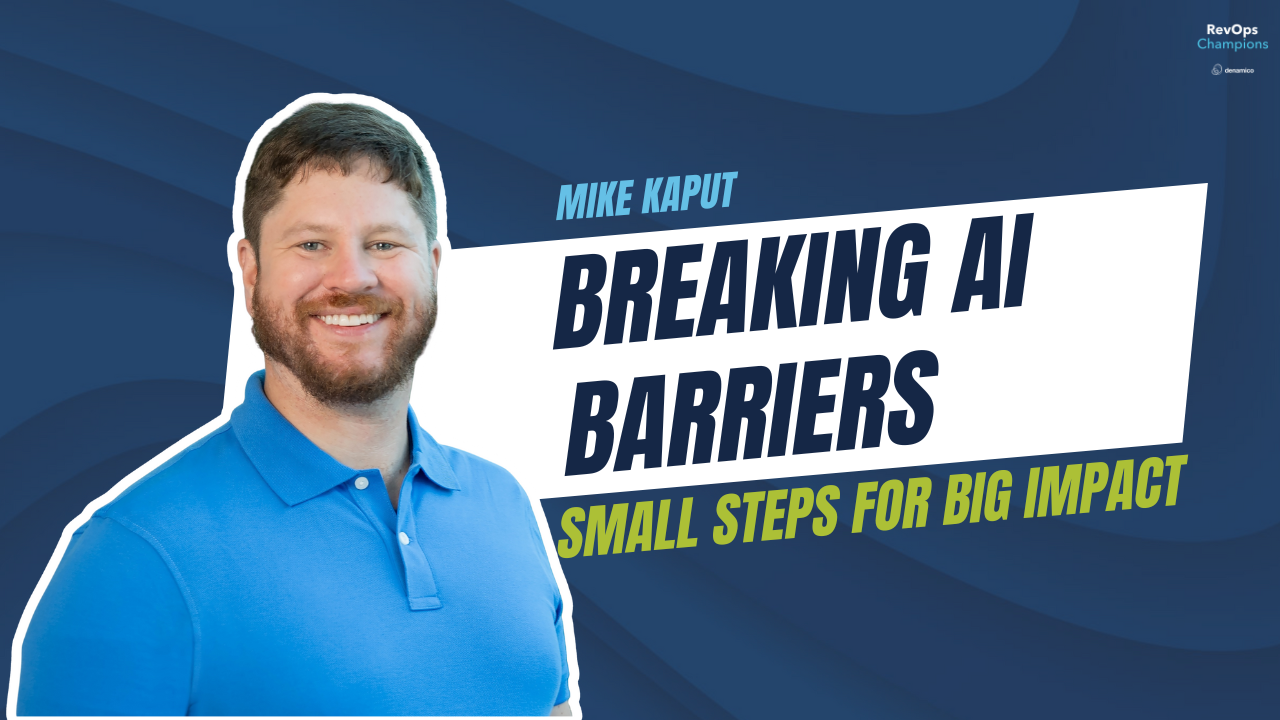
In this episode of RevOps Champions, Brendon Dennewill is joined by Mike Kaput, Chief Content Officer at Marketing AI Institute and strategic leader at SmarterX, to talk about breaking down the real-world barriers to AI adoption—and how teams can take small, practical steps that drive big results.
Mike shares the evolution of the Marketing AI Institute, which launched in 2016 to help marketers build AI literacy. Today, through SmarterX, that mission has expanded to support cross-functional teams: marketing, sales, HR, legal, and beyond, in adopting AI in a way that’s grounded in strategy and education.
Together, Brendon and Mike explore what often holds organizations back. While many invest in tools, they skip the critical first step: ensuring their people understand AI and how it can support their work. Mike warns against chasing the “next big thing” without a clear plan and instead recommends starting with what you have—documenting workflows, identifying use cases, and building a culture of experimentation.
They also highlight how RevOps plays a vital role in enabling AI readiness—from clean, connected data to structured processes. Legal, IT, and change management aren’t just back-end concerns—they're foundational to scaling AI responsibly.
Whether you're just beginning your AI journey or looking to optimize your approach, this episode offers actionable takeaways. The message is simple but powerful: AI doesn’t require a massive overhaul to make an impact. Start small. Stay consistent. And build toward smarter, more scalable operations—one step at a time.
Listen
About the Guest
.png?width=155&height=155&name=Mike%20Kaput%20(1).png)
|
Mike Kaput | Chief Content Officer at Marketing AI Institute Mike Kaput is a recognized expert in marketing, content, and artificial intelligence. As Chief Content Officer at the Marketing AI Institute, he helps organizations grow traffic, leads, and revenue through strategic use of content and AI. He is the co-author of Marketing Artificial Intelligence: AI, Marketing, and the Future of Business and author of Bitcoin in Plain English. Mike has published hundreds of articles and spoken at events like MAICON, ContentTech, and Rutgers Business School. |
Episode transcript
Introducing Marketing AI Institute and SmarterX
Brendon Dennewill: You're listening to Brendon Dennewill, a podcast created for B2B leaders to help you align your people, streamline your processes, trust your data, and leverage technology in order to grow your business. Mike Kaput, welcome to the show. It's good to have you on.
Mike Kaput: Thanks for having me.
Brendon Dennewill: As an intro, tell us a little bit about Marketing AI Institute. I cannot believe how long it's been. I keep thinking it's still three or four years old, but it's been going for much longer.
Mike Kaput: It can feel like it.
Brendon Dennewill: Because of the sort of time warp we've all lived in for the last five years. Tell us about Marketing AI Institute, and then SmarterX, which is the more recently launched venture I'm also very excited about.
Mike Kaput: Sure. Marketing AI Institute is a media, event, and education company we started way back around the end of 2016. Our founder and CEO, Paul Roetzer, that's when he launched the business. We started out as a way to tell the story of what we were seeing happening in AI. Paul owned a marketing agency that I used to work for as well, so we're both marketers by trade. I helped Paul research the AI section in his second book back in 2014 and 2015. Through that work, Paul became convinced AI was going to be a very big deal for marketers.
Through my research, I had arrived at similar conclusions, so I helped with the early content around the Institute while working at the agency. Fast forward several years, and that grew into an industry-leading source of education. We then layered events and courses on top of that. Our entire mission is to help marketers and marketing leaders understand, pilot, and scale AI. We pursue that through our annual conference, MAICON, the Marketing AI Conference, which is happening in October of this year for its fifth annual edition. We also have an AI Academy with courses, an AI Mastery membership for ongoing education, and a range of other initiatives. The entire point is to foster AI literacy for marketers, because we believe that is the most critical skill they need to survive and thrive in the age of AI.
What you referenced with SmarterX: SmarterX is our parent company, launched a couple of years ago by Paul, who is also its CEO. SmarterX was an outgrowth of what we built at the Institute. At its core, it's an AI research and education firm focused on creating AI transformation in companies. We educate and empower leaders to reimagine their businesses, reinvent their industries, and rethink what's possible. If Marketing AI Institute has driven AI literacy in marketing, SmarterX is about AI literacy for all: every industry, every function, every type of company. We also run events, education, and media through that company, so it's a new and exciting journey we're on as well.
The Expanding Scope of AI Literacy
Brendon Dennewill: I'm following SmarterX very closely. I was at the inaugural MAICON event back in 2019 in Cleveland, and it was genuinely eye-opening. I still think about things I learned there. For anyone who hasn't been, check it out: MAICON, happening in October 2025.
Marketing has always been where technology starts and leads. Go back to any major technological breakthrough and marketing is the first area impacted. It's no surprise the Marketing AI Institute launched with a marketing focus, but I've also seen the shift you've made more recently, including the renaming of your show, now called the AI Show. It's probably one of the easiest ways to keep up with the groundbreaking work you're doing every week.
With SmarterX, it's no longer just about how marketing uses AI. It's about how businesses use AI cross-functionally, because it has become that pervasive. I've seen us make that same transition over the last seven years, where we were very marketing-focused before evolving as HubSpot grew into sales, service, and beyond. We realized the real opportunity was the technology that drives an entire business.
Worth mentioning: you were recently chosen by HubSpot to train their Solution Partners on AI. That's a significant validation. SmarterX and the Institute were essentially selected by HubSpot to train any partner who wants to lead in AI literacy.
Mike Kaput: Yes. We've had a number of conversations with HubSpot in various contexts, and a lot of that falls within Paul's wheelhouse. We've had a tremendous amount of companies approach us, which has been striking, especially since January. That's when things really started to coalesce, because we released something through SmarterX called the AI Literacy Project. You can think of it as both a project and a manifesto. It's available at smartrx.ai under Education.
Paul essentially put into words everything we were seeing in the market and everything we were working toward when it comes to accelerating AI literacy for all: not only the need for it, but what the phases of that journey look like from our company's perspective. We launched a roadmap for where our AI Academy is going, and the moment we released it, we had really compelling conversations come in from major companies saying, "We need training across marketing, sales, service, HR, legal. What we're doing now isn't working. It's moving too slow, or we don't know where to start."
That response validates something we've believed for a long time: AI literacy isn't the only thing, but it is the essential starting point where a lot of companies underinvest or go wrong. That's why you see companies spending significant money on AI tools and asking why it isn't working, when the reality is they never gave their average employees any understanding of what AI actually is, what it can do, how they should be using it, or what the impact could be on their own role.
Brendon Dennewill: Which seems to be a continuation of the challenge organizations have always faced with the adoption of any technology. If you don't provide training, there's no adoption. Without adoption, you don't get the ROI of the intended investment. What you're building is incredible, and for anyone who hasn't yet figured out how to provide that training, whether for themselves, their leadership, or their teams, the resources around Marketing AI Institute and SmarterX are a great place to start. That's where I started last year. Thanks for all you do, Mike.
Mike Kaput: We try. It's been a long journey, and we're glad it's resonating with people.
What's Most Exciting Right Now
Brendon Dennewill: You have a front-row seat on this AI roller coaster. What are you most excited about right now?
Mike Kaput: If I had to pick, it's the absolute treasure trove of advanced models we now have access to. It seems like years between product releases, but when I look back, it's been weeks or a month. The biggest, most exciting recent development has been how capable these reasoning models are getting.
We're able to accomplish so much with advanced but non-reasoning models like GPT-4o. That's still impressive and useful for a huge range of tasks. But having access to something like OpenAI's o3 or Gemini 2.5 Pro, the amount of high-level strategic and creative work, brainstorming, and execution we've been able to accomplish in a short time with that level of intelligence has genuinely surprised me. That's where you start to see, beyond all the other exciting developments, the true promise of these tools. You're working with something that is, in many domains, as capable as you are, if not more so.
I'm not saying these models can do everything. But if you're any type of marketer or business professional doing planning, strategizing, forecasting, or the higher-order executive work you're tasked with as part of any quarter or year, I'd highly recommend trying these tools for that higher-value work. What they can do is stunning.
Brendon Dennewill: You're absolutely right. But one of the challenges is that you just mentioned three incredible tools as starting points, and this comes up at least weekly here at Denamico. Everyone has their favorite thinking partner. Some of us lean toward ChatGPT 4o, a few prefer Claude because of their specific roles, and then yesterday one of our engineers was making the case that what Gemini is doing right now is off the charts.
That creates a real tension: you want to commit to a tool so switching doesn't add complexity to your day. But when you hear there's something better, and you already have access to it, how do you know when to make the move?
Mike Kaput: It's a great question, and if you find the answer, let me know, because I struggle with it too. What I keep coming back to is this: it is critical to focus as much as humanly possible on use cases and to document your workflows for achieving those use cases with AI tools. Because I've been reasonably disciplined about doing this in my own work, whenever a new model drops, I can jump into a documented workflow with prompts written down, steps laid out, basic documentation that lets me quickly test a new model against an existing task.
You want that infrastructure in some form. Mine is just Google Docs, nothing elaborate. But it lets you efficiently evaluate new models without starting from scratch.
At the individual level, I'd say: get really good with one or two tools for the right things rather than getting distracted. At the business level, it's harder because you have to make commitments and plan around technology. But there's a lot of FOMO here. It's easy to think, "If I'm not using the latest and greatest, I'm falling behind." The reality is there's a very good chance you're not getting as much out of the tool you already have as you could be. That balance is important to consider.
Biggest Stumbling Blocks in AI Adoption
Brendon Dennewill: We've talked about exciting developments and powerful capabilities. Let's flip to the challenges. What are the biggest stumbling blocks you're seeing, whether firsthand or through the training you're providing?
Mike Kaput: Let me try to tackle this sequentially. First, basic AI literacy is a significant stumbling block. If your company is doing any work around upskilling and your average person in any department has no conception of what AI is or what it can do for them, you have a real problem. Start there, even if it runs in parallel with everything else you're doing.
Beyond that, I'm genuinely surprised by how many companies aren't prioritizing better prompting instruction. It's possible that in the relatively near future, you won't need to be as precise about prompting because you can get very far just having conversations with these tools. But even now, an hour spent learning a solid prompting framework, or using a model to help you write better prompts, will take you a long way. That's an undervalued starting point for a lot of people.
Another major stumbling block is shiny object syndrome, which isn't new but has accelerated with AI. People will ask me, "Which tool is best for this?" And I'll ask, "Have you actually done that use case yet?" Often the answer is no. They're waiting for the best tool. That's backwards. Go do the use case with whatever is available to you, even if the output isn't perfect. There's a lot of that.
I say this as someone who works on courses, podcasts, and has co-authored a book: all the resources in the world won't help you if you haven't actually sat down and experimented. Resources are there to support you as you use the technology. A lot of this comes down to carving out time to just play with the tool.
I've been on recent calls with really smart leaders and executives, and more than one have said, "I've really been meaning to build my own GPT." And I tell them it takes 30 seconds. We could do it right now while we're recording this podcast. The barrier is often much lower than people think. They just don't know where to focus, and it's all genuinely overwhelming. Those are very real barriers I sympathize with, but they're also some of the biggest ones I see right now.
Brendon Dennewill: It always comes back to the same thing with anything you've never done before. How do you run a marathon? You take the first step. And you did a post recently on LinkedIn making the case that if your company hasn't given you AI tools yet, just get a paid tool for yourself. It's $20 a month. Use it to help plan meals, handle personal tasks, save time at home. That builds your literacy. Then when your company does introduce it, you're already ahead.
Mike Kaput: Exactly. And I'd add that I've been surprised by how many limitations companies are placing on how their people can use the tools they do have access to. I've seen companies with custom versions of these tools that have significantly reduced functionality. I understand there are considerations I'm not privy to, and I'm sure some of those restrictions are well-reasoned. But if you've never used basic capabilities like file uploads, data analysis, image generation, reasoning models, or custom GPTs, even on your own time, you'd benefit enormously from exploring those. Because when you do get access to those things at work, or when you move to your next role, you'll already know what's possible.
Data Security and Organizational Readiness
Brendon Dennewill: How do you address concerns from leaders who aren't moving as quickly as they might, particularly around data security?
Mike Kaput: It's a significant barrier, and probably the one I left out earlier. There are very real, very difficult questions around data security. Every company struggles with similar problems, but the ways they address them and the considerations they face are so different that it's hard to give one-size-fits-all advice.
What we often tell people is this: as you move through AI transformation and build AI literacy, whether that means forming AI councils or working through these challenges collaboratively, this is not purely an IT problem to solve. It's not just marketing's problem either. You almost certainly need to involve your legal and security people from day one. I know that may not be what people want to hear because it can slow things down considerably. But it's imperative. These people will get involved eventually, and it is far better to start with their buy-in and build those relationships early.
I've worked with companies that did this well from the outset, and it made all the difference. They built genuine allies and champions within legal, IT, and procurement who helped them navigate the complex scenarios they inevitably faced, and there are many.
Brendon Dennewill: One challenge there: not every business attorney is going to be up to speed on AI security and data questions. If a few thousand companies hear this and reach out to their business attorney, what percentage of those attorneys are actually ready to advise them well?
Mike Kaput: That's a huge challenge, especially around questions of IP and copyright, which are areas of enormous concern. There are legal professionals starting to get up to speed on this, and some of them have appeared at our events. But you have to wonder how much of that market is truly current on something that is, by nature, bleeding edge. Even the most informed practitioners often acknowledge significant gray areas and unresolved questions.
I'd say, and this is not legal advice in any form: if you're talking to a lawyer who has no familiarity with this space, you probably need to find someone who does.
Brendon Dennewill: And know that they might advise you to do less than what you should be doing. That's where leaders have to make a balanced decision. Move too slowly and you get left behind. But move carelessly and expose customer data, and you might have a crisis that threatens the business itself.
Mike Kaput: Absolutely. And at a very basic level, before you get into all of that complexity: if you don't have any kind of AI usage policy for your people, you need one now. As you hire new people, especially younger professionals who are entering the workforce having grown up in an AI-first environment, they are going to default to using these tools for everything. That's already becoming part of how we all operate. You need to be telling people how they can and cannot use these tools from day one, because the pitfalls are avoidable.
It's easy for people not to know what different licenses enable from a privacy perspective. Someone might not realize, "Oh, I thought I was just sharing this with my ChatGPT. I didn't realize it's also on an OpenAI server." A clear, well-communicated policy can address a lot of these basic but serious issues while you're still working through the harder legal and privacy questions.
Brendon Dennewill: That's really solid advice. You mentioned resources on your website related to legal and security questions.
Mike Kaput: The best resource I'd direct people to is the on-demand recording of our AI for Writers Summit. If you go to marketingaiinstitute.com, look under Events. You'll find that event, and you can access the on-demand recordings. We had a full session on AI for copyright and IP, with panelists who work in that legal space. We don't have a centralized database, but those would be the people I'd suggest starting with.
Brendon Dennewill: And can people find the agenda there to get names if they want to dig further into AI and legal?
Mike Kaput: Yes, the event page has the full agenda. You can pull names from there and continue exploring that world.
Glass Half Full vs. Half Empty: What Makes the Difference
Brendon Dennewill: As we move back toward the more forward-looking topics: with anything in life, you have people who see the glass half full and those who see it half empty. When it comes to AI, what do you see as the real differentiator between those two groups?
Mike Kaput: I think about it a lot, and I'm not sure I have perfectly clear answers. But the differentiator seems to be genuine, hands-on experience with the tools, not just reading headlines. Using them for a wide variety of use cases, not trying a tool once with a poorly written prompt, having it fail, and drawing a conclusion from that.
I don't know many people who have used these tools extensively, across both personal and professional contexts, who are deeply pessimistic. They may be clear-eyed about the ways this could go wrong and actively working to prevent those futures. But it's very hard to use these tools adequately and not at least see the positive dimension. Whether you call it half full or just pragmatic, I genuinely can't think of someone who's logged dozens of hours with AI and concluded it's completely worthless and 100% negative. Experimentation and implementation are probably the differentiator, if I had to pick one thing.
Brendon Dennewill: Capability drives confidence. The reason people aren't confident about something is usually because they haven't built the capability yet. It can be as simple as the example you gave: just use it to help plan your meals for the week.
Mike Kaput: Exactly. And it's such a difficult information environment right now because there's so much hype and so many headlines around AI. I'm not trying to minimize the genuine concerns, and there are many things we need to figure out. We'll see whether this ends up being net positive or net negative in the long run. But from a practical standpoint, it's very hard to argue there are no benefits to using these tools for some things.
AI and RevOps: The Foundation That Doesn't Change
Brendon Dennewill: A significant part of what we do at Denamico falls under the RevOps umbrella. We're not just implementing and integrating CRMs and tools. We're advising clients on how to align their tech stack, their data, their processes, and their teams. There's a growing conversation around AI for RevOps. As you've moved from working primarily with marketers to working with cross-functional teams in sales, service, HR, and beyond, what's your perspective on AI's role in supporting RevOps?
Mike Kaput: This is so timely. We had a large virtual event yesterday, an AI for B2B Marketers Summit, and one of the sessions was by Katie Robbert at Trust Insights, who does deep work in AI consulting and data consulting. Her entire talk wasn't about what you should do with AI. It was about how to get your data ready for AI.
What struck me is that it's a very clear illustration of what I often see in this space: organizations get excited about deploying AI and very quickly realize they have all the same foundational issues that RevOps works to solve, issues that existed long before AI was part of the conversation. Data quality, cleanliness, silos, process documentation: all of it ends up being a significant inhibitor to AI, just as it is to good RevOps practice.
I think AI is going to transform what's possible in RevOps. But my sense today is that skilled RevOps professionals are actually needed more than ever to untangle the foundational issues. Because those issues are going to be absolutely critical to address before you can do anything genuinely useful with AI.
Brendon Dennewill: That's a really sharp observation. As we started unpacking this last year, knowing this was coming fast, we kept asking: where do we actually start in guiding clients on AI? We kept coming back to the same foundation. There's very little difference between how you'd advise a client to adopt AI and how you'd advise them to adopt any technology. It always starts with readiness. AI readiness, CRM readiness, growth readiness: it all begins there. And readiness means clean, reliable data. If you have that, you're ready. If you don't, the next step doesn't much matter.
Mike Kaput: Exactly. I can speak to this directly. Paul's agency, where I worked, was a HubSpot shop through and through. We'd go to clients to transform their marketing strategy using inbound, essentially doing a digital transformation. And probably 90% of the time, the first phase was just untangling what they had. You don't use the technology you already have. Your data is everywhere. We couldn't get to the exciting work until that was addressed. Incredibly valuable to solve, but we did not arrive on day one and immediately do the innovative, exciting stuff.
Brendon Dennewill: Looking back on that, what would you have advised those clients to do differently, knowing what you know now?
Mike Kaput: The way we approached it was pretty pragmatic. We were a small shop with focused competencies. We'd do a session upfront that we called a marketing growth hackathon: an afternoon or a full day to actually define what you're trying to accomplish and what KPIs are associated with those goals. Everything else flows from that. It sounds simple, but it was remarkable how many companies came in without that clarity. Once you have it, you can start to make sense of even a messy CRM because you can chunk it into pieces that align with the strategy and goals you've actually agreed on. And sometimes the most valuable part was simply getting all the right people in one room who had never properly aligned on those things before.
Brendon Dennewill: Funny you mention that: Paul was our guest facilitator for one of our events, I think 2018 or 2019. He came to Minneapolis and took about 150 attendees through a hackathon format. We structured it so that ideally two or three people from each organization attended together, so no one was trying to figure it out alone. They'd work through it as a small group and bring it back to their larger teams. The feedback on the value of that experience was consistently strong.
Mike Kaput: That's fantastic. I love that.
Change Management: Still the Most Underestimated Variable
Brendon Dennewill: One of the things that has become increasingly apparent, especially as HubSpot has moved further into the mid-market and the technology we implement now touches entire businesses, is that change management has never been more important. The CFO is in many of our conversations now, which was essentially unheard of six or seven years ago. And one of the primary reasons technology fails, whether it's a CRM, a marketing tool, or AI, is because there wasn't clear communication and training around the benefits for the people actually using these tools daily.
Mike Kaput: So true.
Brendon Dennewill: Change management, or whatever you want to call it, helping people understand why they're using these tools before you get to how and what, seems far more under the spotlight now than it ever was.
Mike Kaput: It's never been more important. And I think it's also a source of real frustration for people trying to find trainers, coaches, or consultants to help with AI work. There are a lot of new entrants in the market who lead with something flashy and treat AI as if it solves everything automatically. But there's this deep, historically validated change management component that hasn't changed at all. If you've been doing digital transformation work with any technology for any length of time, you recognize it immediately. What's old is new again. A lot of these newer players think they can just apply AI on top of existing dysfunction. That's usually a much steeper uphill climb than they anticipate.
Brendon Dennewill: That kind of noise is never good for something genuinely valuable. This actually came up in a team meeting yesterday: a company called Builder AI.
Mike Kaput: Yes.
Brendon Dennewill: The whole premise was helping you build your own AI. Turned out there was essentially no AI in the product.
Mike Kaput: That's been happening since we started Marketing AI Institute. Part of the reason we began publishing was to make sense of the technology landscape, to figure out what was legitimate, what was actually AI, and what was just being marketed as AI. You can more easily identify genuine generative AI today, but the worst place you see this problem right now is AI agents. Everything is being called an agent. Some of what's being labeled that way used to just be called a workflow or an automation.
It's not always malicious. Your sales reps at an AI company may not actually understand AI deeply, and that's okay. But it means we have to accept they may need education on what their solution actually does and doesn't do, and how it genuinely differs from what else is out there.
Brendon Dennewill: Which brings us right back to training and communication. When you use the same word for a hundred different things, it stops meaning anything. And then no one knows what you're talking about.
Mike Kaput: Absolutely. I'm a writer by trade, so I feel this deeply: if you're indiscriminate with your language, you tend to become indiscriminate with your thinking.
Brendon Dennewill: That's a great point.
Closing Advice: Move With Urgency, Start With Your Role
Brendon Dennewill: As we wrap up, what's your closing advice? We're in summer 2025, things are moving fast, and you're closer to the front lines of this than almost anyone. What do you leave people with?
Mike Kaput: If you have not yet begun acting with urgency around AI, now is the time. I don't want to say people are hopelessly behind, because I genuinely don't think most people are. And if you are behind, you can close the gap quickly by focusing on a select few high-leverage actions. But if you've been deferring this, telling yourself you'll get serious about it next quarter or next month, you need to step back and rethink that.
Whatever you do every day, something in that day has to move the ball forward. I'm not even saying it has to involve using AI directly. Even if all you do in a given day is document a workflow while you're executing it, that infrastructure will benefit you enormously. Even if you don't open ChatGPT that day, you're still building the foundation.
We all know you're not going to find the time spontaneously. You have to make it. I'm not saying carve out three hours every evening. I'm saying figure out how to turn what you're already doing into an opportunity: to use AI more, or to put the infrastructure in place so that when you do have a moment to think more deeply about a workflow, you're ready to move on it. A series of steps, a checklist, even the most basic documentation. Inch by inch.
Brendon Dennewill: If you do one thing a day, a year from now that's 365 forward steps. And there's a sobering statistic I think you've referenced before: 100% of leaders acknowledge AI will have a significant impact on their business, yet only 5% are actively doing something about it. If you're not doing anything yet, you're one of 19 others in the same position. Take one additional step and you're suddenly ahead of a lot of people.
Mike Kaput: And one more thing: don't overthink it. I have to remind myself of this regularly. You don't need to know every single thing happening in AI, even when tracking it is part of your job. When I feel overwhelmed, I bring it back to something specific. Today it's AI for content. Even narrower: AI for subject lines. Focus on how it applies directly to your own role. That will take you further than you expect, even on days when it doesn't feel like much.
Brendon Dennewill: That's exactly it. Look at your own situation and ask: what is one thing I'm repeating every day, every week, every month that AI might help with? Start there. Once you've solved that, ask the question again. Mike, thanks so much for being on the show. I look forward to continuing to learn from you through all the great content you and the team are putting out.
Mike Kaput: Thanks so much for having me. It's been a really great conversation.
Brendon Dennewill: Take care, Mike.
Mike Kaput: Take care.
Brendon Dennewill: Thanks for listening. If today's episode gave you a new idea for scaling smarter or helped you see your team, processes, or tech in a new light, be sure to subscribe so you don't miss the next insight. And if it hit home, share it with a colleague. Let's grow this community for forward-thinking leaders together.
Subscribe