
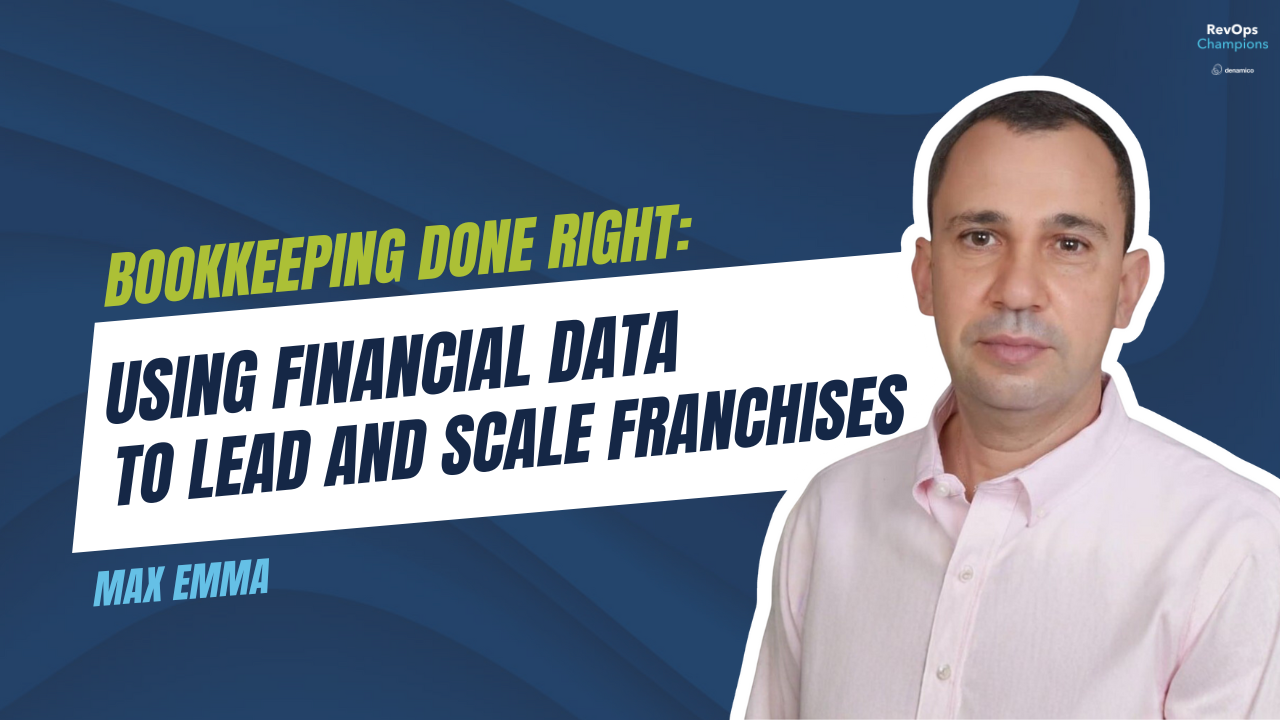
In this episode of the RevOps Champions Podcast, host Brendon Dennewill is joined by Max Emma, Entrepreneur, Certified Franchise Executive, CEO of BooXkeeping, and Founder of Main Entrance. Max shares the behind-the-scenes realities of scaling a service business into a franchise: why delegation is the first step, how financial visibility becomes a leadership advantage, and what has to be true before a business is ready to franchise.
They dig into what breaks when brands franchise too early, why capital and support infrastructure matter as much as systems, and how to think about technology, especially as an accelerator without losing the human relationships that drive long-term franchise success. Max also shares how he helps candidates choose the right franchise, and closes with practical advice on persistence, finding mentors, and building an exit strategy from day one.
What You’ll Learn
- Why “Who Not How” unlocks scale by removing the founder as the bottleneck
- How to use bookkeeping as a real-time decision tool, not just tax prep
- What must be in place before franchising, and why most brands stall under 10 units
- How training, support, and systems determine whether a franchise truly scales
- When AI accelerates operations vs. erodes human connection
- Why defining your exit strategy early shapes long-term success
Resources Mentioned
- BooXkeeping
- Main Entrance LLC
- Strategic Coach
- "Who Not How"
- QuickBooks Online
- International Franchise Association (IFA)
- Entrepreneur Franchise 500
- USPTO trademark process
- franchisewithmax.com
Listen
About the Guest
|
|
Max Emma | CEO & Chief Bookkeeping Officer at BooXkeeping Corp.
Max Emma is an Entrepreneur, Certified Franchise Executive (CFE), and CEO & Chief Bookkeeping Officer of BooXkeeping Corp., where he leads a nationwide team delivering accurate, scalable bookkeeping services through a unique multi-accountant model. He also founded BooXkeeping Franchise, Inc., a franchise that helps entrepreneurs build bookkeeping businesses with proven systems and support. In 2024, Max launched Main Entrance LLC, a franchise consulting company, guiding candidates to the right franchise opportunities with free advisory services and covered sales training. |
Episode Transcript
Introduction
Brendon Dennewill: Welcome back to the Rev Ops Champions podcast. I'm very excited to have as my guest and my friend, Max Emma. Max is an entrepreneur, certified franchise executive, and CEO of Bookkeeping franchise. He is also deeply involved in Main Entrance, his franchise brokerage and consulting business.
Bookkeeping is now a nationwide outsourced bookkeeping provider that has expanded into a growing franchise, empowering entrepreneurial franchisees with scalable business ownership opportunities. Max built his career in finance and entrepreneurship before founding Bookkeeping, identifying a gap in reliable bookkeeping services for small and medium businesses. As a franchisor, his brand now serves as a trusted partner for franchise owners and small businesses. He brings deep expertise in franchising, operational systems, and scalable business growth. Max, welcome to the show.
Max Emma: Brendon, great to be here. Thanks for having me.
The Moment That Changed Everything: Learning to Delegate
Brendon Dennewill: You've built and scaled businesses across different stages and industries. What early experience most shaped how you think about systems, business culture, and scalability today?
Max Emma: The biggest realization was that I can't do everything by myself. I have to delegate and outsource. I've always been a micromanager, and it took me a long time to recognize that I was the bottleneck in my own business. That was the biggest breakthrough.
It started with hiring an executive assistant. I'd been talking about it for years and never executed. Once I finally did, I was able to start growing rapidly.
Brendon Dennewill: I know you and I are both big fans of the book Who Not How? It came up in our annual planning meeting recently. You realize there are still a lot of people who don't understand the power of that concept: don't try to figure out how to do everything yourself. Instead, find the people who can do those things.
Max Emma: Absolutely.
Financial Visibility as a Leadership Tool
Brendon Dennewill: You've spoken openly about how financial visibility, or the lack of it, has changed how you operate. How did that experience reshape the way you think about data as a leadership tool rather than just reporting?
Max Emma: That's a core part of my outreach to business owners and to Bookkeeping clients. A lot of people do their bookkeeping once a year purely to file taxes. They mistakenly think that if they know how much money they have in their checking account, they know how profitable their business is. We both know that's not the case.
I always have to educate them, and you can literally see something shift in their eyes, like they've never thought about it that way. It's common sense to people who read financial statements, but for a lot of business owners, the checking account balance is their only gauge.
When I had my construction business, which I grew from three to 96 employees, it eventually collapsed when the recession hit. We stopped getting new clients but still had a lot of equipment to pay for. If we'd paid closer attention to the accounting, we would have caught the problem earlier. I don't know if we could have done much differently, but at least we would have been ready.
The interesting, or not so interesting, fact is that I was the one with a bachelor's in finance. My wife at the time, who later became a co-founder of Bookkeeping, had a master's in accounting. We both understood financial statements. We knew their importance. But we were so busy growing the business that we never stopped to analyze the financials.
Brendon Dennewill: That's a really good point. Even with a finance degree, when you're running a business, you can't be thinking about everything. Which, of course, circles back to your earlier point: you have to have people who are accountable for different parts of the business if you want to scale.
Max Emma: Absolutely. 100%.
From Chasing Outcomes to Mastering the Process
Brendon Dennewill: At some point your mindset shifted from chasing outcomes to mastering the process. What triggered that shift, and how does that philosophy show up in how you scale Bookkeeping today?
Max Emma: Everybody talks about finding your why. People call it different things. For me, that was the biggest turning point. Both you and I are part of Strategic Coach, and we could talk for hours about what we've learned there. I attribute a lot of my success to Strategic Coach because it opened my eyes to things I simply hadn't considered as an entrepreneur. I was so busy running day-to-day operations that I never had the chance to step back, analyze what I was doing, and build a real plan.
What changed my priorities was realizing that for a long time, my goal had been to make a certain amount of money. The biggest elevation was discovering that money is just a byproduct. It's not my goal. It's not my purpose.
The second realization was that goals are moving targets. Once you get there, they move. You will never truly arrive, because when you do, it's basically over. That's common sense to me now, but even when I talk to other people about it, they'll say, 'No, if I make $10 million, I won't have any problems.' And I ask them: you've made $10 million. Now what? What's your next goal?
Brendon Dennewill: As our friend Dan Sullivan says, arriving is the enemy of thriving. That's a really good point. With 2025 just wrapping up and all the exciting things ahead in 2026, everything ultimately comes down to people and process. Take care of your people, build systems that help them succeed, and you'll be successful. But you have to be ready to set the next goal once you reach the top of the current mountain.
Franchising Bookkeeping: What Has to Be in Place Before You Scale
Brendon Dennewill: Bookkeeping didn't just grow. You franchised it. What systems had to be locked in before franchising became viable, and what breaks if you try to franchise too early?
Max Emma: First and foremost: capital. You have to have enough money to franchise. It's a very expensive undertaking, not only to create the legal documents, file with different states, and produce an operations manual, but also to make sure people know you exist.
There are around 4,000 franchises in the United States, with roughly 1,000 leaving every year and 1,000 new ones entering. Over 70% of franchises have fewer than 10 units. Very few make it past 20, and making it past 100 is a single-digit percentage. So capital is number one.
Second, you have to have systems that you can duplicate. Third, don't try to do everything yourself. When I was building out the franchise, I thought my team could write the brand manual. We run a successful bookkeeping business, so why would we need outside help? We sat down and produced 30 pages. I realized immediately I couldn't sell that as our know-how.
I reluctantly hired a company that specializes in franchise brand manuals. They interviewed our entire team, and I flew to Chicago and spent 15 to 16 hours in one-on-one sessions answering every question they had. When it was done, the manual was over 600 pages. That was something I could present as real value and a genuine blueprint for franchisees.
On the flip side, we did hire a company to develop the marketing plan. That turned out to be a complete waste of money, but through no fault of the timing: the day we received approval to franchise was the day the country shut down in 2020. After COVID, everything changed. The franchise development strategies that worked before COVID largely don't carry the same success rate today. I probably used 10% of that marketing plan. I'm not saying don't do it, just make sure the company you hire understands a landscape that changes daily. Nobody was talking about AI five years ago, and now that's all anyone talks about.
Brendon Dennewill: You and I are both going to be at IFA at the end of February, and I'm pretty sure AI will be close to 50% of the conversation, even as we're there to help franchisors figure out how to scale, grow, and build better systems.
AI in Franchising: Friend, Not Enemy
Max Emma: Every time I talk to a potential franchisee, whether for Bookkeeping or another brand, they ask whether they need to worry about AI coming in. I strongly believe that AI is actually a friend to accounting franchises and accounting businesses, if you treat it right. A lot of people are afraid of being eliminated.
At Bookkeeping, something that used to take five hours might now take an hour to an hour and a half, and a lot of that isn't even something we have to engineer. QuickBooks Online is continuously applying AI on its own and getting better every cycle. We still need to do the final touches, and clients still want to talk to a live person. They want to discuss their kids, their grandkids, their trips. That makes up about half of our client conversations, and you simply can't replace that.
What we're doing is passing the savings on to our clients. Now we can serve three clients for the revenue we used to get from one. We're growing market share because a lot of our competition is holding their prices steady or raising them. They may be doing well financially in the short term, but they're having a harder time scaling. My profit margins are holding, and we're grabbing a bigger piece of the pie.
What Separates the Franchisors Who Succeed
Brendon Dennewill: One of the consistent themes across every franchise conversation I have relates directly to those statistics you mentioned: out of 4,000 franchises, how few have more than 100 units. What seems consistent among the successful ones is that the franchisor takes a long-term view. They're building value over time and not making short-term decisions, like selling five units in a quick hit without giving franchisees the support they need. Without support, franchisees don't succeed. And if they're not successful with the first location, they won't take on the second, third, and fourth, and they won't refer others.
Max Emma: That's the biggest thing. At Bookkeeping, I do have some multi-unit owners, but I don't envision a model where someone owns 10 territories. It's just not the model we have, and I don't think it should be.
The real validation comes from the fact that every prospective franchisee has the opportunity to call existing franchisees. As a franchise consultant, I advise my candidates to do exactly that, and I give them a list of questions to work through. The franchisor isn't present for those conversations, so people can ask anything. They can ask whether the franchisor is supportive, whether they're responsive, whether the relationship feels like a real partnership. That answer determines whether someone buys or walks away.
Every franchisee I have right now has my cell phone number. They text me directly with questions: 'I have this situation, how do I handle it?' The same goes for the rest of the Bookkeeping team. I'm not the right person to answer technical questions about QuickBooks, but I'm absolutely the point of contact for business development, sales, and new ideas.
Franchise Brokerage: How Main Entrance Was Born
Brendon Dennewill: Something you shared with me a few months ago was that after being in the franchise space for so long, people began coming to you for advice, and you realized not all of them were a good fit for a Bookkeeping franchise. That's what led you into franchise brokerage and consulting, and your business Main Entrance. Now that you can consult people who are getting into franchising for the first time, what are the commonalities you look for when recommending two or three franchise brands for a particular person?
Max Emma: The first myth people bring in is, 'I'm great at this, so I should open a business in this area.' They'll say they love to cook, so they should open a restaurant. But if you buy a Domino's, Domino's isn't going to change their recipe for you. Your grandmother's pizza recipe doesn't apply. Making pizza for a family dinner is completely different from producing 100 pizzas an hour that look exactly the same, with 10 people in a kitchen not bumping into each other and a process built around every single step.
The same logic applies across industries. Someone says they love dogs. Great. But having one dog at home is very different from running a dog grooming operation with 30 dogs coming through per day. Are you actually ready for that?
On the other side, if you genuinely dislike something, maybe that industry isn't for you. If you don't like animals, dog grooming probably isn't your business. If kids at home drive you crazy, a children's tutoring franchise may not be right either, because even if you're not there full-time, you'll still be walking into a room full of kids running around.
A lot of people confuse hobbies with business models. I believe you can run a very successful painting company without knowing how to paint. You need to understand the process, but you don't need to be a talented painter. That's the first thing I work through with people.
The second thing I'm assessing is whether they're coachable. That's the most important quality in franchising. Not everyone is. A lot of people are born leaders and find it genuinely hard to operate within someone else's system. But when you're a franchisee, you follow the system. Even if you're convinced that adding pizza to a burger shop would add value, McDonald's isn't going to let you sell pizza.
Speaking of our own business: Bookkeeping does not offer tax services. That's a deliberate strategic decision. We get a lot of referrals from CPAs, and it positions us as the only true bookkeeping franchise. We could become another H&R Block or Liberty Tax, but I'd never find a CPA who refers business to H&R Block. I do get potential franchisees who push back, asking why we're leaving so much money on the table. My answer is: this is our business model, and we're committed to it. If it's not a fit for you, that's okay. Don't buy Bookkeeping.
Finding the Right Match: How Franchise Recommendations Actually Work
Brendon Dennewill: When you're in your brokerage consulting seat and you're at the end of a conversation with someone, and you have five franchises in mind that could be a strong fit, what qualities do those five brands tend to have in common, even if they're in completely different industries?
Max Emma: First, it's never just one conversation. If you want to do it right, it takes several meetings. I start with industries, not specific brands, because I don't want to build excitement around a particular business only to find out it's sold out in their area. McDonald's, for example, won't allow you to build a new location right next to an existing one.
Bookkeeping is a home-based business with no geographic restrictions, but we do protect marketing territory. So I present industries first, and once we've narrowed it down, we run territory checks to see which brands are available.
Take senior in-home care as an example. There are 68 franchises in that space in the United States. Of those, I'd estimate the majority have sold out their best territories. So if someone wants a senior care franchise in their city, they may have to look at smaller markets outside where they live.
Then we research and present options. When I'm evaluating competing brands within the same industry, the qualities I focus on are: What does their training look like? What does franchisee validation say? What level of ongoing support do franchisees receive? I'm a franchisor myself, so I look at this from multiple angles. We also provide bookkeeping services to over 100 franchise brands in the U.S., so I personally know many of the CEOs. I know their personalities, how they communicate with their teams and clients, and I can share that context for each case. Training and support are the two biggest things I'm looking for.
Capital, Systems, and People: The Three Pillars Before Franchising
Brendon Dennewill: This circles back to what you said earlier about what needs to be in place before someone can successfully start a franchise. Capital is number one. Then systems. Would training be the third? Because until you can build a proper training program for franchisees, you can't really be successful as a franchisor?
Max Emma: That's true, but you also have to have enough people to support your franchisees. I've seen franchises sell hundreds of units in just a few months, then find themselves unable to deliver the training and support because all those locations needed to open at the same time. One example I have in mind was a brick-and-mortar concept. Their team had to go find locations for 100 franchisees simultaneously. That's extremely difficult to execute well.
Having enough staff to genuinely support franchisees is critical. I also strongly believe that you can and should outsource many functions today. The old-school franchisor thinking says, 'I want these to be my own employees.' I agree for the core functions. But anything that can be outsourced without sacrificing quality should be, because you'll save both money and headache by not carrying those people on payroll.
Brendon Dennewill: So capital is absolutely the first priority, and a big chunk of that capital is going toward hiring the team that will support the business and the franchisees.
Max Emma: Absolutely. And then marketing. If nobody knows you exist, you can have the best franchise in the world and it won't matter.
The Most Important Question Before Buying or Building a Franchise
Brendon Dennewill: For operators thinking about franchising their business or buying into one, what is the single most important question they should ask before moving forward?
Max Emma: The same thing they teach in business school: you have to have an exit strategy. What is your actual goal? Is it to build 10 locations and eventually sell? Is it a lifestyle business that supports the way you want to live?
One of my most successful franchisees works four hours a day. She could probably triple or quadruple the business, but she's told me clearly: that's not her highest priority right now. She'd rather volunteer at her daughter's school, travel with her husband, and keep her yoga routine. She knows that when her daughter gets older, she'll dedicate more time to growing the business, but this is her choice. I can see exactly what she could do if she pushed, but who am I to argue with that?
Of course I want her royalties to triple. But that's not what she's looking for. So you have to know your own exit strategy and your own goals.
When we do training for Bookkeeping franchisees, we help them write a business plan. I always ask: where do you see yourself in one, three, and five years? I used to ask about 10 years, but I've taken that out. Ten years is simply too far out to plan meaningfully. Based on those answers, my team and I help develop the marketing and sales plans that will get them to their goals.
Brendon Dennewill: That franchisee sounds like a very smart person. Too many of us get caught up in financial success and forget about the rest of our lives: our relationships, our purpose, the things that actually matter.
Max Emma: Absolutely. I look at her social media and she's just living the life she wants to live. She's making a very comfortable living as a Bookkeeping franchisee, but she's also genuinely happy. I respect that entirely.
Brendon Dennewill: And she has the option to step it up whenever she's ready.
Max Emma: Absolutely. Personally, I understand the argument for working more hours to get better results. But the math doesn't work out the way people think. If I work 20-hour days, I can probably sustain that for two or three days, and then I need four or five days to recover. Every day around 4 or 4:30, I shut down my computer and go to the gym. The times I've stayed past that, I look up and it's 9 p.m. I haven't eaten, and there are still more things to do. When you run businesses, there is always more to do. At some point, you have to stop and let the rest wait until tomorrow.
Operationalizing Lessons: How to Build a Team That Actually Learns
Brendon Dennewill: I've heard you say many times that lessons repeat until they're learned. How do you operationalize that idea so teams actually improve from the data and the experiences, instead of just reviewing what happened?
Max Emma: It comes down to finding the commonality between failures. We have offices in multiple countries. Early on, we thought that if we moved an office from one country to another, we'd get better results. But it wasn't about where the employees were located. It was about how we were training and managing them. We had to fix that before we became successful. I wish someone had told me, because it cost us a lot of money and time before we figured it out.
Before going into franchising, Bookkeeping was acquiring bookkeeping practices throughout the United States and bringing them under the Bookkeeping brand. It was a great experience, but an expensive one, because at that time clients still expected their bookkeeper to be local, someone they could walk in and see. When we consolidated everything under the corporate office and moved to remote delivery, we started losing clients. We were offering more efficiency, but not everyone values efficiency the same way.
I remember one client vividly: an older woman who drove 45 minutes each way to the office of the firm we had acquired, just to drop off an envelope with her financial statements. She'd go to the second floor, have a cup of tea, talk to the owner, then drive 45 minutes back. We told her she could fax, email, or scan. We even offered to buy her a scanner. She said no. She'd been doing it that way for 15 years and she wasn't changing. When we closed that office, she was one of the first to leave.
We can debate whether she wasn't operating efficiently. But we lost her as a client. We're not the best fit for everyone, and that's completely fine. Embrace it and move forward.
Technology as Accelerator vs. Distraction in the Franchise World
Brendon Dennewill: As we mentioned earlier, AI is going to dominate a lot of conversations at IFA next month. Over the last 20 years, we've both brought in technology to make our systems faster, more usable, and easier to share. AI is the next level of that. But where do you think technology can become a distraction rather than an accelerator, especially in the franchise environment?
Max Emma: It can be a distraction in personal relationships. Now that AI can write your emails, text messages, and LinkedIn posts, when someone receives an outreach from you, they genuinely don't know whether it came from you or from an automated system. I personally go and wish happy birthday to all my Facebook friends myself. I enjoy doing it. It's important to me. That's a small example of something I refuse to automate, because the personal touch matters.
I also feel what I'd call 'over-zoomed.' Being in front of a screen for extended stretches and not having real in-person discussions takes something away. Whenever I can, I make the effort to meet people face to face. I'm going to Dallas later this month and I have two franchisees in the area. I'm leaving one extra day just to spend time with them. From there I'm going to Orlando, where I have two more franchisees, and I'm giving myself another extra day for that. I can't replace those in-person conversations. Yes, it's more efficient to do it over Zoom. But it's not the same.
Brendon Dennewill: So what you're saying is: there are certain things technology will help make your business more efficient and valuable, but there are certain things you don't want to give up. Anything that adds the human touch is something technology simply can't replace.
Max Emma: Yes. Some people will choose to give up the human touch because it saves them time. I'm not willing to do that. At Strategic Coach, for example, I know quite a few very successful people who attend virtually because they're saving two days of travel and all the airport headache. I refuse to do that. Being in the room with people like you is priceless. And it's not just the eight hours of class. It's what happens afterward, at dinner, at the hotel bar. For me, that's where the most important conversations happen.
Advice for Anyone Considering Franchising in 2026
Brendon Dennewill: To wrap up: 2026 sounds like you're as excited about it as I am. What advice would you give to someone who is currently considering becoming a franchisee?
Max Emma: Not just for franchisees, but in general: do not take no for an answer.
When we came up with the name Bookkeeping, an attorney told us we wouldn't get USPTO approval because it was too close to the generic word 'bookkeeping.' He said we'd have to call it something like 'Max's Bookkeeping.' I said thank you, went to another attorney, applied, and got it approved. The name means everything in business. If it were called Max's Bookkeeping, franchising the concept would have been far more difficult.
And Bookkeeping was just ranked on the Entrepreneur 500 list, at number 330, out of 4,000 franchises. Four months before that, I spoke with someone at the magazine who told me we didn't have enough franchisees yet and to come back in a few years. I still filled out the application, because what did I have to lose? After we got ranked, he reached out and said, 'I don't know what happened, but I'm so glad you didn't listen to me.'
So that's advice number one: don't take no for an answer.
Advice for someone becoming a franchisee or considering starting a franchise: please talk to someone who's done it before. Most of the time, it's a free conversation. When people come to me about potentially buying a franchise, my services are completely free. We're paid by the franchisor if you buy. I go one step further and share a significant portion of that commission with the candidate and cover nine months of their sales training, even though I receive no royalties after that.
I put all my franchisees through the same sales training and I know it helps them succeed. So I extend that to every candidate. Don't be afraid it's going to cost you. Find the right advisor. Two heads are better than one, and five are better than two.
Brendon Dennewill: That's really good advice. Next time I have you on the show, I want to talk about the very special energy that exists in the franchise world. You touched on something important: I haven't come across anyone in franchising who isn't willing to have a conversation and would never think to charge you for it, whether they're an attorney, a franchisor, or a consultant. People genuinely love what's happening in this space, regardless of industry, because of the incredible value and connectedness it creates.
Max Emma: Absolutely. People are willing to help. I remember a few years back I stopped the CEO of a franchise with over 2,000 units and started asking questions. At the time, I probably had two or three units. He talked to me for 20 minutes, gave me a lot of advice, and then said, 'Write down my cell phone number. If you have any questions, just text me.' He had zero interest in Bookkeeping. He was actually a keynote speaker at that conference. I was genuinely struck by it.
So now I feel almost obligated to do the same for people just getting started.
Brendon Dennewill: There just seems to be a culture in the franchise industry that is very contagious in the best way. Everyone wants to help everyone else, because we all succeed together. Max, what's the best way for people to reach you?
Max Emma: Find me on LinkedIn under Max Emma, or visit franchisewithmax.com. There you can choose whether you want to talk about bookkeeping services for your business, buying a Bookkeeping franchise, buying a different franchise, or becoming a franchisor. You'll speak with someone on my team first, but I promise that I personally talk to everyone who comes through that website. If I can help you, I certainly will.
Brendon Dennewill: Awesome. Max, thanks so much for spending this time with me. It was great to catch up, and I look forward to seeing you again soon.
Max Emma: Thank you for the opportunity, Brendon. Great to see you.
Subscribe