
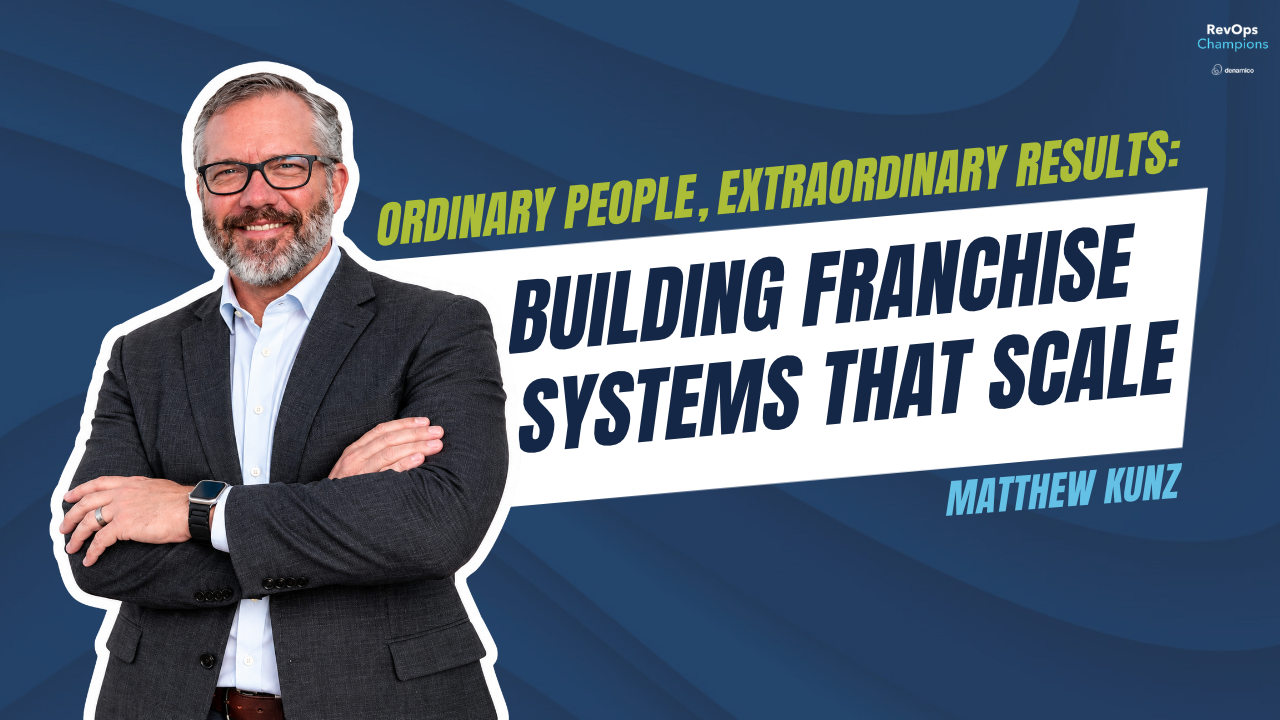
In this episode of the RevOps Champions Podcast, host Brendon Dennewill sits down with Matthew Kunz, President and CEO of Fastest Labs, a growing franchise brand in drug, alcohol, and DNA testing services. With nearly three decades in franchising, from his start as a Sylvan Learning franchisee to leadership roles at Mr. Rooter Plumbing and Five Star Painting, Matt brings an engineer's discipline for repeatable systems and a hard-won appreciation for the human side of franchise growth.
Matt shares why franchisee support must balance data with emotion, how a "quality communication" standard creates accountability without eroding trust, and the phases-of-development model that aligns specialized franchise business coaches to each stage of an owner's growth, extending coach tenure from two or three years to five or six. He also explains why franchisee profitability matters more than AUV, the survey question that reveals system health, and the first thing emerging franchisors should evaluate when growth outpaces their processes. Franchise executives, operations leaders, and emerging franchisors will walk away with practical frameworks for scaling support, leading change, and building a system where owners succeed.
What You'll Learn
- Why franchise support must balance data and emotion
- How a coaching model by growth phase reduces FBC burnout
- The franchisee-to-coach ratio that keeps support effective
- Why franchisee profitability outranks AUV as a health signal
- How to lead franchisees through software and system changes
- What to secure first when growth outpaces your processes
- When to use one-to-one versus one-to-many communication
Resources Mentioned
- Franchise Business Review (FBR)
- International Franchise Association (IFA)
- Franchise Advisory Council (FAC)
- Amazon Web Services (AWS)
- Maslow's Hierarchy of Needs
Listen
About the Guest
|
|
Matthew Kunz | President & CEO | Fastest Labs
Matthew Kunz is President and Chief Executive Officer of Fastest Labs, a franchise brand specializing in drug, alcohol, and DNA testing services. A mechanical engineer by training, Matt began his franchise career as a Sylvan Learning franchisee before leading the brand's domestic and international operations, and later held senior leadership roles across Neighborly brands, including Mr. Rooter Plumbing and Five Star Painting. With nearly three decades in franchising, he is known for building repeatable operating systems, franchisee coaching models, and support structures that turn strategy into consistent execution. His leadership philosophy centers on relationship-first, process-backed growth and healthy franchisee unit economics. |

Episode Transcript
Introduction
Brendon Dennewill: Hello and welcome back. Today I'm excited to welcome Matthew Kunz, Chief Executive Officer of Fastest Labs, a growing franchise organization specializing in drug, alcohol, and DNA testing services.
With almost three decades of experience in franchising, Matt brings extensive expertise in franchise operations, organizational growth, leadership development, and multi-unit business performance. His experience includes helping franchise systems navigate the challenges of expansion, strengthen support structures, and build the processes needed to translate strategy into consistent execution.
As CEO of Fastest Labs, Matt's leadership perspective emphasizes relationship-first, process-backed growth; healthy unit economics; franchisee support; and a culture where franchise owners and teams can succeed together. His professional experience also spans franchise development, field support, accountability, B2B sales, local relationship-driven lead gen, and national accounts.
What makes Matt's perspective particularly valuable is his ability to connect people, process, and performance. Through his focus on repeatable operating systems, mentorship, and leadership development, he offers practical insights into how growing organizations can strengthen execution, support franchisee performance, and build the foundation for sustainable growth. Matt, welcome to the RevOps Champions Podcast.
Matthew Kunz: Thank you for having me.
Lessons from an Engineering Background and Three Decades in Franchising
Brendon Dennewill: Matt, you have nearly three decades of experience in franchising and have worked across different franchise sectors. Looking back at your career, which experiences most shaped the way you think about building and scaling a franchise organization today?
Matthew Kunz: I pride myself on being a student for life, so I think it starts with the foundation. Before I was in franchising, I was a mechanical engineer. I think about the processes and disciplines that trade taught me about building systems. That's where the repeatable process comes from: breaking it down to its smallest component and making it as easy as possible for the average person to execute, whatever the product, good, or service.
Each step along the way has taught me what to do and what not to do. I was with some brands that made some mistakes, and I made some mistakes. I think I learned a lot more from the mistakes than I did from the wins. Wins tend to cloud your judgment on the learning opportunities.
Brendon Dennewill: Absolutely.
Matthew Kunz: A couple of things in franchising stand true. Rarely are you doing something for the first time. There's somebody in the industry, somebody in your business, a mentor, or a peer who has at least a similar experience. So I think the very first step is recognizing that we're not moonwalking here for the very first time. There's somebody who's done something similar that we can talk to and learn from.
Then it's that constant lesson that it's not going to be me executing the process. It's the franchise owners and their employees who are going to take those steps. So you've got to constantly be thinking about how to make it so an average, competent person can do it. I don't want to use terms like "idiot-proof."
I had a franchisee back in my Sylvan days, a great couple of guys out in California who had multiple centers. Jack was famous for getting right in my face and saying, "I don't want to hire extraordinary people and have them do ordinary things. I want to hire ordinary people and allow them to do extraordinary things." I still remember that finger in my face when I was young in this business. He was right. That was one of the best lessons I learned, and I was very fortunate to learn it early in my career.
For a franchise system to be successful, the average person has to be able to do extraordinary things by executing the systems that my team and I develop.
Brendon Dennewill: That is really good advice, and there was a lot of good advice in there. The fact that we definitely learn more from our mistakes than we do when everything goes well is a repeating theme in successful business growth.
Leading Change in Emerging vs. Mature Franchise Brands
Brendon Dennewill: Matt, throughout your franchise leadership career, you've worked through different stages of organizational growth, including challenges involving development, support capacity, and profitability. Can you share a particular experience that changed the way you think about sustainable franchise growth?
Matthew Kunz: One of the differences I've noticed is the unique position I'm in today with an emerging brand. It's been franchising for about sixteen years, so it's still relatively young. If I were going to put it in a stage, it's going from juvenile to young adult, and there are a lot of unknowns that go into that. Previously, I took over a very mature brand, a large, fifty-year-old brand.
Steering those ships is very difficult. Right now, I can make a decision today, have an execution plan by Friday, and have an FAC meeting Monday to walk them through it and get their input. We make an announcement next Wednesday and start rolling out next Friday. When I was at Mr. Rooter Plumbing, it was months of talking, game planning, and building it in a sandbox. That's important for all brands, but in that big brand, there were more moving parts and a much larger, more complex system in place.
So I think it's always important to ask: Can you undo this change with relatively low pain? If this is the wrong way and we have to reverse it, is it going to be super painful? We had to make some changes at every brand I was at, from logo changes to software changes to website vendor changes. Unfortunately, I've had to go through multiple website vendor changes at every brand I've had the opportunity to lead. Those are extremely painful experiences.
You've got to focus on feel versus fact. Make sure you're addressing the fear, but focus on the facts and what we control. Let people know: here's what it looks like today, here's what we're going to do tomorrow, and here are the goals. We should expect a little dip, then a ramp-up, and then be in a better place going forward.
It's those levels of communication. You've got different types of franchisees in every system. You've got the Chicken Littles, where one little hiccup and the sky's falling. You've got the people who aren't fazed by anything. Then you've got all the people in the middle who are marginally engaged with their business, or it might be their second business.
You've got to make sure you're communicating to all of those people. Some people just need to have that freak-out moment so they can fully exhale, and then they can hear what you're saying for the first time and you can move forward. Those are some of the lessons. I know I didn't give a very specific example, but there are so many.
Software changes are probably the biggest. When you're changing your point-of-sale system or making a significant upgrade to it, those are very emotionally driven decisions at the franchise owner level. You can't lose sight of the emotion involved. With my engineering brain, I think mostly in facts: A is better than B, so we're going with A. It's a stack ranking and we move forward. There's not a lot of emotion on my end.
But for the people who have invested their money and their lives into running this business, that software is an extension of them. If you're moving their cheese a little bit, maybe they don't want their cheese moved. So you've got to really go through the benefits and the analysis and give everybody time to go through their stages of change at their own pace.
At the same time, we have a definite timeline to get this done. So you've got to let them go through their stages at their pace, but you also have to guide and push that pace along. Leading a franchise brand is a lot like balancing on a beach ball. It takes constant adjustment to stay where you want to be.
Why Change Management Matthewers More Than Ever
Brendon Dennewill: Especially if you're growing. If you're not growing, change is a little easier to handle. But if you are growing, and everybody in the network wants to continue growing, then you're going to have more frequent change.
You started touching on some of the things we help franchises and other multi-location businesses navigate. When you outgrow your technology or your systems, the leadership team makes that decision because they know the existing system is not going to get them where they want to go. To your point, you've made that decision and you know it's the right one, but then it's about navigating that change.
As you were speaking, all I was hearing is that change management is such a critical piece of this. I believe change management is going to be an even bigger deal in the next couple of years because of what's happening with AI and all the opportunities it's bringing. Leadership teams are going to realize there's a better way to do things, and they're going to make decisions to do those better things. Then they have to bring everybody along on that journey, which is not easy. But change management is becoming a more real practice that businesses, especially growing businesses, are taking on board, and I think they're getting better at it every year.
Matthew Kunz: In business today, worldwide, you have to. And you're right, it's not just more important; it's more frequent because of the rate of change.
I had several mentors, and I don't remember who originally said this, so I don't want to take credit for it. But they said, "If you don't like change, you'll like irrelevance even less." That could not be more true than it is today.
And it's not just AI. AI is changing how we work, but there's also an extreme change in consumer behaviors that is both related to AI and politically charged. All of those factors come into play in consumer behaviors, trends, and preferences. At the end of the day, that's what we're responding to. If you don't have a consumer buying your product, you don't have a product to sell, and you don't have a business to operate. Yes, we all want the efficiency of AI, but our customers just want the product in their hands faster, better, and stronger.
Brendon Dennewill: It's interesting, with your background as an engineer. One of my kids was fortunate enough to have an engineering class in high school, and we were all so excited about it. I remember the teacher had us parents come in and sit down. There was a big display with maybe six or seven slides. The only slide I remember from that class was two words: "Failure equals success."
I thought, this is what kids need to be learning, because that's the science part. If you talk about the art and science of business, especially growing a business, that is the science part, which I totally agree with. But to your point, the hard stuff is the soft stuff, as they say. It's the art of bringing the humans along. You can see where you need to go, but getting there is a little trickier.
The Emotional Side of Franchising
Matthew Kunz: Right. I remember early in my career in franchising, I started as a franchisee with Sylvan Learning. After a number of years, they invited me to come to the corporate office. So I changed sides and ran their operations, both domestic and international.
It might have been the second or third franchisee I visited. This franchisee was doing okay but could be doing so much better. We did the analysis, I had all the data, and I flew to their location and sat down with them. This was the early 2000s, so you emailed to say you were coming, but you didn't have a video conference. You went and sat face to face with them.
I'm halfway through the meeting, and this franchisee starts crying. My engineering brain is just like, "I don't understand why there's liquid coming out of her face right now." We weren't talking about anything emotional, or at least it wasn't emotional to me.
So finally, I said, "Okay, what did I say? What was wrong?" And she said, "I'm not upset. I'm happy. I've been struggling with this, and you showed me what I was missing." It was just this happy moment for her, but she was so emotionally connected.
There were two big lessons there. First, I was not consciously preparing for the emotional side of the conversation when I went out and talked with owners. Second, when you work with these franchise businesses, it is impossible to put a delineation between where the person stops and the business starts. They're the same. The person and the business are intertwined at the molecular level, and you have to recognize that as a franchisor.
In fact, you have to adopt that in your own business. At Fastest Labs, I've been there about a year and a half, and I take it on as a badge of honor. This is my business. I put this jersey on and go to work, get emotional about it, and high-five people when there are wins. Let's get serious about learning when there are opportunities to learn.
That's what franchise owners want. They want to see that there's an emotional investment as much as a financial one, because the emotional investment is way larger in the franchisees' minds than their financial investment.
Balancing Personal Relationships with Systems and Processes
Brendon Dennewill: Because they've literally invested everything to be a franchisee in many cases. That brings me to my next question: How do you balance the personal relationships that drive franchise success with the systems and processes needed to maintain consistency across a growing network?
Matthew Kunz: Let's get back on that beach ball and say it's constant adjustment. With one franchise owner, you need to lean a little more to this side, and with the next, it's the opposite direction, or some degree in between.
To my last point, I need to know what's going on in their life outside of the business. If they're going through health challenges, a divorce, or a kid moving off to college, all the things that happen to human beings, those affect the business when you're running a small business. So I need to know what's going on and learn how to understand it.
At the same time, I can't take ownership of solving the personal. I can only guide them, coach them, and push them through to business success. So we bring it back: "I'm sorry you're going through all that. I understand that's tough. Let's make sure the business doesn't add to the stress. Let's get this thing running and bring in the manager," whatever the situation is.
You want to be friendly with your franchisees, but it's important to have a clear line, because at some point you might have to issue a default, come down on them for a compliance issue, or give them some tough love. That's not as easy if you're so close that you're having beers with them on a regular basis. It's hard to discipline that friend when they really need it.
So you have to toe that line. But some franchisees are different. When I was at Mr. Rooter Plumbing, they weren't going to trust me at all until I sat down at the bar and had a beer with them. We fought like the dickens in the meeting, then went to the bar afterward, toasted a beer, and talked about hockey and whatever else was going on. That's when they finally heard what I was saying in the meeting, because I was relatable to them. But I didn't go on vacation with them or anything like that. You have to have boundaries.
It's having that constant awareness of what adjustments you need to make and understanding that your franchisees are not all the same. They're as far from a cookie-cutter operation as you can think of, so you've got to treat them differently. You've got to meet them where they're at in every circumstance.
I wish I could give viewers a simple five-step process for connecting with your owners, but it would be like a two-hundred-fifty-step process, and I'd still probably be missing some steps. It's being flexible, meeting them where they're at, and understanding that they're unique, individual human beings.
Brendon Dennewill: It sounds like that is the three-step or five-step approach. You have to meet them where they're at and then go from there. That's really good advice. In summary, you could say when you've met one franchisee, you've met one franchisee. It's not "when you've met one, you've met them all."
Matthew Kunz: Right. At the same time, you can take advantage of where they are similar. In your communications, you can say, "This communication is very consistent across all our franchisees, so this is a one-to-many conversation." Another topic is very individualized, so maybe it's one-to-small-group or one-to-one. That helps guide you in efficiency as well.
Brendon Dennewill: So it's discerning exactly where you need one-to-one and where you need one-to-many communication. That's really good.
What Effective Franchisee Support Looks Like
Brendon Dennewill: Matt, from your perspective, what does effective franchisee support look like in practice? And how can franchisors create accountability while continuing to build trust with their franchise owners?
Matthew Kunz: The very first thing we do is establish a standard with our coaches. We've got franchise business coaches, a help desk, trainers, and so on. The minimum standard is a monthly quality communication: a minimum of one a month per owner.
Then you go a step further and define what quality means. Quality is not just "I sent them an email." This can differ based on the owner and their preferences, but it's a two-way conversation where information is gathered, information is shared, a specific topic is pushed forward, agreement is maybe gained, and the conversation is furthered. At minimum, it's got to be two-way communication: listening to their concerns, understanding where they're at, hearing their opportunities, and seeing if we can provide the methods to capitalize on them.
Ten years ago, I used to dictate that it had to be a video call on Teams, recorded and logged. Today, I don't dictate the medium. For some owners, it could be text messages, emails, video conferences, phone calls, or in-person visits. But I need that quality communication, and I need it logged in our system. That's the minimum standard.
Very rarely do we have just one. With our more engaged franchisees, the higher performers, you have a quality communication on a weekly basis. Then you've got the very unengaged franchisees, where you struggle to get the one in, and some months you can't even get that one communication.
So the first thing is establishing that we have to communicate in order to support. The next step is that the communication has to have a financial component. There's got to be that baseline. For some franchisees, this is the majority of the conversation. For others, it's two or three minutes: "Hey, I looked at your KPIs. Looks good. Let's not take our eye off this ball. Where's your next biggest opportunity?" Then we spend the majority of the conversation on that.
For other franchisees, you know financials and KPI dashboarding are not their strength. We have to take a lot more time and say, "This is what your current dashboard looks like. When you move this conversion number two points to the right, your average ticket goes up and your profit margin goes up." You have to show them all that and let them feel it and see it, so they know why it's important to focus on conversion.
It could be something else, but conversion is always a hot topic for us. It's a lot easier to make money if you're converting two points higher than you were last week. You're already spending the marketing dollars, so you get more bang for your buck.
The Phases of Development Model
Matthew Kunz: Then we take it a step further. We operate in what we call phases of development. They're identified by revenue bands, and people always get hung up on the revenue, but the revenue isn't as important. Each phase is when the franchise owner has to make a significant change in what they do, and that often includes more things they have to stop doing than things they have to start doing.
Their focus gets narrower. They have to let go of the front line. They've got to move up into manager, then sales leader, then enterprise management. When they have to redefine who they are as a business owner, that's when the phase changes.
Then we align our coaches to those phases. In a normal franchise, a coach is a very unique human being, because they have to be an expert in startup, multi-unit management, hiring a GM, and running sales conferences. If your FBCs were franchisees, they would be super franchisees. That's what we're expecting them to be, and that's very difficult to find in an employee.
You've got some brilliant individuals, and what we want to do is narrow their focus. If they focus on just phase one, that FBC becomes the absolute expert in moving franchisees from opening to profitability. That's their window of opportunity. Then they hand them off to the next FBC. Now the franchisee is hiring managers and growing the business, and that's this FBC's wheelhouse of expertise.
So they become specialists. They still have to understand all aspects of the business, but they don't have to be experts in every phase. We have seen faster growth, and then come the benefits of gamification. Franchisees take their phase very seriously. "I went from phase two to phase three in the last twelve months." When they come to conference, they have a little badge that says they moved up a phase.
It becomes a badge of honor. It also becomes a bit of a cone of shame if they're not moving quite as fast. Then a little peer pressure comes in, people want to help them, they start asking the right questions, and we move them up. It's a fun way to do it, and it helps me move franchisees faster.
One of the biggest benefits of the phases of development is FBC retention. Before we had it, you'd have two or three years with an FBC, and then they'd say, "Man, I just can't do this anymore. You're asking too much."
Brendon Dennewill: They just burn out.
Matthew Kunz: Yeah, they burn out and go do something else. Now we've got five- or six-year tenure with our FBCs, and FBCs who are more promotable because they've shown they're an expert in something. If you want to get promoted, don't be an expert in everything; be an expert in one thing. That's how you move up the ladder: "I can do this better than everybody else." As the business scales, everybody's vision narrows.
Brendon Dennewill: Right. From my understanding, every role in any network is important, but most people would tell you the FBC is the most critical person in an organization, because they are the link between the zor and the zee. It sounds like you would agree.
Matthew Kunz: I would say it's one of the most critical jobs. It's also one of the harder jobs, but it's one of the most rewarding, because they get to feel the win first. They're the first person the franchise owner texts, calls, or emails when they have a success. There's a mentor-mentee or parent-child relationship, whatever analogy you want to use. It's challenging, though. They get hit with the bad news and the challenges first. But they also get to feel the rewards before anybody else.
Brendon Dennewill: I've heard a lot of incredible stories. They're the ones who get the birthday messages and the "congratulations on whatever your kid did."
Matt, the phases of development approach, where you have specialist FBCs for each phase, is that a fairly common approach, or is it something that's increasingly used?
Matthew Kunz: No, it's something that was invented during my time at Neighborly, with the help of a few others, and this is now the third brand I've implemented it with. It's not very common. When I go to franchise conferences, especially with operations leaders, when they hear about it, people always pull me aside and say, "Tell me more." I guide them through it a little.
It's just about getting the concept. Once you have the concept, the document writes itself. The way I describe it, it's like going to a theme park. You go to Disneyland and walk in, and there's a sign. It's probably digital now, since I haven't been there in years, but I remember a sign that said "You are here." Then you see the ride you want to go to and a little snake path. It doesn't have every brick mapped out, but you see it's a left, then a right, go past the hot dog stand, and you're there.
It's about finding the pitfalls that are going to derail me from getting there. What are the steps I have to take? What does it look like along the way? It's almost like a literal map between here and there.
Brendon Dennewill: Like a wayfinder.
Matthew Kunz: But it's not the exact recipe. We're not baking a cake with exact measurements and exact temperatures. This is a journey from here to there. You might hike faster than the next person, or you might not get distracted as easily. You can take those paths differently, but it serves as a guide more than anything.
It's a fun process. It's a lot of fun to design and build. Usually, after you implement it for a couple of years, you need to sit down with some of your top franchisees and your FBCs and ask, "What did we miss? What edits do we need?" Keep in mind this is not the Ten Commandments. We're not chiseling it in stone. It's a digital booklet. You can edit it, and you should edit and update it, because your business is also going to evolve. Your first version is going to be useful, but it's not going to be the final one. There will be edits to make, and as your business changes and consumer needs change, you make adjustments there as well.
Brendon Dennewill: Your processes, of course, need to evolve as your business grows and changes.
Matthew Kunz: One of the biggest things we see is that there's a sample org chart at each phase. The quantities of different positions might change, but these are all the roles, and more or less the task list that has to be executed at that phase. That org chart is probably where we're seeing the most change due to technology, because positions are being eliminated, but positions we can't even dream of yet are being added.
Brendon Dennewill: Being created, yes.
Matthew Kunz: Those are the things we really have to think about: What evolutionary change is necessary for our brand to stay relevant?
How Many Franchisees Can One FBC Support?
Brendon Dennewill: I know we don't have a lot of time, but I want to ask one more FBC-related question. One of the struggles you hear about so often in franchising, and why so many franchise brands stall at a certain point, is what's happening at the FBC level. Suddenly you have an FBC who has to support a hundred and thirty different franchisees, which to me sounds impossible. Even within the phases of development model, how many franchisees can one FBC support successfully?
Matthew Kunz: My target range is about one to forty owners, not units but owners. We have a lot of multi-unit owners in our brand. It varies based on the brand, but it's about one to forty. When the ratio gets to one to forty-five, we start thinking about how to work another FBC into the budget. At about one to forty-seven, we push the panic button, because we probably should have hired three months ago. So we're constantly balancing that.
Technology can change that number. That's the number today. Five or six years ago, my number was one to thirty-five, but technology has allowed us to grow it a little, because our FBCs are still traveling, just not nearly as much as they used to. You can do a lot more from a desk today. But there's no substitute for going out, shaking hands, and breaking bread with an owner. It just doesn't have to be your primary mode of communication.
Brendon Dennewill: That's really helpful, thank you, and it makes a lot of sense. With FBCs, like any highly relationship-focused role, you want to spend as much of your time as possible having face time with whoever you're supporting. Technology helps you do that more because it takes care of the logistics and coordination in between.
Matthew Kunz: Another big benefit of using the phases of development: we use Franchise Business Review for surveys. There are other options, and I think most brands survey their franchisees somehow. One of the most common complaints I've received, and I think a lot of my peers have received, is, "I've been in business six years and I've had nine FBCs. How do I get any consistent support?"
You implement the phases of development, and the next time you do the survey, that complaint just goes away, because they're excited. "I moved up. I graduated. I went from Joe to Jamie. I'm super excited that I got to move up an FBC." It changes that complaint literally overnight.
Brendon Dennewill: That's amazing. I love that.
Key Indicators of a Healthy Franchise Network
Brendon Dennewill: Moving on. Matt, when you evaluate the health of a franchise network, whether it's your own or when you're helping others do the same, which financial and operational indicators do you pay the closest attention to, and how do they influence your decisions?
Matthew Kunz: If I'm evaluating a brand for the first time, either as a peer or as an opportunity for myself, the very first thing I want to know is what profitability looks like at the franchisee level.
A lot of times at these conferences, people ask, "How many units, and what's your AUV?" You can say your AUV is two million dollars, and people think, "My god, that's super impressive." But if the profit margin is eight percent, that's not good. You have to look at it relatively. In my current brand, AUV isn't that high, but profit margin is. If you've got two or three locations, it's a decent living. So I want to focus on the profitability side first.
Next, I want to see what the franchisees are saying. I want to understand their satisfaction level. There's a question Franchise Business Review asks that I think is one of the most important: "If you were making this decision today, with all the knowledge you have today, would you invest in this business?" If that number isn't in the high seventies, there's a big problem.
This all stems from communication. There are brands where franchisees are winning: same-store sales are up and profitability is high, but everybody's pissed off. What it comes down to is poor communication. A software change was poorly communicated. A new fee was added without properly demonstrating why it was necessary. A service went away. It all comes from communication.
I'm looking at the dashboard and seeing nothing but green dots, but then I look at the FBR survey and they're ready to light the torches and sharpen the pitchforks. It's much harder to fix communication, especially when franchisees are conditioned to bad communication.
Those are some of the initial KPIs I look at. Then it depends on the brand: conversion rates, marketing spend. Top-line revenue is probably the last KPI I look at. It's absolutely important, but there are so many nuances and closer-to-the-heart KPIs.
Profit solves a lot of things. People can be really upset, but if they're making really good money, well, "I'm sorry you only have a thirty-eight-foot boat, not a forty-foot boat." Life's tough, but you get through. But if they're not making money, I tell you what, you've got to focus all effort on franchisee profitability, and that has to be your mission in life until it's where it needs to be.
There's something wrong with your model, your execution, your support, your marketing, whatever it is; find it. Keep going upstream until you find it, then move on to the next thing, because there are probably going to be five or six things that need work. Keep moving upstream and let the franchisee see it, feel it, own it, and feel the success. Then they believe we're moving in the right direction.
Brendon Dennewill: I like that contrast between AUV and profitability. If you ask any owner whether they'd rather have an AUV of a million with thirty percent profitability or an AUV of two million with eight percent profitability, we all know which one they'd choose.
Matthew Kunz: Yes, for sure.
Advice for Franchisors Growing Faster Than Their Processes
Brendon Dennewill: Matt, I have a bunch more things I'd like to ask you, but in the interest of time, I'm going to wrap up with one last question. For a business owner whose organization is growing faster than its processes, leadership structure, or support capabilities, and I think this is probably most relevant for emerging franchisors, what is the first area you would recommend evaluating, and why?
Matthew Kunz: You can absolutely grow too fast. You can outgrow your cash flow, your support model, or your software. So I think it's important to take a couple of hours or half a day, step back, and ask, "What would take us out right now?" Then make sure those things don't happen.
I'll give you an example. During my Five Star Painting days, we had two years in a row with over forty percent same-store sales growth while adding thirty-five-plus units a year. Just rapid growth. With that much growth, something happened that blindsided us the first time. It was one of those things where you think, "This is a stupid problem," but it's still a problem.
The software was fine, but suddenly we saw a hundred-twenty percent increase in the number of estimates going through the system, and sixty percent more user accounts. The software was hosted on an AWS server, and there was a fixed amount of server capacity at that subscription level. We had to upgrade our subscription.
But it took us a while to figure out why we were having slowdowns. Why does our software take a break on us at two o'clock every afternoon? We had to get AWS involved, and they helped us figure it out. We didn't see it coming, and it stopped us from doing business.
So as you're seeing rapid growth, the very first thing you want to do is have a really honest conversation with yourself and your team: If our software stopped right now, what would happen? When you're small and growing, that's a pain in the butt, but probably not a showstopper. When you're going through rapid growth, it's an absolute showstopper. So how do we shore up the things that could be showstoppers?
Once you have those protections, it's like Maslow's hierarchy of needs. You have to have that base level of protection figured out. When you're in rapid growth, you keep reaching for the top, but if your first and second layers aren't secure, they can kneecap you.
Then, through rapid growth, a lot of times the brand leader, and I've been guilty of this myself, stops talking to other people. It's just me and my whiteboard, and I've got to figure this out. Well, this brand is way bigger than me. It's fifty or a hundred times bigger than me.
So bring in your team. You've got a smart team; use them. You've got consultants available to you. You've got peers in the IFA. You've got smart franchisees you can bring into the conversation. Talk to people. Where's the opportunity? How are we going to capitalize on it?
In the franchise world, the best ideas for the future hands down come from the franchisees. How could they not? They're the ones delivering the service. They're the ones in the trenches. I'm over here at the corporate office. I don't know what it's like in the lab unless I'm spending enough time there.
When things get tough, a lot of leaders like to look internally when they really need to be vulnerable and say, "Hey, we're going through this growth, and I don't know what the answer is. I need some smart people to come into my office and war-game this." Be vulnerable, and you'll get brilliant ideas.
The challenge is you might get fifty ideas. You've got to pick one, maybe two, and execute on it. You can't have seven number-one priorities and expect any level of success.
That's the advice I'd give. You can go through rapid growth. There are a ton of brands going through it, and it's fun to be a part of. I'm kind of addicted to hearing about it. When I go to these conferences and people come up and say, "I'm going through this growth," I tell them, "Let's go grab a coffee and walk around and talk about it." I get to ask questions and learn.
As we talked about, your wins don't necessarily teach you a lot. Hopefully they do. Your losses teach you a bunch. And other people's losses are a lot cheaper to learn from, so take advantage of that.
Brendon Dennewill: Absolutely. That's really good advice.
Closing
Brendon Dennewill: There was a lot in there I'd love to unpack further, but we'll maybe do that another time. Matt, thank you so much for sharing all your valuable insights with us today. I really appreciate it. It was good to see you, and have fun at all the conferences coming up in the next couple of weeks, including your own.
Matthew Kunz: Yes, mine's coming up right around the corner. That's the Super Bowl for us.
Brendon Dennewill: Fantastic. Thanks again, Matt.
Matthew Kunz: All right. Thank you.