
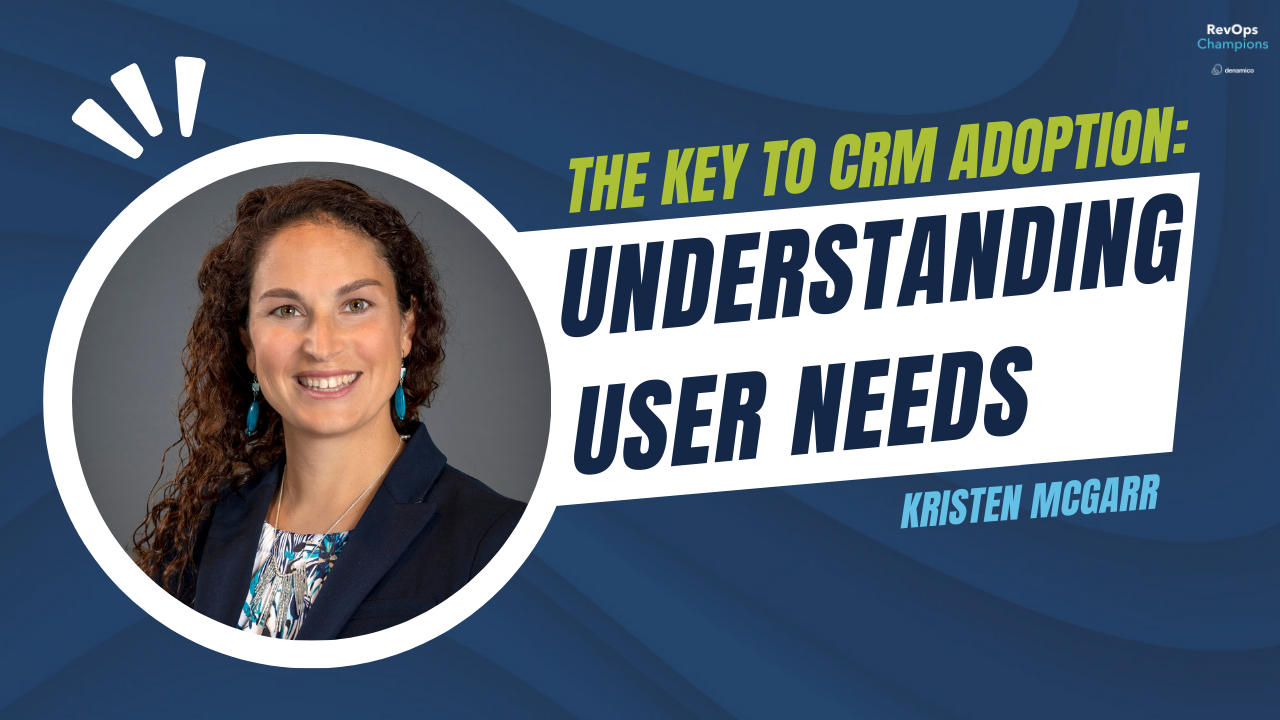
In this eye-opening conversation, Brendon Dennewill sits down with Kristen McGarr, Founder and Fractional CRO from Adroit Insights, to discuss why most CRM implementations fail and what businesses can do differently. They dive deep into the critical importance of prioritizing people and processes before technology, sharing real-world examples of how this approach transformed a 6-person company into a 21-person team in just six months.
Kristen brings her unique perspective as both a CRO and CRM expert, explaining why adoption is the #1 metric for CRM success and how to think about your CRM as a valued team member rather than just another software expense. This episode is perfect for business leaders considering a CRM implementation, struggling with current adoption issues, or planning for growth.
What You'll Learn:
- Why the "people, process, technology" framework is critical for CRM success
- The real reasons CRM implementations fail (and how to avoid them)
- How to calculate the true cost of CRM ownership beyond software subscriptions
- Strategies for maintaining data integrity as your business grows
- The importance of having an internal CRM champion
Resources Mentioned:
Listen
About the Guest
|
|
Kristen McGarr | Founder and Fractional CRO at Adroit Insights
Based in Maui, Kristen McGarr blends over 20 years of sales strategy, business process design, and CRM expertise to help small businesses achieve outsized growth. A passionate athlete and coach, she brings the same discipline from triathlons, surfing, and cross-country coaching to designing streamlined, user-friendly systems that drive measurable, award-winning results worldwide. |
Episode transcript
Why People and Process Must Come Before Technology
Brendon Dennewill: Kristen McGarr from Adroit Insights, thanks so much for joining me today. It's good to see you.
Kristen McGarr: Yeah, thanks for having me. I'm excited to be here.
Brendon Dennewill: I wanted to dive straight in. There's one thing that really stood out to me when I was introduced to you: our philosophy is very similar. We have a shared view of the priorities for companies and their leaders when implementing a CRM. We talk about this every single week, and when I was reading what you talk about, I thought, we're speaking the same language. Your philosophy, the same as ours, is people, process, technology. Ours is people, process, data, and technology.
So explain to our listeners why, because I know and you know that when our clients come to us, what they're really looking for is a CRM. But we know, and they often don't, that yes, the CRM will be the end result, but we have to do a few things first. Do you have the people and process pieces figured out? Because otherwise, what's the technology going to do for you? How do you think about it, and why do you have that philosophy?
Kristen McGarr: The biggest thing I see is that when people look at technology, they hear, "This is the newest technology for my industry" or "This is the tech I should use." But so many of us also say, "My business is unique." Those are contradicting statements. Don't just grab something industry-specific if you're so unique.
So we look at what tool really fits best. And the only way we know what fits best is by understanding who your people are and what your processes look like. By approaching it from that perspective, we get better user adoption. When we sit down with teams to determine which CRM makes sense and which features to focus on, we're finding out who's on the team and what they're used to. Do they still have Post-it notes on their desk even though they're using the CRM? Do they have 27 different spreadsheets because they're analytical and want to manipulate data in every possible way? Where are they coming from? What's their history, their experience, and what matters to them?
Once we understand that, we find even just one key feature that each person wants in the system and make sure it's in there. When we go live, we can say, "Hey, remember that one thing you talked about? Look, it's right here." Now that person has ownership in the CRM because we built something specifically to meet their needs. That really helps adoption.
A lot of organizations also lack process consistency. Everybody does things their own way, especially as you bring in new salespeople, new team members, and a new manager with their own methodology. Finding a uniform process, something that works for everyone and helps grow the organization, is something you can build into your CRM. It guides people, it walks them through, it removes the need for micromanaging, and it lets the system support the organization as a whole.
CRM Adoption: The Real Metric for Success
Brendon Dennewill: I like that. For folks listening who are maybe considering implementing a CRM, or who have recently implemented one and it's not going well, I think one of the things that isn't made clear to them from the very beginning is that the number one metric for success is adoption. If it's not being adopted by your team, what's the point of having a CRM? You're not going to have any useful data to make better, faster decisions, no matter where you sit in the organization. So there's a very strong link between thinking about people and process before technology, because the people have to understand why they need to adopt it and how their day-to-day processes will actually improve. How else do you explain adoption to your clients?
Kristen McGarr: I think you really nailed it. It's the why. Why are we doing this? This is not just some new administrative task that leadership wants done so they can see some data. If that's the why, it's not going to succeed. If the whole goal is "I need to see these reports so I can micromanage you," no salesperson is going to comply. They're going to be resistant and they're going to find ways to convince you that the technology is the problem when it really isn't. It's the resistance that's built in.
Really helping them understand the value they're going to get is critical. You know that really annoying task you wish you had a virtual admin for? Your CRM is that virtual admin. We're going to take those annoying administrative tasks that salespeople don't like and turn them into relief. Most CRMs off the shelf are administrative hassles. A CRM with the right configuration becomes an administrative asset.
Choosing the Right CRM: Integrations, Automations, and Analytics
Brendon Dennewill: Which is something we both deal with. We at Denamico are very heavily focused on HubSpot as our core platform. But I really like the approach you've taken: even though you build a lot on Zoho, your philosophy is that the technology doesn't matter as much as why we're doing what we're doing. Why is the business implementing a CRM in the first place? The technology is ultimately very important, but it shouldn't be the deciding factor. Unfortunately, because CRM companies are really good at marketing and sales, that's often why people buy before they know what they're going to do with it.
You might lean into some technologies and we might lean into others, and I think a lot of it comes down to business size and complexity. You might have many clients who are a perfect fit for Zoho, but when you know the complexity calls for HubSpot, that's what you'd advise. You've worked with a lot of small businesses, solopreneurs, and small franchise businesses. On the tech side, how do you think about when one technology becomes a better option than another?
Kristen McGarr: I go through an evaluation process with a client, and there are key things organizations can look at to decide which CRM is right. The key components that set most CRMs apart are things like integrations. What software are you currently using that you want to integrate with your CRM? Sometimes it doesn't need to integrate, but other times there's a huge value add. Which ones have a native integration or integrate well with what you're looking to do? That's a big deciding factor.
Another is automations. A lot of people automate very heavily right at the start and it makes everyone freak out, because if you click a button you don't know what seven actions are going to happen. You have to be careful. But you do want the system to have the ability to grow with you. What automation capabilities will make sense for your organization?
Then there's analytics. As much as we don't want to build a system purely to get reporting out of it, we do want that to be easy. Reporting for reporting's sake is a terrible idea, but if you can look at a dashboard and it tells a story you can act on, that's where the huge value comes from.
It also goes back to the people. If I've got people who are stubborn about leaving a spreadsheet, I have to take that into account. I had one organization that couldn't grow past six people. They had one person who was amazing, but she was at the crux of it all and everyone worked in her spreadsheet. We got them into a CRM, but she really wanted to keep her spreadsheet. So we made it a Google Sheet, integrated it with the CRM, and the salespeople worked in the CRM while she continued in her spreadsheet. The data flowed fluidly back and forth. Within six months, they grew from 6 to 21 reps because that one pain point was removed.
It doesn't always mean throwing out everything you have. Sometimes you're just underutilizing what you have. I had a client come to me saying they wanted to leave Zoho because it was terrible. Turns out they didn't have half the features turned on. Once we did that, four years later they're still loving it and referring people to Zoho. I call it the 0.5: most of the time people are not using the other half of their CRM, and we've got to help them pull out those other elements to get the value from it.
The Most Common Reasons CRM Implementations Fail
Brendon Dennewill: Kristen, you and I have both learned this the hard way, as most business owners do. You didn't figure it all out on day one. Some of those lessons came from failed CRM implementations. What are the most common reasons you see for implementations failing?
Kristen McGarr: The two biggest things are a system that doesn't align with your processes, and overengineering the system.
If you're constantly having to adjust the way you do business to make it fit within your technology, that's not the right technology. The technology should bend to the way you do business, not the other way around. You shouldn't change a core process because the technology can't do what you need it to. That's where I see it fail every time, because your process is the process for a reason. It's proven, it's repeatable, it works. Don't change it because the technology can't keep up.
And that leads right into overengineering. We know our process so well, so we try to build everything in. We overcomplicate systems and make them far more technically complex than they need to be because we're trying to solve everything.
I always ask: is this the 10%? Is this applying to 90% of cases, or is it a one-off? A lot of overengineered systems are only focused on the 10%. They're not focused on the big picture, on what happens the majority of the time. Exceptions to the rule are not what you should be designing your system for. We can put in smaller elements to help support the exceptions, but the core design should be based on the rule. If I could tell organizations one thing as they think about a CRM: ask yourself, is this the 10%? Because if it is, don't build your system around it.
Brendon Dennewill: Because what happens if you do? When you're adding people, the more complicated the system is to use, the less likely it is they'll use it successfully, or the longer it'll take them to get there. Keep it simple and let it handle the 80 or 90 percent well. That makes a lot of sense.
Planning for Business Growth and Scale
Brendon Dennewill: As we talk about growth, whether it's 6 to 21 people or 20 to 50, one thing we see is that a lot of business leaders are blindsided by the fact that adding people adds complications. Processes change, and of course the technology is changing too. How do you help clients address growth? It seems like they don't really think about it when implementing a CRM. They think the CRM will take care of the growth organically, which of course doesn't happen.
Kristen McGarr: We talk about five-year and ten-year plans and visions when we think about your system. Think about where you expect to be in five years. Now, the technology will be completely different ten years from now. If you asked me six years ago what the right CRM tools were, I'd give you a different list than today. So you don't necessarily need to plan your tech a decade out, but you want to think about your business from that perspective. Where do you want to be in three years?
When you're building your system, you need to build for today, but you also need to make sure that technology can grow with you. If a system is great right now but gets cost prohibitive at 15 people, and you want to be at 15 people in two years, is it actually cost prohibitive by then given your revenue growth? Or does it get more expensive before you can afford it?
If you've got a solid process in place at the core, adding more people shouldn't shift your process that dramatically. There will be changes, new ideas will come in, and you need flexibility for that. It's about asking the right forward-thinking questions, and finding someone to work with who knows how to ask them. We've both been around this industry for a while. We've seen the changes and can have a rough idea of what the future looks like for this technology, so we can start to assess and plan for where clients will run into limiting factors.
Maybe you choose a system that's perfect for your CRM needs but you don't do any marketing right now. You're thinking, "I don't need HubSpot." But are you planning to do marketing? If in six months you're ramping up your marketing and bringing on a firm for content, HubSpot is perfect for that. Sometimes people are so focused on today's decision that they don't think far enough ahead. The good news is it can do both: work today and serve you in future years. We just have to think about both.
The True Cost of a CRM: Beyond the Software Subscription
Brendon Dennewill: You mentioned cost and expense, which is another area where a lot of business leaders get stuck. They don't understand what the real investment is in having technology support their long-term business objectives. A lot of business owners still think the cost of a CRM is just their software subscription. How do you position the fuller picture with them?
Kristen McGarr: One of the first things I do when talking to someone about bringing on a CRM, or even just utilizing their existing one better, is ask: who is your internal champion? If you don't have a person identified, that's something to think about. A lot of times organizations will hire a sales admin to support sales functions and be the champion for the CRM. That right there gets them thinking about additional expenses that may come into play. Maybe you don't want to hire someone internally, but you're still going to need some level of support. You should not be having your marketing person or your BD person take time away from their work to figure out how to automate a tool when you can pay someone with expertise 30 minutes to do it.
Every CRM implementation should be considered a phased approach, and it is not three phases. It is an infinite number of phases. As your business changes and grows, you add a new phase. Some phases are really small and some are larger, but you have to think about what that growth looks like and where you want to add new capabilities. Finding the right partner, or even using tools like Upwork to find a resource when you just need something done occasionally, are all ways organizations can support themselves through this.
We always provide a video library to all of our clients, just as you provide guidance and direction to yours. I think that's so valuable: helping them be their own best CRM developers. Giving them little 30- to 60-second clips that say, "If you want to call me to add another option to your dropdown field, I'm happy to, but you don't need me for that. Here's a 20-second video showing you exactly how." And by the way, it's only 20 seconds because that's all it takes.
This is your system. Own it, love it, make it what you need, and don't feel like you're at the mercy of your support teams. Ask the questions of your CRM providers. If you're working directly with the technology company and not with implementers like us, make sure to ask what kind of support they offer. Some have fantastic support; others bring on partners like us because they don't. That really impacts the long-term costs.
Brendon Dennewill: Right. The support the technology company offers is really to support the technology, not the business processes. They can handle any technical issues around the tool, but it's very unlikely they'll guide you on improving your processes or training current and future team members.
Kristen McGarr: You make such a great point. You need that business process mindset. A technologist building the technology will do exactly what you ask. You say, "When I click here, I want this to update." Great, they'll do that. But they didn't think about the fact that four other elements of your CRM are affected by that. You didn't ask them to. You simply asked them to do one thing. Having that business mindset, having that Process First, People First mentality, makes a massively impactful difference on the success of your tool.
Brendon Dennewill: If you don't have someone with that business analyst approach, someone thinking more strategically than just fixing the one thing, that can lead to a lot of frustration. The technologist fixes something, and three months later it's like, "That thing you did caused this, this, and this." And they'll say, "Well, you didn't ask me to do any of that."
Part of the total cost of ownership of a CRM is way beyond the technology subscription. HubSpot publishes a report through IDC, I think annually now, that talks about the total value of the ecosystem. For every dollar invested in a CRM, there's roughly six dollars invested in making it work. That's because each unique company needs to customize the software from off the shelf to fit their specific business.
What do you think is the mindset shift that happens during a conversation with a business owner where they suddenly realize the cost of the CRM isn't just the software, but that they need people, whether internal or external, who know how to think about this strategically first, and then tactically?
Kristen McGarr: Historically, that realization usually hit around the six-month mark. They get six months in and go, "Oh, there's more to this than just the raw cost." What we do now to prevent that is bring it up right in the early conversations. Because I come at it as a Chief Revenue Officer, every conversation we have is from the perspective of the organization's overall strategy. So right off the bat, I'm already talking about phase six when we're in phase zero, in pre-planning. We're talking about those future steps so that everyone's thinking further down the line. This is an ongoing, multi-year relationship.
I don't say that to intimidate people. Nobody wants to hear "three years to implement my CRM." The goal is that you're up and running quickly with a tool you can use right away. But you don't want to stop there, because that will stunt your growth. Just like you wouldn't hire someone and then walk away assuming the business automatically improves, you're going to continue to develop that person. You're going to add new offerings. It's the same with your CRM. As you grow the business, your CRM continues to grow with it. So we have all of those conversations from day one. There's no aha moment because it's right from the start.
That's why I love solopreneurs and micropreneurs. They often have a shortsighted, "I need this right now" view, and when you can get them to think just a little further ahead: "Yes, it's just you right now, but what if tomorrow you had three people supporting you? How transformational is that? Let's get you there now, faster, with the technology."
The Fractional CRO Role and How It Connects to CRM Strategy
Brendon Dennewill: You just alluded to something I didn't mention earlier. What percentage of your engagements have you coming in as a fractional CRO, CMO, or CSO, where the CRM is really a next step?
Kristen McGarr: As a CRO, there are only a handful of clients I take on at any given time. From the CRM side, we're taking on dozens at a time as a whole team. Every client using virtual or fractional support has to have good technology in place, so if it's not there, it's a key component of what I'm working to establish.
One of the great things I love is working with a lot of other fractional CROs and CSOs. We partner together really well. If I'm going to be deep in the weeds of the technology, I'm thinking about it from a CRO perspective, but I'm not necessarily doing both in tandem. A CRO will often bring me in to do the CRM implementation because we think the same way. Other times, if I'm in as the technologist on someone's CRM, I'll bring in another CRO to work the project. They'll be looking at the big picture, and when I'm deep in the technology, I don't like to muddy the waters. That said, I can't turn off my CRO brain. It's always there. It comes into every conversation I have as a technologist with my clients.
I'm certainly not the lowest cost person you'll find, but that's because you're getting a CRO and a CRM strategist all rolled into one.
Brendon Dennewill: That really clarifies it, and brings us back to where we started: people, process, and technology. That's exactly how a CRO, whether fractional or full-time, has to think. I need to lead and coach my team, make sure they have processes so everyone knows what success looks like every week, and then bring in the technology to make all of that better, faster, and more scalable. It makes complete sense.
Data Strategy Inside the People, Process, Technology Framework
Brendon Dennewill: Let's bring this back to your CRO perspective. Where does data fit into your people, process, technology framework?
Kristen McGarr: Most people think, "Our data is pretty good." The second you try to merge it all together, you realize how much of a mess it is. Data can be a big undertaking.
So we look at data from day one. The first conversation I have with someone, I say, show me all your spreadsheets. Show me what you've currently got. If you've got a wall of Post-it notes, take a picture. If you've got a whiteboard, send it to me. Because the key thing isn't each little element of that data; it's how your brain is currently processing data. I can see that by looking at how you've organized your spreadsheet, how you're adding notes, how your whiteboards are written. When I understand how you organize and work with data, that's when I can start building the best structure for your CRM, really customizing the views, the layouts, and all the elements.
For example, which fields should be multi-select versus single-select? It seems trivial, but it has a huge impact on reporting. I had someone who wanted a multi-select field, and it really should have been single-select. When people started choosing option A and option C together, that combination became its own line item on the report. Suddenly instead of six options in their report, they had seventeen. It can really skew your data when you're looking at the big picture.
The conversations we have around this always come back to: reporting for reporting's sake versus what are you going to do with it? What conversations is your C-suite going to have in their quarterly strategy sessions? Once I understand that, I know how we should build the data into the system. It's the why, not the what or the how. Why do you want this in the first place? Then we can understand how to actually build it.
Brendon Dennewill: That's super helpful. I remember exactly what you're talking about. Now we're working with much bigger companies where the data component is so critical. We need to know from the very beginning what metrics marketing is responsible for, what the SLA handoff to sales looks like, and what sales needs to hand off to customer service. The revenue team is marketing, sales, and service, and you have to have aligned systems if you want to grow. I can now see what I remember from working with single business owners where it was all just one set of data, because they didn't differentiate between marketing and sales. It was all just sales. That brings back some good memories.
Kristen McGarr: It's that cross-departmental element that's so vital. People think, "CRM is for my sales department." But don't you talk to your marketing department? Don't you interact with operations? If there's overlap in your teams, there should be overlap in your technology as well.
Sometimes operations already has their own tool and we find a way to integrate with it. Other times operations is also using spreadsheets, and we look for a CRM solution that's more of an ERP, crossing finance and operations and sales. Those are the fun and exciting parts. We're not just looking for sales. We're looking for something that will make everyone happy and work across the whole organization. That's when you start talking about more significant, multi-year implementations, because you don't want to pull the rug out from under your entire organization all at once. That's why building a well-formulated roadmap for a change of that magnitude is so important.
Brendon Dennewill: As businesses grow, the negative impacts of silos become a real issue. Businesses will not grow until they figure that out, which is of course why we talk so much about RevOps. What RevOps does, and why we lean into it so heavily as a layer above the CRM technology, is that it aligns people, processes, data, and technology cross-functionally: from marketing all the way to operations. You have to have aligned systems if you want to grow.
Keeping Data and Technology as Business Assets
Brendon Dennewill: Data and technology can be assets or liabilities. How do you manage these areas for your clients to keep them on the asset side?
Kristen McGarr: It really does slip quickly. So we put little triggers and reminders throughout the CRM. Depending on which tool you use, there are different ways to go about it. Sometimes it's tasks; sometimes we build a report that automatically emails to your inbox. Pushing data that you want someone to act on is the best approach. If you just put it on a dashboard and expect people to go look at it, it's probably not going to happen, at least not in the beginning.
For example, we'll create a report on close dates in the past. How often do you look at a pipeline and see close dates from two weeks ago, three months ago, a year and a half ago, still sitting in an active pipeline? We'll put a report on that. Another thing we do is provide a quick, easy way to see any opportunities that don't have a next step. That's one of the easiest things you can do to avoid dropping the ball. Every opportunity has to have a next step. In Zoho, for instance, there are filters you can put in the deals module, and you'll see a little number next to it telling you, say, seven deals are missing activity. The second you open your pipeline, you see it.
In HubSpot, the analytics that come out of the box are amazingly robust. Looking at those and leveraging that information to find trends on where you might be dropping the ball is so valuable.
But it always comes back to people. People are the ones who manage the data at the end of the day. So how do we make it as simple as possible for them to keep the data integrity up? Don't ask someone to fill out 50 fields if you're only going to use 13 for reporting. Ask them to fill out the 13 that matter. You'll have a much better chance of it actually getting done.
One of the biggest things in CRM systems is the linear scroll. I'm going to scroll and scroll to find the data I want, or click 17 times to find it. What we like to do is reconfigure the layout. Move all the fields you don't really care about to the background. Keep the important stuff above the fold, so as soon as you open a record, you can see the information you need to work with and fill in. You're not hunting for that one field your boss told you not to forget.
Brendon Dennewill: Which of course is not a surprise, but interesting how as you explained that, it started with the people, and really what you were describing was a process for those people to do certain things at certain times to make sure their data and technology remain assets and don't become a liability. I loved how that all came together.
Closing Advice: Think of Your CRM Like an Employee
Brendon Dennewill: Kristen, we're going to wrap up with one last question. For some of your bigger clients, who probably overlap with some of ours listening right now, what advice would you give them as they think about their CRM investment over the next three years?
Kristen McGarr: The best thing I can say is to think about your CRM the way you think about investing in a new person in your organization. What's that thought process? You think about how they're going to alleviate pain points, how they're going to make things better. Think about your CRM exactly that way. Just like we tell people to think about AI as a person on your team and talk to it like one, think about your CRM the same way. It is a really valuable asset. It's like another employee you've brought into the company.
How do you want that employee to grow over the years? How do you want your CRM to grow with you? When we think of a CRM as a piece of software, we think of it as a cost center and an extra headache. When we think of it as another member of the team, it becomes a valuable asset we're going to foster. We're going to work with it, make sure it becomes a valued member of the team. That takes out the burden, the expense, and the headache, and gets people into the mindset that this is a true asset to their organization.
Brendon Dennewill: That's really good advice. I love that. It reminds me of when websites were a big deal and one of the biggest messages we always had was: your website could become your best salesperson. I love the way you frame the CRM as a human you nurture and grow. As long as they're going to be with us, let's make sure they're doing bigger and better things every quarter.
Well, Kristen, thanks again so much for being on the show. I look forward to chatting again soon, and we'll share some relevant links to all your stuff in the show notes when the episode comes out in a few weeks.
Kristen McGarr: Excellent. Thanks so much. This was really fun, and I love working with you. I always get inspired with new ideas every time we have a conversation.
Brendon Dennewill: Likewise. Thanks, Kristen. Thanks for listening to Brendon Dennewill. If today's episode gave you a new idea for scaling smarter, or helped you see your team, processes, or tech in a new light, be sure to subscribe so you don't miss the next insight. And if it hit home, share it with a colleague. Let's grow this community for forward-thinking leaders together.