
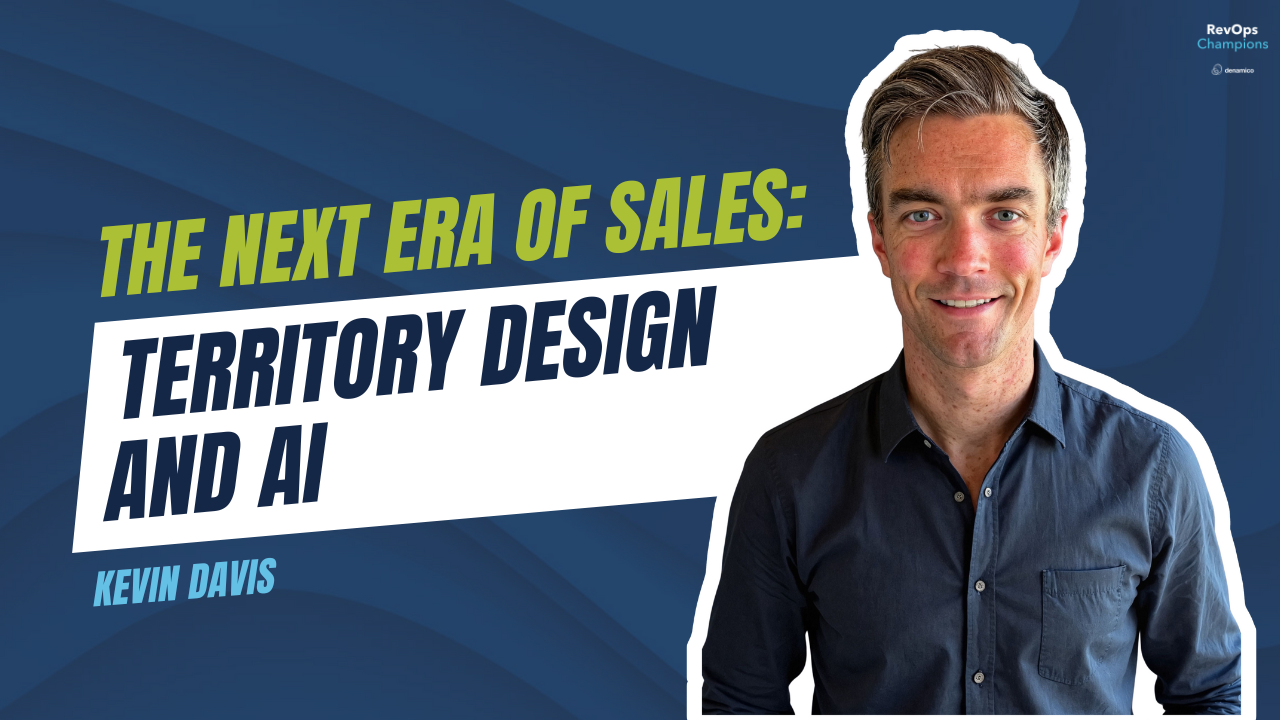
In this episode, Brendon Dennewill sits down with Kevin Davis, Founder of BoogieBoard, to explore how territory design can make—or break—sales performance. From his experiences at NetSuite and Google to launching BoogieBoard, Kevin shares how poor territory planning costs companies time, money, and morale. The conversation dives into sales strategy, AI's role in market intelligence, CRM integration, and how to overcome the hidden opportunity costs that stall growth. Whether you're a RevOps leader, sales strategist, or part of a seller-doer team, this episode is packed with insights on designing smarter systems that drive real revenue outcomes.
What You'll Learn
- Why territory design is a strategic lever, not just an operational task
- How poor territory planning erodes trust and increases sales rep turnover
- The role of AI in transforming market data into actionable territory insights
- Why RevOps leaders often identify problems but lack empowerment to solve them
- How seller-doer models in professional services can benefit from territory optimization
- The importance of establishing a "North Star" for territory design processes
Resources Mentioned:
- BoogieBoard
- Roger Federer's Commencement Speech: Referenced for the "54% winning" mindset
- Salesforce & HubSpot
- Snowflake
- EOS (Entrepreneurial Operating System)
Listen
About the Guest
|
|
Kevin Davis | CEO at BoogieBoard Kevin Davis is the Founder of BoogieBoard, a territory design and planning platform. Previously, Kevin was a sales professional at NetSuite and Google Cloud, where he experienced firsthand the challenges of territory management both as a sales rep and later as an operator. His frustration with the limited tooling and complexity of territory design sparked the creation of BoogieBoard, a suggestion engine that helps companies design better territories using data-driven insights. |

Episode transcript
From Sales Rep to Startup Founder: The Origin of BoogieBoard
Brendon Dennewill: Kevin Davis, thanks so much for joining me today on Brendon Dennewill.
Kevin Davis: Brendon, thanks for having me. It's a pleasure to be here.
Brendon Dennewill: Awesome. Kevin, you've got an incredible background, both with your time at NetSuite and Google, and now you're running BoogieBoard. Tell us quickly: what sparked your passion for starting BoogieBoard?
Kevin Davis: I was in sales for most of my career. I was a salesperson at NetSuite and then at Google Cloud. I joined the dark side and became an operator while at Google Cloud. Throughout all of it, I'd been looking to start a business, and they always tell you to look for problems you might be able to solve. A problem that was very close to me throughout my entire career was territory design and territory planning.
I experienced that as a sales rep. I was probably the person complaining about my territory every now and then. And then when I got under the hood of the car and was actually responsible for delivering on these things, I realized how hard it was and how limited the tooling was. The initial premise of our company was: what if we could build a suggestion engine that could help companies design territories with a little more data backing? That was the start, a couple of years ago. We've since grown a bit bigger in our product scope, but at the core, that's still what we are: a suggestion engine to help companies design better territories.
Brendon Dennewill: Very cool. I'm sure a lot of people listening have had their interest piqued, because this is a very common challenge. It's something we see often in how we set up CRM for mid-market companies, where the complexity and the need for organization becomes so critical as they grow. So, Kevin, if you want to get a little more granular, what are the biggest challenges you're seeing in the industry right now for RevOps and revenue and sales leaders when it comes to territory design?
The Two Core Problems in Territory Design Today
Kevin Davis: There are two big ones. First, there's been this explosion of market data. Every company now has access to incredible, very precise market data and new ways to manipulate it. But it's not manifesting into thoughtfully designed, precise territories. Companies are trying, but it's just a really difficult thing to do right now, and there's a lack of ROI on that effort.
The second problem is that it's simply a bad-vibes process. It involves multiple stakeholders, and nobody enjoys it. The sales leaders don't like it. The sales reps don't like it. The operators hate doing it. That's largely because it happens in spreadsheets, and it's actually a very difficult quantitative problem.
Brendon Dennewill: Do you see differences based on company size or industry? You have a strong background in very large SaaS companies, but you're likely working with smaller, mid-market companies now. Is territory design a challenge across industries, or is it more specific to certain types of businesses?
Kevin Davis: I've seen it as a challenge across industries, but the variables in play differ significantly. A company selling heavy machinery with reps out in the field might need to optimize for drive time and physical, in-person conversations. A SaaS company might be optimizing for technographic data, trying to sell to customers with a similar technical footprint.
I always say a territory is often the way you describe the community of your customers. Most companies and industries share that consistency, but the way they deploy it and the data they use are often very different.
Brendon Dennewill: And I'm guessing that because of your scale and experience, when you're talking about territory design, you're talking beyond North America. You're talking about global territory design?
Kevin Davis: Absolutely. I'm talking about grouping regional accounts in EMEA, APAC, wherever the business has a sales presence. Anywhere you need to group accounts and have a plan for how you're going to attack the market.
Brendon Dennewill: As a quick side note: do you believe AI is going to have a positive impact on how this is done going forward?
Kevin Davis: I've already seen it. AI has a massive positive impact in how we retrieve and organize market data, allowing us to be far more specific and precise for our customers. We use a lot of that to help divvy up accounts and create the actual territories. And then there's just the consumption of the process itself: things can now be done in a much more natural language sense, which removes the spreadsheet experience. I see a three-pronged approach to how AI is already changing the game here.
What Hundreds of RevOps Interviews Revealed
Brendon Dennewill: Switching gears: when you got started at BoogieBoard, you interviewed dozens, and eventually hundreds, of RevOps leaders. What patterns emerged, and how did those real-world insights shape your product?
Kevin Davis: When we were interviewing, and we still do this regularly, we were met with immense frustration around a multitude of things. But the one we kept coming back to was that operators were trying to provide a delightful process to their sales leaders and reps, their internal customers, and they just weren't able to do it.
That really shined a light on the relationship between sales and RevOps, and what that dynamic looked like. We would often propose to fix this through RevOps, but we learned that RevOps could almost always identify the problem. They could speak to what a solution might need to do. But they often weren't empowered to go fix it themselves. They may not have had the budget. They may not have had the tooling. And they rarely had the time.
I felt for RevOps because they knew what was going on, but they hadn't been elevated to a truly strategic seat at the table. They'd been asked to do the strategic work without always being given the ability to solve the problem.
Territory Design in the AEC and Seller-Doer Model
Brendon Dennewill: The three main industries we're focused on are manufacturing, AEC, and franchises. I think franchises are probably less directly impacted here, since it's not a sales rep network in the traditional sense. But thinking about AEC, architecture, engineering, and construction firms, which are essentially professional services businesses, they often operate in a seller-doer model. They don't necessarily have large sales teams, but they might have a thousand employees where seven or eight hundred of them are both selling the work and delivering the service as an engineer, architect, or designer. Do you see any application for what BoogieBoard does in that seller-doer model?
Kevin Davis: Absolutely. I love the seller-doer model. In the software world, we tend to place restrictions on salespeople and put them in a box. Sometimes you need to unleash them to be more of doers. I think of seller-doers as a resource utilization problem. They're delivering for existing customers, sourcing new customers, and they're very important to the customer experience and the bottom line.
If they're spending time on the wrong accounts, or having to organize their day in a way that eats into the time they could be utilized as a resource, that's a problem. A territory, to me, is their orientation to their accounts. It's critically important to figure out who gets what account.
Brendon Dennewill: One of the challenges in the AEC space, and in a lot of professional services businesses, is that every leader will tell you it's all about the client relationship. But what they haven't figured out yet, and they know it's the difference between scale and profitability, is that they tend to spread their energy and resources equally across all clients and prospective clients. They don't have data-driven ways to focus on the clients who are going to drive the most business or lifetime value. And because they're so relationship-focused, and genuinely great at relationships, it actually becomes a detriment to their growth.
I like the way you framed that. They love what they do. A lot of engineers will tell you they'd do it for free if someone just paid their mortgage and tuition. The seller-doer model is a fascinating one, but it also means you're expecting a lot from these highly qualified professionals. The question becomes: how do you help them be more effective as an entire organization? If you have a thousand-person firm and everybody does just a little bit more efficiently, you can imagine the impact that kind of structure could have.
Kevin Davis: I think it's really interesting because when I think of those professions, I think about the point where science and rigidity elevate into art. The structures and buildings I love are highly and thoughtfully designed, but you don't necessarily see that. It manifests as something more beautiful and fluid.
Forgive me for waxing poetic about territory design, but I find that a similar spirit needs to exist in that process. You have market data, you need to organize your reps, and it's tempting to bring in major rigidity, or to do the opposite and say it's all about customer focus and everything should be fluid. That's actually a false dichotomy. You need to use the science to elevate it into an artful experience for your clients.
Manufacturing, Distribution, and Franchise Territory Models
Brendon Dennewill: Moving to manufacturing: we have clients that straddle both spaces, like industrial HVAC companies that are also territorial, but those territories are typically controlled by the manufacturer of the product itself. That's probably similar to the franchise model, where the distributor with the exclusive territory handles the sales, so the brand owner isn't directly responsible for territory design. In that case, would a company like that not need to worry much about territory design, because it's already built into their distribution model?
Kevin Davis: It's probably already built into the distribution model. They're essentially paying for that clarity as part of the distribution fee. Those folks have already decided how to attack the market. They've created groupings and built processes around them to scale and serve customers properly.
The actual brand company going through the distributor wouldn't typically need to sit down and say, "How do we segment the market to sell?" That's what they're using the distributor for.
How Bad Territory Design Shows Up: Rep Retention, Opportunity Cost, and Churn
Brendon Dennewill: So coming back to day-to-day: when companies are making common mistakes in territory design, or simply lack it altogether, how does that show up? Churn is probably one way, but what are the main ways the problem manifests?
Kevin Davis: Sales rep retention is one that I think is a really big deal. If you've ever been in sales, you receive a territory and you quickly start comparing notes with everyone around you. Of course, your territory always seems like the worst one. But if that feeling shows up across multiple people on your sales team, it becomes a major trust erosion. You also end up with significant resource cost on designing territories through a long, ultimately unsatisfactory process.
And then the big one: if you are incorrectly or suboptimally oriented into the market, if you're not putting the right people on the right accounts, you get customer churn, opportunity cost, and wasted time from your sellers.
Brendon Dennewill: I'd love to unpack opportunity cost a little more, because we see it constantly. When a company comes to us for help setting up a CRM for the first time, the total cost of opportunity isn't something they're typically bringing to the table. We have to walk them through it. For the least sophisticated buyers, it sounds like, "We just need to pay a few thousand dollars a month for the software." And then we have to explain the other costs, and flip it around to ask: what is the total opportunity cost if you don't do this right?
That's the same frustration you have when you see bad or absent territory design. We made that mistake ourselves when we bought software we thought would fix all our problems, only to realize that in reality, all software does is accelerate your existing problems if you haven't first mapped out what you need it to do. How do you explain opportunity cost in your space?
Kevin Davis: Let me start with a simple example. I've been going to sales conferences since early in my career, and at every single one there's a slide that says sales reps only spend 30% of their time actually selling. It's been the same slide every year. Maybe nothing has changed because the industry doesn't care. But if you believe that statistic and you're still expecting reps to organize their own market approach without territory design, you're essentially asking each rep to be not only a seller and a deliverer, but also a sourcer doing their own analysis of where to go and why. You're ignoring that statistic if it's something you care about.
The easiest opportunity cost calculation is this: if I can be more prescriptive, if I can use the data to tell my reps where to go and why, what does that unlock from a resource utilization standpoint?
Brendon Dennewill: Completely agree. Anyone who's been responsible for sales or for helping companies become more efficient has seen that slide at multiple conferences: whatever low percentage of the day your reps are actually selling, what are they doing for the other five hours?
I heard something similar just yesterday, actually. Someone was comparing their custom CRM approach for a specific industry and saying that customers only use about 30% of what HubSpot can do. Companies shouldn't feel bad if they're only using 30 to 60% of their software, as long as they're getting done what they need to get done. But I think the strategic leadership question is the same in both cases: what do you need to do to have your reps spending more time doing the most valuable things?
Kevin Davis: Exactly. To be concrete about it: instead of each rep going online to find accounts on their own, you have one or more people orchestrating that centrally. Those people are data hawks. They know how to find great data and eliminate bad data. So instead of a rep thinking, "I've got all of Ohio and Kentucky and I'll just search for accounts," you say, "We know what that exercise looks like, and we can do it better at scale." You surface the right accounts to reps on a cadence that makes sense for the business. For existing clients, you're doing that planning for them: here are our highest-priority clients, here's what we expect to do with them and why. You're moving up the starting line so they can spend time engaging with clients rather than researching and planning.
Where BoogieBoard Fits in the Tech Stack
Brendon Dennewill: I want to make sure we help folks understand where BoogieBoard fits in their tech stack. Is it a product, a service, or a combination?
Kevin Davis: It's a software product that you subscribe to.
Brendon Dennewill: Got it. What are the most common integrations? What does a typical tech stack look like, and where does BoogieBoard fit in?
Kevin Davis: Our biggest integrations are with CRMs. Most of our customers are Salesforce customers, though we have some HubSpot customers as well. We're also seeing a large emergence of Snowflake data and other customer data platforms.
Think about wherever your main place is for storing customer and market data: first-party data about your market and third-party data about your market. That could be industry classifications, spend data, company size, and so on. BoogieBoard pulls all of that in. That same place likely also has your sales rep structure. We ingest all of it and allow you to come into BoogieBoard and orchestrate it. BoogieBoard lets you run suggestions through our algorithm to get territory design recommendations, which then manifest back in your CRM as the most likely next scenario.
Brendon Dennewill: Does that happen in real time, or do you pull it into BoogieBoard, do the work, and then push it back to the CRM?
Kevin Davis: It depends on the customer. Some companies use BoogieBoard heavily during major fiscal planning periods, once or twice a year, and then operate in maintenance mode the rest of the time. Companies with higher-velocity sales models, where they're moving through accounts more quickly, may use it on a monthly or even weekly basis.
Brendon Dennewill: And who are the primary users of BoogieBoard: sales leaders or RevOps leaders?
Kevin Davis: It depends on company size. Typically, someone in sales ops or RevOps does the tactical work. The person who would have been doing this in a spreadsheet now has access to BoogieBoard. They then invite sales leaders and sales reps as collaborators so they can see what's happening with territory design, make approvals, and have a lighter-touch experience.
Brendon Dennewill: Once it's set for a given timeframe, whether that's a few weeks, a month, or a quarter, the sellers, whether reps, managers, or leaders, go back to living in their CRM?
Kevin Davis: Exactly. They never fully live in BoogieBoard. They visit to review their territory, provide feedback, and then click a button to push to CRM. The idea is that everything in CRM is now better managed. BoogieBoard's fingerprints are in there so they know we're around, but the day-to-day experience is still in the CRM.
Territory Design and the 90-Day Planning Cycle
Brendon Dennewill: A lot of our audience operates on EOS. Whether it's EOS, Scaling Up, or another business operating system, the commonality is that you're planning and running your business 90 days at a time. Every quarter, when the leadership team gets together to set priorities, whoever represents sales has a strong voice in what those priorities are. So once the plan is set, is that typically when sales and RevOps get together to adjust territory design?
Kevin Davis: Exactly. The planning phase is where RevOps or sales ops is likely building different scenarios for what they could do during that period. When a plan goes live, BoogieBoard handles the orchestration: pushing that plan into CRM and managing the territory assignments. So there's a cycle of planning, then orchestrating, then planning again, with BoogieBoard handling the orchestration piece.
The Most Common Mistake: Failing to Anchor Your Territory Design
Brendon Dennewill: Coming back to the challenges you help customers solve on a daily and weekly basis: is there one thing that RevOps or sales leaders get totally wrong before they start working with you, whether it's around quota design, CRM structure, or dashboards?
Kevin Davis: I'd say the biggest thing they get wrong is failing to anchor their territory design process. What I mean by that is: the company never explicitly says, "Here's what we're doing. Here's what a territory means to our business." And the downstream consequences of that are significant.
You've got people trying to design territories without a North Star. You've got sales reps complaining about fairness without a clear definition of what fairness is. And you've got people managing all different kinds of data without clear parameters on what data this exercise is actually for, so they can iterate and test going forward.
The biggest mistake I see is that companies are defeated in how they think about territories, because it's always been this nightmarish thing they have to deal with. If they can anchor the process with a North Star, which I think largely means empowering RevOps to define it, they can have a completely different experience.
Focus as the Foundation of Winning
Brendon Dennewill: That's really useful for a lot of people listening. Kevin, thinking about the difference between companies and teams that scale and perform versus those that don't: how does territory design help or hurt them from winning?
Kevin Davis: The word I'd use is focus. Territory design is about how you orient to the market, and in a single word, that's focus. When everyone on your team is focused on the market, they're not spending time on bad activities or accounts that don't matter. And focus is also iterative. Once you've aligned on what your focus is, you can measure it and adjust it. The winning companies we see aren't always getting things right, but they have a focus, and that focus manifests into additional, more refined focuses as they go forward.
Brendon Dennewill: I love that. And the idea that winning doesn't mean getting it right all the time reminds me of something Roger Federer said in what's become a well-known commencement speech. He asked the graduating students what percentage of points he won throughout his career, and they were all shocked when he said it was around 53%. All he had to do was win a few more points than the next person, and that was enough to win. It's a great mindset, and it reminds me of an engineering mindset as well: failure is learning, try, fail, try again, and eventually you get a better product.
Kevin Davis: I had my kids watch that Roger Federer speech. I'm a big tennis fan too. It's such a beautiful idea, and incredibly humbling coming from someone who has won so much and done so so elegantly. Fifty-three percent is very tangible. We're a startup, and there are many days where you wonder if what you're doing is winning at all, because the results don't come quickly.
But if you can hold onto that perspective, there's a saying in Buddhism I love: no mud, no lotus. You have to be in it. You have to keep pushing. And eventually, there'll be a flower.
Brendon Dennewill: I love that. And it probably connects back to what you said about rep mindset. If they're stuck in a cycle of grind and perceived unfairness, no one survives that long-term. You have to play the long game. If you keep doing the right things, eventually you'll get where you're going. Or along the way you'll learn that maybe this isn't where you want to go, and you'll find somewhere else that aligns with that North Star. Any kind of real success takes hard work, and that work is a lot more sustainable when it's meaningful to you.
Kevin Davis: Absolutely. Trust is paramount. Everyone listening has had a job where they didn't feel like a fit, or where something above them created a feeling of uncertainty. Once you have one foot out the door, the quality of your work drops significantly. But if you can get people fully in, and show them how much you're trying to position them for success, the ripple effects are major.
Leading Through Uncertainty: Advice for Finishing 2025 Strong
Brendon Dennewill: As we start wrapping up: we're now in the second half of 2025, and there's a lot going on for leaders in North America and beyond. There are significant macroeconomic and political challenges that affect us personally and impact our teams. Uncertainty is always difficult. With all of that in mind, what advice do you have for leaders with sales teams of 30, 50, 100, or 500 people as they look to finish 2025 strong and set themselves up for success in 2026?
Kevin Davis: That's a great question. On the bigger picture: it's always a balance between taking in enough to understand what's happening and not letting it paralyze you. You can't control a lot of it. What you can control is how you're orienting your team and how you're running your show as a leader.
On the tactical side, a good pulse check is: are my sales reps oriented to the right accounts most of the time? That's a concrete, actionable question. And then there's the AI layer, which is increasingly within reach for everyone: are folks experimenting with it? Are they feeling scared of it? Are we getting any value from it yet?
Culturally, this is a big moment for leaders to say: there's a lot happening outside of here. We have a goal to meet. We have access to new tools, which is a good thing. We need to ride the wave. It's a time to take measured risks, lean into trust, and move forward.
Brendon Dennewill: I completely agree. Focus on what you can control and try not to get pulled into the noise you can't. That's practical advice that applies to any team in any function right now. And I think one of the real benefits of conversations like this is that they happen in real time. A lot of us just need to be reminded of these truths, especially as more uncontrollable noise enters our world.
Kevin, anything else you'd like to share as a bonus tip?
Bonus Tip: Stop Treating Your Data as a Liability
Kevin Davis: The only other thing I'd add is this: most companies we meet get really frustrated when asked about their data, specifically their first-party and third-party customer and market data. They throw their hands up and say, "Our data is dirty, it's unreliable, it's not an asset to us." But I'd say this: AI can now help companies address that problem in a very cost-effective way. If you've been a data minimalist when it comes to your sales team, I'd challenge you to start reading some of the Substacks coming out on how to change that relationship with your data. I can recommend a few in the show notes, but the time to act on this is now.
Brendon Dennewill: That's really good advice. We talk a lot about data and technology as either assets or liabilities, and I know you think about it that way too. Over the nine years we've been doing CRM implementations, we've seen the same pattern play out with AI adoption as with CRM adoption and every technology before it. The data readiness component is absolutely critical if you want AI to work for you.
And I don't think it's ironic at all that what we've been talking about for the last 45 minutes is essentially returning to the problems you know you need to solve in your business, and asking one additional question: how could AI help you solve those problems better or faster than you could without it?
Kevin Davis: Absolutely. I 100% agree with that.
Brendon Dennewill: Kevin, thanks again so much for joining me today. It was really great to connect, and I look forward to learning more about BoogieBoard.
Kevin Davis: Brendon, thank you so much for having me. This was a pleasure.
Brendon Dennewill: Awesome. Thanks again.