
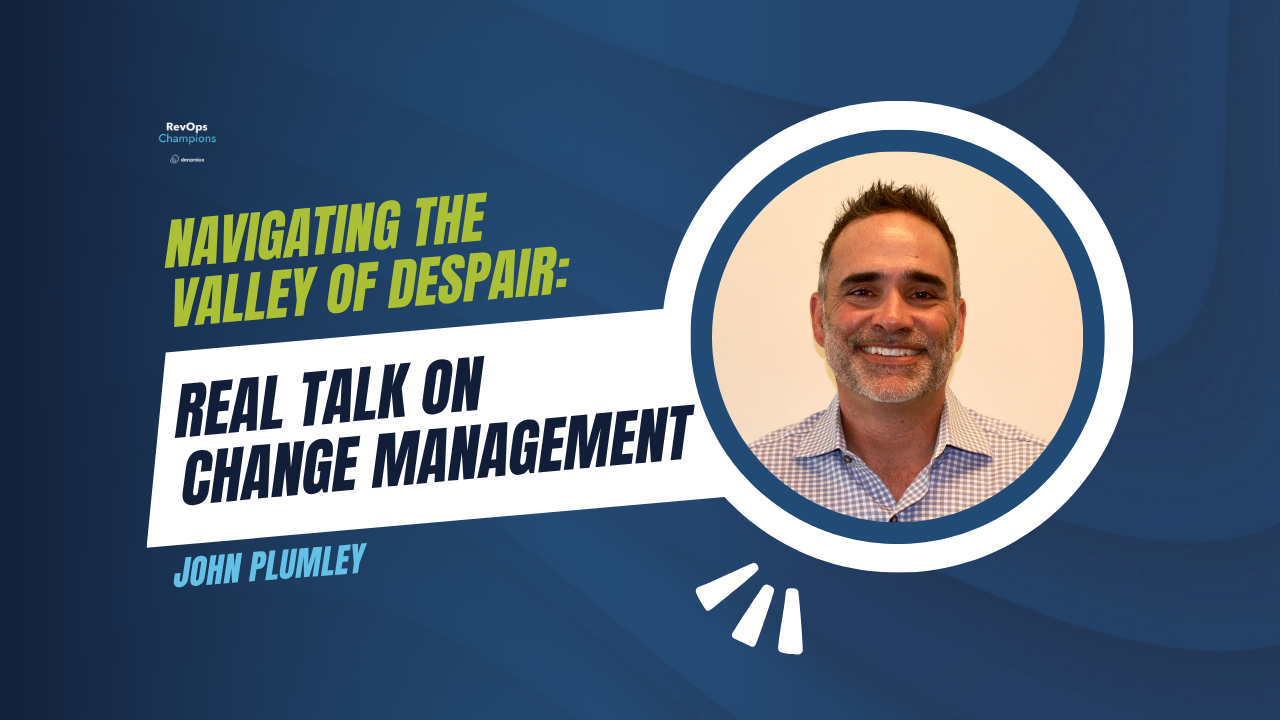
In this episode of RevOps Champions, John Plumley, Director of Revenue Operations at TriState HVAC, joins Brendon Dennewill to discuss the intersection of technology and process in scaling a traditional B2B business. John provides insight into TriState HVAC’s unique position as a commercial HVAC manufacturers representative focused on large projects and key relationships within the Philadelphia region. With a mechanical engineering background and decades of sales experience, John shares how his long-standing fascination with CRMs led him to transition from sales into a full RevOps role, where he drives both digital transformation and cultural change within the organization.
The conversation delves into the real-world challenges and triumphs of adopting new technologies like HubSpot CRM, integrating operations with accounting, and implementing smarter, data-driven processes. A significant focus is placed on the human side of change—navigating resistance, fostering buy-in, and the importance of mapping out and communicating process improvements before rolling out new solutions. John and Brendon explore how aligning people, data, and technology not only streamlines internal operations but creates a fresh competitive advantage in an industry that’s traditionally slow to change.
Looking ahead, the episode highlights opportunities for leveraging AI and knowledge management to enhance both customer and employee experiences. John discusses the value of sharing expertise through podcasts, video content, and smart knowledge bases, meeting evolving customer expectations and scaling relationships in a modern way. The key takeaway is clear: success with RevOps is about progress and learning, prioritizing customer experience, and empowering teams with the right tools and mindset—practical advice for any leader considering their own digital transformation journey.
Listen
About the Guest
-1.png?width=155&height=155&name=HubSpot%20Profile%20(11)-1.png)
|
John Plumley | Senior Director of Revenue Operations at TriState HVAC
John Plumley brings more than two and a half decades of industry knowledge to our conversation today. For the past 16 years, he has been an integral part of the TriState HVAC team, where he recently took on the role of Senior Director of Revenue Operations. As a leader, he has already made a significant impact by successfully integrating the company's core technology stack, including HubSpot, BuildOps, and Sage Intacct. This leadership role is the latest step in a career that began as a Sales Engineer, a path he pursued after graduating from Lehigh University with a degree in Mechanical Engineering. |
Episode transcript
Introduction
Brendon Dennewill: John Plumley, it's good to have you on the show. How are you?
John Plumley: I am excellent. It's great to see your face in person, almost, instead of being on the phone. Thanks for having me.
Brendon Dennewill: Absolutely, John. It's my pleasure. We've been talking about getting you on the show for about nine months now, and I'm glad we're finally doing it. To kick us off, tell us a little bit about Tri-State HVAC.
John Plumley: Sure. The funny thing is, when I tell people I'm in air conditioning, they think residential. That's usually the normal response. But we're a commercial HVAC manufacturer's representative. We deal with hospitals, universities, large projects.
We typically don't sell directly to the end customer. Our main client has traditionally been the engineer who designs the project. We work with them to generate plans and specifications, hopefully around our product. It goes out to market through a bidding process to contractors, and then we're involved in that process where the contractor purchases the equipment from us. That's our main business. We also sell parts for those products and service them as well.
Brendon Dennewill: Right. Commercial HVAC is really the big category you're in. And you and I have spoken before, so I understand how that industry is set up in the US. It's a very regional type of business because you have to be able to service the customers where the equipment was initially installed, correct?
John Plumley: That's correct. We have a unique business model in that we serve the Philadelphia metropolitan area: Philadelphia, Southern New Jersey, and Eastern Pennsylvania.
There are only a few big manufacturers in the HVAC world. The company that majority-owns a piece of our business is one of those manufacturers. We deal only in that market and expand within it. It's a bit of a captured market, meaning we typically sell to the same engineers, the same contractors, and ultimately the same owners. It's a repeat business.
Brendon Dennewill: That sounds like a great business model. And what is your current role at Tri-State?
John Plumley: This is a new role, and it has something to do with you: Director of RevOps. About two to two-and-a-half years ago, one of the manufacturers purchased a majority of our business. The two previous partners moved on, and there's myself and two others who have taken over. We've each broken things up into different areas. I've always loved the idea, as crazy as that sounds, of implementing a CRM.
When our previous partner was here, he had developed a CRM himself, and I advised him on what the salespeople would want to see, because I was in sales for 25 years. I always wanted to do this. Even dating back 25 years when Salesforce came along, I'd take their free version and play around with it. I always had this interest in figuring out how to use technology to advance sales.
Now, going back to your original question, it's not just sales. It's about how we grow the business, how we use technology, and how we become data driven. These aren't new concepts, but they're something people are increasingly interested in, especially with AI. So I've transitioned into this new role. We've had to implement three or four different software platforms to get to this point, but now this is where the rubber hits the road. We can start to take this technology and produce revenue from it, which is at least my interpretation of RevOps.
Why CRM? The Value of Visibility and Automation in B2B Sales
Brendon Dennewill: Going back a little deeper: why have you always been so interested in CRM? What value have you seen all along, for yourself and for your team and business?
John Plumley: From a personal standpoint, I'm a mechanical engineer. That's what I went to school for, and I went into it because I always had that problem-solving thought process. As far as the CRM goes, I find it interesting how you can leverage what you're doing by getting visibility. Nowadays you can automate things, which is even better. We're starting to use the Marketing Hub in HubSpot, as you know.
But even before automation, it's just having visibility into what you're doing, what you've done, and how you can figure out where to go next based on that information. If you're doing the normal thing and just picking up the phone, it's easy, especially with existing customers. But there is a point, especially as a company grows and brings on new salespeople, where you need to produce revenue for them and dig a little deeper than just calling your existing customers.
Brendon Dennewill: So you talked about two things: automation and visibility. When you talk about visibility, going back to the data-driven piece, every business has metrics they're driving toward, typically starting with sales KPIs. You need to be clear about what those metrics are and then drive behaviors that will lead to hitting them. Is that what you mean by visibility?
John Plumley: Sure. From a very simple standpoint, it's just seeing what you've done. For instance, if you've got certain mechanical contractors, you have a feel for what you've done with them: what types of projects you've sold them, what you've lost. You can see all of that. On the simplest level, that's the easiest thing when you start using HubSpot or any other CRM.
Taking a step back, before I stepped into this role, we didn't have those KPIs you talked about. We didn't have the structure to jump ahead to that. So the first thing was: let's just pull data in and see what's happening. We had some hunches about what we'd find, and they're actually coming true: who our best customers are, what types of projects we should be chasing based on our win rate, and so on.
Now we can move into larger KPIs, and not just through HubSpot. There's other software we have that lets us say, okay, here's how long it takes us to invoice someone, here's how long it takes to close a work order through service, here are our ratios between different divisions within the company. Those are the metrics we're trying to hit. That's the visibility.
Brendon Dennewill: So visibility into the data and those metrics ultimately allows you to make better, faster decisions.
John Plumley: We're just starting that. It's been a two-year process: discovery, implementation, and now having the data. We're just beginning to see that we can make those decisions. It doesn't necessarily have to be quicker at first. Let's just make the decision and focus on it.
Then I think we'll get to the point where we'll start making them more quickly. What used to be a hunch is now in the data. And we can even see it happen as the market shifts. We're looking at the numbers and saying, it's time to change based on how many projects per month we're bidding, what the dollar volume is. We're trending the data. That's really the reason I've always loved CRM, as weird as that sounds.
Lessons from Implementation: Change Management Is the Biggest Challenge
Brendon Dennewill: Going back to the implementation process: you've always been excited about having a CRM that can help you lead better, enable your team, and drive results. As you went through implementation and started looking ahead to optimization, were there any surprises, things you weren't expecting to think about as you got into it?
John Plumley: I could probably go on for days. It's a new role, and I didn't have implementation experience. I didn't have experience picking out software and rolling it out within a company. It's gone pretty well overall. There have been ups and downs, but there's been a lot of learning, and we were able to pull it off.
The biggest challenge, and I'm not going to say it was unexpected, is change management: how you handle implementing software, and really any change, including the process documentation we're going through right now.
Brendon Dennewill: Yeah.
John Plumley: It's about explaining what you're doing. We didn't do a great job of it. It's something new, you're going to make mistakes, and you learn from them. Change management means telling people what you're doing, why you're doing it, when and how you're going to do it, and, beyond just telling them, getting their input.
We thought we did a good job getting input. We could have done much better at pulling in key resources and people to make decisions. It's always a balance. We were under a deadline. We had to get it done. It was a significant dollar amount we would've been stuck with because of the timeline. But I do believe we could have done a better job communicating.
So next time, we know: let's go slower, bring everyone in, talk about what we're going to do, have different divisions talk to each other, and let them come up with the process. That's really been the biggest learning experience.
Brendon Dennewill: I love the way you ended that, because you talked about process. That's one of the things we see most frequently when we're doing implementations. You're a business leader who's passionate about working smarter, but when you haven't done something before, you come into a CRM implementation thinking it's just a technology implementation. How hard can it be?
But you touched on some of the most important things: change management, the why and how and when. And then you ended on process. You cannot implement technology until you understand the processes that the technology is supposed to improve and automate. You have to map those processes out manually before you add any technology. The same goes for data: you need to understand what the data outcomes are. Not surprising, but thanks for sharing that.
John Plumley: That's a good point about mapping processes out ahead of time. That's what we're doing now as we bring on more pieces of the software. We would've loved to do that from the start, because it would've been much clearer for everyone. We do see the need for documenting and involving people in those processes. It's much easier.
Brendon Dennewill: You alluded to something else that's important: you were pressed for time because you had a previous CRM you had to get off, correct?
John Plumley: Yes. We had a deadline where it renewed. It was quite a bit of money, we were losing support, and we were concerned the business would not be able to function if there was an issue. So we knew we had to get off. But the interesting part was that we also had our accounting software. So when we made one change, the changes cascaded, because the ultimate goal was to have all the systems talk to each other.
We could have just replaced the CRM, replaced the operations software, and kept our original accounting software. But then we would've ended up with the same problem: systems that don't talk to each other. The benefit of having them connected is that we're now catching things we didn't expect to catch, like duplicate invoice payments or project tracking gaps. That was the end goal. But it made the time crunch much harder. In a perfect world, I would've spent a year figuring it out. Instead, we went from go to implemented in six months.
The Competitive Advantage of Going Digital in a Traditional Industry
Brendon Dennewill: Which leads to: if you'd had the luxury of knowing what you know now, you would've started 12 months in advance. You would've mapped out marketing, sales, service, and accounting integration, then gone out in good time to get pricing on both software and implementation partners. We deal with that all the time. The accounting software always ends up being a critical integration point. And with CPQ technology now, the process from customer to quote to sale can be made dramatically easier, which is forcing that integration. It's really cool to see.
John Plumley: That's really been a great benefit. I sometimes forget about how we used to do things. We knew moving into this that we'd speed certain processes up. Just like you talked about invoicing: having an invoice come in, being able to skip the printing and desk-routing and have it automated with a quick turnaround. People were resistant to it, but we're starting to see those processes speed up and save time so the accounting department can take on more or feel less stressed. It's finally taken hold.
Brendon Dennewill: And that's another great example of the change management you were alluding to. When you started a CRM implementation and realized you could also integrate invoicing and accounting, you didn't expect your AR and AP teams to need to go through change management too. But if you do it correctly, and they see how their lives are going to get better once the change is made, it's an absolutely worthwhile investment.
John Plumley: Someone told me about the Valley of Despair. Anyone in SaaS knows about it, but people who sell air conditioning don't. As someone goes through the pain of change, and it touches everyone in the company, from technicians to accounting, they're not seeing it the same way I am. Here are all the benefits. It's affecting them. Things were fine before. They may not have been perfect, but whatever system you had, it worked.
Now you've put all this turmoil on them and said, it's for the better, this is what's going to happen. And even when you're through it, people are still resistant to seeing that it's helping. I just want it to be a little bit better for them. Getting out of that Valley of Despair, even if it's just a small improvement, offsets some of the pain they went through. So I'm hoping that at the end of the day, it's just a little bit better for everyone, and therefore better for the company.
John Plumley: We're just out of that Valley of Despair now. We're moving on.
Brendon Dennewill: That is an awesome place to be.
John Plumley: It's much better.
Brendon Dennewill: Until each individual user sees what the benefit is to them personally, it's going to be really hard for them to get on board. That's ultimately what it comes down to. We've spent a lot of time in the last year and a half investing deeply in training and change management, because we've realized it's the single biggest factor in technology being adopted long-term, not just in year one. You're investing all this time and money into systems that are going to make your business better. You want to make sure people use them the way they were intended.
Traditional Industries and the Opportunity to Leap Ahead with Technology
Brendon Dennewill: You touched on something that comes up a lot with more traditional businesses. Would you consider yourself in the larger construction space? Construction and real estate are always seen as more traditional industries where the attitude can be: we've been doing this successfully for a very long time with very happy customers. Why would we want to complicate things? And I think that's where there's a massive opportunity for businesses in those industries right now.
John Plumley: That's always the opportunity I've seen. This business is captured. The more successful rep firms are backed by one of the bigger manufacturers, so you have national marketing and brand recognition. It's easy just to show up. The question is: how do you take it to the next level?
Our business is also very sleepy. It's an older business. People stay in it for a long time. I've been doing this for 25 years and at this company for 16. People stay and do what they know, but there's not a lot of technology adoption. The only real difference from when I started is that we now send engineers catalogs electronically instead of going into their office to update binders.
But if we can jump ahead of everyone to another level, there's an opportunity. There's IoT, bringing in data from the equipment itself so we can showcase it and respond more quickly. But even just being data driven, figuring out how to go after new markets, marketing to expand within our own territory: our competitors aren't doing that.
Brendon Dennewill: Let's unpack that competitive advantage. Where does it actually show up? You're staying ahead of opportunities using technology, RevOps frameworks, the models we talk about. I can tell you there are not a lot of businesses in your industry doing that. But it doesn't really mean anything until you make it real. Where does the rubber meet the road as far as looking different from your competitors?
John Plumley: I don't want to give away too many secrets, but the reason Tri-State does well compared to competitors is that we are the knowledge base for engineers. They rely on us because they don't know the particulars of our equipment. We rep over 30 lines, and they have multiple representatives they work with. They come back to us for information, and that's why they use us to help with their designs.
Moving forward, dealing with engineers used to mean going into their office and handing them catalogs. Times have changed. Even the older guys like me say, pick up the phone. But younger people don't want to pick up the phone. They want to watch a short video clip. So if we can take our knowledge and deliver it the way they want it, and link that to HubSpot so we can track who's coming to our site, who's looking at our selection guides, that's where this is going.
It's always about personal connection. We want to bring it back to that. But now we know what they're looking for, whether they're on LinkedIn, our Instagram page, or our website. If we can harness the information we're giving them through podcasts, video clips, whatever the format, and bring them back through the CRM, we know what customers are looking at even if they're not calling us. That's where this is going for us.
Brendon Dennewill: And it's funny: to me, that makes total sense. But I also know there are peers of yours across the country who would say, what do you mean, customers have seen something on your website? To me, that's something we were doing in 2012. But so many businesses still don't realize that if you're tracking even a thousand customers, you can know if they've visited your website and looked at things on your knowledge base that indicate they might be ready to buy. These are such simple things that so many businesses still aren't doing.
John Plumley: That's a good point. As I say it, I get excited about it. But I have a friend who's deep in technology, and every time I mention something, he almost dismisses it because he was doing it 10 or 15 years ago.
Going back to my earlier point: if the industry is sleepy, and we're not the only sleepy industry, people want to learn how to get into AI and all the rest. I don't know all the answers, but I know you can do what we're doing and be ahead of the curve, because most people in smaller businesses don't know how to take advantage of the technology that's out there.
Serving Multiple Customers: Engineers, Contractors, and Owners
Brendon Dennewill: As you were talking, you were already talking about your customers. In your case, you almost have two different types. The engineers really are your first customer. Would that be accurate?
John Plumley: Sure.
Brendon Dennewill: But ultimately, wherever the product is being installed and later serviced, that may be a different customer from the engineer, correct?
John Plumley: Right.
Brendon Dennewill: Either way, those are your customers, and they're judging you against your competitors. Would you agree this really comes down to customer experience?
John Plumley: We would like to make it about that. The industry was never really focused on customer experience. It was about whoever was in front of you at that moment. But that's what we're trying to change. We've learned from the SaaS world about customer experience and customer success managers.
Our company had never done a great job dealing directly with the owner, meaning whoever is building the building. That's the cradle-to-grave cycle we want to complete. We deal with the engineer and the contractor, but when we get to the owner, we want the owner to go back to the engineer and say, we want Tri-State on our next project. That's typical for any business, but that's the circle we're trying to close.
Brendon Dennewill: That's interesting, because we also do quite a bit of work in the AEC space, architecture, engineering, and construction. And just as a side note, we love engineers. A few of our clients who are trained engineers but now do sales and business development all share one constant. One of them once said to me: the thing about engineers is they love what they do so much that they would do it for free, as long as someone paid their mortgage and their kids' education. I've actually started tracking that, and it's remarkably true. Engineers are good people who want to do great work for great customers.
Coming back to customer experience: when you come from a more traditional industry, that concept can feel like something only the SaaS world cares about. But what we've seen is that in the AEC space, customer experience simply means relationships. In construction and engineering, it's always been about relationships.
You've mentioned several times how in the old days you'd physically bring a set of documents to a customer's desk and sit down with them. That was customer experience. That was how you built the relationship. And then you said, that's not how people want to do it today. What customer experience looks like has evolved, just like everything else. We just have to figure out what our customers want today, and if you can deliver that, you're always winning.
John Plumley: I think that's the most important part: identifying what they want. The challenge is always that it's about the relationship. How do you maintain a relationship with someone while also making everyone happy? We can still have our relationships, but the customer success piece is about how you replicate that at scale. There are maybe 200 universities in the Philadelphia area. We can't have a personal relationship with all of them. We need to figure out how to scale beyond the number of people we have.
Brendon Dennewill: Absolutely. And how do you do that using technology, I guess.
John Plumley: That's what we're going to find out.
AI, Knowledge Bases, and the Next Phase of RevOps
Brendon Dennewill: The knowledge base you mentioned is something I'd love to talk more about another time. Pretty much every CRM worth its salt has a knowledge base built in, but very few companies are using it the way it was meant to be used even a year or two ago. And now with AI, knowledge bases can do all kinds of things. You talked about having a knowledge base for engineers where they can find anything they're looking for. There's a lot of really interesting opportunity there. With AI, engineers can find what they need in your knowledge base even more quickly than before.
John Plumley: That's where we need to get to. Going through implementations and getting the building blocks of correct data input, now the question is: what are we doing with it? We're onto that next phase. Even internally, we use Gemini and ChatGPT to look at specifications and identify key points.
There are other thoughts we have, not to give away all our secrets. But we'd like to bring that capability to customers and also to our technicians in the field. There's typically one or two people they go to for information. If we can help them move along more quickly and get the knowledge in front of them faster, that would be amazing. And I know we're not that far off.
Brendon Dennewill: That's another perfect use case, and incredibly valuable. Essentially they'd have access to that information 24/7 without waiting for one or two people who might be a bottleneck.
John Plumley: We'd love to do that. But when I think about change management, those guys are still going through a new system. So as always, we're going to take this one slowly, get their input, talk to them about what they want, and implement gradually so no one is caught off guard.
Brendon Dennewill: The knowledge base is actually a lot easier than most people might realize. HubSpot's customer agent is a perfect example. It's now the fastest-growing AI agent in HubSpot. They've surveyed hundreds of thousands of customers using it, and at minimum, around 50% of customer questions are now being answered through the knowledge base. In some cases, up to 90% of customer questions are being handled by the AI agent. We'll definitely talk more about that because it's a great opportunity.
John Plumley: The more I'm in HubSpot, it's amazing how much is out there that I haven't explored yet, and we've been using it every day for six months.
Brendon Dennewill: The customer agent was in beta until just about a month ago, but the people using it in beta saw the value immediately, and now it's taking off like wildfire. That's the great thing about partnering with a technology company that's always looking at what their customers need next and then delivering it.
John Plumley: HubSpot has been amazing. Just seeing different companies and how implementation goes, getting feedback, the pace at which they're growing. That was one of the decisions we had to make: custom-built software might be tailored to your business, but it may not have what you need to grow. When we found HubSpot, there seemed to be no end to what they roll out. We spoke to Aaron the other day and he said, let me turn on some betas for you. You just can't keep up with how fast they move.
Brendon Dennewill: If you take that engineering approach, which is another benefit of thinking like an engineer, you see what's available but also look at what's practically necessary right now. If there was one thing that would really help your team do better work or be more productive, just do that one thing at a time. It can be overwhelming because so much is possible, especially with AI. The possibilities are what make it overwhelming. So it's really important for everyone to figure out: how could this benefit our business most in the next 90 days? Do that, and then figure out what's next.
John Plumley: There's so much out there, and I'm sure everyone is overwhelmed. How do you decide what to use? Part of what's helped us is planning and focus. I love the idea of The One Thing. There's a book by that name. Focus on what you can do now.
That's part of the change from before: previously, things were scattered. A little of this, a little of that. Now it's, let's get this one thing right. That's what we're doing with our dashboards in HubSpot for the sales team. Before we roll everything out, let's get these three dashboards right. Let's get these reports to the point where they trust them. Then we move on. We could produce dashboards in five minutes with AI, but that's not how you want to do it. You want to make sure it's correct.
Has It Been Worth It? Real Results and the WIP Report Breakthrough
Brendon Dennewill: You've made a lot of changes over the last year and a half to two years. Has it all been worth it?
John Plumley: Absolutely. There's the business side, where we've grown tremendously and things are only getting bigger and faster now that we have the foundation. But personally, it's been a great development. It's a testament to taking a big leap out of sales and into this new role. There's been a lot of personal growth and learning that's been awesome.
A perfect example on the business side is our accounting department. We had a new CFO come in during this process. He picked up the old way of doing things because that's how they needed to get done. There's a report called the Work in Progress, or WIP report. It's a construction accounting method. It used to take us four days to put together. He would hunker down with spreadsheets, copying and pasting. I told him: Steve, it's going to take 10 seconds when we're done.
That Valley of Despair was tough. Getting the right information from multiple areas, getting the reports right, getting it all through BuildOps, our operations software. But one day it finally worked, and I saw Steve showing someone else that it only took a couple of seconds, and that we could run it at any point in time. We saved four days of manpower. It took six months of pain to get there, but those kinds of wins make it all worthwhile.
Brendon Dennewill: So that's essentially now real time.
John Plumley: Correct. We can look at the business, where we are on projects, at any point in time. Not just May to July, but what it looked like on May 15th within that period. We can see how things change. Previously we just had to take another four days to rerun it. Now everything is live. You click a button and it's there.
Brendon Dennewill: And you talked about something else that's really interesting. You spent most of your career in sales, and you just said you made the switch to RevOps. Until you said it, I hadn't fully thought about it this way. What you're doing now is as valuable as anything else could be to your sales team. RevOps enables your entire revenue team: marketing, sales, and customer service. The value of going from sales to RevOps is really compelling, especially when you understand what matters to salespeople and can now enable the entire revenue team through scalable technology and automation.
John Plumley: For the salespeople alone, it's something I always wanted to do, because I knew there were tools to help them grow beyond what they had. But for the business, you're multiplying your effect. I only had so many customers I could personally deal with. This is about helping the company grow, find new markets, and multiply. We're just the tip of the iceberg. We're just starting to bring on marketing, which we've never done before. It's going to be pretty amazing.
Advice for Business Leaders Considering RevOps: Progress Over Perfection
Brendon Dennewill: As we start to wrap up, John: for anyone listening who hasn't heard of RevOps before, or maybe they have but aren't sure what it is, now that you're well into this journey and seeing the benefits, how would you describe why any business should consider this kind of integrated, aligned, customer-facing approach?
John Plumley: If you have an engineering mindset, if you're a problem solver who's interested in processes and technology, this is perfect, because you get to use technology to implement process. And if you have that interest in business growth, you can leverage what you're doing through technology. It's like a sandbox of toys that you get to use to grow a business.
It's not for everyone. But if you're in a market that doesn't do these things, you get to lead the charge and do something your competitors aren't doing.
Brendon Dennewill: That's a great analogy: a sandbox of toys. And if you can put your customer at the center of it, so they're the ones who ultimately benefit from everything you're doing, that makes it even more powerful.
John Plumley: When we get to the point where we leave a job site and the customer has a report of everything we did, because so many times we do great work and the customer doesn't know it, we'll have changed the relationship. When you call them and they say, oh, wow, you did that? That's great. Going forward, through this technology, we want to have that report ready before we leave. Here's what we did. Because now they're going to say, we want Tri-State on our next project, look at how quickly they respond and fix our problems. We were fixing the problems before. Sometimes they just didn't know it.
Brendon Dennewill: Really cool. John, one last thing: as a business leader, do you have any final advice for revenue leaders, business owners, or business leaders out there?
John Plumley: Take your time and listen to people before you start doing things. If you have that luxury, getting people on the same page and making them part of the team has been the most important learning experience. They own it. They come up with it. It's not just you dictating what you want to do. You can put any technology in front of someone, it could be perfect, but if they don't want to use it or feel they didn't have a part in it, you're still dealing with human beings.
You can't just implement technology and expect people to use it. We haven't been great at it, but we'll get better every time. Hopefully in a couple of years, all 125 employees will say: this is great. That's our goal.
Brendon Dennewill: That's really good advice. And it goes with everything you've been talking about as an engineer, which we've been leaning into heavily: it's all about progress, not perfection.
John Plumley: Absolutely. I think I may have heard you say that before. I might have had it written on my wall somewhere.
Brendon Dennewill: Which I actually learned from my daughter. She was fortunate enough to be in one of the first all-girls engineering classes in high school. At the parents' evening, we walked in and there was one slide on the screen that said: failure equals success. I thought, yes. Finally, the kids are learning how the real world and business actually work. And from an engineering perspective, I wish I'd had that training, because I always tried to hide my failures. Now I realize failures are exactly how you learn and grow.
John Plumley: Exactly. You take one step at a time, try to figure things out, you're going to make mistakes, but you just keep pushing through.
Brendon Dennewill: No, that's really good advice. John, thanks so much for being on the show. I look forward to our next conversation.
John Plumley: Thanks so much, Brendon. I really appreciate it.
Brendon Dennewill: Take care.
John Plumley: Alright, see you.
Subscribe