
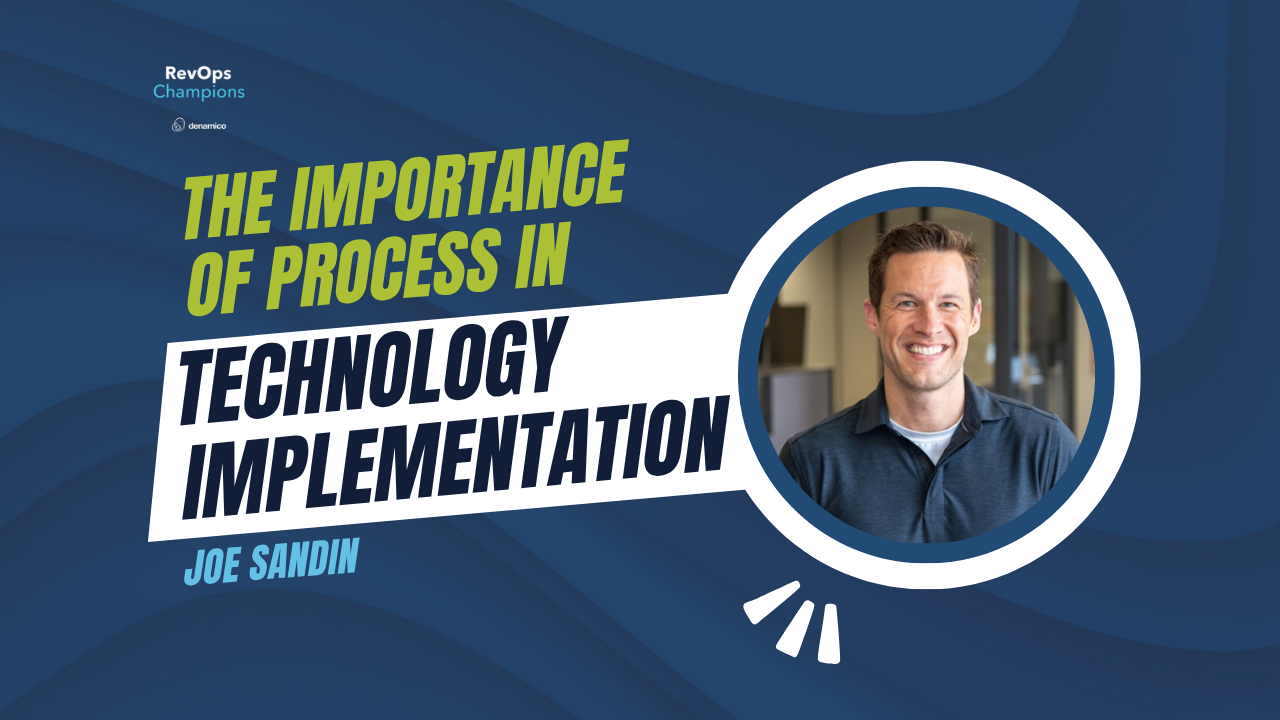
In this episode, Joe Sandin, president of OnSharp, discusses the intersection of technology, process, and data in business operations. He emphasizes the importance of having a clear understanding of business processes before implementing technology, the critical role of data in ensuring successful outcomes, and the necessity of a strong team to optimize these systems. Joe also highlights the growing trend of custom portals as a solution for businesses seeking to enhance efficiency and customer experience, while addressing the need for integration across various systems.
Joe Sandin also discussed the development of a new customer portal called Core, designed to integrate seamlessly with HubSpot and provide a holistic experience for users. He emphasizes the importance of change management in technology implementations, particularly for larger companies, and highlights the need for businesses to adapt to the increasing velocity of change driven by technology and AI. Joe shares insights on entrepreneurship, the significance of patience and progress, and the importance of building a strong team to complement individual strengths. He also offers book recommendations that align with his journey towards transitioning from a service-based to a product-based business.
Listen
About the Guest
|
|
Joe Sandin | Founder and CEO, Onsharp
Joe Sandin is the Founder and CEO of Onsharp, where he brings over 20 years of experience living the small business dream. Known for his positivity and optimism, Joe is passionate about building supportive teams and helping others succeed. He enjoys mentoring aspiring entrepreneurs, sharing stories of his own successes and failures to guide them in making informed decisions. Joe believes in following your passions and encourages his team to pursue their dreams, even if it takes them beyond Onsharp. With a people-first mindset, he is dedicated to creating an environment where growth, authenticity, and fulfillment thrive. |
.png?width=209&height=209&name=HubSpot%20Profile%20(11).png)
Episode transcript
Introductions and Background
Brendon Dennewill: Joe, thanks so much for joining me today. You're the president of OnSharp.
Joe Sandin: That's right. I've been the president of OnSharp for going on 25 years now, coming up in June or July. I don't remember which month we started, but I started as a college student back in 2000 and just kept going. Here we are.
Brendon Dennewill: It's amazing how time flies when you have your head down, getting things done and growing a business, in addition to all the other personal obligations that most business leaders have.
Joe Sandin: Four kids keeps you busy too.
Brendon Dennewill: I only have three, and that was busy enough. I can only imagine how busy four is.
Joe Sandin: Three and four are about the same. It doesn't really change too much.
Brendon Dennewill: We were just talking about in the office this morning how there are a few people who have two kids, and I was teasing one of them: just wait until you have the third. That's when everything changes.
Joe Sandin: You're right. It was the two to three transition. Three to four, I feel like it just becomes parenting by committee at that point. As long as you're herding them all in one direction, you're okay.
Running on EOS and the Value of Business Operating Systems
Brendon Dennewill: We all learn lessons at work that we can use at home, and the other way around as well, which is especially true when you've been doing it for 25 years. Joe, I know you also run on EOS.
Joe Sandin: We do. We've been running on EOS since really the early days. I was fortunate enough to get connected to Mike Payton early on in the Minneapolis market. There were some guys from St. Thomas that I worked with. One in particular was using Mike to implement, and I was there in the IT seat on the leadership team as kind of a contractor. I got to go through the experience of an EOS implementation. This was probably 2010. I think EOS started in '08 or '09, so I've been around EOS for a long time.
Brendon Dennewill: I'm guessing it's been a great help, and you'd credit a lot of the success you've had at OnSharp to running on EOS.
Joe Sandin: Absolutely. I'd agree with the way Gino talks, whether it's EOS or another system: you just need to have a system in your business that you run on. EOS was that system for us. Just having all those components, whether it's data, people, process, or all the different pieces of Traction, it gives you a really nice model to understand all the pieces you need to have figured out and feel good that you've got your bases covered.
Joe Sandin: It's been good for us, though it has taken a long time. Even after 15 to 20 years of running on it, we're still working hard to get it all the way through the business. The hard thing for us was going from the leadership team doing EOS to getting it ingrained in the whole company. That's another feat in itself, but we're still pushing and making progress even today.
Brendon Dennewill: One of the themes we've seen on this show over and over again is how connected process is to the technology implementation work that both you and we do. If the client doesn't have clear processes around what they're trying to have technology help them do better or faster or more efficiently, the technology is not going to help.
Brendon Dennewill: You mentioned Mike Payton, who literally wrote the book on Process. We've been running on EOS since 2014. We were invited to one of the first EOS events in Minneapolis by our bank, Bridgewater Bank, in 2014. And Mike Payton is actually the implementer for Bridgewater Bank too. I've literally watched his kids grow up across the street from me for the last 13 years.
Joe Sandin: That's pretty cool.
Why Process Clarity Is the Foundation of Any Technology Implementation
Brendon Dennewill: Let's dig in there. Setting aside the specific type of technology for a moment, what part does process play when implementing technology, and what separates a successful implementation from a failed one?
Joe Sandin: You make a good point right off the bat. If a business doesn't know what it's doing or how it operates, it's really hard to be successful with tools and software. It's almost like the same analogy: garbage in, garbage out from a content perspective. It'll be the same way on the process side.
Joe Sandin: A lot of businesses want to start getting into process and make it really complicated and detailed from the beginning. I think you just start simple. Just like EOS, come up with your top five to ten processes, document them simply, and make sure everyone is following the high-level basics first. Then as you get going, you add pieces over time until, two or three years down the road, you've matured well into it.
Joe Sandin: You really need to understand how your business operates before you dig into a deep software implementation or start spending a lot of money on tools. You need to know: what's the OnSharp way? How do we do business? What does that look like? When you're really clear on that, the software piece becomes easy, because now you're just matching up what you do to what the software has to do. You're not trying to invent yourself at the same time as implementing a piece of software. It's very hard to tackle both of those things at once.
The Revenue Operations Framework: People, Process, Technology, and Data
Brendon Dennewill: On this show, we talk a lot about the RevOps approach, which we see as the layer of services and people that make technology and data actually work for a company. Once you've implemented technology, whether it's a CRM, a client portal, or something else, there's a layer on the revenue side of the business crossing marketing, sales, and customer service. Many businesses are now calling that their RevOps team, and it's essentially the team that makes the technology do what it was meant to do in the first place.
Brendon Dennewill: Implementing technology doesn't create the solution. It just gets you started. You then need a team, internal or external, to optimize the system, the data, and the processes. I love the EOS 80/20 approach to creating processes: start with the 20 percent that gets you 80 percent of the way there, then iterate over time. How do you think about data when it comes to a technology implementation?
Joe Sandin: I've always been a data person, going back to my programming days and databases. I've always highly valued structure, cleanliness, and having good data. It's kind of a deal breaker for me. At the end of the day, the business has to have good data to run on, whether that's your scorecard data, your sales and marketing data, your customer information, your prospect data. You kind of have to be a data junkie.
Joe Sandin: What's hard in a lot of businesses is that maybe the visionary or the integrator, or some of the leadership team, aren't super focused on the data side. But I've been fortunate as a technical founder to always be really focused on data and technology and how it all works together. I also have a really good integrator in Samantha, who's been with me for 12 or 13 years now.
Joe Sandin: From a RevOps perspective, it really does roll down from the leadership team. Trying to create a culture that's focused on, once we have these systems in place, how do we monetize on top of them? How do we create efficiencies? How do we position ourselves to grow? It's got to come from the top down.
Joe Sandin: We've spent the last couple of years building a lot of foundational pieces at OnSharp: the CRM, sales and marketing processes, and building out a management layer inside the company. For a while, being in that 25 to 35 employee range, we were still in the mode of leadership team plus everybody else. That can only work for so long. You have to start empowering more people and creating structure so your leadership team can truly focus on leadership activities.
The Four Components of RevOps: Technology, Data, Process, and People
Brendon Dennewill: Every time I speak to a leader about the four components of a successful and increasingly efficient RevOps function, whether or not they call it RevOps, it comes back to knowing that someone is optimizing marketing, sales, and customer service. We've talked about technology, data, and process. The fourth and most important component is people. Without people, you can't do any of this. But I think everyone listening understands that, so let's keep it brief. Is there anything on the people side you'd like to add?
Joe Sandin: From a people perspective, my first focus was getting a leadership team in place. As a founder, you can get stuck running the company forever, and it just becomes a job you're trapped in. My first move from a people standpoint was to let go, delegate, get out of the middle of things, and trust people to execute. This business has to be able to run without me for a week, two weeks, or a month without skipping a beat.
Joe Sandin: When you talk about AI and people and efficiency together, to me it's about taking people out of the process when they don't need to be there, and injecting people into your business where they can add that extra special flair. It's all about finding the right mix: where do people need to be, and where can AI and technology handle the repeatable and easy tasks, so people can focus on the things that create the X factor in your business.
Custom Portals: What They Are and Why Businesses Need Them
Brendon Dennewill: From what I can gather, the custom portals you're building for clients are a big part of what you're currently focused on at OnSharp. Is that accurate?
Joe Sandin: That is our focus. We historically haven't always talked in that language, but when we looked back at everything we've done over all these years, most of what we build is a portal of some kind. Whether it's for customers, employees, or partners, most of what we do for our clients is helping them get information and services out to an audience of people.
Joe Sandin: When you build custom software, there's an analogy that you're selling vapor. We don't have a hard, tangible product. But talking in terms of portals, and helping people understand how we connect people to create efficiencies and grow revenue, just resonates better and helps people understand what we do.
Brendon Dennewill: For those listening or watching who don't know what a custom portal is, how would you describe it?
Joe Sandin: A custom portal is building an interface that allows you and your customer, or whatever audience, to transact, do business, and communicate. Whether that's a customer portal so they can update information, view quotes, shop, purchase products, manage projects, it's a way to connect people. At the fundamental level, it's helping our clients use technology to be more efficient and better serve their own clients.
Brendon Dennewill: At what point do you see businesses wanting something custom, where an off-the-shelf portal or dashboard just won't cut it?
Joe Sandin: Most of our clients have their internal systems: a CRM, accounting software, all these different foundational pieces. Those systems try to have a portal component that exposes information to customers or partners, but that's not their focus. They're built to be internal tools. A lot of times, off-the-shelf solutions can't integrate all the systems a client wants to bring together.
Joe Sandin: A lot of what we do is connecting the dots using APIs to bring data from all these places into one place to give the customer the full experience they're looking for. I've been in situations as a consumer where to do one thing, I have to log into one place, and to do something else with that same business, I have to log in somewhere else. It's all about creating a more seamless experience for the customer. When you build something custom, it gives you a real differentiator.
Who Is the Right Candidate for a Custom Portal?
Brendon Dennewill: Are there certain industries or company sizes where custom portals make more sense? What criteria should someone consider if they're intrigued by the idea?
Joe Sandin: The biggest criteria is always: are you creating value, or are you gaining efficiency internally? Whether you have 100 customers or a million, if you look at your internal processes and see that you're spending way too much time doing things inefficiently with that audience, or there are things customers are asking for that your technology doesn't allow you to deliver, then you're a good candidate for something custom.
Joe Sandin: I'm really big on measuring the tangible effectiveness of implementing something. If it wouldn't really save money or help grow revenue, then maybe there are bigger fish to fry right now. The two biggest drivers are always: can we become more efficient and reduce costs, or can implementing this help us grow revenue?
Joe Sandin: As for industry, it doesn't really come into play. We do a lot in manufacturing, agriculture, banking, finance, and medical. There are people in every industry, and if you're interacting with customers, there's always an opportunity for a portal to help you be more efficient or grow revenue.
Brendon Dennewill: What about company size? At what point do business leaders start considering a custom option versus something off the shelf?
Joe Sandin: When you're smaller, maybe under 500 employees, it can be a little tougher to justify putting a lot of development effort into a custom portal. You might look for something more off the shelf. On the flip side, we've worked with publicly traded companies with millions of customers who are building custom interfaces because they really want an X factor that nobody else has from an experience perspective.
Joe Sandin: Most of our clients fall in the 500 to 2,000 employee range. They have a large enough audience they're serving, and a large enough internal team serving that audience, that there's significant efficiency to gain. And then there's the revenue opportunity: cross-selling products or services and capitalizing on the existing client base rather than prospecting for new customers.
Data Integration: How Custom Portals Connect Front-End and Back-End Systems
Brendon Dennewill: In what percentage of situations where you're building a custom portal are you pulling data from both the front end, like the CRM, and the back end, like an ERP or financial system?
Joe Sandin: Most of the time, yes. If you're building a full-fledged portal that does multiple things, you're typically pulling from multiple systems in that business and connecting data together.
Brendon Dennewill: Does the custom portal become the single source of truth for that business?
Joe Sandin: Not typically. We're not changing their source of truth. We're not changing what's true in the accounting system, the CRM, or the ERP. We're typically creating a layer to the outside that empowers them to transact, communicate, and interact with their customers in a way they just weren't able to do before.
Joe Sandin: So many businesses might create a portal with zero or very little connectivity back into the internal system, which creates extra overhead trying to synchronize data manually. When we do these projects, our goal is always to have everything connected. We've seen every ugly database you could ever imagine. There's no system we can't find a way to talk back and forth with. We've just had a lot of experience with old systems, new systems, and everything in between.
Introducing Core: A HubSpot-Integrated Customer Portal for Smaller Businesses
Brendon Dennewill: For businesses under 500 employees that are still more likely to use an off-the-shelf solution, and for those familiar with HubSpot, which hub would you use as an off-the-shelf portal?
Joe Sandin: My biggest issue to this point has been that the only real customer interface HubSpot gives you is through Service Hub and ticketing. If you're using HubSpot Service Hub, they do have a portal you can turn on that lets you interact with clients just for tickets. Your customer can log in, see open tickets, submit tickets. But ticketing is just one little piece of the entire picture of a business.
Joe Sandin: If my customers are going to sign into a portal, I want to show them a lot more than ticketing. I want to give them a lot more opportunity to understand our services and transact with us: invoicing, quoting, service contracts. So we've actually been building a new product we call Core, which integrates directly with HubSpot. We're building a portal that we feel is much more in line with what a HubSpot company would want to give to their customers.
Joe Sandin: It'll do ticketing just like the HubSpot ticketing portal does, but we're also building Core to expose a lot of other HubSpot components to customers so they have a more holistic experience. They just have to connect their HubSpot account and configure how they want it to work, and then everything is locked and loaded. All the data synchronizes, all the components are enabled. It'll be a pretty fun product for us to push forward with.
Brendon Dennewill: What's the timing on that?
Joe Sandin: We're probably within 30 to 45 days of getting a first beta version out. We have a small group of customers we're going to pilot with to get some initial feedback and make sure we're on the right track. We also have a separate website at coreportal.io, and we're still looking for businesses that might want to be in that pilot program. I invite people to check it out.
Brendon Dennewill: So it sounds like Core is essentially bringing that custom customer portal experience down to companies under 500 employees?
Joe Sandin: Exactly. There are a lot of companies using HubSpot that are smaller, that want great portal functionality but can't afford to build it themselves. They want something simple. There are some tools out there that let you build a portal and connect your HubSpot account, but they can take months of work and require a technical background to set up. Our goal is to create something you can sign up for and have up and running in 10 minutes. Simple, easy, and getting you to market fast.
Understanding Customer Pain Points: Why Businesses Come to OnSharp
Brendon Dennewill: What are the main business problems that bring clients to you?
Joe Sandin: It's always something to do with sharing data with an audience. It's usually: I want to build an app that allows me to do this or that with my customers, or I want to build a web portal. When we look back at all the work we've done over 20 years, a lot of what we do is help people connect through technology.
Joe Sandin: Most new business, or existing clients coming back to us, have another similar challenge. There are always people in the middle of the problem. It's always: we need a better way to share or transact with a certain audience. In agriculture, for example, a lot of times we build portals where a manufacturer has dealers and wants to communicate better with them, handle warranty issues dealers are reporting. It's always a matter of transacting information back and forth with an audience efficiently.
Joe Sandin: A lot of companies are trying to figure out how to not have to hire another 10 people in their support team. How can they stick with the team they have and just be more efficient so they can continue to scale?
AI Integration: Moving Thoughtfully Toward the Future
Brendon Dennewill: That leads everyone to think about how AI is going to impact all of this. I'm guessing you'll have the ability to build AI into your new Core platform.
Joe Sandin: In our first iteration, we're not really tackling AI quite yet. As a founder and entrepreneur who is used to getting my hands dirty, it's very hard to sit back and let the process play itself out. But we need to get to market with our initial MVP, prove that we have product-market fit, and then take time to understand how AI plays into this properly.
Joe Sandin: In my time looking at AI, there's a lot of great stuff out there, but there's also a lot of hype. You've got to sift through it and understand what's really going to move the needle and what's really going to stick long-term. My wife runs an estate planning law firm in Fargo, and I'm doing some AI work with her right now to help her understand how to be more efficient throughout the whole legal process. There are so many great implementations of AI. I just want to be careful about how we integrate it into the product. You can spend a lot of time going down a track that doesn't prove to be a valuable feature or that nobody adopts.
Joe Sandin: I want to be a good steward of our time, get something to market first, and then listen to what our customers are asking for before we jump on the AI ship and start shipping things nobody ends up using.
Brendon Dennewill: So you don't feel there's current demand from your ideal Core customer for AI, but it's something you could add over time?
Joe Sandin: There are some obvious use cases, like chatbots. And since Core integrates with HubSpot through the HubSpot API, there are a lot of AI components we can flow through into the portal experience. Chat would be a great example. There will be pieces we'll put in quickly that I think are proven at this point. But I'm really trying hard to stay MVP with the initial rollout.
Brendon Dennewill: The advice I keep receiving and therefore giving is: use very specific use cases in your business that can be solved by AI, start there, and iterate out. It's similar to what we talked about with the EOS 80/20 approach to processes. Start with those specific use cases, learn as you go, and it's also a great way to get people slowly adopting AI rather than feeling like they have to implement everything at once.
Joe Sandin: AI is no different from other things that have come around the corner at 120 miles an hour. Change is hard. People resist change. When you've got a bunch of employees, you've got to be careful not to flip the table upside down and rock the boat too much. You've got to be deliberate: take this one piece at a time.
Joe Sandin: A lot of people right now are just worried about falling behind with AI, and I understand that. But business is business, and proven things will always be the proven things you have to get right. Don't freak out. Take it one piece at a time. As long as you're making progress and putting one foot in front of the other, you're going to get there. If you move too fast, you might make a bunch of mistakes and have to take 10 steps backward. That's probably more painful than moving methodically from the beginning.
Change Management: The Critical Missing Piece of Technology Adoption
Brendon Dennewill: We've seen a huge increase in demand for change management as part of our technology implementations over the last year, especially as HubSpot has become more robust and larger companies are using it. For companies of 500 employees or more, the need for change management has skyrocketed. Adoption is the key metric. If the technology isn't adopted by the company that made the investment, it becomes a failed investment. Have you noticed that same trend?
Joe Sandin: Absolutely. We've always been big proponents of including training components in every technology project, whether it's a website, a portal, or anything else. A lot of businesses like to jump in and build something new and then forget to go back and update their process documentation or train people on how to do it. You can't skip those steps.
Joe Sandin: Whenever you're implementing HubSpot, adding a new hub, or adding a portal, you have to stop and say: how is this changing the way we operate, and who needs to understand how to do this? You have to make sure everyone moves along together and stays consistent. The worst thing in a company is having 10 different customers interact with you and walking away with 10 different experiences. You have to budget for training, process documentation updates, and making sure your business is ready to actually move forward with the new tool.
Brendon Dennewill: We started using a framework about a year ago from a company called PROSCI, P-R-O-S-C-I. They're one of the leading change management firms, and they've created a framework called ADKAR, A-D-K-A-R. We have one person on our team in that full-time role. She's certified by PROSCI in change management and works on all the more complex implementations and ongoing client optimizations.
Brendon Dennewill: I think we'll be doubling down on that because the velocity of change is so much greater now than it was in the 2000s or the 2010s. The whiplash for our teams and our clients' teams is a lot greater. Technology is evolving faster, information moves faster, and expectations are much higher.
Joe Sandin: Everything moves way quicker because information moves way quicker in today's world. Expectations are much higher.
Brendon Dennewill: Exactly. And that's why I really believe change management matters. Adoption is the key metric, and the most critical component leading to adoption is change management. Even smaller businesses are going to need to start thinking about how to invest in it.
Joe Sandin: Agreed.
Domain-Specific AI and the Future of Professional Services
Brendon Dennewill: You mentioned your wife's law business. Have you checked out harvey.ai?
Joe Sandin: It sounds familiar, but I can't remember exactly what it does.
Brendon Dennewill: It's domain-specific AI for law firms and professional services providers. It's currently targeted at Fortune 500 firms, but I'm pretty sure it'll be coming downstream fairly soon. I think every category of professional services, especially law firms and accounting firms, are going to benefit a lot from what's happening in the industry. And we're seeing it as a professional services business ourselves: it used to be very hard to scale without just adding headcount, and we're all seeing that change.
Joe Sandin: That's my wife's biggest challenge in her estate planning firm: there's just not a lot of younger estate planning talent out there. Growing the firm has been very difficult. So it becomes an exercise of: given the team we have and knowing it's going to be hard to scale people, how do we become as efficient as we can and really maximize our time?
Joe Sandin: I've been playing around with some low-code and no-code tools as well. I grew up as a founder in the early 2000s, right as things were starting to get more sophisticated. And now it's at a whole new level. I haven't gotten my hands dirty with code for a long time, so it's interesting to go back into some of these technologies and see how much you can accomplish without writing code. Things I look at now and think: how many thousands of lines of code would I have had to write in the old days to accomplish that? And now it might be 10 lines of code, or it's just a SaaS service for 10 dollars a month.
Brendon Dennewill: Having that ground knowledge of code makes it so much easier to use low-code and no-code tools.
Joe Sandin: It does. And I think a lot of people in business without a technical background struggle to understand whether something is expensive or cheap, hard or easy. As a founder, it's always good to brush up as much as you can and become as technical as you can be. Everyone has their own level of what they're willing to pursue, but the more technical you can be as a founder or anyone in a business, the more powerful and better equipped you'll be. This world is changing fast.
The 'Who Not How' Principle: Building the Right Team
Brendon Dennewill: I spend a lot of time with successful entrepreneurs, including many who don't feel very comfortable technically. One of the best books I've read in the last two years is Who Not How by Dan Sullivan and Ben Hardy. It relates to a lot of what Gino Wickman built EOS around. The idea is that one person cannot be good at everything. You figure out your unique strengths and build a team with the strengths you're missing.
Brendon Dennewill: For any leader, especially if you're the president or CEO and everyone is looking to you for technical direction around AI, and that's not your strength area, find somebody: whether it's a permanent resource or an external part-time resource who acts as your CTO or chief AI officer. Someone who can translate the technical opportunities for you, because you still understand your business better than anybody else. You just need that technical partner who can bridge the human and business side with the technology side.
Joe Sandin: You're right. We all have our unique thing that we're best at. The best thing you can do is surround yourself with good people who complement the skills you don't have. That's how you build a good business. Samantha, our integrator; Jake, our leader of sales; Joe Hickson, who runs our operations: they have very unique skills that I'm terrible at. I knew that from the beginning. It's good to be self-aware of when you need to hand the baton off to somebody else and be okay with it. You don't have to be the number one at everything.
Brendon Dennewill: We use the African proverb at least once a week around here: if you want to go fast, go alone. If you want to go far, go together. And I think it's most useful for entrepreneurs like us, because we have to remind ourselves that there's only so far we can go on our own.
Joe Sandin: That's such a great analogy. There are many times I think: if I was just by myself right now, I could be moving twice as fast. But then I instantly think: I sure wouldn't get very far down the road. I would run out of gas at some point. We need the collective whole of the entire team to get us to the long-term vision.
Final Advice: Patience, Mentorship, and Slow Steady Progress
Brendon Dennewill: Any parting advice for those listening, particularly folks who are familiar with HubSpot and the benefits of a well-integrated CRM with good data flow so that leaders can make fast, accurate decisions?
Joe Sandin: My advice is to be patient with yourself. I look back at my journey. It's been 25 years, and I still feel like a startup. I get up in the morning and feel like we just started this business yesterday. There's so much pressure from social media and just generally in today's world to go from zero to hero in six months. I just don't believe that.
Joe Sandin: I spent the first 13 years of OnSharp just trying to get to the million dollar revenue mark. Slow and steady wins the race. Get a mentor. Don't try to make every decision on your own. Try to cut down on mistakes. I love to mentor people as best I can and share the mistakes I've made so others don't have to make them. Be patient. As long as you're putting one foot in front of the other and making progress, you'll get there. Don't feel like you've got to follow the pressure to build the next great billion-dollar company in two years. A lot of great businesses are built slow and steady.
Brendon Dennewill: The sooner you stop comparing yourself to others, the happier you'll be.
Joe Sandin: Just be the next best version of you from last week. Use yourself as your comparison. That's it.
Book Recommendations
Brendon Dennewill: Any book recommendations? Things you've read recently or tend to re-read?
Joe Sandin: I read Traction just about every year to continue refreshing on all the little details. That's an obvious one. I just read The SaaS Playbook as well. We're trying to become more of a product-based company over time. I've spent a lot of time in the services-based business, hunting and killing and living in the consulting world, and I'm really excited to move us more toward SaaS and building recurring revenue. So that's where my focus is: understanding how to do that, what the right metrics are, and learning from others' mistakes and successes.
Brendon Dennewill: I look forward to following that journey. I know you're not the only leader of a professional services firm who would love to have a product-based business.
Joe Sandin: It's getting tougher with all the advancements in AI and development tools. More people can jump into the mix way more easily. The barrier to entry is getting very small. It's going to be challenging. That's where great ideas and great execution are going to come into play.
Brendon Dennewill: No matter how low the barrier to entry is, you still have to do the hard work. It's all about progress, not perfection. That's really good advice, Joe. Thanks so much for joining me today. It was great to connect, and I look forward to following your success for the next 25 years.
Joe Sandin: I really appreciate it. Thanks for having me on.
Subscribe