
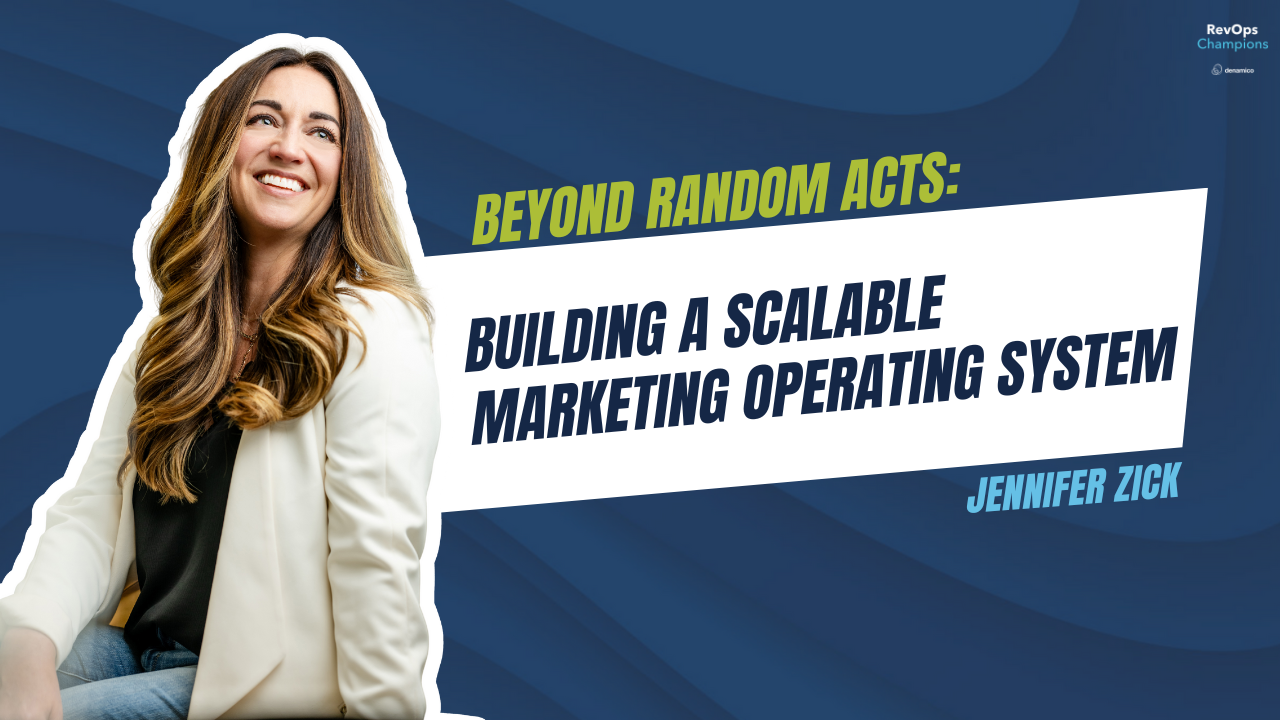
In this episode of RevOps Champions, host Brendon Dennewill talks with Jennifer Zick, CEO of Authentic and creator of the Authentic Growth Marketing Operating System. With 25+ years in B2B marketing across startups, PE-backed companies, and global organizations, Jennifer unpacks the predictable pattern she’s seen as companies scale: founder-led, sales-driven growth eventually leaves behind a trail of “random acts of marketing.”
Jennifer explains the “little marketing vs. big marketing” shift, where marketing stops being a sidecar to sales and becomes a strategic, leadership-aligned growth discipline across the full customer lifecycle. The conversation covers why marketing often lacks the right seat in the organization chart, how RevOps becomes the glue for execution and measurement, and why fractional leadership is evolving into a long-term operating model, especially as AI improves tactical efficiency without replacing executive judgment.
This episode is essential listening for CEOs, revenue leaders, CMOs, and RevOps professionals who want more predictable growth, clearer ROI, and a scalable marketing system that supports acquisition, retention, and valuation over time.
What You’ll Learn
- The growth lifecycle shift: founder-led → sales-driven → go-to-market strategic
- Little marketing vs. big marketing
- The evolution of fractional CMOs from a temporary “bridge” to a long-term operating model
- Why RevOps/Marketing ops acts as the connective tissue
- The predictability mindset
- The measurement ecosystem beyond CAC/LTV
Resources Mentioned
- Authentic Growth Marketing Operating System
- Random Acts of Marketing Assessment
- Fractional is Forever
- Bow Tie / “Flipped Funnel
- The E-Myth
Listen
About the Guest
|
|
Jennifer Zick | Founder of Authentic®
Jennifer Zick is the Founder and CEO of Authentic®, a leading fractional CMO and marketing transformation firm that helps growing businesses overcome random acts of marketing and build disciplined, scalable growth systems. With more than 25 years of experience across startups, private equity–backed companies, and global organizations, Jennifer is the creator of the Authentic Growth® Marketing Operating System, designed to align marketing strategy with revenue goals and long-term business value. A recognized leader in the fractional CMO space, Jennifer is an Inc. 5000 member, Fast 50 awardee, and multiple-time honoree for leadership and workplace excellence. She is known for bringing clarity, accountability, and predictability to growth by connecting marketing leadership, RevOps, and executive decision-making. |

Episode Transcript
From Founder-Led Sales to Strategic Marketing: Recognizing the Pattern
Brendon Dennewill: Jennifer, you've worked across startups, private equity-backed companies, and global organizations. What patterns did you begin to notice that signaled marketing was breaking down as companies try to scale?
Jennifer Zick: I lived the pattern and then saw it in larger organizations I was both consulting into and eventually went to work in. It's a natural life cycle that most growth businesses go through.
Most businesses are founded by the vision of a founder or founders. They're founder-led with a hypothesis or an initial offering, and then they're sales-driven because businesses have to sell more than one time to actually exist. As that founder-led, sales-driven business begins to grow and create critical mass, it very naturally goes through many different evolutions in its go-to-market message and focus. They have to experiment in the early days to find market fit and to accelerate.
When they eventually find that market fit, they'll look behind them and recognize a trail of random acts of marketing. That's not a critique; it's just the reality for growing businesses. But there will come a time, whether it's when they receive their first infusion of private equity funding or when a fourth-generation family-owned business is changing hands, that the organization recognizes it needs to become strategic in its overall go-to-market approach. That's what Authentic was born to do: to help those growing businesses, wherever they are in that pattern, break through founder-led, sales-driven ways of thinking and become go-to-market strategic thinking organizations.
Brendon Dennewill: As you were saying that, I kept thinking back to the book many founders have read, "The E-Myth." It's almost like if you could write a version of that book, you'd write "The M-Myth," because marketing has to evolve as businesses evolve.
Jennifer Zick: I have not yet written a book, and "The M-Myth" might be a good title. But I am talking this year about what I'm calling the "little marketing dilemma," which feeds into where and how businesses get stuck with their understanding of marketing as they grow and evolve. We can talk more about that as we go.
Little M vs. Big M: Why Marketing Needs a Seat at the Leadership Table
Brendon Dennewill: Let's talk about that.
Jennifer Zick: That pattern of being founder-led and sales-driven, or even a company that has put significant effort and dollars behind marketing but still feels uncertainty about whether they're doing things in the right way, in the right order, toward the right outcomes: a lot of that confusion and frustration is happening because marketing isn't owned by the right person or doesn't have the right seat at the leadership table.
I get it. I'm a founder who bootstrapped a business. You cannot hire every executive role right out of the gates. But what happens in many growth businesses is that the traditional org chart will serve them well in the early stages and then becomes a hamstring. That traditional org chart will probably have a CEO, a head of finance, a head of operations or services delivery, and a head of sales.
Marketing ends up being this awkward area of the business. It's either tucked under sales management, still directed by the founder because they're the visionary and brand voice, or set off to the side with the expectation that agency partners will handle it. In every single one of those situations, marketing is living in this "little M" reality where its greatest and highest potential is limited.
At this stage, most companies think of marketing as just sales support: lead gen, demand gen, getting the brand out there and creating more at-bats. That's a critical role of marketing. But what a lot of growing businesses don't think about is what altogether healthy revenue looks like for their organization. Marketing needs to play a role not just in creating new sales, but in ensuring successful onboarding, retention, and repeat business. That's healthy revenue.
You and I live in the world of funnels. Too many businesses are thinking only about the sales funnel, not the customer lifecycle or what I call the "flipped funnel." Visually, that flipped funnel looks like a bowtie, and that's where marketing should play a supporting role across the entire customer journey. I am passionate about helping companies understand what marketing really is and how it can support healthy revenue from end to end.
Brendon Dennewill: So visually, is the flipped funnel essentially the same as the bowtie funnel?
Jennifer Zick: Yes.
Brendon Dennewill: I like that. Even as far back as 2017 when you started, around the same time I started using the bowtie funnel, we were seeing how much value founders and business leaders were leaving on the table by staying focused on the traditional funnel and constantly chasing net new customers instead of focusing on the lifetime value they could create. You recently started a new blog, or is that the right word for it?
Fractional Is Forever: How AI and Collaboration Are Reshaping Marketing Leadership
Jennifer Zick: I've gotten my hands back into blogging on topics I'm really excited about coming into this year. My latest piece is really the platform for what I expect to speak about a lot in the future. It's a bit of a shift in how I'm thinking about our business model, not based on wishful thinking, but on measured impact from our client relationships over the past nine years, particularly the last two.
My most recent blog on our website is called "Fractional Is Forever." When you and I first met in 2017 over coffee, I still didn't know what kind of business I was building. I just knew that small businesses needed access to the wisdom of executive marketing leadership sooner than they thought they needed it, and I wanted to provide a model that delivered that in a flexible, part-time role.
As I built Authentic, I came to learn the word "fractional" from looking at other fractional marketplaces that have existed for some time in finance, HR, and other back-office areas. My hypothesis in those early days was that if I could build a fractional CMO business backed by methodology that brought operational rigor to marketing, I could teach marketing maturity to businesses.
I thought of our business as more of a bridge solution: get in, spend a year alongside the client, help build foundation, teach fundamentals, give them an operating system, and then work our way out of the job. But as we built our client relationships and used our own tools to measure the impact of our work, we started to see that the longer we stayed with a client, the stronger their results got and the stronger their confidence in how they were spending their marketing dollars.
So I started to learn that we weren't just a bridge solution. We were a long-term solution to building foundation, scale, and maturity. And what I'm seeing now is that fractional is becoming not just a short-term or longer-term strategy; it's becoming a forever strategy for many businesses.
You and I have both experienced the power of AI in the marketer's world to take tactical components and make them more effective. It doesn't replace the wisdom of an experienced leader and orchestrator. The efficiencies our CMOs now have, with our methodology backed by AI to accelerate planning and research, can 2x and 3x the effectiveness of their time in a fractional role. A company that might have needed a full-time CMO at $100 million in revenue in years past can now get a lot further down the road with a fractional leader.
Any leadership role that isn't a core component of what you deliver as a business: fractional can be a wonderful permanent solution that creates P&L fluidity and gives you the ability to maneuver through talent changes without disruption. The future of marketing teams for our clients is a fractional leader who knows how to orchestrate the right mix of internal hires, agency partners, contractors, offshore resources, and AI. It's an incredibly exciting time to be in this space.
Brendon Dennewill: Do you think much about the future world of collaboration replacing the world of competition? Earlier you mentioned how fractional started in HR and finance. To me, those were the initial signs that this outdated model built around the Industrial Revolution and competing with each other is starting to shift. The future is collaboration. It does take a mindset shift, because whatever our age is, minus our first seven years, we've essentially been trained to be competitors. The more collaboratively leaders can think and plan, the more successful they'll be, because everything just gets easier.
Jennifer Zick: It absolutely does. I'm really grateful to have built a culture at Authentic from the beginning that recognizes the power of collaboration. One of the unique things about our model is that we're one of the only fractional CMO firms in the world whose CMOs are W2 employees. They're all exclusively committed to Authentic, and they're all working together.
We hire for very bright, very talented, very experienced executives, but we hire those who are humble and collaborative, who don't bring ego to the table, and who are willing to say out loud, "I don't have all the answers," because none of us do. This marketing world is changing so fast that no marketer has all the answers, and we shouldn't show up and pretend otherwise. We need to lean on each other. Our solution for the client is always: who is the right point person, backed up by the entire team? That helps us move much faster when everyone leaves their ego at the door and we're genuinely just trying to find the right next step for the client.
When Referrals Aren't Enough: Identifying the Inflection Points for Growth
Brendon Dennewill: Let's go back to something you said earlier. Every business, at different stages, has to shift from a founder-led, sales-driven model to whatever comes next. What are the clearest signs that referrals and relationships are no longer going to be enough to support the next phase of growth?
Jennifer Zick: Those inflection points happen under different circumstances in different companies. I already mentioned generational businesses; we work with many privately held, family-owned companies. Sometimes the trigger for recognizing that the current network isn't the future growth opportunity comes with a change of generation and a change in vision: what does healthy growth look like for us in the next chapter?
Another big pivotal moment is when a company brings in new investors, especially private equity investors. They're looking at low-hanging fruit and how to optimize and grow the business beyond where it is today. That means taking what works, amplifying it, and doing things differently.
For earlier-stage founder-led businesses, like yours and mine, I knew that the first stages of growth for Authentic would come from my own network and people who already trusted me. But I also knew that long-term growth had to come from clients and the positive experiences our team was creating for them, and from a much broader ecosystem of trust than my founder's network alone.
These inflection points happen at different times as businesses redefine growth. That might mean new ownership, new investment, new markets, new products, or new services. They start hitting walls where the people who got them this far don't have all the capacity to create the roadmap for the next chapter.
RevOps as the Glue: Connecting Marketing Strategy to Revenue Outcomes
Brendon Dennewill: How do you see marketing leadership, fractional CMOs, and revenue operations becoming more interconnected as companies pursue more predictable growth and valuations?
Jennifer Zick: RevOps is the glue. It's the heart of what makes the strategy possible. I'm living this at Authentic. I've sat in the seat as our visionary CEO and our own fractional CMO for the past nine years, and I see 2026 as the year we finally appoint someone else to take on our own fractional CMO role.
Within our team, we have a marketing manager who is our RevOps specialist. She sits at the center of everything we're executing to ensure data integrity, compliance, the right segmentation strategy, and the right sequence of events. She makes sure the vision for what we're trying to achieve in marketing is practical, orchestrated, and automated so that we never lose the essence of our brand or the humanity behind what we're doing. Nothing is ever automated to the point where it feels inauthentic. That takes a special kind of chemistry between a CMO's vision and the orchestration of all the moving pieces.
RevOps is really the centerpiece of strategic marketing execution and optimization over time, because if it's not well managed, you can't see the results of what you're doing. And if you can't see the results and understand the engagement around them, you can't make it better.
Marketing has gotten far more complex than when I started my career 25 years ago, but the fundamentals are still simple and true: Who do we want to matter to? Why should we matter to them? How do we enter their natural habitat? And when we get there, how do we build trust? You cannot answer those questions with any clarity without a strong marketing ops underpinning.
Brendon Dennewill: Over the last nine years, assuming a lot of your clients have made the shift from little M to big M: how many of them actually think about RevOps specifically, or is it something your CMOs are having to educate them about?
Jennifer Zick: We do a lot of educating and a lot of foundation building. This is why our relationships live on beyond 12 months: because change takes time. Implementing new systems and processes, cleaning up data, setting up metrics, getting to baselines, and then accumulating enough data to have patterns from which you can draw insights, that does not happen overnight.
One of the biggest pieces of education we lead for our clients is: you don't just move from little M to clear marketing ROI by flipping a switch. They are always missing pieces of foundation, process, and data. So it takes time to build. We walk with them hand in hand, using our tools upfront to assess the maturity of their tech stack and marketing ops approach, and then we formulate an action plan and an evolving roadmap for how we're going to fill those gaps over time.
There are some industries that have historically never believed in CRM or relationship nurturing. They have an ERP and know who their customers have been, but they have no data, no process, and no programs for nurturing the entire lifecycle. It takes time, but nothing is more satisfying than starting to prove the value of those investments. When a business can predictively model how they're engaging their audiences and how that converts through the pipeline to drive predictable growth, that's magic.
Brendon Dennewill: We see that all the time too. Whether it's little M and big M, little R and big R, you can use that analogy across different functions of the business. It ultimately comes down to a leadership mindset shift. One of the things we talk about from a RevOps and CRM perspective is that it's not an implementation, it's a practice. We compare it to a yoga practice or a fitness regime: you're not going to do it for a year and then be done. If you want to keep getting fitter or maintain better wellness, you have to keep doing it. Sales, marketing, customer service, RevOps, CRM: they're all the same. It's a practice, not an implementation.
Jennifer Zick: You're so right, and I love that analogy. I started strength training two years ago, and life really does mirror the work we do. Every quarter they do an assessment and show me the tangible gains compared to the prior quarter. Those are gains I can't feel day to day, because it doesn't seem like I'm doing much differently and progress doesn't feel dramatic. But when you add up the gains, little as they may be, quarter after quarter, year after year, your life starts to change. It's the same with marketing. It's the same with any discipline in a business.
Those of us who have been growing companies know that every single stage requires a new stretch. You're never done. That's why Authentic doesn't take on projects. We don't come in and do a three-month assessment and hand you back a marketing roadmap, because those businesses don't actually know how to implement it. And even if they can implement the initial steps, they don't have the maturity to continue repeating and reformulating the strategy based on what they're learning. It's a discipline.
Fractional Is Forever: Reducing Leadership Churn and Building Continuity
Brendon Dennewill: In our RevOps model, it's people, process, data, and technology in that order. We cannot successfully implement and optimize a CRM for a business without going through the RevOps lens, because otherwise we're just adding technology without strategy. Going back to what you were saying earlier: every entrepreneur, when they first start a business, ideally would have the best people in every functional area from day one. But that's not going to happen. That sophistication comes from not yet having people with that experience. That's really what's missing, and it's partly why fractional roles began: it didn't make sense to hire someone at $150,000 to $250,000 when you could get them at a fraction of that to start making progress. Once a business grows and has the revenue, it can invest in full-time staff. But now you don't necessarily have to make that switch; you have options.
Jennifer Zick: That's right. And "right person, right seat" is another reason I stand behind the fractional is forever model, particularly in fractional CMO. Those of us who've been CMOs understand that you reach a point in your career where you're sitting in the hottest seat at the leadership table. The marketing leadership role is one of the most volatile, with one of the fastest turnover rates on any leadership team: an average life cycle of 18 to 24 months in many organizations.
When you factor in a full-time executive headcount with bonus, benefits, recruiting costs, onboarding time, and then the cost of lost progress, the cultural shakeup of losing a leader, and the cost to replace, it's a revolving door cycle. Authentic's model is designed to eliminate that friction. There will be times when you need a different leader. The leader who helped your business through three years of growth may not be the right fit when you're opening a new line of business or moving from distribution to e-commerce. We're designed to have those colleagues ready without disruption to your business, all operating from the same marketing operating system so that the language, programs, and processes keep running through those times of transition.
Brendon Dennewill: How much of that is connected to your little M, big M work? Or do you think that even companies that realize marketing is big still need to go through the evolution of what's required from the marketing leader seat?
Jennifer Zick: Big M isn't a destination where you arrive and live happily ever after. We've seen businesses hit brand nirvana and a beautiful revenue growth flywheel, only to experience a massive market disruption: new tariffs, COVID, an acquisition, or being acquired by a larger organization. In those moments, the well-built flywheel suddenly becomes unsettled again, and mature, robust processes have to be redefined. Business just doesn't stand still.
The other reality, whether we like it or not as marketers, is that when a business is preparing to be sold, marketing is often one of the first areas to experience cuts in order to bump up EBITDA and look ripe for acquisition. If you're working with a firm like Authentic, you can turn that dial down without losing your leader, without losing continuity. You can create that kind of fluidity for those events, with a leader who knows how to orchestrate through a merger, an integration, or a major change management moment, and carry the team through with the executive acumen needed during major transitions.
Building Authentic from the Ground Up: On Courage, Cancer, and Entrepreneurship
Brendon Dennewill: We also know that growth isn't linear, and some of our biggest leaps come right after our lowest lows. I know you've talked about how losing your job became a defining moment in your career. What made you confident enough to step away from the traditional path and build Authentic from the ground up?
Jennifer Zick: I love thinking back to where I was at that moment in 2017. I was 39 years old and had been grinding away at my career, really and joyfully. I've always loved to work. My husband has been an amazing partner in navigating both of our careers at every stage while raising a family as our top priority. But I always thought my trajectory would continue to be that of an executive CMO at a tech company rocket ship in the Bay Area.
When I ended up losing my job for the first time, at a Bay Area-backed company with a team I loved that I had built, I was not planning to start my own business. There was a small entrepreneurial seed in my heart, but I had never really watered it because I grew up in scarcity and made a lot of fear-based decisions: take the safe route, the predictable route.
What made me brave in that moment was that just a few years earlier, when I was 35, I had survived a scare with ovarian cancer. I was approaching my five-year cancer-free anniversary, and I was cherishing my one short, precious life. I had decided in that journey that I was going to learn how not to make decisions out of fear, but out of love. To pursue big things and take big risks, because on balance, what's the worst that could happen? Either I don't enjoy it or I fail. And so what? I've got a great track record. I'll get up and find a new path.
But there have been many micro moments since then that have made me braver, and almost all of them have come from the struggles: the losses, great team members leaving, roles we needed to fill but couldn't yet. All the struggles along the way are what make you braver every day in entrepreneurship.
Brendon Dennewill: I guess looking back, I didn't realize at the time that you weren't all that confident. But I never for a minute doubted that you had what it took to be extremely successful.
Jennifer Zick: I'm really grateful to you and Kristin for being one of the early mirrors that reflected confidence back at me, because I did have a lot of self-doubt. I felt like an imposter for the first few years as a solo operator. I remember the feeling from the coffee shop the first time I published a blog, thinking: I'm a career marketer, I've been writing content that promoted other people and brands my whole life, but I've never published anything with my name on it as thought leadership. People are going to find out I don't know what I'm talking about.
The opposite happened. People like you and others in my community started to see what I was doing, believed in me, and it made me braver. So thank you for being an early champion for me, because I needed it badly. I hope I can continue to be that for other entrepreneurs.
Brendon Dennewill: And you've proven it many times over. What would you say to that?
Jennifer Zick: Thank you, Brendon. I'm still running scared, honestly. But bravery isn't the absence of fear. Bravery is recognizing the fear and deciding to move forward anyway.
Proving the Model: The Shift from Bridge Solution to Long-Term Growth Partner
Brendon Dennewill: In the early days of Authentic, what result or realization confirmed that this was more than a marketing service and instead a different model for growth?
Jennifer Zick: It took a few months. In the first few months, when I needed to provide for my family, I took on whatever projects I knew I could deliver. My whole background has been B2B professional services, sales, and marketing. That's the world I knew.
The big stretch came in deciding, after several engagements where I had placed other CMOs in B2B roles that were successful and had longevity, that the model was proving itself. Once we had enough proof, I needed to place a bigger bet: converting to a W2 hiring model and starting to hire CMOs with expertise I didn't have. I built a team that included B2B and B2C expertise across business scenarios I had never personally worked in.
The proof came when we were consistently able to sell the concept of a right-fit fractional CMO for each client, regardless of industry or business model, and consistently earn client trust and deliver value quickly by leveraging the Authentic Growth Methodology I had developed and continued to evolve. It's been a slow burn, but being brave enough to know what I don't know, and continuing to bring really experienced people around me, is what makes this model work.
Brendon Dennewill: Everybody has unique experiences, and that's what makes each of us valuable. You cannot learn everything another human has learned; it'll take their entire lifetime. That comes back to the teamwork and collaboration piece. If you have a team of two, three, or ten, you have more experience and expertise, and therefore you'll be making better decisions and providing much higher quality service.
Jennifer Zick: Yes. I am smarter every day just by sitting in the company of the people I work with. I'm really grateful for that.
The Random Acts of Marketing Assessment and Metrics That Matter
Brendon Dennewill: As we wrap up, if a CEO or revenue leader listening today could ask their team one question this week to improve revenue alignment, what should that question be?
Jennifer Zick: I'm going to offer more than one question, because there are so many things I'd want them to ask. One of the tools we use to baseline a new client and understand how mature, or how random, their marketing is, is our Random Acts of Marketing Assessment. It's a simple tool with 20 questions, available for free on our website under our resources.
If you were to have the folks on your marketing, leadership, and sales teams take this simple survey, it won't just show you where there might be weak spots and opportunities. It will show you where there's misalignment. Maybe the CEO thinks marketing is really strong in a particular area, but the person sitting in the marketing seat sees it very differently. That's where there's an opportunity to understand one another's worlds better and create clarity.
I feel like I'm cheating by not giving just one question, but this tool, which underpins our methodology and helps demonstrate the impact our CMOs have in leading teams forward, is a powerful way to suss out what might be broken and what might simply be misaligned.
Brendon Dennewill: That makes total sense. That assessment is essentially what's behind your Authentic Growth Marketing Operating System. It's the diagnostic to figure out where someone's operating system could be improved.
Jennifer Zick: Yes, it's one of the tools our CMOs draw from, and we use it consistently with every client as a baseline score and then quarterly thereafter. Across more than 2,000 survey respondents over the last two years, we've been able to unequivocally demonstrate that all of our clients see improvement against all 20 attributes, quarter over quarter over quarter.
It also underscores the journey that marketing is. The assessment runs on a scale of 20 to 100 points. Clients might start with us at a 36, and after the first year, they're at a 68. We have yet to have a client hit 100, because nothing's perfect. There's always room to optimize and improve. But it builds confidence: now we know where we are, and we can identify where we need to start improving.
Brendon Dennewill: It creates clarity. Many of the people listening live in a 90-day world. Having clarity on what you and the team need to work on for the next 90 days to improve that score means you're also driving revenue, growth, systems, and structure that will increase the value of the business.
Jennifer Zick: That's right. Because ultimately, we're in the revenue game. But the true role of strategic marketing in an organization is to increase healthy revenue and profitability, and in doing so, and by building a strong brand, to increase the value of the business. That's the real why behind what we're doing.
Key Metrics for Marketing Maturity: LTV, CAC, NPS, and Net Revenue Retention
Brendon Dennewill: The two metrics I always start with are LTV and CAC. However, a lot of businesses aren't yet at the point where they're measuring those two unless they're in the SaaS space. What are the other big metrics you look at as your clients mature in their growth and scalability?
Jennifer Zick: LTV and CAC are the big two we're aiming to understand with clarity and to direct our strategies around. We're also looking at NPS, or some kind of equivalent customer satisfaction and net promoter score, because we're looking for the strength of advocacy. For a business to achieve that flywheel result, the word of buyers will begin to outweigh the word of the brand if things are going well.
We also want to measure employee net promoter score (eNPS). We want to look at the health of all the relationships that surround the business. Tactically, we're watching funnel conversion metrics: from engagement to marketing qualified lead, to sales accepted, to sales qualified, to new buyer. We're looking at conversion percentages and time to close. And we're always looking for the levers and dials. Where in this business can we speed things up while keeping quality? Where can we lengthen and strengthen relationships? Where can we add value and increase profitability and the longevity of the relationship?
The important thing is to have a formula. Measure it.
Brendon Dennewill: One metric we're seeing more and more with some of our bigger clients that seems to be becoming a really core measurement is net revenue retention (NRR). How often do you see that showing up?
Jennifer Zick: That matters a lot in models where long-term contracts, renewals, and subscriptions are present. At Authentic, our fractional CMO services are packaged as retainers. Our CMOs are all paid the same rate; we offer flat-rate retainer pricing. Our contracts are flexible: always current month plus the next 60 days. So we can do accurate projections because we have a forward forecast, but we're always earning and creating value in order to retain that business.
It's a balance of understanding our net recurring revenue month over month and year over year, and then when we set new goals, how much of our revenue we can count on from retained clients versus how much we need to win net new. This kind of metrics-driven decision-making is what creates healthy cultures. Otherwise, I see leadership teams doing goal-setting in the dark: "We need to 2x again next year." How are you going to do it? Who's responsible for which piece? How confident are you in your existing customer relationships? They've never answered those questions. It's just wild to me.
Brendon Dennewill: And of course, you just mentioned 2x, which could take this conversation in a whole other direction, because I'm a big believer that 10x is easier than 2x. But that's a conversation for another day. Jennifer, thank you so much for joining me today. It was so great to catch up, and I wish you and the team at Authentic all the best for 2026.
Jennifer Zick: Thanks, Brendon. It's always great to have a little reunion with my friends at Denamico, and I'm always cheering you on. Keep up the good work.
Brendon Dennewill: Appreciate it. Thanks, Jennifer.
Subscribe