
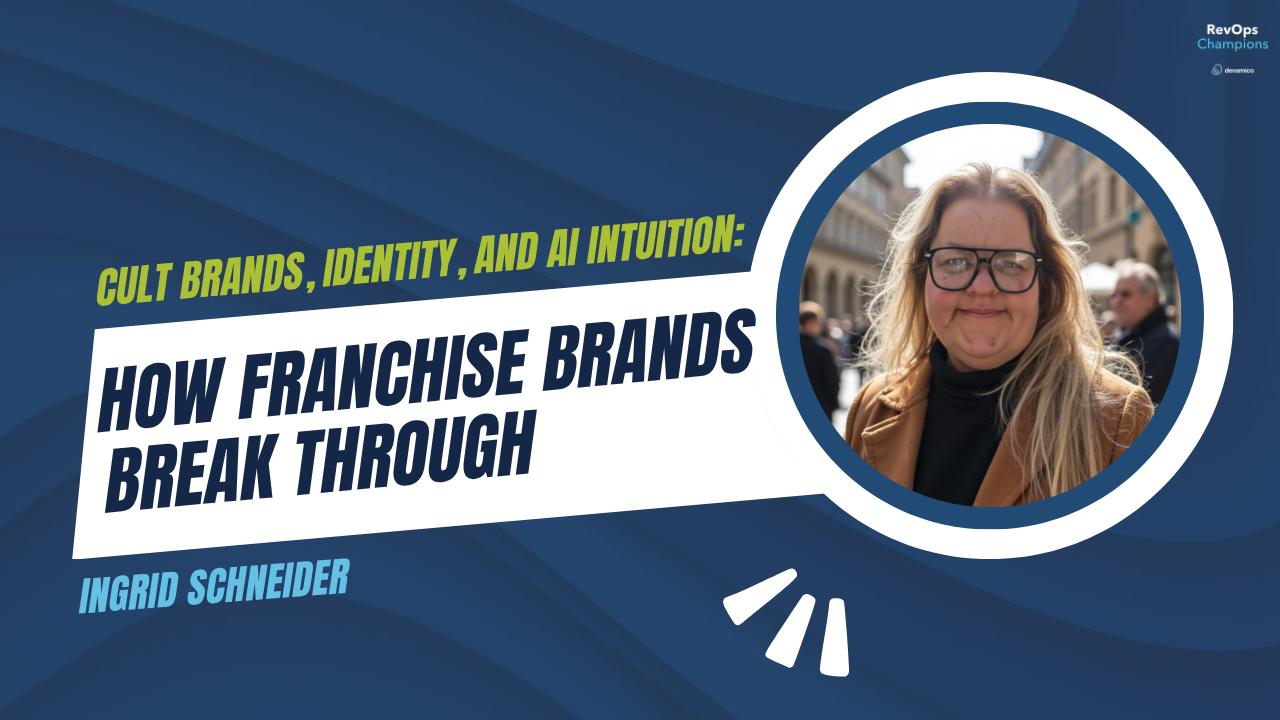
Ingrid Schneider, Founder and CEO of Stay In Your Lane and Train In Your Lane, joins Brendon Dennewill to challenge how franchise brands approach AI adoption, brand identity, and scaling past the critical 30-unit ceiling. Drawing from years of fractional C-suite work across franchise and multi-location systems, Ingrid unpacks why companies that skip education and jump straight to implementation almost always fail, and what a smarter, more human path to AI transformation actually looks like. If your franchise brand is stalled, scaling, or just starting to explore AI, this conversation reframes the entire conversation.
What You'll Learn
- The 30 unit franchise growth wall
- Marketing problem vs. identity problem
- The education-first framework for AI adoption
- AI intuition as a core team skill
- Cult brand philosophy at the local level
- Writing AI policies that feel like permission slips
Resources Mentioned
- Train In Your Lane
- Stay In Your Lane
- HubSpot
- AI ROI Calculator
- Figma
- International Franchise Association (IFA)
Listen
About the Guest
|
|
Ingrid Schneider | Founder & CEO of Train In Your Lane & Stay In Your Lane
Ingrid Schneider is the Founder and CEO of Stay In Your Lane and Train In Your Lane, where she transforms 'good' companies into iconic 'cult brands.' With a career spanning high-end steakhouse management, professional comedy clubs, and even scaling an auto body shop into a multi-location powerhouse, Ingrid brings a gritty, operator-first perspective to growth. Today, she is a leading voice in fractional C-suite leadership and AI adoption, teaching franchise systems how to scale using a blend of high-tech systems and deep human empathy. |

Episode Transcript
Welcome and Introductions
Brendon Dennewill: Welcome back to the RevOps Champions podcast. Today I'm joined by Ingrid Schneider, founder and CEO of Stay In Your Lane and Train In Your Lane. After building and fixing real businesses across industries like auto body, restaurants, and entertainment, she launched Stay In Your Lane during the pandemic and grew it into a fractional C-suite firm supporting franchise and multi-location brands. Known for her cult brand philosophy and practical approach to AI adoption, Ingrid brings a unique perspective on how companies scale through alignment, identity, and systems. Ingrid, welcome to the podcast.
Ingrid Schneider: Thank you so much for having me. I'm excited to be here today.
Brendon Dennewill: I had the pleasure of attending your session at IFA on AI, so it's great to have you on the other end of the conversation this time.
Ingrid Schneider: Now you get to ask me the questions. How did you enjoy the session? Did you feel like you were drinking from a fire hose?
Brendon Dennewill: Not really. The real reason I attended was to see if there was anything I was missing. As a leading HubSpot partner, we're dealing a lot with the transformations happening in AI. I think the biggest takeaway for me was just how aligned we are in how we're thinking about this. I'm really looking forward to this conversation.
Ingrid Schneider: That's awesome. Thanks for the kind words. I'm always curious about people's reactions because we're all at different levels, right? Some of us are just starting out, and others are deep in the pipeline thinking, this is remedial stuff.
Brendon Dennewill: Absolutely. And the reality is that even if we're in similar spaces, we're seeing things from a slightly different perspective. So, Ingrid, you've built your career as an operator across very different industries. How does that shape the way you approach growth, especially now in franchising?
The Operator Mindset: Building Across Industries
Ingrid Schneider: I think the thing I talk about often is what I call the "I'll figure it out" gene. Some people have it and some people don't. I'm a little neurodivergent and a lot ADHD, and I've taken that and used it as my superpower. I'm almost 50, and I don't mind talking about that. We were under-diagnosed as kids and didn't know what ADHD was. But I've learned that I have it, and I have this drive to figure things out.
What I've taken from each chapter of my career is that A, I don't have to fit in to do what I want to do, and B, I can figure things out. When my auto body chapter started, my business partner at the time came to me and said he wanted me to take it on. I thought there was no way. But now I'm super passionate about cars because I figured it out. I just love to learn and grow.
I've taken all of that into Stay In Your Lane and Train In Your Lane, and I've continued to figure things out in new ways. That's honestly how I approached AI when it became democratized: this is fun, I'm going to figure it out.
Brendon Dennewill: That's awesome. And Ingrid, you started Stay In Your Lane first and then added Train In Your Lane. Can you tell us a bit about both: what is Stay In Your Lane, and how is Train In Your Lane different?
Stay In Your Lane and Train In Your Lane: The Origin Story
Ingrid Schneider: Absolutely. I started Stay In Your Lane after I got laid off from a franchisor who ran out of money to pay me. I said, I'm not going to work for anyone ever again.
I think as women, we come into our 40s and we can really stand in who we are and know our worth. I had built a real name for myself through rebranding and understanding what emotive marketing looked like, the kind that really pulls people in. People just started asking if I could help with this or that, and I'd say, I don't know, but I can figure it out. I ended up collecting a team of people who know so much more than me in their respective areas: a Meta ads expert, a Google ads expert, a copywriter, operations people, and someone who helps me catch all the dropped balls.
It wasn't a master plan. I'm a visionary, but I didn't sit down and say, I'm going to build this agency that does all of this. About halfway through, we added franchise development, which we love. Building the systems, the drip campaign emails, the broker decks, the two-minute drill. So that's Stay In Your Lane.
Then when AI was democratized, I started talking about it and figuring it out. Kitty Academy was the first brand that came to me and said, hey, Ingrid, can you train our team? I have a master's in education, which I never actually used because I student-taught with a group of rowdy fourth-grade boys in Aurora, Colorado, and said, this is not for me. But I did get that degree, and I've applied it to what we're doing now.
I'm also a perpetual learner, and when you're a perpetual learner, you understand how people absorb information. We like to cover topics in micro-sessions and little micro-classes. People's attention spans are shorter than they used to be, so that's how we like to teach. When people started thinking we were an AI teaching company, I realized we needed to rebrand and spin that off into its own entity. Train In Your Lane was born out of that.
We've been really successful. I speak at a bunch of conferences, and if you'd told 25-year-old Ingrid that she'd be a speaker, she would have laughed at you. I was always told I didn't speak well or too fast. So it's a bit ironic that I'm now speaking to large groups like Ben and Jerry's and Wild Birds Unlimited. I have 10 speaking engagements this year so far and would love to do more.
On the Train In Your Lane side, we do classes as well. Yes, we specialize in the franchise space, but we're doing a ton more outside of it. I just spoke at EO Philadelphia for a women's conference, and we're starting a cohort with about 30 women from that event who want to dig into AI. I love creating environments where people can learn.
Brendon Dennewill: Awesome. So Train In Your Lane is the newer of the two, and that's the one that really scratches your education itch?
Ingrid Schneider: It does. My idea of a good time is to walk the dog, finish my nightly routine, turn on Netflix, and then dig into a new AI tool and mess around with it. I like to blow my own mind: wait, this can do that? I think as AI gets more democratized, I see people getting a little lazier with their work. But for me, relying on AI more just means continuing to learn what it can do. It's not laziness; it's building AI intuition. That's one of the biggest skills right now, and we're seeing employers ask about it in hiring too.
We're actually looking for a new CMO as one of our team members moves on. One of the requirements I've put in the job description is that you have to be fluent in AI. You have to be able to adapt these tools and use them, because we make a real difference in the lives of the people we serve.
What Makes Franchising Operationally Unique
Brendon Dennewill: You spend a lot of time in the franchise space. What makes franchising operationally more complex or different from other business models?
Ingrid Schneider: I think the franchisees themselves make it more complex. You're dealing with so many personalities. These are people who have invested their life savings or rolled over their IRAs to buy a business. Their entire livelihood depends on it. That's a huge difference from an independent company where maybe one person or a PE firm is bearing the risk. In franchising, there are far more stakeholders and far higher stakes.
It's also incredibly nuanced. There are laws around what you can say and what you can't say, what you can do and what you can't do. But I genuinely love the model. As a serial entrepreneur, I love that it allows people to get into business without necessarily knowing how to run one from scratch. They have a lot of guidance and support to build something that makes money.
Where Franchise Systems Break During Growth
Brendon Dennewill: When a brand starts scaling, where do you most often see things break first? Is it alignment, systems, leadership, or something else?
Ingrid Schneider: Honestly, it's a combination of everything. I've gotten to the point in my own company where I brought in a CEO and said, hey, I'm the founder, and I can only take this to a certain place. Not because I'm incapable, but because I know what I'm best at. I'm a builder, but I'm a builder to a point where I get bored and need to figure out the next thing. Sometimes founders hold on to that seat too long.
We actually pitched a new client today. A brand we've worked with before is acquiring another company, and that's exactly what we discussed: the founder took it as far as they could, and now they're struggling. In franchising specifically, I see it a lot around 33 to 39 units. That's where people start flailing and asking, what do I do now? We see a lot of private equity getting involved at that stage.
Brendon Dennewill: That's interesting. I like that statistic, the 33 to 39 units, because I've been reading a lot lately about the Rule of Three and Ten. Are you familiar with it?
Ingrid Schneider: No, tell me.
Brendon Dennewill: The idea is that things break at 3, 10, 30, 100, 300, 1,000. Those are the inflection points where systems and processes have to evolve. So it makes total sense that you're seeing it at 33 to 39, because those are the brands trying to get from 30 to 100.
Ingrid Schneider: It's the hardest stretch. The brands that come to us and say, we're stalled out, our systems are broken, we need help: it's almost always at that 33-to-39-unit mark. I've never heard of the rule, but I'll definitely look it up.
Brendon Dennewill: It was created by a Japanese CEO who noticed it in his own business and then confirmed it through conversations with other leaders. Anyone who's gone from a team of three to ten, or from ten to thirty, knows the feeling intuitively. Systems and processes have to evolve at each stage.
Ingrid Schneider: Absolutely. What served me at four employees does not serve me at 16. And AI has exacerbated that. If you're not paying attention, you're falling behind. I'll also say that AI exacerbates growth in a bad way too. We see a lot of scope creep now because things get done faster. People think AI means better, but faster doesn't automatically mean better. The human has to stay in the loop. The dragon needs a rider.
They're also paying for my experience. I can ask AI to do something, but it doesn't know all the nuanced behaviors of marketing. And yes, AI is getting better: this is the worst AI we're ever going to use. But the human in the loop has to remain.
The Identity Problem at the Core of Franchise Marketing
Brendon Dennewill: You've said that most businesses don't have a marketing problem; they have an identity problem. How does that show up specifically in franchise systems?
Ingrid Schneider: Branding is a huge piece of it. People think branding is just colors and fonts and logos. It's not. Branding is the nuances: how you talk about your brand, how your franchisees talk about your brand, your propositions, your core values, your mission and vision. Brands need to evaluate those things every three to five years, especially as they grow.
Who you are right now is probably not who you'll be in three years. You have to go back through your messaging and ask: is this still our value? I'm working with a client right now who has multiple real estate brands under one umbrella, and it's a huge identity crisis because they don't know how they all work together.
I think of it like a person. As I've gotten older, I've learned to know myself better. I know my inadequacies. I know where I'll succeed. I know when I need to pass something on. It's the same with brands. When we start with a client, we always start with goals. What are you trying to achieve? People are so deep in their own day-to-day that they can't step back and see the bigger picture: yes, this is our goal, but how do we get there using our identity and our story?
When people come to us saying they don't know how to build this, we typically start with identity. What does it look like? How does it feel? Is it emotive? Does it tell a story? And then: how do we get people to join the system and buy into that story?
Brendon Dennewill: Have you found that franchise brands figure out their identity from the beginning, or does it change as they grow?
Ingrid Schneider: It can absolutely change. And a lot of people don't know how they built the first thing. Take a hair salon with a great culture and great people. They think, we can replicate this. But they don't always know what actually made the first one work. Was it a great leader? The concept itself? The perfect team for that location? When you can't identify that, replicating it gets very hard. You have to dissect the entire process.
We talk to founders all the time: tell me the story from one to five, from five to ten, from ten to fifteen. What we consistently see in franchise brands is that after about ten units, franchisees start selling the brand. The first few are the biggest risk-takers. They're buying directly from the founder. But after ten, new prospects are buying from the franchisees who are already in the system. That's a very different story, and brands have to start telling it differently.
I like to work backwards. Take it apart, put it back together, and ask: how do you think the next ten are going to sell? Storyboard it. Can you figure out what the next iteration looks like before it happens?
How Alignment Evolves From Five to Fifty Units
Brendon Dennewill: When alignment actually starts working inside a system, what changes? And how does it need to evolve as a franchise system grows from five units to twenty-five to fifty?
Ingrid Schneider: At first, it's just fun. You're building something because you're passionate about it. Then you hit the brakes and realize: we built this, but we don't have the systems, we don't have an org chart, we don't have a marketing manual. So you put those things in place.
And then those things outgrow themselves. The Slack channel that worked for ten franchisees doesn't work for twenty. So what's the next iteration? You put them on a CRM where they can actually see what's happening. You build an LMS. If you don't evolve as a franchisor, you're going to struggle. That's the single biggest thing: always evaluate the transformative changes you need to make.
Structurally, teams grow and you have to be very clear about who owns what. Delegation is something I've done poorly at times, and then really well. My team will actually come to me and say, hey, we need an alignment meeting. Someone owns too much and we need to redistribute. I've learned as a leader to listen more and use what I call the director model: be direct without being a dictator. Ask why. Ask what they need. Then roll out timelines and help people feel like they're part of something. That's how you get buy-in for the next iteration.
Brendon Dennewill: So what separates the brands that get to 30 units from the ones that get to 100 and beyond?
Ingrid Schneider: There are a lot of reasons. Some brands that only reach ten are just too trendy. I look at certain concepts at IFA and think, that's so cool, but it'll be gone in two years. What's the longevity of the brand? Trendy donuts, trendy food: if you can't sustain the trend, you can't sustain the growth.
Another ceiling is not adapting. Old technology is a huge one. I'm sure you've seen it too: you walk in and someone's managing thirty franchise leads on a Google spreadsheet. That's a waste of time and money, and you're not closing deals fast enough.
Systems and infrastructure are obvious ones. If you don't have the team to support thirty franchisees, you're not going to get there. I've seen situations where a brand has seventy-five franchisees and three executives supporting them.
Brendon Dennewill: That might be more possible in the future once AI fully kicks in, but right now it's hard to believe. We had a booth at IFA, and one brand stood out to me: close to 50% of their franchisees were using HubSpot on their own, but the franchisor didn't endorse it. Those franchisees just had to figure it out themselves.
Ingrid Schneider: I actually think that's a good instinct from the franchisees. Think about the Filet-O-Fish at McDonald's: a franchisee in a Catholic neighborhood said, my business tanks on Sundays without a fish option, and a great menu item was born. We need to listen to franchisees. Committees are great, but you also have to manage them. When franchisees go rogue and the franchisor isn't adapting to what they're discovering, that becomes a ceiling.
Brendon Dennewill: Right. So the franchisor can become the ceiling to their own growth.
Ingrid Schneider: They can be their own demise. I got out of the way in my own company. I don't want to run it anymore, not because I'm incapable, but because I genuinely believe it's going to go way bigger with someone else in the driver's seat.
Brendon Dennewill: We all have to stick to our strengths. And that's probably the core reason brands stall at 33 to 39 units: they weren't willing to bring in people who could take it from the thirties to the hundreds.
Ingrid Schneider: We all have pride and ego. Ego can be great: it moves us forward and gets things done. But it can also be our demise when we hold on too tightly and won't let the baby start to walk.
Building Cult Brands: Consistency vs. Local Flexibility
Brendon Dennewill: You talk about building cult brands. How do you balance strong brand consistency with local flexibility in a franchise model?
Ingrid Schneider: AI has helped us enormously with this. I talked about it at Ben and Jerry's: how people communicate in California is very different from how they communicate in Boston or New York. We're now able to talk to local demographics in genuinely different ways. We develop the overarching concepts and plans, and then we use AI to localize them appropriately. The franchisor still has control, but we can tweak things quickly.
Building a cult brand starts with strong leadership. But cults also require buy-in from the members. How are you compelling? How do you listen? How do you empathize and bring people along on the journey?
At the local level, that also means guerrilla marketing. Are you involved in your BNI group? Are you sponsoring the soccer team? Are you at chamber events? You're building your own little following in that community. I think of a local Smoothie King I go to. I know the owner. His son runs it with him. I have a relationship with them. That's the cult brand experience at the local level, layered on top of the national brand.
McDonald's actually does this really well. Down south, they have biscuits and gravy. I don't get biscuits and gravy in Denver, and I'm a little jealous. They do a great job of segmenting their markets and responding to local demand.
Brendon Dennewill: So even within a national or international franchise system, there are things that need to happen at the local level because what works on the East Coast doesn't necessarily work on the West Coast.
Ingrid Schneider: Marketing is never one size fits all. And the locations that perform best are sometimes the ones you'd expect to underperform. When I was CMO at a franchise brand, one of the highest-performing locations was in a very small town, because there wasn't any other option. You can never make assumptions. The best franchisors challenge the status quo, listen to their local markets, and understand that what works in one market may not work in another.
Why Most AI Projects Fail: The Education-First Approach
Brendon Dennewill: All right, Ingrid. I think I've managed to delay the AI conversation for about 30 minutes, so congratulations for making it this far. Let's get into it. You were presenting a session on AI and franchising at IFA in Las Vegas, which is actually how we first met. You've said most AI projects fail because companies skip education. What does getting it right actually look like?
Ingrid Schneider: What we see over and over again is companies going straight to implementation. Imagine I walk into your office, hand you a computer, and say: build a website. If you've never seen anything but encyclopedias, you'd look at me like I had my head on backwards. You don't know what a mouse is, what a keyboard is, what a website even means.
We have to start at the foundational level: what is a model? How are these models trained? You build AI intuition by understanding how all the pieces work together. Some people don't want to learn that, and I understand. But you have to ramp up your knowledge base. You have to understand how to use the tool before you can use it well.
Safety is also critically important. If you hand someone a computer and they don't understand the philosophy of safety, they could upload sensitive information somewhere harmful. They don't know what's real and what isn't. So education has to come before application. Then transformation follows.
I can name five large brands off the top of my head that went straight to implementation. One of them spent a significant amount of money building an AI product for their franchisees. The franchisees didn't want it. They didn't know how to use it. Why are our royalties going toward this? It failed because education came last instead of first.
What needs to happen first for franchisees is education. We also act as fractional AI officers for some brands. Dream Maker Kitchen and Bath, for example, has us on for weekly office hours. The best outcomes come from collaboration, not from just building something for someone. If you hand someone HubSpot and say, use this, they'll say, what is this? You have to educate them on the nuances. If you do this, then this happens. And then people can actually apply it, and then they see transformation: we're moving leads through faster, our franchisees are so much happier. Education is the root of AI democratization.
The Biggest Obstacles to AI Adoption in Franchise Systems
Brendon Dennewill: What do you still see as the biggest obstacles to AI adoption within franchise systems?
Ingrid Schneider: Education, honestly. Nick Pope, our fractional chief AI officer, and I talk about this all the time. I go into these classes and I'm like, this is too remedial. They're not going to like this. And almost every single time, people leave with their minds blown. Because it's normal to me: I live in it all day. But these people genuinely need to understand where the foundation is.
I also think franchisors are missing the opportunity to educate their franchisees, and they're afraid to try. At Ben and Jerry's, I showed franchisees: you're writing the same catering email 26 times a day. If you build a custom GPT to handle those responses, what does that take off your plate? That's the low-hanging fruit. Not automating everything from start to finish, but starting there.
The full automation will come. We're going to automate inventory, calls, all of it. I don't know if you've encountered the Tesla calls or some of the AI sales calls circulating right now: they feel genuinely human until you get that slight uncanny valley moment. That's where we're headed.
But right now, the education piece is still missing. When AI first got democratized, Nick and I talked about how the bar can sometimes feel low in franchising. I felt like if the industry dug into AI harder, it could truly set itself apart. I haven't seen that happen at scale yet. There are some brands adopting and digging in. Dream Maker is a great example: we spoke at their conference, taught a class, and they came back for more. We have an ROI calculator on our site that shows the value of adoption, and even just saving one hour a day per team member produces astronomical savings.
Brendon Dennewill: What do you think is preventing more franchise leadership teams from pushing harder into AI?
Ingrid Schneider: We hear a lot of "we don't have time." And if you don't have time, that's exactly when you should be adopting. What are the low-level tasks that can just be automated and taken off your plate today?
Fear is another big one. I still see so many people living in fear that AI is going to eat them. Yes, it's going to change you. Yes, it's going to change your business. It won't eat you. But if you're not adopting now, your business will become outdated.
The other thing I want people to think about: if AI frees up hours that were spent on repetitive tasks, don't just cut those dollars. Reinvest them. How fast can you grow if you put that savings back into the company? I take a lower salary because I want the money going back into scaling. It's the same philosophy with AI.
Immediate AI Opportunities for Franchise Operators
Brendon Dennewill: For franchise operators and their teams listening to this, what are the biggest immediate opportunities to use AI to drive efficiency or growth?
Ingrid Schneider: Start with minutiae: answering emails, managing reminders, organizing information. My AI assistant on my phone is incredible. It answers questions, and given my busy brain, I genuinely need it. If you and I had a meeting six months ago, it'll remind me of who you are, where you work, and what we discussed. We are inundated with more information than ever, and AI helps us categorize it.
Meeting notes are another huge one. We used to lose so much context. Now we put it all in, automate the checklists, assign action items, and take the human out of the loop for all those low-level administrative tasks. And it's not hard to automate this anymore.
Then teach your franchisees to do the same. Want higher royalties? Want your franchisees selling more? Help them get the minutiae off their plates. That's a massive opportunity that most franchisors are leaving on the table.
Advice for Brands Concerned About Adopting AI
Brendon Dennewill: What advice would you have for brands that are still concerned about adopting AI?
Ingrid Schneider: The longer you wait, the harder it's going to get. Analysis by paralysis is dangerous. Just start with education. You don't have to have everything figured out. Start there and let it snowball. When you roll out education to a large team, you'll identify your super users quickly: people who are already doing things you didn't even know were possible.
Then start a cohort. We have one every Thursday morning: both sides of our team come together to share what they've learned and teach each other. Fostering a community where people can grow and explore safely is huge.
Also: have an AI policy, but make it feel like a permission slip, not a detention slip. I want my team coming to me saying, hey, did you try this new tool? We just rolled out a new tool that replaced Figma for us: an AI-driven, web-based design tool that moves faster. My two graphic designers and our UX/UI designer are still very much in the loop, but it removes some of the remedial steps. You have to let your team explore and grow.
The franchisors fostering a community of growth mindedness are going to be the ones that win.
Closing Thoughts: Start Small, Build a Fire
Brendon Dennewill: Ingrid, to wrap up: what's the last piece of advice you'd leave for our audience, particularly franchise brands between 50 and 1,000 units who need to break through the next growth tier?
Ingrid Schneider: Educate your people and educate yourself. Don't stick your head in the sand. It's moving fast, and it can be overwhelming. But if you're fostering a community of growth, you can all learn from each other.
Also: change your algorithm. If you're going to doom scroll, doom scroll on AI content. Follow AI influencers. Watch videos. You don't have to commit hours to it: just start pointing your feed in that direction and let the learning accumulate.
Continue to be a learner, listen to podcasts, and reach out to people who've done it. One of the best things about the franchise community is that nobody gatekeeps. If you want to know how someone did something, they'll tell you. Phone a friend who's been through it. And that friend will probably tell you the same thing: it started with education.
I still get messages almost daily from teams we've trained at brands like Empower: "Ingrid, look what I did," or "have you tried this?" That's the coolest thing, watching those little flickers turn into a smoldering fire when people are finally given permission to dig in.
Brendon Dennewill: Start with something small and let it snowball. Really great advice, Ingrid. Thanks so much for being on the show. I look forward to the next conversation.
Ingrid Schneider: It was a lot of fun. Thanks for having me. Time is a gift, and I appreciate you spending it with me.
Brendon Dennewill: Absolutely. Good to see you.
Subscribe