
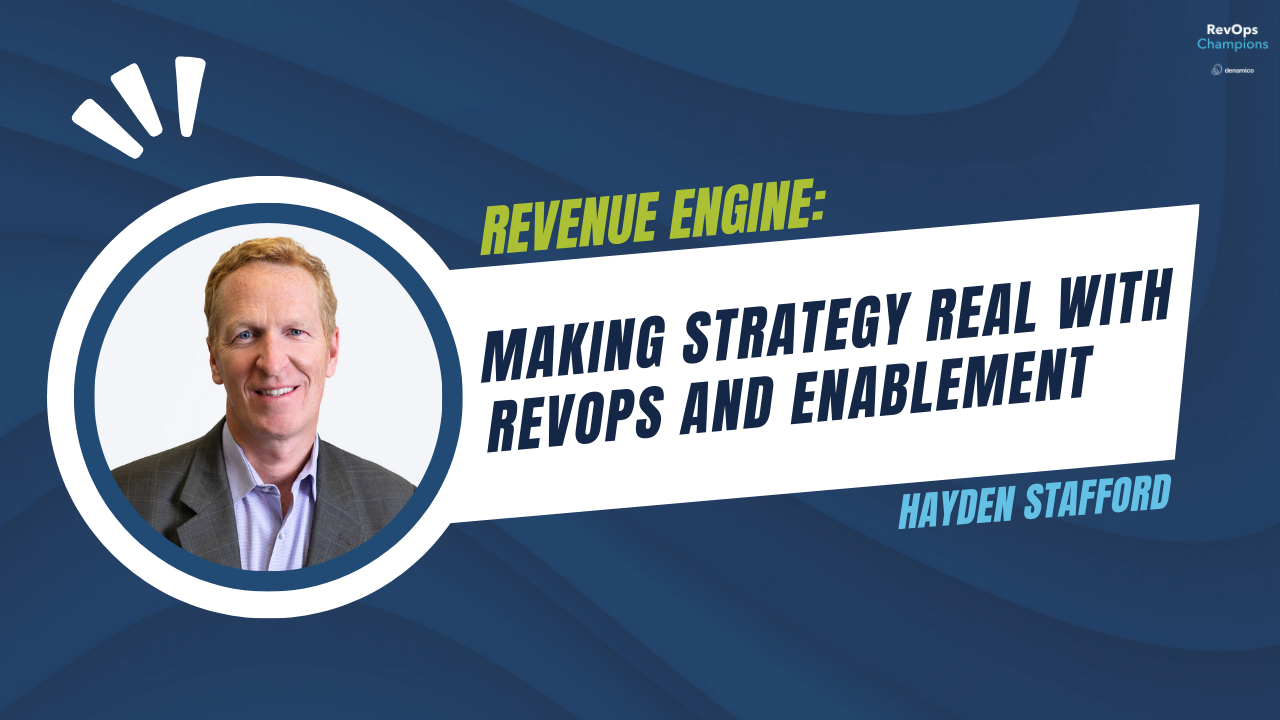
In this episode of RevOps Champions, host Brendon Dennewill talks with Hayden Stafford, President and Chief Revenue Officer at Seismic. Drawing on 25+years leading go-to market teams at Microsoft, Salesforce, IBM, and Pegasystems, Hayden explains why modern growth depends on a "well-plumbed" revenue system, where sales, success, support, partners, and service operate as one connected engine.
Hayden reframes enablement as the strategic translation layer that turns boardroom strategy into frontline execution with the right context, content, and coaching inside the flow of work. The conversation also tackles market downturn readiness, the CFO/CRO tension, and the importance of leading indicators, and a pragmatic view of AI adoption.
What You’ll Learn
- How revenue strategy and revenue systems work together to drive results
- Why enablement is a cross-functional translation layer, not just training
- What it means for RevOps to move from reporting outcomes to surfacing signals
- Where AI delivers the most value when embedded in daily workflows
- The first alignment levers CROs should focus on
- How to recognize when AI adoption stalls before impact shows up
Resources Mentioned
Listen
About the Guest
|
|
Hayden Stafford | President & Chief Revenue Officer of Seismic
Hayden Stafford is President and Chief Revenue Officer at Seismic, where he leads all global go-to-market functions, including sales, marketing, customer success, partners, and professional services. Since joining Seismic in 2022, Hayden has focused on building connected revenue systems that drive smarter enablement and measurable growth. With more than 25 years of executive leadership experience, Hayden has held senior go-to-market roles at Microsoft, Salesforce, IBM, and Pegasystems. At Microsoft, he served as Corporate Vice President of Global Business Applications, where his team drove over 300% revenue growth and scaled Dynamics 365 cloud revenue more than 10x. Hayden is known for building high-performing global teams, leading through market disruption, and aligning revenue strategy, operations, enablement, and technology to create durable growth. |

Episode Transcript
Introduction and Career Background
Brendon Dennewill: Welcome back to the RevOps Champions podcast. I'm very happy to have with me today Hayden Stafford. He's the President and Chief Revenue Officer at Seismic, where he leads the global go-to-market organization across sales, customer success, partnerships, and professional services. With more than 25 years of experience in go-to-market leadership at companies including Microsoft, Salesforce, IBM, and Pegasystems, Hayden brings deep revenue operations expertise and a track record of driving growth at scale. Hayden, welcome to the podcast.
Hayden Stafford: Thank you. Thanks for inviting me and hosting this today. Delighted to be here with you on this midwinter day we're both going through.
Brendon Dennewill: It's going to be a fun conversation. Hayden, you've led major go-to-market teams at Microsoft, Salesforce, IBM, Pegasystems, and now Seismic. What early experiences shaped the leader you've become?
Hayden Stafford: I started in services. One company that was left out of the intro, I was actually there for a while was Ernst & Young. That grounding in consulting and the consultative approach to selling and revenue played a major role. Learning by listening and engaging as a team is at the core of where I started.
The other piece was getting a solid grounding in a large company that put a lot of emphasis on discipline around forecasting and revenue operations. I was at IBM back when they had big training programs. That fiscal discipline and commitment, my word is my honor and it's what I'm going to deliver, those two things came together at an important point in my career. As you grow, what you say you're going to do, you better do, and delivering on your word becomes all the more important, particularly in public companies.
Brendon Dennewill: I think one of the things I've observed in people who have had that consulting experience and gone on from there is a higher emotional intelligence, which comes in handy both internally and externally.
Hayden Stafford: I agree. I've seen all sorts of leaders: intimidation leaders, inspiration leaders. The best tend to have that 50/50 split between EQ and IQ. High-IQ folks tend to not be quite as strong on the people development side. I'm a strong believer in that balance.
Managing the Tension Between Sales and Finance
Brendon Dennewill: You've spoken about the tension between fast-paced sales environments and the structure that finance teams require. What was the most difficult example of this tension in your career, and how did you resolve it?
Hayden Stafford: There are so many examples. Fundamentally, the roles of a CFO and a CRO are a bit at odds. My goals as CRO are in the here and now: taking down what's in front of us and delivering for the quarter. Of course, there's a longer-term vision and commitment to the business. The CFO, on the other hand, is thinking about the long range plan and how to deliver on those commitments. When they're approving or declining things, it's based on how that fits within the longer-range plan. So there is a natural tension.
For me, that tension is most acute during a downturn. I've gone through two major ones in my career. I led a big chunk of Wall Street for IBM during the global financial crisis from 2007 through 2010. Then the last three to four years have been a bit of a downturn, though a different kind. Back in 2007, it was like a door slamming shut and everything stopped. What we've just gone through is more of an on-off pattern.
When the fundamentals of the business change and customer behavior shifts, that's when the tension is most acute and you need to sense and respond accordingly. I met the Chief Customer Officer of one of the world's largest shipping companies right after the tariffs came. His job was sensing and responding to an immediate, unforeseeable disruption to the business. When those tariffs hit, it was suddenly about getting product out the door before they took effect. The ability to sense and respond to that signal is what differentiates success from failure, and having alignment with the CFO, communicating that things are different right now, and that you need to be set up for success while mutually supporting the long-range plan, that's the key.
What Enablement Really Means in a Revenue Context
Brendon Dennewill: Let's jump forward into Seismic. Because of what you do there, you and your team talk about enablement hundreds of times a day. How do you explain what enablement is to someone not familiar with it in a business and revenue context?
Hayden Stafford: I always use this saying: if you ask 10 people what enablement is, you'll get 15 answers. It truly is different to everyone. For some, it's training, onboarding, and annual certifications. For others, it's a heavy hand in what you say, what you do, how you respond, what you share. For me, enablement is giving the right context to the right customer at the right time, and making sure the right content carries that context, all within the flow of work.
Enablement isn't: here's our new product launch, go take this training, read this stuff, and you're on your own. Instead, think about a new product launch where you can see how the team is behaving, what they're saying in meetings, how customers are responding, where they're getting tripped up, where they're getting excited, and using all of that as positive reinforcement back into the system.
The number one failure companies face is launching a major product, after enormous R&D investment, and then only checking results after the fact. True enablement means having a program where the product team, CEO, CRO, head of enablement, and marketing team are all able to see leading indicators in real time: how is engagement going, how are customers receiving the new messaging, and can you tweak based on the signals coming back? Yes, there's training. Yes, there's content. But doing it within the flow of work and being able to react in real time: that's true enablement.
Enablement, RevOps, and Change Management
Brendon Dennewill: There's a strong relationship between enablement and revenue operations. But as you were explaining enablement, you touched on something we see constantly at Denamico when we're doing implementations and optimizations of tech stacks for our clients: change management is a big component. How do you talk about enablement through the lens of revenue operations, and how do you think about it through the lens of change management?
Hayden Stafford: Let me take it back a step. What we've all seen is the rise of the CRO title. Ten years ago, did I aspire to be a Chief Revenue Officer? No, it didn't exist. Why has the title proliferated? Because there are many levers to revenue: sales, services, customer success, channel and partners, and even marketing. Customer buying behavior has changed, and every revenue lever needs to be optimized and working together to achieve the end outcome.
That's only possible when you have a well-plumbed revenue system. It's not just a sales booking. It's your success and support team recognizing an opportunity from an open issue, which then gets efficiently picked up by the sales team. That is not possible without a RevOps team that has the right wiring in the system. Think of it this way: you have a revenue strategy that defines intent, but then there's the revenue system that determines outcomes, whether that's growth, margin preservation, or anything along those lines. Without that system, led by the CRO and operated by a plugged-in RevOps team, the team won't have the insights they need to react to downturns like the tariff example.
Where change management comes in: I mentioned earlier the terms EQ and IQ. I've started hearing the term AQ, the adaptability quotient. With the advent of AI, the question is whether your teams can adapt to sudden changes in how they run their business and how they use new tools. To drive effective change management, you first need the signals that tell you change is coming before it's too late. Then you need people with EQ, IQ, and AQ, and the systems that recognize the need for response and provide the right training and content. You might be selling one product, but the macro environment changed, and now you need to snap into selling something else. That's the plumbing working: signals from your RevOps team, leaders dictating direction, people willing to adapt, and the content to help them do it.
Brendon Dennewill: That's essentially how we've been operating for the last year. We do technology implementations, then maintain and optimize them as our clients' businesses scale. We have to help them make strategic decisions and not just buy a shiny object they think will solve all their business problems. We've landed on three layers to a successful tech stack, with the CRM still at the center. And everything starts at the top: the CRO is accountable for making the strategy real within a given period of time. From the CRO, it goes to RevOps. That allows you to zoom out and recognize what's important before you zoom into execution.
Hayden Stafford: You are absolutely right. I think about sales operations back during the global financial crisis. It was there to give you the data to review your pipeline, to look at standard reporting. I called it reporting the news. What I'm seeing now with RevOps is that it has evolved into a strategic function. The RevOps team is on my leadership team because they're not reporting the news, they're making it. They're pointing out areas within the revenue system that might be failing or falling behind.
The alignment between revenue leaders and the RevOps team has to be genuine and trusting, because alignment breaks when complexity outpaces structure. The last thing I'd say: the typical default for many RevOps teams is to focus on lagging indicators, the KPIs. I would ask every RevOps leader to help identify what I call TLIs: transformative leading indicators. These are the precursors to the KPIs. When you've done that, that's when RevOps and revenue teams are truly walking hand in hand.
Brendon Dennewill: Right before you said that, the note I made was: if RevOps has leading indicators, they need to be informing leadership about what's happening in real time so everyone can adapt and adjust.
Hayden Stafford: That's right. I connect with our head of RevOps more, via Slack, email, and calls, than with any one of my direct reports. That tells you a lot about the importance of that relationship.
What Unlocked Transformation at Microsoft Dynamics
Brendon Dennewill: At Microsoft, your team drove significant revenue growth for Dynamics. What unlocked that level of transformation?
Hayden Stafford: First, you need the commitment. Dynamics had been the ugly redheaded stepchild of Microsoft — the business applications group that talked to front office people. It was a satellite, way off campus, and the broader company didn't fully understand it. The big catalyst was Satya Nadella. It's no coincidence that the Dynamics business took off when it did. I joined four weeks after Satya became CEO. He had actually run Dynamics in his past and understood that front office applications generate data that, combined with productivity applications and the underlying data, would someday be hugely valuable.
For us, the big move was a decision to get more balanced. First, you need the right product fit for the market. Then came a massive shift from a partner-led, mostly mid-market motion to a largely enterprise direct sales motion. That transition took time, but we played with incentives. More importantly, we built a marketing engine and a support engine that generated intelligence about where opportunities were.
We were providing partners with information about customer intent and customer signals, and we started working with them in a way that eliminated friction between the partner team and the sales team. The lift took off from there. When you use data to help someone else and it becomes a win-win, that's the escape velocity. We were an unheard-of distant fourth or fifth CRM and mostly a mid-market ERP provider. Dynamics is now undoubtedly number two in the CRM market.
Brendon Dennewill: It's no coincidence that you led with Satya, because everything starts with a leader who has the vision, the courage, the conviction, and the commitment. Without that, everything else becomes so much harder. With it, everything becomes so much easier.
Hayden Stafford: And what is said in the press about Satya is true. I've had plenty of interactions with him. But there's something else important that I've taken from Microsoft and adapted into my own leadership principles: clarity, empowerment, and accountability.
The most important of those three is clarity. In leadership, if you're going to make any change or drive any new behaviors, clarity isn't just repeating something until it's crystal clear. It's reinforcing clarity through how you build your business rhythm and cadences, how you build compensation plans that reinforce what you're communicating. In Satya's case, it was: we are going to act as one company as opposed to competing business units.
Then empowerment: I don't know what's going to resonate in Madrid or Canberra or Singapore or Peoria. My team does. You empower them to work off the clarity of purpose, stay within the guardrails, and do it their way. But if you're empowering your team, you also need strong accountability systems, reinforced again by compensation and the cadences you run. These three things are inextricably combined. And to tie it back to Seismic: enablement takes the ideas created on the whiteboard in the boardroom and brings them to the keyboard of the frontline, making that translation possible.
Brendon Dennewill: If you boil that down, it really comes down to leadership. If you have the right leaders who can provide clarity, empowerment, and accountability, then everything becomes so much easier downstream and drives all the right decisions.
Hayden Stafford: A thousand percent. Anytime I've faced a major challenge or pivot, I focus on the skills and competencies of frontline management, or even a couple of layers up. That's where you get the biggest scale, as opposed to focusing only on individual contributors. Yes, you need to develop individuals, but if you don't have the right leaders, it won't matter.
Defining Effective Enablement: The Rosetta Stone of Revenue
Brendon Dennewill: You describe enablement as a strategic engine rather than a training function. How do you define effective enablement, and what are the non-negotiable elements?
Hayden Stafford: Effective enablement is an interconnected system supporting different functions. Typically someone thinks of enablement as sales enablement. You'll see the Gartner Magic Quadrant, the Forrester Waves, and the emerging term revenue enablement, which speaks to the idea that it should impact all revenue levers. For me, enablement is the Rosetta Stone of a company.
What do I mean by that? Your services team has metrics tied to comp: utilization, margin, billability. Your customer success team might focus on renewals, adoption, churn rates, net retention. Sales is usually bookings, new logos, expansion. Every group has its own priorities. Enablement acts as the Rosetta Stone, tying the company's vision to the individual business unit metrics. It's the translation engine of corporate strategy down into the action of different functions.
If you've built a system that is reinforced from onboarding a new employee all the way through tenure, through new product launches, new markets, and new competitors, that is a system involving training, content, customer education, customer engagement, and telemetry around all of it. Your product marketing team should be measuring the individual success of every asset they create and its impact on revenue. Your marketing team should know the attribution of their work to revenue. The buying process is already 70 to 80 percent complete before a seller is involved, so that moment of engagement has to count. The signals in your content, the engagement data, all of that should inform your next move. That's enablement.
So it is far beyond education. It's bringing data and activity insertion points into your business and revenue rhythms to help your teams be better when they're engaging customers or trying to grow revenue. I'm on a mission to dispel the myth that enablement is just training or just content. It's about making your sellers and your team more efficient, giving them one gearbox to run your revenue engine.
Brendon Dennewill: What clicked for me there is something I've been calling my theme this year: deliberate translation. I hadn't connected it back to what we do from a RevOps perspective, but that's exactly it. RevOps is a big part of enabling sales, marketing, and customer service teams. And the idea that they're translating signals and data from a continuously evolving business — both internally and externally, because customers are evolving, you're adding people, behaviors are changing — and those signals eventually need to reach the CRO and CEO to drive the right decisions.
Hayden Stafford: That's right. And I immediately know a company is well run when I see the enablement team has a seat at the leadership table. Not because they're talking about the number of courses taken or calls logged, but because they're measured on metrics that matter: lift in pipeline, accelerated close rates, productivity gains, efficiency gains. When the enablement team's metrics align with the company's metrics, that's where alignment happens. That's where you get all the efficiency and lift out of the team.
One other thing: enablement shouldn't be a separate place you go. It should be embedded within the workflow of how your teams operate. We have companies that don't even know they're using Seismic because it's white-labeled within Salesforce, where they go to get predictive, contextually relevant content. When it's within the workflow and everyone is looking at the same metrics that matter, you have alignment. And alignment is where it all happens. As organizations scale quickly, alignment becomes less about intention and more about execution. Shared language, shared data, and shared accountability.
Where AI Delivers the Greatest Impact for Revenue Teams
Brendon Dennewill: You've opened the door to AI. How should revenue leaders decide where to apply AI for the greatest impact right now?
Hayden Stafford: There's a lot of hype. You roll out AI, there's a spike in activity, and then it falls off. The way we look at it: the most successful AI initiatives begin and end around clear business problems or specific areas of improvement. Things like onboarding speed, deal execution, follow-up from customer engagement, seller productivity. You go target those business problems rather than experimentation for its own sake.
AI delivers value most when it's embedded directly into the workflow. Here's a perfect example: I'm getting ready for a big closing meeting with a customer. I haven't sold this product before, but if I close it, I'm making Presidents Club. Without a true revenue enablement system, I'm digging through old notes, asking colleagues about previous calls. With AI: it tells me what happened in the last call, what the open items were, where they're comfortable, where I need to dig. AI then helps prepare the deck, the talk track, the workflow. AI helps me practice, and it knows how to coach me because it's listened to all my prior calls. AI listens during the meeting and makes real-time recommendations. Then comes the follow-up: summary for me, summary for my manager, and a digital sales room with everything I said I'd send them, immediately ready.
But the most important piece: AI has listened to all of your calls and recognizes that you're not confident with competitive positioning, that you don't know the value proposition of a particular product, and that you talk too fast. It then recommends targeted training and reading. That takes the burden off the manager to scale by listening to every call and joining every meeting. We have a customer whose average span of control was one manager to seven reps. Using call prep, call listening, and call follow-up AI tools, they're now one to twelve, because the manager can focus on the moments that matter instead of coaching and developing each person from scratch.
The Next Two to Three Years of AI Adoption in Sales and Customer Success
Brendon Dennewill: You've noted a growing need for AI literacy across go-to-market teams. What do you think the next two to three years of AI adoption will look like for sales and customer success?
Hayden Stafford: AI has already provided massive lift on prospecting: BDRs, SDRs, sales development reps getting their messaging together in a personalized and relevant way. If your enablement system is tied to your CRM, you can personalize everything. There are two areas where I think it will have the biggest impact.
The first is real-time, personalized training. We're already doing real-time training today. If you prefer learning by listening, like podcasts, while someone else prefers reading or watching, AI will create training based on your own learning style. But where I think it really takes off is when AI becomes preemptive and proactive, building content specifically for you. Not just: here's a document that other customers like this one responded to. It will be: we built this document for you. The branding is right, the template is right, the messaging is on point. Think about all the time wasted building documents and presentations today.
The second is meeting preparation, execution, and follow-up. Your average seller might be handling 19 concurrent opportunities, with three to five active in-quarter deals. AI will significantly increase the scale of what an account executive can manage, because the back-end work, the legwork, the administrivia, will be handled by AI. You'll get huge productivity lift from a smaller workforce generating more revenue. That's the nirvana for me.
Where to Start: Practical Advice for Revenue Leaders
Brendon Dennewill: For business leaders who want a more aligned and effective revenue organization, what is the first change they should make Monday morning?
Hayden Stafford: If you're a CRO and you're not regularly meeting with your head of enablement, start that today. When you run your leadership meetings, ensure that your RevOps leader, your enablement leader, and your marketing leader are equal members of the team. Then ask yourself: when my CEO comes to me and asks how the new product launch is going, can I answer that? Most CROs will turn around and ask their enablement person. If you can't answer that question with a dashboard, you need to empower your enablement team, listen to them, and measure them on the metrics you're measured on, not things like lessons taken.
I meet CROs who say they're not interested in talking about enablement and send me to their enablement person. I tell my team: stop the pursuit. You might win the deal, but you're probably going to churn in a year or two. Start there: make enablement and RevOps equal voices at the revenue leadership table.
Brendon Dennewill: When you say leadership team, are you talking about your revenue leadership team specifically?
Hayden Stafford: Yes, my revenue leadership team. I call it the GTML: the go-to-market leadership team. That includes my services leader, sales engineering, North America sales lead, and so on.
One Key Insight for 2026: Don't Leave AI Adoption to Chance
Brendon Dennewill: Last question. What is one learning from the last year that you think our audience should consider if they aren't already?
Hayden Stafford: Is your team properly using AI? I know it sounds like the cliché everyone is talking about. But here's what I've learned: we launched Salesforce Agentforce, we relaunched Microsoft Copilot, there was a lot of fanfare, a big spike in usage and adoption, and then it fell off. Go dig into why your team isn't using it, because I guarantee the bulk of them aren't.
AI delivers the most value when it's embedded into the daily workflow and paired with enablement activities that help people act on insight, not just generate it. So go unpack why the team isn't using it. Don't leave that to somebody else. You go figure out why it's not being adopted at the rate it should be, because the lift you're going to get is unreal, as we've seen across several parts of our own business.
Brendon Dennewill: That's really good advice. Hayden, thank you so much for joining me. I look forward to another conversation in the future.
Hayden Stafford: Thank you, Brendon. Appreciate your time and thanks for having me on.
Subscribe