
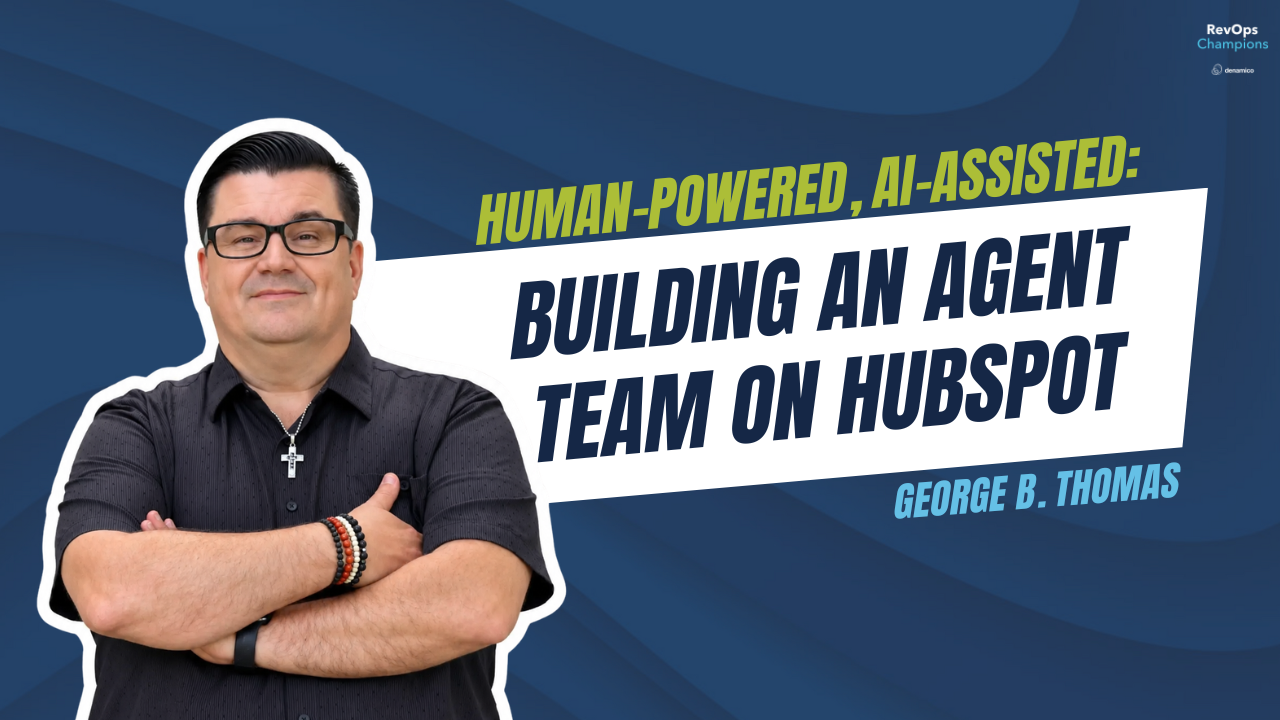
In this episode, George B. Thomas, AI and HubSpot consultant, keynote speaker, and founder of Sidekick Strategies, returns to the RevOps Champions Podcast for a conversation with host Brendon Dennewill on what it really takes to make AI work inside a business. With more than a decade in the HubSpot ecosystem, George argues that most companies struggle with AI because they apply it to old-school thinking. The CRM is no longer just a customer relationship manager; it's a massive context holder, and the organizations winning right now are the ones building systems around it.
George shares how his team runs a crew of named AI agents that write sequences, build landing pages, track HubSpot product updates, and even produce an AI-driven podcast, all guided by human judgment and taste. He explains the personal context layer that makes this possible, why every agent needs onboarding and guardrails just like a new hire, and why employees must evolve into managers of bots. RevOps leaders, marketers, HubSpot admins, and executives navigating AI adoption will walk away with a practical blueprint for augmenting their teams instead of simply adding another tool.
What You'll Learn
- Why AI adoption stalls when it's layered on old-school thinking
- How the CRM has evolved into a context engine for AI
- What a personal and professional context layer includes
- Why every AI agent needs onboarding, guardrails, and earned trust
- How employees shift from doers to managers of AI agents
- How multi-agent workflows can run marketing tasks on repeat
- Why "Is it possible?" is the most important question for leaders
Resources Mentioned
- Sidekick Strategies
- Hub Heroes Podcast
- The Spiritual Side of Leadership
- Andrej Karpathy's LLM Wiki
- They Ask, You Answer by Marcus Sheridan
- Mighty Networks
Running several brands, locations or business lines? The Revenue Operations Playbook lays out six practical strategies to align systems, data and processes across every part of your business.
Download the playbook: https://www.denamico.com/revenue-operations-playbook
Listen
About the Guest
|
|
George B. Thomas | Founder | Sidekick Strategies
George B. Thomas is an AI and HubSpot consultant, keynote speaker, and educator who has been in marketing since 2010 and in the HubSpot ecosystem since 2013. As founder of Sidekick Strategies, he helps organizations get more value from HubSpot across marketing, sales, service, and AI, building human-powered, AI-assisted systems that augment teams rather than replace them. A HubSpot Certified Trainer with more than 40 HubSpot Academy certifications and over 100 keynotes delivered, George also co-hosts the Hub Heroes podcast and founded The Spiritual Side of Leadership. |

Episode Transcript
Introduction
Brendon Dennewill: Hello and welcome back. Today I'm excited to welcome back George Thomas, an AI and HubSpot consultant, keynote speaker, entrepreneur, and educator who helps businesses grow through technology. With a marketing career dating back to 2010 and experience in the HubSpot ecosystem since 2013, George brings extensive expertise in CRM, inbound marketing, and sales and marketing technology. He's a HubSpot certified trainer, holds more than 40 HubSpot Academy certifications, and has delivered over a hundred keynote presentations.
George is the founder of Sidekick Strategies, a consulting business that helps organizations get more value from HubSpot across marketing, sales, service, and AI. He also co-hosts the Hub Heroes podcast and founded the Spiritual Side of Leadership, where he explores the connection between faith, purpose, and professional leadership.
Since his last appearance here on the RevOps Champion’s Podcast back in 2022, which is like an entire lifetime ago...
George B. Thomas: Right.
Brendon Dennewill: George has continued exploring how businesses can make better use of HubSpot and AI. With more than a decade of experience in this ecosystem, he brings practical insight into helping organizations make technology work better for their people and toward their business goals. George, welcome back to the Brendon Dennewill Podcast.
George B. Thomas: Brendon, I'm so excited to be here, my friend. It's been a while, and there have been a lot of learnings along the way, a lot of changes along the way. But I can't wait to have this conversation with you. I can't wait to add value to your community. And yeah, just thanks for having me back on the show, my friend.
Brendon Dennewill: Yeah, thanks for being here, and thanks for giving us an excuse to catch up, because it's been a while. I know I saw you a couple of months ago, but we didn't even have a chance to have a two-minute conversation.
George B. Thomas: There you go. It has. It was like ships passing in the night, my friend, at Unbound for sure. There were so many humans; I'm surprised we even saw each other, to be honest.
Brendon Dennewill: Right, right, exactly.
How CRM, Marketing, Sales, and AI Have Changed the Way Businesses Grow
Brendon Dennewill: Cool. Well, let's dive in here. George, you spend a lot of time in this space, working in the HubSpot ecosystem and helping businesses understand and make better use of the technology that's available. Over that time, you've seen how CRM, marketing, sales, and now AI have evolved. How have those changes shaped the way you're thinking about how businesses grow and operate more effectively today?
George B. Thomas: Yeah. My gosh. Okay, well, there's this answer, and then there's the end of the podcast. [laughs] It's funny, because the first knee-jerk response that came to my brain with that question, Brendon, is the massive amount of freedom that organizations now have to go in a direction they once maybe thought was impossible.
What I mean by that is there have been so many years where we've struggled with sales and marketing. Everybody knows the problems, the hurdles that they faced. And now there's a way where things can be a little bit more human. Things can be a little bit more conversational. Things that no one could have thought about building can be built, and in a time and at an expense that before was unheard of.
So many of the organizations we're helping now are building some of their own tools. They're integrating those tools into HubSpot. We're seeing a lot of humans use Claude or ChatGPT or Grok in conjunction with the CRM. And so even the CRM has changed from, at some point, a customer relationship manager to now basically a massive context holder for the things you're trying to build or do.
So if you can dream it, and you can think about it, meaning what's the goal, what's the outcome, and what has to change to get there, there's kind of nothing stopping you from implementing those things.
Brendon Dennewill: Hmm. Yeah. I thought you were going to complete the Enzo Ferrari saying: "If you can dream it, you can do it."
George B. Thomas: Yeah.
Brendon Dennewill: Which I think is really relevant right now, because we are at a time where you don't have to be Enzo Ferrari and be as creative and passionate as he was back in the day.
George B. Thomas: No.
Brendon Dennewill: Nowadays, so many people can literally do it if they can dream it.
Real-World Examples: Custom Assessments and Canceling Adobe
George B. Thomas: Yeah. I'll give you a couple of real-world examples. I have a client; they help people with tax strategy. They're on HubSpot, but they wanted to do this really dope assessment. Creating this assessment could be done in HubSpot, but it might be kind of clunky or hard to get, or historically there were even capability limits for us as the agency to develop that thing.
Meanwhile, where we sit now, it's like, "Well, what do you want to ask them? What do you want it to do? Let me go ahead and take a stab at this." And within a couple of days, there's an assessment on a platform that they can go through. I even added a couple of features they didn't think about. When they went through it, they were like, "This is mind-blowing." And by the way, we've got it so that you can embed it on a HubSpot page, and it just looks like it's part of the page. So you get the tracking of the page, but you also get the tracking of the app we created that's hosted in it.
We've done that for multiple clients, where they're like, "We would have never thought of doing it this way," but it gives them tools and resources. And really, the part I want people to pull from this is the experiences you can create for your users or customers or prospects or leads, whatever you want to call them. I call them humans, by the way. Whatever experience you want to create so you can get them into a process of understanding how they solve their problems, it's just super crazy what you can create.
Maybe you're watching or listening to this and thinking, "Well, I don't have clients, but I own my own organization." Think about the things you can do from an organizational standpoint. Now, I know the words that are going to come out of my mouth might be sacrilege for some. But two weeks ago, Brendon, we canceled our Adobe Creative Cloud, and we're an agency. We canceled our Adobe Stock account, and we're an agency. But we have built systems and processes in ways that mean we no longer need that set of tools.
We've built an entire system in the background where, basically, if you could pick the best of ClickUp, Asana, Teamwork, keep listing them here, and also get it to work with humans and bots or agents as a task board or a system, we've built that. One of the things that gets exciting to me is I can go to our CFO bot and say, "Hey, Sterling, I canceled this. Can you add it to the list?" And I go down and look at the yearly savings. But I also look on the other side at the yearly impact it means for the organization and the humans that we're augmenting along the way with these agents, bots, and systems.
So again, the things you can do, the ability to create the things you need, and the time to first value you can provide in these experiences... but only, Brendon, if you're focusing in that direction and focusing on serving the humans that need you to serve them.
Brendon Dennewill: Hmm. Absolutely. I think every business ultimately starts with: Who are you going to be helping? Who are you going to be solving problems for? And you've got to be focused on that forever if you want to stay successful.
George B. Thomas: Without a doubt.
Why George Focused on the Intersection of HubSpot and AI
Brendon Dennewill: So George, you've started touching on a lot of the possibilities already. You've built your work around helping organizations get more value from emerging technology, and a lot of your work has HubSpot at its core, very similar to us. What led you to focus on this intersection of HubSpot and AI, and what opportunities do you see for businesses there?
George B. Thomas: Yeah, let me take you on a little bit of a journey. When ChatGPT came out, Brendon, I looked at that and I was like, "Dang, that's the fastest typist on the planet." Now, to help you understand why that's relevant: one, I didn't pay attention in typing class in high school. Couple of reasons. My teacher was hot, and I was young and I was dumb. [laughs] Two, I was a high school dropout. I dropped out my freshman year. I had a math teacher who told me I'd never amount to anything. And within six months, I had signed into the Navy, and life happened the rest of the way.
So I've typed with two or three fingers my entire life. But I'm a creator, right? By the time ChatGPT came out, I'd been doing podcasts for years. I'd been doing YouTube videos and HubSpot tutorials for years. But I always had this Achilles' heel, which was writing, because for me to sit and write an article, my God, it's a no.
So I sat there and watched ChatGPT type, and I went, "Fastest typist on the planet. I don't need it to be creative. I'm already the creative one. What I need to do is give it all of me and then just ask it to be the fastest typist, the ghostwriter for the thing I'm actually trying to get out of my brain." And so I went down this long journey of, "How do I create a second brain?" Andrej Karpathy and wiki-style items. I went into this whole identity piece: mindsets, beliefs, core values, mission, vision, voice, tone.
I started building this system, and it knew my stories and my timeline, because I could literally extract those from historical podcasts and meetings I'd had with humans. It got to the point where I'd say, "I want you to write an article about this. Use this story. Think about these four things. And ask me any questions you might have along the way where there are gaps." So it could pull it out of my brain. And all of a sudden, these articles would pop out the other side, and I'd be like, "Holy crap."
So now I had taken a weakness. Can't type. You've got no real articles. That's SEO, that's AEO. You know you're supposed to be following They Ask, You Answer. You've been "They Ask, You Answering" your butt off in podcasts and video. But now let's do the trifecta and make this happen. So it really came from a place of, "I wish I could fix this. Oh my God, I can fix this. But to fix this, I've got to build a system, a process, to make that work."
That started leading me into really interesting places, where instead of ChatGPT, I started playing with Claude, and then Claude Code. And because it was code and not necessarily the writing of an article, all of a sudden it was, "Well, can I build this assessment? Can I do this thing?" And Brendon, I'm curious George. That should be my spirit animal, right? Because I'm a curious type of guy. I've always had a growth mindset.
So all of a sudden, these barriers, these shackles, were taken off. It was, "I don't need to hire a developer. I can become the developer, or at least augment myself through an agent that can be the developer. I don't have to be the writer. I can augment myself as the human and have a ghostwriter agent." What I'm alluding to is this mindset I started preaching two or three years ago at Inbound, before it became Unbound: ladies and gentlemen, we've been quickly ushered into, and are now living in, a world that is human-powered, AI-assisted.
And when you get that right and you start to have systems thinking and framework thinking, the stuff you start to build and put in place is a game changer for your organization.
Brendon Dennewill: Absolutely. It seems like if you can architect systems that create repeated value, that's the answer to a lot of what many of us are trying to figure out.
From T-Shaped Marketers to AI-Augmented Teams
George B. Thomas: I'll tell you one other thing that comes to mind. You've heard the saying, we've all heard it: "Jack of all trades, master of none." Which, by the way, isn't even the real saying, but we've all heard it. We've also heard HubSpot, or just organizations in general, talk for years about T-shaped marketers, right? You know a little bit about a lot of things, and then you've got one area where you go really deep.
I got to a point where I was doing some kind of crazy stuff and having those aha, wow moments. And I reached out to a former boss of mine, Remington Begg from Impulse Creative, and said, "Dude, marketers are going to kill it with AI," because I'm an excitable guy. And his response made me check myself. He said, "No. Marketers like you will kill it with AI."
What I want to say is: forget marketing, forget sales. Marketing, sales, business owners, whatever you are, if you can start to have this T-shaped thinking around you, the human, of "Here's the thing I'm really good at, and now I need to learn the two, three, four principles around it," then when you start having those conversations with AI assistants, because you know enough... You know the other saying, "enough to be dangerous"? We live in a world where you are now officially dangerous, in a good way.
Brendon Dennewill: Very cool. I'm already starting to visualize that. I'm obviously very familiar with the T-shaped marketer. And you have to believe that now, with AI and all the opportunities around agentic growth that we're all building into our businesses, that T becomes almost like a very simple comb, with, let's say, ten or twelve teeth, where each of us was only really good at one or two of those things.
George B. Thomas: Yep.
Brendon Dennewill: Now we can have our agents be really good at the things we weren't good at. Because we have the overall T, the agents can go deep on the things we weren't necessarily good at.
George B. Thomas: Without a doubt. Absolutely, one hundred percent, yes.
The Biggest Challenges in AI Adoption
Brendon Dennewill: Very cool. So George, as more companies begin adopting AI, and we know it's been bumpy for a lot of them... You don't have to be all that smart to read the statistics on successful AI adoption so far. But every week, more and more companies are gaining traction because, to your point about mindset, they're starting to think about it in the right way. What are some of the biggest challenges you see them facing when trying to apply it to their day-to-day business operations?
George B. Thomas: Well, they're trying to apply it to old-school thinking. So you've got to realize, and I can take you in a couple of different directions here, but first of all, we've all been taught our entire lives to be employees. Plain and simple. Some of us ended up being managers; some of us ended up being owners. And I can tell you that if you're going to get AI adoption, you can't have employees. You have to have managers, because they're going to be managers of bots if they're not managers of humans.
So how do you build a trajectory of, "How do I teach an employee to be a manager," because now they're going to have three or four bots they're managing throughout their day to get things done? It's a different mindset. And then you escalate: how do I get my managers to think with an owner mindset, because they've got to be the overarching piece?
What I'm alluding to is that organizations are paying all their attention to the AI and little to the human. And the problem is, to get AI adoption, you've got to change human mindsets and the human understanding of what their work actually looks like now.
Trust me, Brendon, when I tell you that in the next one, two, three, five years, we're going to see this massive side of AI that not a lot of people are talking about yet. If your worth is your work or your title, and your work and your title don't mean anything because you're managing agents, then what does that do to your identity? How do you navigate a world where worth and identity are a blur, but you still know you're providing value to the world?
Well, you've got to change the way you're thinking. You've got the latest iPhone, the latest Android, it's on the latest update, but you haven't updated your brain for the new world we're in, and you're trying to fit a square peg in a round hole. Not to repeat myself, but I am human-powered, AI-assisted.
You've got to change things like vernacular, too. I don't have MQLs and SQLs. I don't really talk about leads. I have conversations with humans who happen to need help. So when I talk to my agents or my human team about that, there are fewer places where we can get stuck. So many organizations, because of a manufacturing mindset or whatever it is, have created systems with places they can get stuck, versus a fluid flow and just having conversations with the human.
Again, many are driven by a board, and many are driven by investors. It's these old-school frameworks and systems that are making it super difficult for organizations to get one hundred percent of the juice that's possible right now. That's why I believe we're seeing... not that there haven't been big organizations killing it, but there are also a lot of big organizations getting their butt handed to them.
Meanwhile, I've watched solopreneurs and small to medium-sized businesses put the second brain in place, put the system in place, and within a couple of months they're driving in a different direction at a speed never thought of before. That's the transition: mindset and implementation of AI into how they're doing things.
And by the way, it doesn't have to be complex. I've got many clients that use HubSpot, but one client in particular wanted a follow-up email generated after meetings. They went into HubSpot, and HubSpot has created a Breeze button, "Generate follow-up." And he's like, "George, you know I love HubSpot and I love you, but I hit that button and no, that's not what we're looking for."
So I said, "Well, cool. Can you just tell me what you're looking for?" I listened to him and let him talk. Then I went over to my system and said, "Hey, we're in HubSpot. We're doing this." And in less than a day, I had a saved prompt in Breeze so that when he went to a meeting, or a record associated with that meeting, he would hit a button and it would create a follow-up email for him. He emailed me back and said, "Dude, I used this, and multiple clients have emailed me back saying, 'Thank you for this. This is absolutely amazing.'"
Right there is AI activation. Because what does he ask me for next? Three or four more prompts, three or more pieces of a system. So you give them a little nibble, and all of a sudden they feel it, and they're like, "Let's put the hammer down."
You Can Lead Without Being the Leader
Brendon Dennewill: And what you're touching on there is that you're helping them go through the change every leader needs to go through. As you were talking about different-size businesses and their challenges and opportunities, which are often the same things, it seems to come down to the same person being responsible for starting the change.
If you're a solopreneur, it's pretty obvious who has to start the change. If you're running a small or mid-sized business, again, it's pretty obvious where the change needs to start. It gets a little more complicated in larger companies with boards and what have you. But ultimately, the leader has to lead the change, because if the leader isn't going through that change themselves first, chances are the rest of the organization, upstream or downstream, isn't going to be able to go through it either.
George B. Thomas: I don't disagree with you, but I want to throw something in here, because I think you can be a leader without being the leader.
What I mean by that is, one of the things Marcus and I used to really get into when I worked at The Sales Lion was the Columbus principle: how do we help the human feel like they've discovered their own America? Which, by the way, is flawed when you go back to real history, but that's not why we're here. [laughs]
So you could be a leader in marketing, and you could help the leader who holds the purse strings understand what's needed. You don't always have to start at the top of leadership to get this to roll down, though there are places where that does make sense. VP of sales, VP of marketing, HR director: if you can get those people to start thinking, "Ooh, we could really do some cool stuff if...," then all of a sudden they help the leader of leaders.
Because the leader of leaders is super busy. The leader of leaders is supposed to be the visionary. They're on the track they're on, and it's really hard to get off that track and say, "Let me go play with AI and burn five days or two weeks figuring this out." So if other people can play while they're at work and then enable that leader of leaders, give them the vision moment of, "We were able to do this"... And by the way, "able to do this" might mean saving time. It might mean creating more value.
But the thing they're not measuring enough is whether employees enjoy their jobs more. Because if it's enabling the humans, then we want to enable joy. If we enable joy and they love where they're working more, that's going to drip off onto the humans they're actually helping. And those humans are like, "God, I love working with that company. Those people are just so happy." Well, they're happy because they've been augmented and optimized, because you actually embraced AI technology the way it needs to be embraced, versus thinking it's a Band-Aid or just a tool.
AI Is a Tool With a Brain
Brendon Dennewill: Yeah. I'm just talking aloud here, but I think this goes back thousands of years. People who are given the right tools to do the job are always going to do a better job and always be happier. And this is essentially the next phase of giving people the tools, which often requires training as well, and change management.
George B. Thomas: The interesting thing about that, though, is that this is probably the only tool you've given them that has a brain. You can give them a shovel and they can dig better. But the shovel doesn't tell them where to dig, or that there's a big freaking boulder right under where they're about to dig, right?
So yes, it's a tool, but a tool with the mindset of an assistant. How do I use the brain it has, but layer my personal and professional harness, my brain, onto it so that all of a sudden my tool has a brain? And then how do I give it the connectors so this ultimate brain can actually go do work?
I'll pivot here for a hot second on that. I'll let you know, Brendon, I spend 50, 60, maybe 70% of my day watching an agent work in a browser tab or on its computer, because I'm teaching them to get the work done. It's a human-powered brain and years of strategy, but they're actually doing the writing and the clicking and all the rest.
That's why we can do things like this: I had a client say, "Yo, I'm in a pinch. We've got these three sequences we need to get out to the sales team, and they're four emails each. Can you build those?" And I'm like, "Yeah, I can build those." She's like, "Good, because it would take me half a day to a day." Thirty minutes later, I'm delivering three sequences in a folder and a bunch of message templates in a folder, saying, "There's your V1 draft. Go look at them, make any edits, and you're good to go."
But that's because we're taking the time to find the joy in getting these agents to actually do the work, because they can think. They're not just a shovel or a rake.
Guardrails, Trust, and Managing Agents
Brendon Dennewill: Yes. Good point, good differentiation. One of the interesting things that's also unfolding, George, and I'm not sure if you have an opinion on this, is that because agents have been tested so much more over the last few months than they were last year, people are starting to realize the difference between managing humans and managing agents.
One of the areas where humans come prebuilt, especially by the time you reach working age, is around security and the things you know you should not do, just from having been a human on the planet for twenty years or whatever. Agents don't come with that fear factor built in. So as a human managing agents, you have to give them that twenty years of education they didn't have around what is safe to do and what is not, and what is okay and what is not okay.
George B. Thomas: Yeah. It's funny, because there are a couple of layers to this for me. One, when I really started to build out what I call Echo... I graduated from ChatGPT, started using Claude Code, and built this independent agent, because multiple agents weren't really on my mind yet. And it was, "I want to build you as an echo of me. You're a mirror of me."
Now think about that. If you tell it, "You are a mirror of me," and I'm circling back to the words I blasted through earlier, the first thing I load is, "Here are my beliefs, here are my core values. When you're making decisions, make sure we're using the framework of my mindsets, beliefs, and core values." We also had a voice and tone doc. And past that, we had an examples doc: "Here's what we love, here's what we do. Make sure you're looking at this."
But the best piece, and what you're leaning into, is the freaking guardrails. In a world where everybody all of a sudden had a bazillion dashes, even the Bible app had devotions with dashes, and I'm like, "You suckers, what are you doing?" One of our hard-and-fast rules was never use e dashes, because right now in society it's a blatant sign of AI, even if some human used one because it needed to be there. Because dang it, dashes have a purpose. Save the dash! But AI killed it. So that was quickly one of our rules.
You have to think about it like this: there are hard skills and soft skills, and there are soft rules and hard rules. Soft rules are things like, "Just don't be a jerk when you're replying to my emails for people." Hard rules are, "Never reply to them; always do a draft. Never use this tool; always ask me first." So you need to take a good amount of time figuring out what you have them do or not do.
And I'll tell you, and this is going to sound weird, that changes over time. When I first got started, a good amount of stuff was on lockdown. But as you work with them more, and the more you think of it less as a tool and more as how you would manage a human relationship, even though they're not human... I'm going to use a real dicey word for some humans listening to this: they started to build trust.
I would see them do it right all the time, and I'd be like, "You know what? For that, don't ask me anymore. You've got it down. The skill is perfect. You're doing it right. Go."
And now I trust it enough that I've created a team bot. Earlier today, an employee used a bot we turned into a team bot to do four pieces of client work, and it knocked it out of the park the first time, no questions asked. It delivered what it needed to deliver to the human on the other end, and that human said, "This is amazing." That was four things I was able to take off my plate, because it used to be me and my bots.
But I had gotten to the point where I trust it. So when you're getting started, lock it down a little bit, but give yourself the freedom to give it freedom as you build trust and understand how this tool or assistant or agent, whatever you want to call it, works.
Onboard Your AI Agents Like New Hires
Brendon Dennewill: Yeah. I guess it's the same as training or coaching anyone or anything. It's always been the same: the more time you take to train and coach, the better it's going to be and the more quickly it'll become self-sufficient. But you have to give it that initial training.
George B. Thomas: I love it when people go, "Oh, I tried AI. It's crap." And my first response, Brendon, is, "Can I ask you just one question?"
"Yeah, you can ask me a question."
"When you hire a human, do you onboard them? Do they get two, four, six, eight weeks to get up to speed on what you want them to do in your organization as an employee? Yes or no?"
"Yes."
"Did you onboard your agent?"
"Oh."
Brendon Dennewill: Exactly. Yep.
George B. Thomas: Again, these are real-world human things that, for some reason, we're forgetting to implement in this AI journey. If you just stop and ask, "Well, how would we do a typical hire? This, this, this, this. Cool. We're going to hire an agent. Let's make sure we do this, that, this, and this," and then ask it to do the stuff and have a conversation with you...
Brendon Dennewill: Yeah. Which is why, even though with your agency and our business the value the client feels they're receiving from us is thought of as technology, there's clearly a lot of stuff we have to do to build the technology so that it works for their particular business.
That's why all this stuff really comes back down to this: AI is a leadership challenge. It's not a technology challenge. We'll all figure out the technology. But if we're not approaching it, to use your word, by onboarding it in the correct way, then we're treating it as a technology and not from a strategic leadership perspective.
George B. Thomas: Yeah, yeah. Without a doubt.
What Is a Personal Context Layer?
Brendon Dennewill: Cool. Okay. Sort of an extension of what we're talking about here is that AI can only produce meaningful results when it understands the business it's working for, right? You've introduced the concept of a personal context layer.
George B. Thomas: Yeah.
Brendon Dennewill: Can you explain what this means and how it can help businesses get better results from AI?
George B. Thomas: Yeah. We're on a podcast, so it's hard to talk about this without showing it visually. But what I want everybody to realize is, first, who it's doing it for comes in a couple of different layers. One, it's the firm. Let's say you're a CPA. There's the identity of the firm: mindsets, core values, mission, vision. There's the identity of you, the actual employee, and what that means. And then there's the identity of you, the individual person outside of work.
When you start to fill in the gaps for those three layers and the information you need to give the assistant, all of a sudden you're in a way different place, because now it's, "Oh, all of this context on everything I know makes me go in this direction or say things this way."
The other side of this is the personas. For years, everybody has had, "Yeah, we've got a persona PowerPoint," and nobody on the team looked at it, and nobody used it. Or, "Yeah, we've got HubSpot, and we're using the persona tool in HubSpot." To which I say: you're probably using it wrong. I've been teaching it the right way for years, and you're still probably using it wrong. [laughs]
But now you can actually have your personas in the system. So when you say, "Hey, we're going to write this article," or "This human is this type of human, so when we draft a reply to this email...," it knows the difference between a small to medium-sized business, the CEO of an enterprise, the CEO of a startup, a marketer, or a sales VP. Now it's paying attention to the persona in anything it creates or communicates. Talk about personalization at scale, because it's in the brain that is the personal and professional context layer on top of the large language model.
HubSpot's talking about, "We're a harness." By the way, I think I've been building a professional and personal harness on top of Claude for a year, a year plus now. So now it's this personal and professional harness on top of the HubSpot harness, on top of the large language model that is Claude.
And the way we build it, it's portable. That's an important piece people need to pay attention to, because tomorrow it could be ChatGPT. A week from now, it could be Google's new "holy crap, they finally did it, they're beating everybody" model. All I've got to do is plug that model into that personal and professional context, and we're off to the races. It could be an open model. You see what I'm saying? It's got to be portable.
But here's where it gets to the next level. This is its own Karpathy-style wiki to build a second brain and give it this context layer. Then, inside of there, we'll say, "All right, sweet. Now you're going to create a mini Karpathy-style wiki for each of these clients. Every transcript from our calls is going in there. Every email we have is going in there. Every Slack message is going in there. And you're going to remove anything that shouldn't be in there and not let it get in. But anything that's context and important for us to do our work and strategize is going in there." So now every client has a Karpathy wiki.
Then you say, "Hey, we do a lot of HubSpot stuff," so you create a HubSpot knowledge wiki. You get your agent to go out and pull all the HubSpot knowledge docs, all the developer docs, all the HubSpot Super Admin YouTube transcripts, all the Hub Heroes podcast transcripts, anywhere there's education you want. Now all of a sudden, you've got this wiki. "Well, we help our clients with Mighty Networks." Sweet. Create a Mighty Networks wiki.
So now, and by the way, we have an agent per client, we can say, "Hey, agent, make sure you use the main brain and this knowledge base, and go do these four tasks in HubSpot for us." What? What?
That's totally different from people going, "Yeah, we hooked up Claude, IT let us do a thing, and then it wouldn't build a segment." Well, no. You went to a random restaurant and said, "Hey, guy or gal, can you come in and build a HubSpot segment for me?" And they'd be like, "What's HubSpot?"
What Information Should You Give AI About Your Business?
Brendon Dennewill: Exactly. Great explanation. George, when a company wants to make AI more useful across its sales, marketing, and customer service functions, what information should it provide so AI can better understand its business, customers, products, and communication style?
George B. Thomas: Everything. Everything. That's what makes HubSpot so magical in this conversation, or anybody doing something like HubSpot: line items are in there, deal stages are in there, revenue is in there, users are in there, right? Then think about the stuff I've been layering on here. Each individual starts to layer their stuff in there. And holy mackerel, if you create a Teams version of this... Because this whole conversation, I've been talking about an individual human knocking it out of the park. But really, it is everything.
I go back to my statement. When I saw ChatGPT, I was like, "How do I put more of me in it?" So how do you put more of you in it? How do you put more of your employees, your products, your services, your personas, your mission, your vision, your voice, your tone... everything?
It's funny, because I was on a team training earlier today, Brendon, and one lady said, "I don't know if I did something wrong." I said, "Okay, what happened?" She said, "It just kept asking me questions. I'd say a thing, and then it asked me another question. And pretty soon it was asking me about these other employees." And I said, "Just so you know, you did nothing wrong. The fact that you did that is golden," because you start to teach the AI about your org structure.
What does that mean? I told this story. I said, "Listen, historically, I suck at divvying out work. I've always been a doer." Even back in the days of the HubCast, it was "George B. Thomas, #GSD. That dude gets stuff done." I've always been good at getting it done, but never at delegating it to other people.
So I had a conversation with my assistant. I said, "Look, I've hired these humans, and I know they're not doing enough." And by the way, when I say I hired humans, many of them are my family members. One of them is Jorge, my right-hand guy, and he's amazing with HubSpot stuff. They're doing work, but I knew I shouldn't feel as loaded as I do, and I'm the problem.
"If I tell you who's in the organization, what they're good at, and what they could potentially do or learn, can you help me build a system where I can deliver an SOP based on work we've done together? You actually write the SOP, but deliver it in a way that human can understand. How can you help me?"
And now it says, "By the way, this task could go to Jorge. Kaylee, with this information, could go do this thing. If you record this, you could give it to Noah," and so on. But only because it knows the org chart, right? Again, I go back to everything.
Brendon Dennewill: Context. Yeah, yeah, yeah.
George B. Thomas: Yeah.
Balancing Automation With Human Judgment and Oversight
Brendon Dennewill: Great. Okay, we have two more questions, George.
George B. Thomas: Yeah.
Brendon Dennewill: The next one is: as AI becomes more capable of handling tasks and making decisions, what role should people continue to play? How can business leaders balance automation with human judgment, oversight, and accountability?
George B. Thomas: Yeah. Again, I go to management. We have to have a manager mindset. And with oversight, you still have to understand the foundations. You should get really good at the foundations of the things you do, and be really good at being human to the humans in the things you do.
I'll give you an example. I'm getting ready to get on a meeting, and I know I've got a client with a landing page that's part of a campaign they need done. So before the meeting, I give the agent that's dedicated to their company a PDF and a copy doc they gave us. "You already have their brand colors and fonts. Here's the landing page URL; it's empty, nothing's built on it. Here's the theme we use, and you have a skill for that theme. I'm going to go get in a meeting, but can you build V1 of that landing page for me? I'll talk to you in an hour."
I had my meeting, came back, and my agent said, "Hey, we've got V1 done." And I said, "Okay. It looks like you duplicated some things. The hero doesn't feel special. Can you give us 50 pixels of padding top and bottom? Can you use a light blue gradient? Can you make that button pop? Let's start there. I'll come back and give you more feedback in a hot minute."
It goes and does its thing. I grab a drink, answer a couple of emails, come back and say, "Beautiful. The hero's great. Now, make sure any button on this page links down to the form. Also, I don't like how big this image looks. Can you crop it, give it rounded corners, and replace it on the page?" Then I go answer more emails.
That's multitasking and managing. Now think about if that were three or four or five agents doing things. Systems thinking.
I'll give you another example. I have an agent named Casey. Casey is my HubSpot expert. Casey goes in every day and creates MD files for every HubSpot update HubSpot releases. I'll stop there for people who know. [laughs] So Casey can literally tell us, "Here are the things that have changed." It also has every Hub Heroes podcast episode, so it knows not only what's changed, but how George thinks about it, and what users may need to think about regarding the change, based on how George's mind works.
Brendon Dennewill: I'm hoping Casey has a little orange hat on the avatar.
George B. Thomas: Yeah. If I could show you, all of my Sidekick agent avatars wear orange: orange sweater, orange shirt, orange jacket. They're all in orange. Now, my Spiritual Side of Leadership team are all in blue, and they look like historical biblical figures. So you can have fun with it, too. That's the thing.
Brendon Dennewill: Sweet, sweet.
George B. Thomas: But here's the fun part. Casey will help the team write blog articles about HubSpot updates. And as soon as the blog articles for the HubSpot updates go live, Casey lets Boom know: "Hey, there are new updates. Go look at the podcast episodes you've created and don't duplicate anything, but let George know if there are new podcast episodes that need to be created for users."
By the way, Boom is in charge of Sidekick's What Just Shipped podcast. It's a completely AI podcast: the music, the intro, the outro, the hosts. It'll look at those updates, go do research in HubSpot knowledge articles, and look for anything it can find. It'll never make stuff up, and it literally says, "We're not going to make it up, so you should check it out in your portal first." And it creates these five- to eight-minute HubSpot update episodes, human-powered and AI-assisted, on repeat.
Because these bots work together. Once the episodes are live, Boom says, "Hey, Sam," and Sam is the social agent, "you need to get these new podcast episodes into the social thread over the next two weeks."
Brendon Dennewill: Beautiful.
George B. Thomas: There's probably a whole podcast episode in unpacking the fact that a 100% human-powered, bot-driven process for releasing podcast episodes about HubSpot updates even exists on the planet. But anyway, unpack some of that and think about the things that happen in your business: the baton-pass moments, and the things that can be automated. Again, not to replace the humans, but to augment the humans who are actually there for the taste. "Give it a blue gradient. Give it fifty pixels. Make the button pop." That's the human element that needs to go into these pieces.
One Principle for Business Leaders: "Is It Possible?"
Brendon Dennewill: Hmm. Yeah, that was a great example. Unfortunately, George, we're up at the end of our time.
George B. Thomas: No, man.
Brendon Dennewill: So I've got one last question for you as we close.
George B. Thomas: Yeah.
Brendon Dennewill: What is one principle or practical step you believe business leaders should keep in mind as they work to make AI a meaningful part of their business strategy?
George B. Thomas: Mm. My knee-jerk response, and I'm sitting here wondering if I want to use it, but I'm just going to use it: I would want them to wake up in the morning and ask themselves, "Is it possible?"
For so many years, we've needed more time. We've needed more money. We've needed a developer. "If only I could get this shop built, I could sell these dog T-shirts, and I know it would blow up, but I don't have the time, the money, or the developer experience." If you can just have the mindset of "Is it possible?" and then give yourself the freedom to chase the dream...
Ladies and gentlemen, please, by all that is holy, if there is a dream in you, chase it with passion. Chase it with purpose. It's a dream because it's something you love. And if you can intersect love, purpose, and passion, be persistent and just keep at it, and create something that is human-powered, AI-assisted, content-driven, and value-first, it'll work in the world. But it starts with "Is it possible?"
Brendon Dennewill: Yeah. I love that. So to summarize: grab a little yellow, or whatever color you like, sticky note. Stick it on your computer screen or your laptop with "Is it possible?" Three words and a question mark. Love it.
George B. Thomas: Is it possible? Yep. And then take action. Figure it out.
Brendon Dennewill: Great advice. George, thanks again. There were a lot of nuggets in there, and I'll let each person take what's most important for them right now and run with it. Thanks so much again for being here. It was great to see you.
George B. Thomas: Thanks for the opportunity, my friend.
Running several brands, locations or business lines? The Revenue Operations Playbook lays out six practical strategies to align systems, data and processes across every part of your business.
Download the playbook: https://www.denamico.com/revenue-operations-playbook