
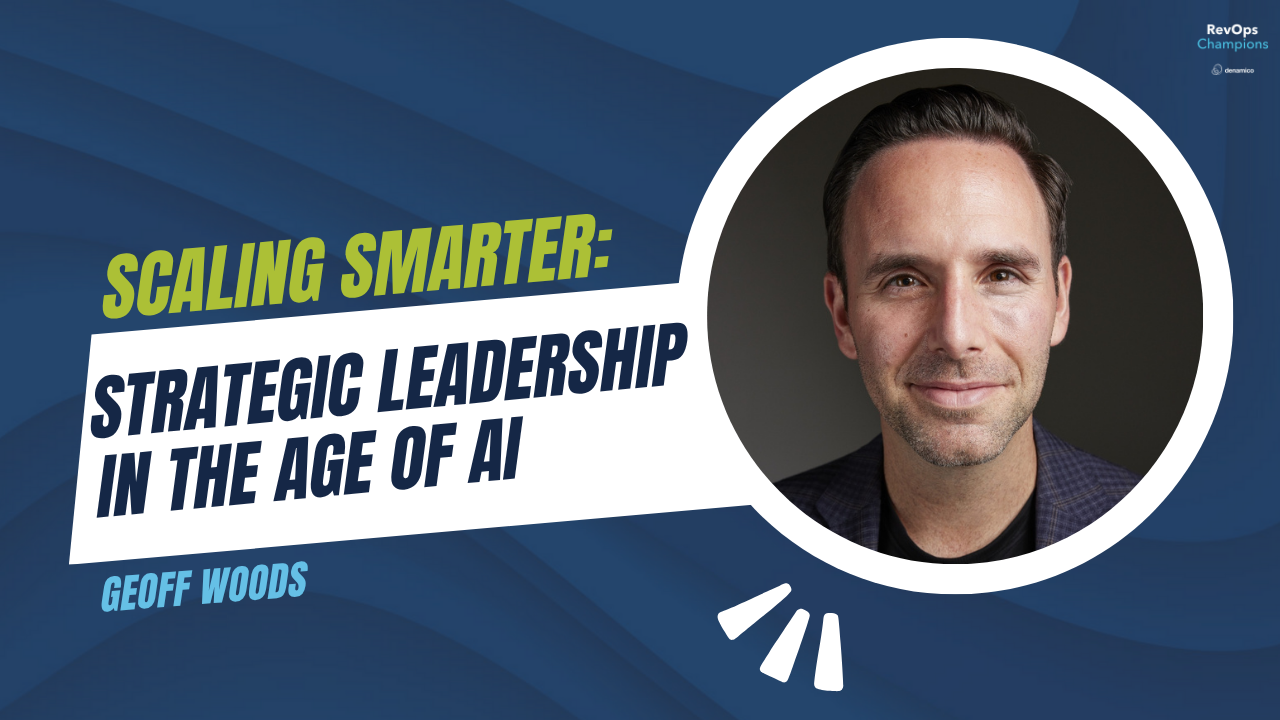
In this episode of RevOps Champions, Brendon Dennewill welcomes Geoff Woods, a dynamic leader whose career spans scaling The ONE Thing brand, driving a steel company’s market cap from $750M to $12B, and now guiding executives at the forefront of AI-powered leadership.
Geoff shares how his success stems from two key drivers: surrounding himself with the right people and asking the kinds of high-leverage questions that spark real transformation. Together, he and Brendon explore how AI, when used strategically, not just tactically, can help leaders amplify their impact and focus on what truly moves the needle.
A key theme of the episode is Geoff’s redefinition of AI as more than just automation. He shares how he uses AI as a thought partner—from building AI “boards” to support business planning, to curating The Collective, a peer group of C-suite leaders collaborating on real-world applications of AI. Geoff also introduces his CRIT framework (Context, Role, Interview, Task), a practical model for using AI to solve high-value problems—the 20% of work that drives 80% of outcomes.
Geoff Woods is the founder of AI Leadership, author of The AI Driven Leader, and a trusted coach to Fortune 500 executives. Brendon Dennewill, co-founder of Denamico, brings deep expertise in aligning people, process, data, and technology for growth. Together, they challenge listeners to think bigger, act with vision, and embrace AI as a catalyst for both personal leadership development and organizational transformation.
Listen
About the Guest

|
Geoff Woods | Founder at AI Leadership Geoff Woods is a visionary executive with a proven track record of helping companies scale through strategic thinking and AI-powered solutions. As the founder of AI Leadership, he equips leaders to harness the power of artificial intelligence to grow their businesses, outpace the competition, and make better decisions, faster. Previously, as Chief Growth Officer at Jindal Steel & Power, Geoff helped drive the company’s market cap from $750 million to $12 billion in just four years through AI-driven leadership and strategic execution. He also co-founded the training and consulting company behind the bestselling book The ONE Thing, where he coached and advised businesses with annual revenues ranging from $10 million to $60 billion. |
Episode transcript
From the One Thing to AI Leadership: Geoff's Origin Story
Brendon Dennewill: You're listening to Brendon Dennewill, a podcast created for B2B leaders to help you align your people, streamline your processes, trust your data, and leverage technology in order to grow your business. Geoff Woods, thanks so much for being with us today. I've been looking forward to this interview. You're a busy guy, and I know we've been planning this for about two months. So glad to finally have you on the show.
Geoff Woods: It's a pleasure, and thanks for sticking with me and my schedule.
Brendon Dennewill: I can imagine how exciting your life must be right now, Geoff. I'm going to dive right in. You've gone from scaling The One Thing to growing a steel company's market cap by 15x to leading in AI. That's quite a path.
Geoff Woods: It has been a wild ride.
Brendon Dennewill: Tell us how that progression happened and what you learned in those first two chapters, both incredible journeys in their own right, to where you are today.
Geoff Woods: When I look back on my journey, I realize it's been a reflection of surrounding myself with people who are where I want to be and asking them the right questions to unlock collective knowledge that you can then turn into action.
This goes back to college. My senior year, I was doing an internship and I sat down with the CEO right before graduating and asked him what job he thought I should get after school. He leaned in and said, "Jeff, you're asking the wrong question. You really should be asking: what are the skills I can master that are so valuable they'll serve me no matter where I go? Then go find jobs that will help you build those skills."
A few things happened in that moment. First, it was the first time in my life I was introduced to the power of asking the right questions. Second, what I didn't realize is that asking the right questions would be a skill that would define my career.
Geoff Woods: After college, I went into sales because he suggested it would be a skill worth mastering. He was right, by the way. I wanted to get into business ownership, and I ended up partnering with Gary Keller, who started Keller Williams, and his co-author Jay Papasan. They wrote The One Thing, a massively popular business book, and they wanted to turn it into a company. But Gary's one thing was running Keller Williams. Jay's one thing was writing books with Gary.
They had been looking for somebody whose one thing was The One Thing, and that became me. So they gave me all of Gary's models and systems for scaling companies. Keller Williams is a massive company. They said, "You've got to learn them, you've got to live them, and then you've got to be able to teach them."
A lot of what I ended up doing was going into companies, a lot of mid-market and all the way up to Fortune 500, driving strategic planning. Core to this was the skill of asking the right questions. There's a company that delivers the majority of your packages. I used to lead strategic planning for them. I remember walking into our offsite and the senior leader handed me his draft of the business plan. It was 21 pages long. By the end of the day, by asking the right questions and not adding more, but by doing less, we collapsed the plan from 21 pages down to one. One focused page that truly reflected the things that mattered most.
This is when I realized I had a power to ask leaders the right questions to get them to focus on what matters most, and that focus would drive company growth.
Building AI Strategy at Scale: The Jindal Steel Chapter
Geoff Woods: In 2022, I sold my stake in the business and it was time for the next chapter. I ended up going in-house as Chief Growth Officer for a big steel company out of India. I had been the chairman's coach and the coach to the whole exec team when I was with The One Thing, and they asked if I would come in to drive growth of all their operating companies. We're talking a hundred thousand people around the world.
My focus was strategic, built around four drivers: strategy, execution, people, and technology.
Strategy meant working with every operating company to define the competitive moat they were building for the future. Most companies don't really know that. If you said, "Tell me the competitive advantage you're building," they're going to look at you like a deer in headlights. If you can't articulate where you're going to go, how do you know where to go?
From there, execution: what is our focused business plan that, if we stay committed to it, will lead to building and fortifying that competitive advantage? Once we locked that in, we looked to people. The purpose of people in a company is to achieve the goals. Goals change every year. But do job descriptions? In our case, the answer was no. We had a hundred thousand people working really hard, but sometimes running in the wrong directions.
The only way you could realign a workforce of that size was through technology. This focus on those four drivers of growth took the market cap from $750 million to $12 billion over four years. Part of that was AI.
The Moment AI Became Personal
Geoff Woods: It was December of 2022 when I saw ChatGPT for the first time. I saw the next skill. I remember thinking, "This is so cool." But then I had these limiting beliefs: I'm so busy, I'll get to this later. Or, I can delegate this to the team and they'll figure it out. I think a lot of leaders listening can probably identify with not taking action because you don't know where to start and you're just too busy, or you assume tech will figure it out.
There was something deep inside me that said, "I think this is a skill worth mastering." So I made a commitment: I'm going to use this once a day.
The problem was I was asking myself the wrong questions. I was asking, "How do I use this to write a better email?" No wonder the results were underwhelming. Then I thought, maybe it's not the tech. Maybe it's me.
My career had been defined by surrounding myself with the right people and asking them the right questions to unlock new levels of growth. What if, instead of asking AI questions, I turned the tables and had AI ask me the right questions?
That was the game changer. It wasn't about using it as a Google or as an assistant. It was about using it as a thought partner.
Geoff Woods: I was in Delhi every quarter. I'm at the chairman's house, showing him how I'm using this for strategy. He says, "This is incredible." I say, "Yeah, it's the future." He agrees. I say, "I think we should drive it through the whole company." He agrees. I say, "I think this is so important, you should own this as chairman of the board."
He goes, "I disagree. How about you do it?"
One problem: I knew nothing about AI. But asking, "How do I drive this through the company?" was the wrong question. I learned from Gary Keller that anytime you're hitting a ceiling of achievement, you're just missing a person. Who am I missing that, if I could get into relationship with them, could enable me to drive this through the whole company?
That led to a partnership with Google. I started going to their headquarters in Delhi, learned a lot about the technology, and started identifying use cases. Pretty quickly it became very clear: the tech is not the difference that makes the difference. It's the leader who harnesses it.
But nobody was talking about the leader. So I resigned, literally burned the ships, and said, "I'm going to write a book about this. I'm going to build a company based on this." No net.
The AI Driven Leader is now the number one book in the world on the subject. AI Leadership is our company focused on building the world's largest network of AI-driven leaders. They come together in what we call The Collective: a cohort of about 100 to 120 C-level executives from different companies who collaborate on how they are harnessing the technology. You have so much collective intelligence that you're vastly ahead of your competition, and everybody is driving amazing enterprise value.
The Collective: Who It's For and How It Works
Brendon Dennewill: The AI Driven Leader is, of course, why I initially reached out to you. It became my favorite book this year. It helped me figure out what we're doing at Denamico as far as how we adopt AI. You just mentioned The Collective. The book is helping hundreds, if not thousands, of leaders be more strategic. Can you tell us more about the size and types of companies in The Collective?
Geoff Woods: Mid-market to enterprise, mostly. The core is mid-market, so call it the $50 million to $1 billion range. You've also got C-suite from Fortune 500 in there, as well as some companies around $10 million that are growing really fast. The diversity makes it interesting because everybody has strengths and everybody has challenges. You're just learning from everybody.
None of these people are technical, by the way. These are the CEO, COO, CSO, CFO, CIO, and sometimes multiple people from a single company. If it's just the CEO, they come up with a vision but then step back into the business like a wrecking ball. If they bring the integrators who make it real, it becomes very powerful.
It's tough to read the label when you're inside the box. When you get into a room with other leaders who are playing at your level, who are equally committed to harnessing this technology to build better leaders, better businesses, and better lives, and you start sharing use cases on how you're deploying it, the movement we see people make in 90 days is remarkable.
Brendon Dennewill: And to complete that analogy: if you're inside the box, you cannot read what it says on the label. But when you're in a room of people with similar labels on the outside, you can see your own business through everybody else's perspective.
Geoff Woods: Exactly. Literally yesterday I was talking with one of our collective members. He built a custom GPT trained to act as a CRO. Every week, he has it review his HubSpot pipeline with him, interview him, and ask him questions about the status of certain deals, and unlock non-obvious insights about revenue and projections.
And I'm thinking, how have we not thought of that? But then I walk him through how we built a GPT to help with product-market fit. Any new idea we have, instead of just going on a hunch, we submit it to this GPT. It asks a few questions, then scores it on a strategic rubric we've created and tells us whether we should pilot it, pivot it, scale it, or kill it.
Brendon Dennewill: Very powerful.
Geoff Woods: And I'll take it one further. We use Fathom as our AI notetaker. When it's running and we're talking to customers and they say something smart, we click the highlight button. My team, none of whom know how to write code, used AI to build out this workflow: when we click the highlight button, it rewinds, captures the relevant segment, and sends it to a customer voice channel in Slack.
Then once a week, an email is delivered to my inbox where all the voice-of-customer segments from the last week have been sent to NotebookLM, which turns them into a 15-minute podcast. That podcast is waiting in my inbox so I can listen to the voice of our customer as prep for our product-market fit meeting.
Brendon Dennewill: That is incredibly powerful, and a great real-world example.
Geoff Woods: The brain trust we've created has become massively more valuable than I ever imagined.
From "I'm Not an AI Expert" to Global Thought Leader
Brendon Dennewill: You alluded to this earlier: when you were first challenged with the AI opportunity, you didn't think of yourself as an AI expert. How did you go from that to being a global leader in the space?
Geoff Woods: I learned something from Dan Sullivan, who started Strategic Coach, called the Four C's. Most people think you need the confidence and the capability before you start. He says it's backwards. First, you make a commitment to become who you want to become. Then you summon the courage to start taking action when you feel utterly unqualified, until you gain enough capability that you eventually get confidence.
This was February 8, 2024. I know the exact date. I was having a conversation with Charlie Hone, one of the best business book coaches in the world. He was behind Tim Ferriss and many well-known authors, and he was behind me.
Charlie said, "You've got to write the book to drive the company." I said, "Two problems. One, I don't know what the book is about. Two, the company doesn't even exist yet. And three, I don't feel qualified to write it, because the more I learned at Jindal Steel, the more I realized how little I knew."
I asked myself: do I wait to become qualified and then start writing, or do I start writing and use it as a forcing mechanism to go so deep on research and so heavy on application that I actually emerge as a global thought leader? The moment I asked the question, I said, "That's it."
February 8, 2024, I committed to writing a book. My goal was to get to a draft by the end of the year. I had no idea I would go start to finish in five months, that it would instantly release as a number one bestseller, and that we'd have a company formed by end of year. We've only really been in business about eight months, and it's a material business, full team, and I've almost fully leveraged myself out of the company to the point that it can operate without me.
Brendon Dennewill: That is unbelievable. When I heard about the book, I got it, started reading, and very quickly realized there was a real business behind it. Then I looked at the timeline and thought: how could you write the book, start a business, and be so far along already? It's been like a year.
Geoff Woods: It's amazing what happens when you learn to harness AI to enhance your strengths and turn them into superpowers. Classic example: people ask, "Did you use AI to write the book?" My answer is, every word in that book is mine. And I used AI to overcome all the obstacles that stop 97% of first-time authors from even getting to a draft.
Brendon Dennewill: Sounds like there's a strategy circle in there.
Geoff Woods: Oh, absolutely. I used it to act as my ideal reader, which I trained on a persona of who that reader was. It read every chapter and gave me feedback on what it liked, what it didn't, and the top changes I'd need to make so that reader would call it the best book they'd ever read. Then I would restructure the chapter. I just collapsed time with AI.
Writing the Book That Built the Business
Brendon Dennewill: So the recommendation was: write the book, and the book will drive the business?
Geoff Woods: Yes. He knew I wanted to start a business, but he said a lot of people write a book without a purpose for it. They don't think strategically about how the book becomes a springboard for a business. I already knew from building the company behind The One Thing that I wanted to align both. But I had no idea what the company was going to be about, and no idea what the book was going to be about. How do you start when you can't connect those two dots? My answer: start, and figure it out.
Brendon Dennewill: So you were building the company in parallel to writing the book?
Geoff Woods: Nope. My full-time focus was the book, and it wasn't until the book was done and published that I started focusing on the company. It wasn't until Q4 of 2024 that we actually started selling anything.
Brendon Dennewill: That's like six months ago.
Geoff Woods: I know.
Brendon Dennewill: Yeah. That's crazy. On a related note, I've heard Dan Sullivan recently say that a truly powerful vision is based on capability. It shouldn't just be a dream. He reframed it for me: if your vision is not grounded in your current capability, knowing that your capability will grow, it's going to be really hard to execute on it because it's not based on any kind of reality.
Geoff Woods: I agree. I'll put it slightly differently. A lot of people focus on product-market fit, but they don't think about founder-market fit.
This was something I was purposeful about before I started building AI Leadership. When I exited The One Thing, I lost my identity, because I had made the mistake of attaching my identity to my work instead of aligning my identity to my work. That took about six months of deep inner work to discover: who am I? I am not my job. I am not my title. I'm a family man with a business, not a businessman with a family. I'm someone who is here to share ideas that change what's possible for people.
In writing The AI Driven Leader, I really thought about how to build a business around my unique ability: how do I lead with revenue and reinvest it to acquire people who have other capabilities, so I stay in my unique ability? That's where I played "who, not how" very hard these last six months. We have a full team now. I set the goal that by the end of this year, 90% of my time would be in unique ability. When I said it, I honestly didn't believe it. We're halfway through the year and I'm almost there.
Brendon Dennewill: That is incredible and very impressive. For those listening who aren't familiar: Who Not How, written by Dan Sullivan and Ben Hardy, was my number one book two years ago. Last year my number one was also by the same two authors: 10x Is Easier Than 2x. And it sounds like I'm talking to someone right now who is doing exactly that.
Geoff Woods: It's crazy. I look at certain revenue metrics from the beginning of the year. This year we haven't just 10x'd. We've already 20x'd in six months.
And yesterday, literally yesterday, my goal used to be to 25x our revenue over the next 10 years. Yesterday I realized I was thinking too small. So I went to my AI board, which is a custom project inside ChatGPT. I've fed it my 10-year vision, my business plan, my strengths and weaknesses, my personality profiles. I had it interview me to identify the strengths I'd need to acquire if I were to assemble a real board to get me where I want to go in 10 years.
Steve Jobs is on my board for vision, product design, and storytelling, but he is not allowed to give me advice on being a husband, a father, or a leader. Warren Buffett is on my board for long-term planning and risk mitigation. My future self, 30 years in the future, is on my board so I can have a conversation with the man I want to become today.
I was on a flight from Austin to New York yesterday, and for two and a half hours I was having a back-and-forth conversation with my AI board. I said, "Our goal has been to 25x revenue over the next 10 years. I think I'm thinking too small. I want to 250x revenue in three years. Your job is to interview me, ask me the right questions, pull the context out of my head on what we're currently doing, and be ruthless about what we need to keep doing to get there, and what we need to stop doing. Ultimately, create a credible plan that has sufficient grounding to actually 250x revenue in the next three years."
Two and a half hours of back-and-forth later, I now think I'm still thinking too small. I can see the path. I understand what we can do. It's very within our capability, which means I have to raise the goal again.
I presented that to the team yesterday. When I told them the number, they said, "Yeah, you're smoking something." When I showed them the plan, they said, "Oh. I was thinking too small."
Thinking Bigger: Why Timelines Are the Real Limiting Factor
Brendon Dennewill: One of the things Dan Sullivan talks about a lot is that entrepreneurs don't have unrealistic goals; they just have unrealistic timelines. But even that is being challenged now, and I think you're a perfect example. In his model, you take a 25-year timeline and ask: could we 20x something in 25 years? Eventually people say, "25 years is a long time, yeah, we could do that." So what about 20? What about 15? What about 10? Suddenly you can ask: why couldn't we do it in three years?
Geoff Woods: And it's a combination: it's mindset, and it's AI. This is rooted in the core of The AI Driven Leader. Is it serving you to hold on to the person you used to be, versus what would happen if you were willing to let go of who you've been so you could reimagine who you can become?
When most people set goals, they anchor themselves to the past for a future outcome they desire. That makes no sense. Being willing to say, "This has been our product offering, but if it's not going to scale to where we want to go, then it's no longer the right product offering," is essential. Maybe you're missing a new product offering. Maybe you're missing a person who can deliver it. Go hire them. Acquire the capability.
If you draw a line in the sand and say the past does not predict my future, I get to set a goal and use it as a compass to inform who I can become. And if you set a short timeline, it collapses your options. Not anything will get you there. Only a few things, maybe even one thing, will get you there.
AI plays into this because so much of what we have done is acting like machines: send this email, do this task, generate this report. We were standing at an assembly line, setting aside our human strengths to act like industrial workers. People are still doing this. Our public education system still teaches people to act like machines.
Brendon Dennewill: Don't even go there.
Geoff Woods: Show up on time. Take direction. Do something repetitively with minimal error and maximum efficiency.
Brendon Dennewill: You have to learn this because it's what worked 100 years ago.
Geoff Woods: If we've been acting like machines, and that's the majority of our time, and AI is going to take that away, I say hallelujah. Isn't it ironic that a machine is likely what's going to return us to what makes us human?
What would your life look like if your day was filled with harnessing your unique strengths as a human, focused on the 20% priorities of your role in alignment with the company goals, and you used AI to turn those strengths into superpowers? That sounds pretty good to me. And this is not some pipe dream. This is my life now. Under a year and a half ago, I started writing a book before I felt qualified to do it. That's how fast this has happened.
How to Use AI for Strategic 20% Work
Brendon Dennewill: We've touched on this multiple times. You talk a lot about focusing on the 20% of work that drives 80% of the results. More specifically, how does AI help entrepreneurs and leaders double down on that 20%?
Geoff Woods: When you're using AI, ask yourself: am I using it for a 20% priority that drives 80% of the results, or for an 80% task that only drives 20% of the results? Most people are using it on the tactical 80%. The AI Driven Leader shows you how to focus it on the 20%. That's strategic.
Step one is just: do I use it to write a better email? Yes. Do I use it as a search engine? Yes. Is that where I focus? No. Walk through my use case from yesterday: how do we go from 25x revenue in 10 years to 250x revenue in 3 years? Let's turn that into a credible, sufficient business plan. That was a good investment of my time.
Last night I did a session with a group in Hong Kong. They want to double the size of their business in 10 years. I said, "You're thinking too slow and not thinking big enough. We're going to do it in three." We used AI to come up with a credible plan for them to expand into Japan and identified five high-impact, non-obvious strategies they could deploy to ensure they'd successfully double the size of their business by expanding into Japan, even though they have no Japanese people in their company. By the time I was done, he said, "This will work."
That use case took 10 minutes. You can spend 10 minutes checking email, 10 minutes on social media, or 10 minutes figuring out how to double the size of your business in three years. The difference is not the tool. The difference is the person wielding it. I'm just getting people to think more strategically.
Brendon Dennewill: And I think that's the core of your book. It's not really about AI. It's about being a strategic leader. AI is just the technology we're harnessing to get there. If there's nothing else people take away from this conversation, it's: get the book, knowing it's going to make you a more strategic leader. You just happen to be harnessing AI to do so.
Geoff Woods: And I'd encourage you: don't treat this book like any other book. Your goal is not to read it cover to cover as fast as possible, although you will read it fast because it's an easy read. Your goal is to apply it.
I had a conversation with a collective member this morning. I asked what his AI journey had looked like. He said, "I listened to your book once, then two more times. After listening three times, I got the hard copy and read it twice." I said, "Let's stop. You're a busy CEO of a decent-sized company. Why?" He said, "Because this changed who I am. This returned me to who I am. Using this technology to enhance me: this is not something to skim through. This is something to apply. This changed my life."
That is extremely honoring and humbling. But I share it because you have a career-defining opportunity right now. It is so early in the game. Everybody asks, "Am I behind?" The answer is yes, you're behind. But it's so early that the real question is, can you still win? That answer is also yes. It does require that you stop buying into the excuses of "I'm not technical" or "I don't know where to start." You're just missing a person, missing a who. In this case, I might be that person. Read the book and find out.
Brendon Dennewill: I did the same thing. I got the Audible version, which was fast, then downloaded the Kindle version, then got the hard copy so that depending on where I was, driving or sitting somewhere I could take notes, I had the right format. My wife is also my business partner. She got her own copy, and her AI journey over the last two months because of it has just been remarkable.
You're right. It's a playbook. You have to consume it in multiple ways.
Getting Started: One Simple Step for CEOs This Week
Brendon Dennewill: I have two more questions because I want to make sure we get you out of here on time. For a CEO listening right now, what is one simple way they could start using AI this week that would make a real difference?
Geoff Woods: Simple. Get two sticky notes and a Sharpie.
On sticky note number one, write the question: "How can AI help me do this?" Put it on your desk. That serves as a forcing function. It's tough to read the label when you're inside the box. I guarantee that within a day, you'll be doing something and you'll look down, see that sticky note, and ask, "How can AI help me review my financial statements?" That happened to me.
Then you'll see the second sticky note: CRIT. Context, Role, Interview, Task. That's my prompt framework. This is how you talk to AI. It works for any use case and will take you into the top 1% of AI users globally.
You give AI lots of context. You assign it a role, telling it to act as a certain type of expert.
Brendon Dennewill: Like your Steve Jobs example.
Geoff Woods: Exactly. Then you turn the tables and have AI interview you. I don't ask AI questions; I get AI to ask me questions so it can then accomplish the task you want. Real use case: I was reviewing my financials, saw the first sticky note, and asked, "How can AI help me review my financial statements?" Then I saw CRIT and built the prompt:
Context: here are my financial statements, dragged and dropped in. Role: act as a strategic CFO who's great at telling a CEO the top five things they don't know about their business based on the financials. Interview: ask me one question at a time, up to five questions, to gain deeper context. Task: tell me those five things.
That prompt was so powerful I eventually turned it into a custom GPT. Now when I get my financials, I just drag them into the GPT, it asks five questions, and it tells me the things I should know about my business that I don't currently know.
Who Is the Right "Who" for Your AI Journey?
Brendon Dennewill: There was something else I wanted to ask, because I think the "who" question is a big one for a lot of leaders: "I'm not technical, I don't know about AI." Your example back then was the Google team in India. When leaders are thinking about a who, do you have any more tips? Is it an individual, a company? Would The Collective be considered a who?
Geoff Woods: Yes. But the first who is actually you. Before you can build an AI-driven organization, you have to become an AI-driven leader.
Let me be clear: you do not need to become a technical person. You do not need to become an AI expert. You need to become an AI-driven leader. That means you know enough to use the tool daily so that you can define your vision for the future, articulate your strategy for how you're going to win, and lead the change. That is exactly what The Collective is for.
We don't do AI implementation. We connect our members to strategic partners who can do it, the same way you do this for HubSpot. We introduce our members to the right people who can get it done.
As you start driving this through the company, getting your team using it, figuring out how to augment your processes, you then start thinking about how to weave it through your product or service. The reason you can't do that right now is because it's like you've been living in black and white your entire life and have never seen color. You're trying to describe color. You have to become an AI-driven leader before you can understand how to create an AI-driven organization.
All leadership starts with self-leadership. The who you're missing is you. The question is: who can you become?
Brendon Dennewill: Which again is: what makes me a more strategic leader, and then add AI to it.
Advice for Thriving with AI, Not Just Surviving
Brendon Dennewill: If you could give one piece of advice to entrepreneurs and leaders about how to thrive with AI, not just survive, what would it be?
Geoff Woods: Go first, and use it every day. Two sticky notes. "How can AI help me do this?" CRIT: Context, Role, Interview, Task. That's it.
Brendon Dennewill: And finally, what's inspiring you most right now in your own journey with AI and leadership?
Geoff Woods: Realizing that every time I think I'm thinking big, I realize I'm still thinking small. I'm expanding what's possible, which is my purpose in life: to share ideas that expand what's possible for people. And I'm getting to see that happen every single day.
Brendon Dennewill: I love that. And it sounds like it works really well here too. If you've been living your whole life in black and white and now you're figuring out what color looks like, that seems to wrap it up.
Geoff Woods: That's right. But then you start to see color, and then you start to see different shades, and it just keeps going. Welcome to the game. It's going to be a lot of fun.
Brendon Dennewill: It's almost like this is what the future is supposed to feel like. Geoff, thank you so much for joining me today. It was awesome to connect with you. Safe travels, and I look forward to speaking with you again soon.
Geoff Woods: Thank you so much for having me.