
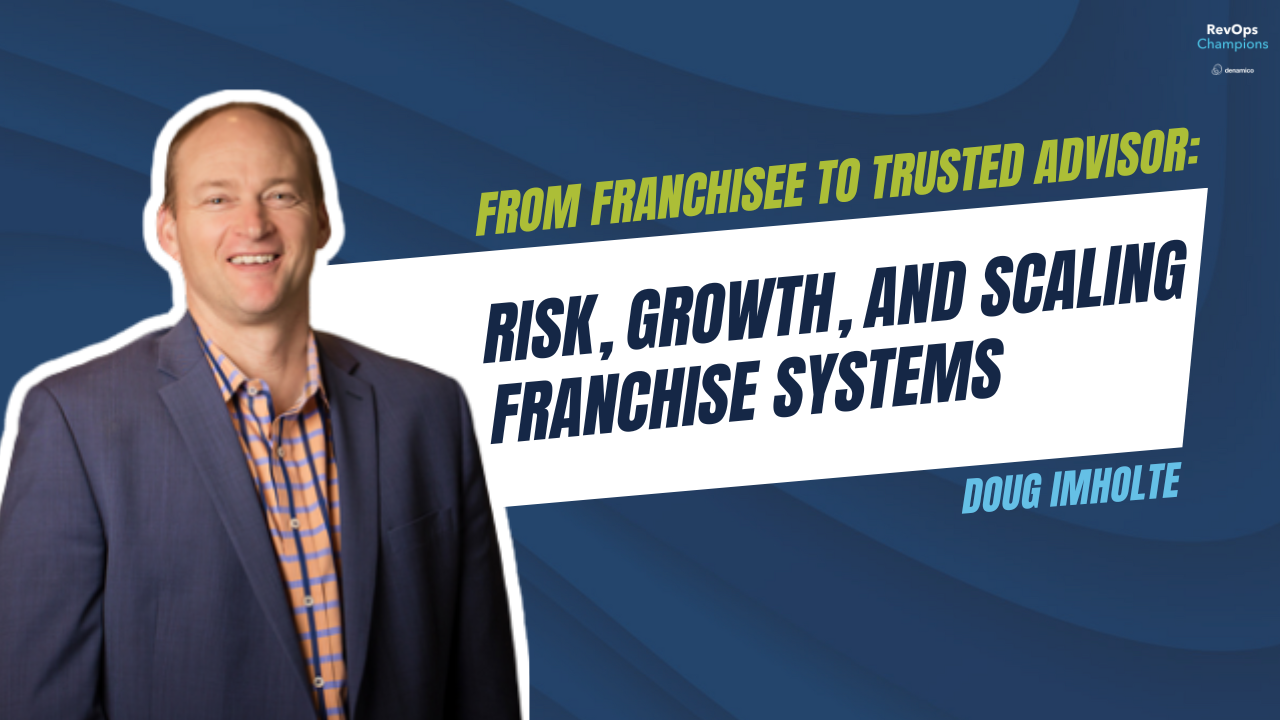
Doug Imholte, Franchise Programs Practice Leader at Marsh McLennan Agency, joins host Brendon Dennewill to explore why franchise brands so often stall between 30 and 40 units, and what it actually takes to break through. Having started his career as a franchisee before becoming a trusted advisor to franchisors across North America, Doug brings a rare, ground-level view of the operational, financial, and cultural strain that growth puts on franchise systems.
The conversation dives into the disconnect between franchisor and franchisee incentives, the overlooked role of risk management in protecting growth, and why treating insurance as a commodity almost always backfires. Doug shares real examples, including a paint-and-sip brand whose franchisees lacked basic liability coverage, to illustrate how small gaps in support can create outsized business risk. He and Brendon also connect the dots between Doug's "total cost of risk" model and Brendon's four-pillar revenue operations framework (people, process, data, technology), showing how growth, culture, and systems are inseparable.
This episode is essential listening for RevOps professionals, franchise executives, and B2B growth leaders looking to scale without losing operational control, and to understand what truly separates brands that grow responsibly from those that grow recklessly.
What You'll Learn
- Why growth alone isn't the answer
- The real reason brands stall at 40 units
- How franchisor and franchisee KPIs conflict
- What "total cost of risk" actually means
- Why cheap insurance costs more later
- The four pillars behind scalable systems
- How to keep culture intact through growth
- Why brand standards make or break trust
Resources Mentioned
- Franchise Disclosure Document (FDD)
- Franchise Errors & Omissions Coverage
- Total Cost of Risk (TCOR)
- Ready, Fire & Aim Leadership Philosophy
- HubSpot
- Royalty Self-Sufficiency Benchmark
- Franchise Update Media
- IFA Franchise Summit
Listen
About the Guest
|
|
Doug Imholte | Franchise Programs Practice Leader at Marsh McLennan Agency
Doug Imholte leads the Franchise Insurance Practice Group at Marsh McLennan Agency, where he partners with franchise systems to mitigate brand risk, improve compliance, and build highly successful franchisee insurance programs. Unlike many insurance professionals, Doug brings firsthand operational experience to his clients. Before shifting his focus to risk management in 2008, he was a multi-unit franchisee who successfully scaled and sold a seven-store cellular retail enterprise. This unique perspective allows him to truly understand the needs of both franchisors and franchisees. Today, he and his team serve as the preferred insurance partner for multiple national brands. An active member of the International Franchise Association (IFA) and a frequent industry speaker, Doug specializes in Franchisor vicarious liability & E&O, Structuring franchisee insurance programs, Cyber liability exposure for franchise systems, and Insurance certification tracking and compliance. Outside of the office, Doug lives in Edina, Minnesota, with his family and enjoys bicycling, golfing, and traveling. |

Episode Transcript
Welcome and Introduction
Brendon Dennewill: Hello and welcome back to the RevOps Champions Podcast. Today I'm joined by Doug Imholte, franchise programs practice leader at Marsh McClennan Agency and a longtime franchise executive and advisor who has spent his career helping franchise organizations build stronger, more resilient businesses. Doug's perspective is shaped by firsthand experience as a franchisee before becoming a trusted advisor to franchisors across North America. That journey gives him a practical understanding of the operational, financial, and leadership challenges franchise systems face as they grow, and how those challenges affect both franchisors and franchisees.
Today, Doug helps franchise brands think beyond insurance, partnering with leadership teams to strengthen operational discipline, reduce enterprise risk, improve franchisee support, and create systems that enable sustainable growth. His work reflects a simple philosophy: resilient organizations aren't built by reacting to problems, they're built by planning well before the problems arise.
Doug, welcome to the Brendon Dennewill Podcast.
Doug Imholte: Thanks, Brendon. I'm really looking forward to being here. Thank you.
Brendon Dennewill: It's good to have you. Doug, let's dive in. You began your career as a franchisee before becoming a trusted advisor to franchisors. Looking back, how did that experience shape the way you approach leadership and the guidance you provide to franchise brands today?
From Franchisee to Trusted Advisor
Doug Imholte: That's a great question. I had been working for some startup technology companies back in the mid to late nineties, and I wanted to own my own business. But I was smart enough to know that doing this all by myself probably wasn't going to be the most successful path. So I found a brand I wanted to be with: a wireless cellular brand based out of Michigan. I bought the franchise rights for Minnesota and became a franchisee.
There were so many lessons I learned, and the first is this: I'm a top line guy in general. I think grow, grow, grow, grow, grow. But one of the things I realized first is growth is not the answer to all problems. You have to have the systems in place, and you really have to make sure people understand where you're going, where the boat's headed, or what the mountain is that you're climbing.
Building those systems to help you grow is critical, because we got over our skis a little bit. Ultimately, we got to seven locations and sold in the spring of 2008. We were fortunate to sell when we did, given what happened after that. While it wasn't a truly rewarding financial path, we were able to successfully exit.
That experience gave me the guidance to say, okay, I really like the franchise industry. I've seen what works and what doesn't, from a franchisee to franchisee perspective as well as franchisor to franchisee. It led me to this path at Marsh McClennan, and I really love what I do. I'm passionate about the work I do with brands.
Brendon Dennewill: That's awesome. So Doug, early in your career, as you touched on, you believed growth was the answer to most business challenges. What changed your perspective, and what does sustainable growth look like for franchise organizations today?
Rethinking Growth: Why Faster Isn't Always Better
Doug Imholte: It's a great question. I came at it because I was a sales guy, Brendon. I'm like, growth, and then I let somebody else pick up the baton and make it happen. From the standpoint of having retail stores and building out locations, hiring was so critical. If we were losing people while I'm trying to grow and grow and give that message, we had to make sure we had the right culture. That was really important. We needed the systems so we could effectively handle more transactions, more people, and understand what KPIs we had to measure to focus on those things.
When I look at this from a franchising standpoint, a lot of times we'll see: hey, I've got a great business model, I've got one or two locations, and I've got a client base that really likes me. We're well known in this demographic, in this particular area, so we want to grow it. And that's where you see brands grow too fast: going outside their region, adding too many locations, too many franchisees, without a strong focus on who they're actually selling licenses to.
Are those franchisees bought into the vision, the plan, the brand standards? I think one of the mistakes the brand I bought into made is they had a lot of side agreements. Well, this is the FDD and these are the standards, but you can do this. And that spanned everything from marketing to attire. Those things have an impact.
It's great, you're like, hey, we've sold fifty or a hundred or two hundred or four hundred licenses. Now how are you going to get everybody rowing in the same direction, with the same plan, adhering to those brand standards, without a lot of people coloring outside the lines?
To weave in a bit of what we do: there's a coverage, without getting too "insurancey," called franchisors' errors and omissions. As a franchisor, your professional service is what you provide to the franchisees, from what's listed in the FDD through the support your franchise business coaches provide. If you try to get too many franchisees open too quickly and they suffer financial harm, they're very likely to come back and file claims against you. That brings your growth to a halt, because now you're handling claims instead of scaling.
So, long answer to my perspective: how do you properly scale? Focus on getting your first set of units right, ten, twenty-five, forty, to create raving fans of the brand among your franchisees, and use that as the springboard.
Brendon Dennewill: So, Doug, as these organizations grow from ten to thirty to forty units, things start to break down during those growth phases. Even just getting from ten to thirty involves fundamental shifts. One of the things I keep hearing from experts on this show is that so many brands get to thirty units and think, okay, this is it, now we're on our way to a hundred, and they never make it past forty in many cases. What are the earliest signs that leadership and operational alignment are beginning to break down? What have you found to be the most effective ways to keep teams focused and rowing in the same direction?
Warning Signs Between 10 and 40 Units
Doug Imholte: Yeah, it's a great question. I have about a dozen things running through my mind. It's something you and your firm talk about too: unit level economics are so important. Whether it's the first ten or twenty-five or thirty units, you say, okay, we've got thirty open, great, let's go. But how are those thirty performing?
The other thing I really look at, and I ask this to my clients all the time, especially emerging growth brands, is: how are you supporting your franchisees? If we were to call the franchisees, give them truth serum, and ask, at this stage, with twenty-five or thirty locations open, how is the franchisor supporting you, and what are two or three things they could be doing better, or should stop doing? Those are really effective questions early on.
Sometimes it's, hey, we've got thirty open and they're making it for the most part, but there isn't a focus on how we're supporting them and how we can do that better. It's all about guidance and support: how do we get them to that next level in terms of unit level economics? And by the way, those franchisees become your most raving fans, the ones who bring in other franchisees.
Brendon Dennewill: That makes total sense, because if they don't do that, eventually, when they hit eighty or ninety units and reach royalty self-sufficiency, it's going to show up in the FDD. Suddenly they wonder why they aren't getting new franchisees. As part of the franchise sales process, whether you're working with a broker or just using ChatGPT, eventually a prospective franchisee is told: go look at the FDD. Then everything goes quiet, and they wonder why. It's because they haven't been proactive in supporting their franchisees up to that point.
Doug Imholte: Yeah, you're absolutely correct.
Brendon Dennewill: I know some of the best franchise attorneys, and you've already alluded to the fact that your work closely follows, or leads, work with franchise attorneys. The attorneys I've spoken to say they don't really want to be doing the reactive cleanup work. Obviously that's what you get paid for, but you'd prefer to do the proactive work to prevent those things from happening, because once they bring you and the attorneys in, that's typically not the greatest place for a franchise brand to be if they're looking to grow. Correct?
Proactive vs. Reactive: Building in Support Before Problems Arise
Doug Imholte: Yeah, I'll give you a couple of examples. Because the joint employer pendulum has swung back and forth, we've seen some brands pull back on training they've provided to franchisees, specifically safety training. Of course, they don't want to provide HR guidance, but they've essentially taken their hands off the wheel.
We're a full-service risk management firm. For some brands, we actually provide a lot of their outsourced training. We work with brands that have a lot of driving, trucks, vehicles on the road that are wrapped, and we proactively help them create their driver safety manual. We run quarterly safety webinars. We sit on their safety committee as part of their FAC.
We're saying: franchisor, you still have these responsibilities, and this is about moving forward effectively. The small part we like to play in growth and operations is keeping everybody moving forward. If we can take some of those things off your plate, provide support to your franchise business coaches and franchisees around safety and HR, in addition to insurance, that keeps both the franchisees focused on growing their business and the franchisor focused on growing their brand.
When we talk about brand standards, Brendon, that's part of it. What are the brand standards your franchisees are delivering on, since they, or their employees, are delivering on that brand promise? If they're coloring outside the lines, that comes back to impact not just other franchisees but you, the franchisor, which impacts growth and profitability.
Brendon Dennewill: And of course, that inconsistency comes back to a prospective new franchisee. Whether they're looking at one unit or multiple units, when they interview existing franchisees and hear different stories from each one, that inconsistency probably doesn't give them a lot of faith that it's the right brand to invest their hard-earned cash into.
Doug Imholte: You're absolutely right, and there are many examples of that.
Brendon Dennewill: We seem to be hearing them too often.
Balancing Consistency and Flexibility in Leadership
Brendon Dennewill: Okay, Doug, let's switch gears. Your leadership philosophy has been described as "ready, fire, aim": building a solid foundation, taking action, and continuously refining the process. How do you strike the right balance between operational consistency and giving teams the flexibility to adapt?
Doug Imholte: Great question. Sometimes, especially in our industry, there can be a paralysis-by-analysis problem. I try to tell my team: we've got to deliver on our promise, and we're going to make mistakes, and that's okay. We're going to be accountable for those mistakes, look at what led to them, because we all make them. I want to lead by example there, Brendon, and provide grace as long as we're accountable and working on fixing it.
I want the team empowered to go out and deliver. The other piece that's really important, and something I've had to double back on as we've grown, is communication and vision. As we've brought people onto the team, they have a specific role and responsibility, but I want them to know the bigger vision: what our role is, what we're delivering to franchisees and franchisors, and I continually communicate that.
If your role is certificate of insurance compliance, getting certs out, and doing those sorts of things, and you think that's not really important, I want you to know you're an important cog in this, here's how it all fits together, and here's why it's important. And if you stub your toe and make a mistake, own up to it. Let's not be defensive. Own up to it, understand it, and keep moving forward. That's the recalibration piece.
Data, KPIs, and the Disconnect Between Franchisors and Franchisees
Brendon Dennewill: Sure. You're touching on something else I wanted to ask about. One of the things we see in our work, setting up revenue systems for franchisors, built around a central CRM that integrates with their technology and data systems, is that we need clarity on the processes at the corporate level and the franchisee level, and what data or KPIs they're tracking at each. That's the information we need to build a revenue operations system that actually matures and enables better decisions over time.
One of the big disconnects we see is that the metrics driving franchisees are almost the polar opposite of what drives the franchisor. Organizations have dashboards full of metrics, yet performance doesn't necessarily improve. From your perspective, since you're looking at numbers all the time, what separates companies that simply measure results from those that truly use data to drive better decisions and stronger outcomes?
Doug Imholte: Before we get to that, can I ask you something? What are you seeing at the franchisor level when they say, these are the KPIs we're measuring? Are you seeing consistency between what franchisors are trying to measure and what franchisees are measuring, or are you seeing big swings in what each wants to measure?
Brendon Dennewill: I think the glaring difference, across the board, except for the most sophisticated brands who've really figured it out, comes down to something pretty simple: you don't have to have that much experience in the franchise space to understand the difference between how corporate franchise development teams are incentivized versus how franchisees are incentivized. That's really where it starts. The incentives are different, so the KPIs and metrics are going to be different. Over time, if that's not addressed...
And that conversation you mentioned earlier, explaining to each stakeholder why their role and the metrics they're measuring matter to the bigger success, that is so important. It's not just a matter of having more data meaning better decisions, if it's the wrong data. It's having clarity at each step.
The other thing we keep hearing over and over is how many franchisees weren't set up for success from a financial metric perspective. Profitability is obviously a key metric for them, but they don't understand everything further up the P&L that impacts their profitability, the things that would let them focus and ensure there's actually a bottom line. Whereas franchisors are more focused on the top line.
Doug Imholte: Yeah, data is... we could have a two hour conversation on data. Data is great, but there's so much of it now. What's the key data? Trying to keep the main thing the main thing. Sometimes what a franchisor is measuring versus what a franchisee is measuring is going to be different, and I get it. But I think it comes back to unit level economics and helping franchisees understand the key metrics there, without getting so bogged down in the bottom line that they forget to grow the top line. There's a balance, and maintaining it is really key.
There's always going to be some conflict, and I'm okay with conflict as long as there's a culture where conflict is okay.
Brendon Dennewill: And where there are clear lines of communication when there is conflict.
Doug Imholte: Yes, absolutely. Because then it's: hey, we know where we're all going, there's going to be some tension, but we'll work through it because of the culture we have and the operational support we have.
Structuring Systems Around People, Process, Data, and Technology
Brendon Dennewill: One of the other things specific to data that we're seeing is that, typically when we're brought in, it's because the franchisor, the brand, the network, has outgrown whatever systems they had. In most cases they have siloed systems: one system for franchise development, one for this, one for that, instead of a single system where data flows from every unit, no matter how large the brand is. We work with some franchises that have a thousand units, and that's where every unit's numbers are visible to make decisions at the corporate level, with permissioning down to each franchise unit or multi-unit owner so they have what they need to make decisions and support their franchisees. That's kind of where we see the biggest gap: why did it take so long?
Doug Imholte: That has to be so helpful for the benchmarking piece, Brendon. I go back to the early 2000s, where we'd see our revenue numbers, but to be able to benchmark my inventory, my labor costs, my marketing costs against other franchisees, I think that's really important. To say, gee, I'm spending more on labor during these times than my colleagues. What am I doing? Is that a choice I'm making because I want more people on staff? Why am I carrying more inventory than other franchisees? That's what we talked about: what's the key data, keeping the KPIs that really matter.
Brendon Dennewill: Yeah, and it comes back to unit level economics and the information that ultimately needs to show up consistently in an FDD, if the brand is still planning to scale, since all new prospective franchisees are going to be looking at the FDD. How do you structure the FDD so it can evolve as the brand scales and grows?
It's an interesting challenge, and it comes back to what I was saying earlier about the difference between brands that scale effectively and those that get stuck: this mindset of knowing that going from zero to ten, ten to thirty units, things are going to change even at that level. Going from thirty to seventy-five or a hundred, things change again. Once you get to a hundred, or a hundred twenty, or a hundred fifty, you have to change again.
What's interesting, and not ironic at all, is that the revenue operations systems we build are based on four pillars: people, process, data, and technology. Technology comes last. It starts with leadership, the people component, showing everybody where we're going, the communication piece we've already touched on multiple times. If those leaders don't realize when they need to bring in additional leaders, or when they might need to step aside themselves...
We see this a lot in franchise systems: there are incredible leaders whose strength is taking brands from ten to a hundred units, and then when they hit a hundred, they move to another brand, because there are other leaders who can take brands from a hundred to three hundred and beyond. It's about having the mindset that what got us here isn't going to get us to where we're going.
Doug Imholte: Yeah, there are a few founders that come to mind. Joe Keeley, who started College Nannies and Tutors here in the Twin Cities a number of years ago, is a good example. When you start a concept, you've got control, you know what you're doing, you want your team to do this. A lot of times, when you bring on those initial franchisees, they're friends, family, or people in your orbit, and they say, tell us what to do, we want that. You still have your hands on the wheel, controlling it as much as you can.
Being able to find that next level, where you're bringing in people outside that orbit, through your franchise development team or brokers, where you're guiding but not controlling, I think you've got to give up some of that control in order to grow. But you still have to have the brand standards and guidance so franchisees are singing out of the same hymnal.
If I try to control everybody at thirty or thirty-five or forty units, that's not going to work. But if I just say, hey, you're on your own, that's not going to work either. Identifying those four elements and putting a process around each is key. I think you should also have a process around your culture, since that's going to define everything. Those are some of the elements of brands that really get to that next level.
Treating Suppliers as Partners
Brendon Dennewill: It really does come down to that. In the work you do and the work we do, we're brought in as trusted advisors, but we're often put in a box that sits somewhere on the P&L. We're seeing things well beyond what that box says we do, which is why I think these conversations are really helpful for the folks listening. If there's just one thing you and I might remind them about, something they've forgotten as they've gone from thirty units to sixty units, and it prompts them to think, actually, this is probably the time we need to make some changes, then that's great.
Doug Imholte: Sorry to interrupt, but the thing I'd ask, real quick, is that franchisors working with trusted franchise suppliers should treat us as a partner, because we're going to act like one. That doesn't mean we're involved in every strategic decision, but treat your suppliers, especially those with a lot of experience in the franchise space, bring them to the table and say, have you seen this? What have you seen here? How can you help us? Do you know somebody else we might work with, from a CRM standpoint or otherwise? I think that's really important.
Brendon Dennewill: And of course, this is one of the greatest things about the franchise space: the openness of people wanting to help others, whether it's a multi-unit franchisee wanting to help other franchisees or franchisors, or experienced people across the franchise space. It's incredible to see how open people are in wanting to help others without expecting anything in return, because they know that if the franchise industry continues to elevate and succeed, it brings everybody along.
Risk Management Beyond Insurance
Brendon Dennewill: So, Doug, let's get back to specifics. Many people think of risk management primarily as insurance, but your work goes far beyond that. How can franchisors use strategic risk management to strengthen operations, support franchisees, and create a more resilient organization?
Doug Imholte: Great question. Too many people hear the word insurance and their eyes roll back in their head. They see it as a bottom line number on their P&L, and that's the wrong way to look at it. They think, if I just shop around, I'll get a better rate, and that's not how it works.
Think of underwriters as bookies. They're placing money on your business, hoping to make a profit. We want to affect all the risk factors that go into insurance pricing. High turnover is a risk issue that tends to lead to frequency of claims. If you're not doing proper training with franchisee employees, that impacts potential losses too. That leads to higher insurance rates.
We try to be that risk management resource. For example, in cyber liability, we have a whole cyber team that helps franchisors understand their network across franchisor to franchisee. We don't deliver those networks, but we help them understand where the gaps are. Ultimately, we want to provide support and resources for franchisees and franchise business coaches, so we keep pricing stable and consistent, keep them insurable given how the insurance market is going, and let them stay focused on the main thing: growing their business and their brand.
Brendon Dennewill: Doug, I'm going to pause for a second, I lost you there for about thirty seconds. If you're okay with it, I'll ask that question again and we'll cut this part out and get a clean take.
Doug Imholte: That's good, because I stumbled over my words anyway.
Brendon Dennewill: No worries. So, Doug, many people think of risk management primarily as insurance, but your work goes far beyond that. How can franchisors use strategic risk management to strengthen operations, support franchisees, and create a more resilient organization?
Doug Imholte: Great question, thanks for asking. A lot of times people think of insurance as a commodity, and it's not. They think of it as a pure bottom line item, and that's not the case. We come alongside as a full-service risk management provider, protecting the brand and impacting the factors that go into insurance pricing.
High turnover leads to a number of issues: higher workers' comp losses, franchisee employees not knowing proper standards, and customer issues. From a safety standpoint, we have safety specialists who help with everything from OSHA compliance to safety data sheets to DOT requirements if you're driving trucks or have vehicles wrapped. Franchisors need to continue providing that guidance, because if you don't, it leads to losses.
That comes back and pulls the franchisor in from a vicarious liability standpoint, meaning they get pulled into the claim, named in the suit. It affects franchisee to franchisee relationships and overall insurability. If you're a brand dealing with children, spa services, food delivery and foodborne illness risk, driving, any of those areas carry risk. We come alongside with resources and services to help franchise business coaches provide content to franchisees, or provide training directly to franchisees and their employees. That reduces risk, prevents incidents, and helps franchisees stay focused on the main thing: growing their business.
Total Cost of Risk vs. Total Opportunity Cost
Brendon Dennewill: There are a lot of parallels between what you do and what we do. For example, the CRM we typically implement as part of our revenue operations systems for franchisors is HubSpot. They think of it as software, a line item, but what they don't understand is how that software needs to be implemented and integrated into their operational systems, and what value that brings.
What I really wanted to ask you: you work with brands ranging from very emerging stages to incredibly successful, large, multi-thousand-unit brands. We hear all the time that brands reach royalty self-sufficiency, depending on the industry and the specific brand, somewhere between fifty and seventy-five units. You're dealing with brands that might be at thirty units. Who are the brands making that investment in risk management at that level, and how are the leaders of those brands different from the ones who aren't making that investment?
Doug Imholte: Great question. I think there's an understanding of everything we talked about: culture, unit level economics, and looking three years ahead. That's really key. What kind of brand are we going to be three years from now?
Sometimes, for an emerging growth brand, you're just trying to get through the next three months, I get that, but knowing where you're going matters. Strategically, I'll talk to CEOs, COOs, or founders of smaller brands, and they'll say, hey, I want you to handle the insurance for the franchisees, we just want the least expensive option. Cost is always important in our world too. We can get there, but if you're only worried about cost, what happens constantly is franchisees don't get the right coverage. They don't have coverage for the main thing they need.
I'll give you an example. We worked with a paint-and-sip brand, and looking at their first thirty-five franchisees, roughly half didn't have something called host liquor liability coverage. That means if a customer drank, overserved themselves, left, and got in an accident, there's no coverage. They'd have to shut their doors, and that comes back to the franchisor. There are a lot of examples like that where we say, you can be cost competitive and do this the right way at the same time. If not, it's going to come back and bite you down the road.
Sometimes it's not a tangible discussion of "you've got to do this, this, and this," but it has to be strategically important. We have brands in unique industries now where there aren't a lot of carriers willing to write coverage for what they do. They're telling new franchisees, you need to use these specific carriers because we've built out the insurance requirements, or it's going to affect our growth down the road.
Brendon Dennewill: That's really interesting, because we see the same thing. By the time people come to speak with us, they're typically up-leveling their systems. We'll hear very similar stories: we went with a different software that was saving us seven hundred dollars a month, but they're not thinking of it like a Toyota Corolla versus a Cadillac. Both do what they need to do, but in our situation, what happens is they've spent a lot of money outside the software cost trying to make that cheaper software work, which ends up costing them thousands of dollars more per month in extra human intervention.
And what's the cost of that? Not only that, but if they did that at thirty units, at a hundred units they've got to replace it anyway, because that software isn't going to scale from a hundred to three hundred units. Then they go through the whole process again. We get that at that point they're thinking three months ahead, and thinking three years ahead is really hard, especially without royalty self-sufficiency, which is why we typically don't work with brands until they reach that point. That's when they realize where they need to invest to get from seventy-five units to three hundred units and beyond. But it's interesting to see the parallels.
Doug Imholte: Yeah, it's a bit of a chicken and the egg.
Brendon Dennewill: Exactly. We talk about it as total opportunity cost. It's not just the cost of insurance in your case, or the technology we're implementing in our case. It's what you have to spend in other hard and soft costs if you don't have a system that allows for the automation you need to successfully grow the business.
Doug Imholte: We use a similar term: total cost of risk. What is your total cost of risk? A lot of things go into that.
Brendon Dennewill: And you've already touched on a couple: the drinking example, where the business is over. What does that cost you?
Looking Ahead: Responsible Franchising
Brendon Dennewill: Okay, Doug, to wrap up. Looking ahead, what do you believe will separate the strongest franchise organizations over the next few years, and what should leaders start doing today to prepare for that future?
Doug Imholte: It's a really good question. We hear the term responsible franchising, and what does that mean? I still think it comes down to knowing, as a brand, who you are and what you deliver or sell. Being clear on that. Sometimes brands say, we do this, and then we're going to do this, and this, and this. Being really clear on who you are, what you do, and what your plan is gets everybody engaged. To me, that's the real key.
Brendon Dennewill: That's really good advice, because that's also what creates the consistency you've touched on multiple times, consistency that helps franchisees succeed. And if franchisees are successful, the brand will be successful too.
Doug, thank you so much for joining me today. It was a great conversation. I look forward to more of these.
Doug Imholte: Thank you, I really enjoyed it. We'll see you at the Faegre franchise summit this summer.
Brendon Dennewill: Yes, looking forward to that, only a few weeks away.
Doug Imholte: Mid-August. Thanks, Brendon, very much. Bye bye.