
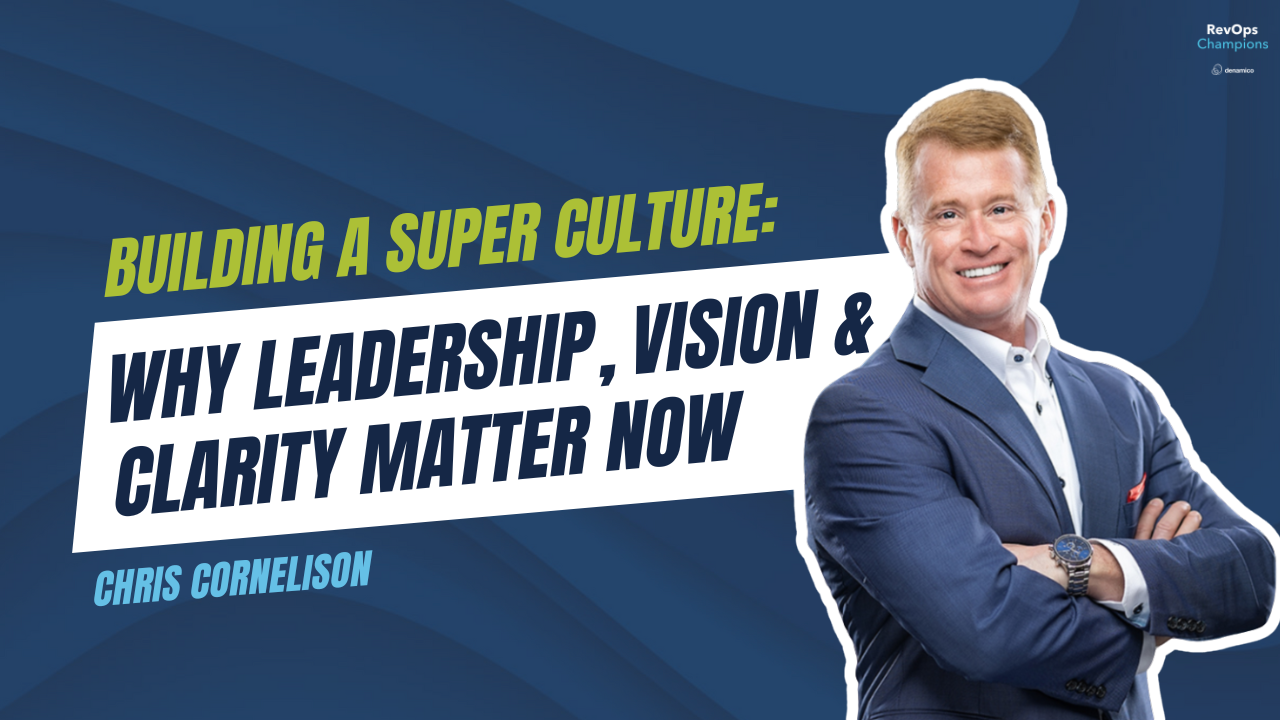
In this episode, Chris Cornelison, bestselling author, leadership expert, and founder of SolutionsRx, joins host Brendon Dennewill to unpack how leadership, clear processes, and focused adoption of AI can transform company culture and performance. They trace Chris’s journey from inheriting a one-location pharmacy to building multi-site businesses, developing the Super Culture Framework, and helping organizations balance accountability, joy, and measurable results.
The conversation centers on practical implementation: short, living documents (one-year vision, culture rules, position agreements), coaching, and using closed AI to turn processes into prompts that scale repeatable excellence. Chris shows how clarity (“clear is kind”), emotional intelligence, and data scraping with closed-AI tools accelerate onboarding, surface buried opportunities in your CRM, and make teams more productive without bloating headcount. This episode is essential listening for RevOps professionals, revenue leaders, franchise operators, and B2B growth teams who want to combine people-first leadership with pragmatic tech adoption to improve retention, speed up onboarding, and drive predictable growth.
What You’ll Learn
- Key elements of the Super Culture Framework and how it can transform your workplace.
- Practical steps to start building a super culture in your organization.
- Understand the importance of having a clear vision and structured processes in business.
- Explore how AI is being integrated into business strategies to enhance efficiency and culture.
- Gain insights into overcoming business challenges and achieving sustainable growth.
Resources Mentioned
- Super Culture Book / Framework
- www.chriscornelison.com
- SolutionsRx
- Cerebro
- EOS
- The Leading Brain
- Positive Intelligence
Listen
About the Host
|
|
Chris Cornelison is a best-selling author, keynote speaker, and CEO of SolutionsRx. He’s the creator of the Super Culture™ Framework, a proven system that helps leaders build energized, accountable, and high-performing teams. Chris began his leadership journey at 24 when he took over his family’s pharmacy, later growing multiple successful companies and earning honors such as PDS National Entrepreneur of the Year, McKesson Southeastern Pharmacy of the Year, and Distinguished Young Pharmacist of Mississippi. Known for his high-energy, humorous, and practical speaking style, Chris teaches organizations how clarity, emotional intelligence, and simple written processes can transform culture and drive sustainable growth. He speaks across industries—from healthcare and finance to manufacturing and education—equipping leaders with tools they can implement immediately. A lifelong athlete and devoted family man, Chris is passionate about helping people improve their workplaces, their leadership, and their lives. |
Episode transcript
From Pharmacy School to First Business: The Early Struggles
Brendon Dennewill: Today's guest is Chris Cornelison, bestselling author, leadership expert, and keynote speaker who has built multiple successful companies, including SolutionsRx, a multimillion-dollar supplement business. Chris is also the creator of the Super Culture Framework, a model designed to transform workplaces into environments where employees feel energized, valued, and motivated. As a pharmacist, entrepreneur, and growth strategist, Chris has taught organizations across all kinds of industries how to combine strategy, leadership, and compassion to achieve sustainable results. From leading independent pharmacies to speaking on stages nationwide, his work empowers teams to thrive and leaders to elevate their impact. Chris, welcome to the RevOps Champions podcast.
Chris Cornelison: Brendon, thank you very much. That's a super kind introduction, and I'm ready to go. This is going to be a really fun podcast.
Brendon Dennewill: I know it is. You and I had the opportunity to meet in person just over a month ago, and I'm so excited to dig in and learn more from you here. I'm sure a lot of our audience is going to learn from you too. So Chris, let's go back to the beginning. Can you share how you first got started in business and what led you to take over your first pharmacy at the age of 24?
Chris Cornelison: My grandfather owned a family business, a pharmacy. I graduated pharmacy school at 24 years old. At 27, I bought my grandfather's family business. My grandfather was a great guy and had built a good small business, but like a lot of small business owners or one-location entrepreneurs, he had no structure, nothing written down.
I came in with poor leadership, not knowing I had poor leadership. I was 27. I didn't know a lot at that time, and I almost destroyed it. In my book, I have what everybody calls the garbage can moment. I actually literally take the same garbage can I kicked in all those years ago around. I still have it in my company as a reminder, and I take that garbage can with me a lot of times when I keynote on culture. I set it on stage and relive that moment.
The way I got into my first business was I bought the family business and came within an inch of driving it into bankruptcy.
The Garbage Can Moment: Discovering Emotional Intelligence
Brendon Dennewill: Wow. Let's go there. What were some of the biggest challenges you faced early on and how did you work through them?
Chris Cornelison: The biggest challenge I faced was I didn't know how to lead a team. I had no emotional intelligence and I didn't know it existed. It's not like I went in and said, "My emotional intelligence is off." I was leading from a standpoint of all I'd seen in athletics. I was trying to be the fiery coach, slamming my hand down, yelling at people, not realizing that would shut them down. With no written-down structure, nothing to lead by, no job descriptions, there was a lot of chaos in this small business that I didn't even realize existed when I came on. I'd worked in this business for three years before I bought it.
The first challenge was actually getting some awareness that there wasn't any written structure and that my leadership needed to improve. When I finally had that awareness moment after kicking the garbage can and making an immature mess across the store, slamming and slinging things all over the place at night by myself — I did not do this in front of customers — I came to the awareness that I did not have it all figured out.
The next step was I hired a business coach. His name was Paul Simpson. He's still a dear friend of mine. We worked together for 16 years, and he reinvented me step by step: how to write a vision, how to write things down. I'm a big process guy. I want everything to be repeatable. Once it turned direction, that's when I realized how important culture was. It became second nature to me to process culture and what it took to get on point. The next thing I knew, I was keynote speaking all over the country about how to flip your culture around.
Developing the Super Culture Framework
Brendon Dennewill: Was there a specific turning point that helped you develop your Super Culture Framework?
Chris Cornelison: It all starts with Rule of the Ones: it all starts with you, and that's leadership. The first step for me was I was taking classes to better myself and stumbled onto emotional intelligence. I got really deep into the neuroscience of it. I'm a pharmacist, so the science side turned me on. When I got into it and realized how low my emotional intelligence was, it was just lightning-fast steps of progress once your eyes are open to where you're going wrong.
Maybe it's my fault that nothing's written down in this company. Maybe it's me who's slamming my hand down. Maybe it's me who's yelling at everybody. Maybe it's me who is causing the problems. And Brendon, it was me. That was a hard reality.
But in business, we want things to go up like a hockey stick. The minute I realized it was me and I had the ability and power to fix it, and I kept improving my tools and skill sets over the years, we went up like a hockey stick. We turned that one store into three, won national awards, and my team was so on point that we were able to enter new markets and build a company known for great work.
Building a Culture of Accountability, Fun, and Compassion
Brendon Dennewill: How do you build a culture that balances accountability, fun, and compassion in your companies? A lot of our clients and listeners are familiar with EOS. For me, I can really be good at the fun and the compassion piece, but where I struggle is the accountability side.
Chris Cornelison: Great question, and I'm excited about this one. I've got tons of friends in EOS. I've never been a member myself, but I really respect their structure and have talked to a lot of the implementers over the years.
I really believe the key is clarity. As Brene Brown says, clear is kind. You have to have a structure for clarity. I have a five-step process in my book. Rule number two is: write it down or it doesn't exist. I believe there are five short documents, key being short, that you need. The main one is the one-year vision.
I give a free template on my website through my book to walk you through this. Last year, our one-year vision was titled "Raise Our Standard." Every year I give it a theme. Then I take the departments inside our company. I always have a culture section. Last year we had some new people in key roles, so I added the ideal customer to make sure the team was aligned on who that was. Then I went through wholesale sales, business-to-business, direct-to-consumer, marketing, sales, research and development, and we added AI last year.
A one-year vision document with all those headings and some bullet points on what we wanted to accomplish gives every department head a clear section to reference: what is my department trying to accomplish this year?
Every quarter when we set goals, we return to the one-year vision. Where are we? How did we do last quarter? What are we trying to accomplish? The one-year vision keeps the whole team on track.
Brendon Dennewill: Yeah, so in your book, Super Culture, and I think this is a really good read for any business owner or leader, whether you run on EOS, Scaling Up, or any other program, or even if you're thinking about skipping the frameworks and just starting with culture. After four years of doing this podcast and having many successful leaders on the show, everything comes down to people and culture. So, how does culture connect to all of this?
Chris Cornelison: Yes, and I think that's right. When it comes to culture documents, my first one had four lines, literally four lines. But those four lines kept us on target. I'm a big fan of all these documents being very, very short, because I want them to be used. I want them to empower people. I don't need documentation that says "turn the computer on." I need them to know: we want this to grow, your job is to coach this group of people, your job is to make this happen. The one-year vision is the most important document.
Connecting Culture, Vision, and AI
Brendon Dennewill: When I had Mike Payton on recently, the previous CEO of EOS, he shared an interesting comment from Gino Wickman: if AI starts running businesses, we're out of business, because we're all in the business of figuring out how to make people happier, more engaged, and more fulfilled. It's all about people. Which means culture really is the foundation. And as I say that, I'm thinking about the incredible conversation you and I are going to have about how culture and AI are going to connect, because ultimately everything we're talking about is how do we improve as humans.
Chris Cornelison: 100%. I would love to tie the AI piece into the culture piece, because when it comes to AI, we had three lines on AI in our vision document. Our culture document says we're going to have fun at work and be accountable to a few things: your position agreement, the vision, and the policy and procedure.
So every time we're looking at something new in AI, and there's been a ton of new developments this year, we're looking at it through the lens of our vision and our company. You don't get pulled away by every shiny new coin. In AI, you have to jump in and see tons of shiny ways you could use it, but we look at it through the question: how are we going to use this tool to fulfill our vision?
My business coach taught me this year after year. He would always ask me the same question: is this on vision or is this off vision? Everything we do in AI, whether it's which software to use, which networks to join, how to communicate with our ideal customer, we know what we're trying to accomplish. We know our theme was to raise our standards. So every chance AI had to make us faster, better, and more effective, we knew that was for us. If it was something else, we put it on the back burner. Doesn't mean we won't use it in the future. It means it was off vision for us right now.
Rule number one in our culture, in every company I have, is: have fun and be happy at work. When I was kicking that trash can, I was not happy at work, and I was making everybody else miserable. So that's number one. Number two: you have to choose your attitude. I can't make someone come in and be happy at work, but I can hold them accountable to it. Rule three: be accountable.
I think all great cultures have to be accountable to something. When you have that written down and that's the environment you're protecting, and you have the vision pointing you in the right direction, you have clarity in the company. And I challenge all my managers to use the verbiage from the vision and the culture document when they're coaching the team.
Brendon Dennewill: Yeah. And you know, no matter who the teacher, mentor, or coach was that we learned from, you learn from all those lows in your life. That's what leads you to find a better way of doing things. And to your earlier point, it leads to feeling happier at work.
Real-World Results: Culture in Action
Brendon Dennewill: Can you give us a couple of examples of how you've seen your strategies for culture and leadership impact teams and business outcomes in real-world settings?
Chris Cornelison: In my background in pharmacies, I used to lead mastermind groups and board-of-directors-type settings for entrepreneurs, and I saw tons of them grow financially and make massive improvements. It always starts with improving your culture. Everybody who comes to me struggling has something going on with some person or some area of the company, and it always traces back to no clear culture environment being created.
Recently I've been working with Ken Williams and a Coca-Cola franchise out of Corinth, Mississippi, operating in four states. It's been fun to watch this company implement the culture work and get more energy in their team. Coke is obviously a great company. They don't need Chris Cornelison to be great. But they've invited me back four times to keep leading their team and helping them build a mindset around great culture, improved leadership, and better focus. Getting to work with a company like that four times in two years, when they keep bringing you back, that's incredibly fulfilling.
The most rewarding experiences, though, have been when leaders call me to brag on their sales numbers and then mention, almost as a side note, that they shared some of this with their kids. They were having a tough relationship with a son or daughter or spouse, and when they tell me they used the emotional intelligence and culture principles in their home life and it made an impact with their children, that takes it to a whole new level. I've had people call and tell me they made millions of dollars, and that's great. But when they say, "The most impactful thing was I was finally able to really talk to my son," that pumps me up more than anything.
Brendon Dennewill: Absolutely. Impacting your most important relationships: there is nothing more important than that, ultimately. But of course it doesn't hurt to have a more valuable business at the same time.
Looking Ahead: Leadership Trends for 2026
Brendon Dennewill: We're here at the end of 2025, and I think a lot of positive people like you and I are very excited about 2026. What trends or changes do you see shaping the future of leadership and team development?
Chris Cornelison: I think every industry is kind of the same with what I'm about to say. I hate to land right back on AI, but I'm a big process guy. One of my favorite foundational books was The E-Myth. It opened my mind to how important processes are in a company. And AI is about to take processes and turn them into prompts.
For example, our salespeople. We realized two or three years ago that we weren't setting them up for success, so we went on this journey to improve those processes. Now we're turning those processes into prompts. A new salesperson on day one can have the same position agreement, but the prompt leads them into amazingly quick success. The vision, their position agreement, and our goals make it very clear what they're supposed to do on a day-to-day basis. And AI makes it better because we've learned to use AI to take those documents and convert them into prompts.
The conversation around AI gets so negative sometimes. People say you're going to replace everybody. We're not necessarily replacing anybody. We haven't replaced a person. But we've been able to be a small, powerful group of people who bring on strategic hires. We don't just plug in holes. We strategically bring on the right person and train them the right way. When you hire people with no process, it destroys your culture. It's really hard to bring in a lot of people at once and keep your culture consistent.
Brendon Dennewill: In fact, I was reading a thread on LinkedIn this morning on that very topic: how every leadership team that goes through high-growth phases gets to the point of "how do we handle all these leads?" And almost every time, the answer is "let's hire more reps," and almost every time it fails, because again, there wasn't enough clarity, enough structure.
Chris Cornelison: Yes. And when you do hire, when there is a real need to bring more people on, they come in and start off at an incredibly high level right out of the gate. Because AI has taken all the processes and all the clarity and made it super simple, super quick, and at their fingertips. New hires are actually more productive than ever, if you use AI well.
AI, CRM, and Sales Process
Brendon Dennewill: Let's talk about sales process specifically. Sales reps in any organization get up every morning with tasks they need to complete on a daily and weekly basis. What I'm hearing is you're using AI to make it simpler for them to know what to do next, and the time it takes to complete each activity is so much shorter. How do you see that impacting the CRM you're using, or are you building this AI outside of the CRM?
Chris Cornelison: I think both will happen in this new economy. Right now, we're building most of it outside of our CRM. We're getting deep with Cerebro. Most people want to use some form of a closed AI and then plug it into the right places inside their CRM. That's where I see it going.
Right now, we're using it to scrape our CRM. We've got our CRM plugged into our closed AI. I don't want open AI doing everything. I want it to operate in a closed environment that does what I want: go through our policy and procedure, treat the customer the way our culture document says, honor the way we value our customers. And then I do want it to pull data faster and easier, and shoot that back out to my salespeople.
Yesterday we had two breakthroughs. We scraped our own data in a totally new way and found people who had contacted our customer and that we hadn't acted on because we didn't even realize all the ways they had reached out. We found people who had added things to a cart we hadn't followed up with. We were able to pull phone numbers, emails, and create very personable outreach. Those are much higher-quality leads than cold calling. And all of it was already in our system. It had been there the whole time.
Brendon Dennewill: Yeah, and in three months from now we might both have a different opinion, but I think you're right. What we're seeing is that it's no longer going to be a single technology solution. It's how you combine different tools and technologies, including AI, to continuously improve the processes in your business.
Chris Cornelison: And at first we were overwhelmed with the whole AI landscape. The way we got it focused was simply asking: what are we trying to accomplish this year? We went right back to our one-year vision, to our quarterly goal. After we learned how to use the closed AI network, we started asking it the right questions relative to what we were trying to accomplish that quarter. Then it became very clear. The managers could take the vision, the goal, properly use AI, and give that to a sales rep who is now equipped to make many more quality calls and add more value to the customer.
At the end of the day, if AI and our processes don't add value to the customer, it's all worthless. When you have that clarity, clear is kind, as both Brene Brown and Terry Novell say, then AI is just allowing you to praise what you will repeat, even quicker.
Year-End Vision: Planning for 2026
Brendon Dennewill: At what point do you complete your vision for the next year? We've got to be pretty close to that right now.
Chris Cornelison: I usually start it in October. I look at what we accomplished the year before. I look at the new trends and what I'm excited about. I keep a three-year and five-year vision for myself, but I only share the one-year vision company-wide. It's usually finished by November. This year it will definitely be finished in December, since I was a bit under the weather. I share it with the team the first week of January every year. We close out the year strong, look at the vision for the next year, get very clear on how we're going to attack it, set our quarterly goals, and start over doing the exact same thing in the exact same environment.
The trends are so hard to predict right now because they're such a moving target. But I think quality is going to go up. You'll have some people using AI in low-integrity ways, and that will open up opportunity for people who use it with high integrity. Companies without structure and without vision won't fall behind because of AI. They'll fall behind because they're not clear in their culture, not clear on what their environment should be. If you don't have a clear vision and some leadership tools in your belt, AI won't help you. If you do have those things, AI will speed them all up.
Brendon Dennewill: I think that's what every big technological leap in history has done: companies doing things the right way accelerate, and companies doing things the wrong way decelerate, or accelerate downward.
Chris Cornelison: You know, I think data is where it's really going to change everything. AI can scrape data so fast and give you a much better scoreboard on how your company is doing, how a new project is going. In the old days, I would have waited until the end of the month or end of the quarter to see how a marketing campaign lined up to our budget. Now I can get that on a daily or even hourly basis. Being able to know your data exponentially better, I think that's the real game changer.
Brendon Dennewill: And I really love hearing that from you, because what changed your life and career from a business perspective has been all around emotional intelligence, leadership, and culture. To hear you talk about the importance of AI and data is very refreshing. We live in a bit of a binary society where even the questions we ask are binary: what is the one thing I should do? There is no one thing. Every framework, whether it's your Super Culture Framework, EOS, or anything else, has to incorporate all of these things: vision, culture, data, and the systems and processes you use to run your business. Data really is going to be what levels the playing field in the AI opportunity.
First Steps to Building a Super Culture
Brendon Dennewill: As we wrap up, if our listeners want to start building a super culture in their organizations, what is the first practical step you would recommend they take?
Chris Cornelison: I recommend grabbing my book, Super Culture. It really is a playbook with five very simple rules. After reading the book or listening on Audible, there are free templates on my website. You've got some do-it-yourselfers who will fill out the documentation on their own, and you'll have some people who already have some documentation and will get ideas to tweak what they have.
The book also walks you through the process of finding a business coach. If you're interested in working with me, go to chriscornelison.com and reach out. But if you want to work with your own coach, that's fine too. I know a ton of EOS implementers who have read my book and use it inside of EOS.
I also do leadership workshops throughout the year. I don't have one scheduled right now, but the next one will probably be around next June. I'd love to work one-on-one or in group settings with people. But wherever you start, grab a book, whether it's mine or someone else's, and ask yourself: do I have structure that is clear to my team? If the answer is not a definitive yes, then ask yourself: where am I lacking most? Start there. Be kind to yourself. Clear is kind. What's the biggest thing keeping me from getting there, and how do I overcome that obstacle?
Brendon Dennewill: That is awesome. We'll put a link to the book and to your website in the show notes on this episode page once it's published.
Chris Cornelison: And we're going to give your listeners a code: REVOPS, R-E-V-O-P-S, for 25% off the book on our website, just to say thank you to you and your listeners for having me on today.
Brendon Dennewill: Awesome! Thank you, Chris. We'll stick that in the show notes too. Chris, from what you've shared, your keynote message and content would be really appropriate for companies of any size looking for a speaker at their annual events, whether they have 100 or 5,000 people getting together. Tell us a bit more about your speaking work.
Chris Cornelison: I like to think so. Some places I'm returning to next year include the Coca-Cola franchise I mentioned and the Mississippi High School Athletic Association, which has been kind enough to invite me back two or three years in a row because the message fits really well in the teaching and coaching world.
I like to work with corporate audiences, from the CEO level down to the management level, on how to coach people. My message covers the leadership skills it takes to be a good coach, how to recognize pace-setting leadership, how not to use command and control at the wrong time, a lot of emotional intelligence, a lot of culture, and my mantra: praise what you will repeat. I don't just use it as a feel-good concept. I talk about it on a neurological level: what happens in the brain when you praise someone and how that drives your goals forward.
Book Recommendations for Emotional Intelligence
Brendon Dennewill: On your emotional intelligence journey, were there one or two people or books that really stood out that you would recommend to folks who love reading?
Chris Cornelison: I'll throw one out there that's a tough but deep read I really enjoy: The Leading Brain. It gets into the neuroscience and neuroplasticity. There's another book I haven't read yet, but it's new and on my list: Positive Intelligence. The reason I recommend it is because I think so much about the praise side of the brain. Most people talk about the amygdala, fight or flight, what happens when you shut people down. I think a lot of people get that. If you don't, grab my book. I cover it in the simplest version possible, and then you can go deeper.
But I think most people miss what I call the praise side of the brain, where dopamine, noradrenaline, and acetylcholine pop your team into what I call maximum focus. The real sweet spot is getting acetylcholine to stay in your brain where you can learn, be in a relaxed state, and actually absorb all the knowledge your company wants you to absorb, as opposed to always being in fight-or-flight mode. That's some of what I cover in my book. The Leading Brain is my favorite neuroscience book personally.
Brendon Dennewill: Interesting. I'll definitely give that one a read. Chris, thanks again so much for joining me on the show today. It was so good to catch up, and I know you and I have a lot more to talk about as we both lean into adding AI into the future of our businesses and our clients' businesses. Thank you so much.
Chris Cornelison: Absolutely. Thank you for having me. It's been really fun.
Brendon Dennewill: All the best wrapping up the year, and I wish you a really strong start to 2026. I know you're going to make it happen.
Chris Cornelison: Thank you, my friend. And who knows, you and I may work together in 2026.
Brendon Dennewill: That would be awesome. Thank you, Chris.
Chris Cornelison: Thank you, Brendon.
Subscribe