
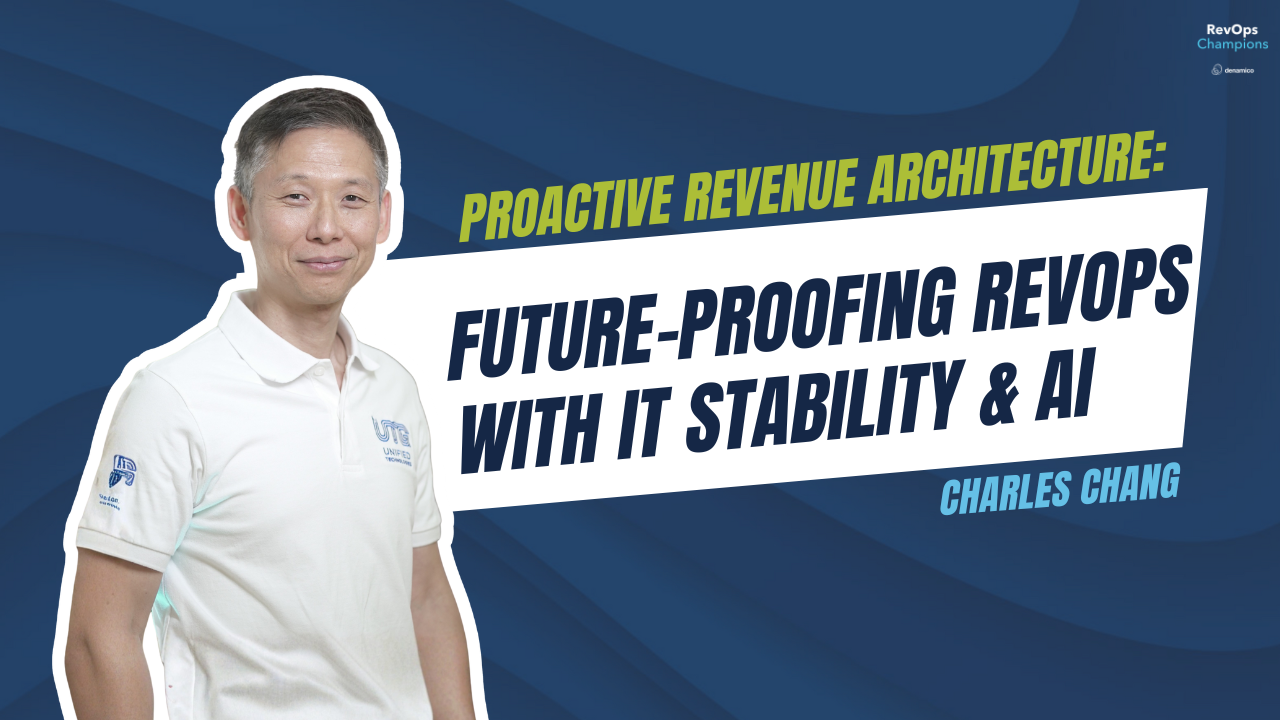
Brendon Dennewill sits down with Charles Chang, Founder of Unified Technologies Group (UTG), to explore what it actually takes to build operations that scale, before crisis forces your hand. Charles brings a systems-first perspective rooted in healthcare IT and multi-company ownership, and his message is clear: most organizations aren't held back by the wrong technology. They're held back by missing SOPs, the wrong people in the wrong seats, and a reactive posture that only responds when things break.
The conversation takes a sharp turn into AI as Charles shares how his team is already deploying AI agents across bookkeeping, email drafting, and reception workflows, using a disciplined sandbox approach to avoid hallucinations and data leaks. He and Brendon explore the tension between visionary speed and operational stability, and why small to mid-size businesses may actually be outpacing enterprise in practical AI adoption.
This episode is essential listening for RevOps leaders, operators, and executives who want to integrate AI without sacrificing security, culture, or momentum.
What You'll Learn
- Why technology always comes last in the scaling order
- The hiring decision that separates scaling companies from stagnant ones
- What a "bookkeeper agent" looks like in a real business
- How to use Delegate and Elevate to identify AI opportunities
- The sandbox-first rule for rolling out AI safely
- When SMBs are actually outpacing enterprise on AI adoptionWhy visionaries need operational leaders to survive growth
Resources Mentioned
Listen
About the Guest
|
|
Charles Chang | Founder at Unified Technologies Group Ltd. (UTG)
Growing up in the world of competitive chess and mathematics, Charles Chang learned early how to cut through distraction, simplify complexity, and focus on the moves that truly change the game. Today, as the founder of Unified Technologies Group and co-founder of Junction Family Dental Care, he applies that same philosophy to business, helping organizations scale through operational clarity, strategic systems, and AI-driven innovation. Known for his visionary mindset and ability to anticipate where industries are heading, Charles combines big-picture thinking with practical execution to turn complexity into scalable growth. His approach, which he calls “Simplify to Multiply,” focuses on removing friction so businesses can grow at the speed of their vision. |

Episode Transcript
Introducing Charles Chang and Unified Technologies Group
Brendon Dennewill: Hi, and welcome back to the RevOps Champions podcast. Today I'm joined by Charles Chang, owner of Unified Technologies Group, a technology and IT solutions provider focused on helping organizations build more secure, efficient, and reliable operational systems, which is music to my ears. With a background in technology, healthcare IT, and business operations, Charles brings a proactive, systems-first mindset to solving operational challenges.
His philosophy, "be proactive rather than reactive," reflects a practical approach to leadership, infrastructure, and long-term business stability. Through Unified Technologies Group, Charles works closely with organizations to strengthen the technological foundations that support performance, security, and scalability, particularly in environments where reliability and operational continuity are critical. Charles, welcome to the RevOps Champions podcast.
Charles Chang: Thank you so much, Brendon. I'm excited to be here.
Brendon Dennewill: I'm looking forward to this conversation. Charles, you're known for your philosophy of proactivity. When you say "be proactive rather than reactive," how has that mindset shaped the way you build systems and lead organizations?
The Data-Centric Foundation of Proactive Leadership
Charles Chang: A big thing for us is that we're very data-centric. We're looking at the data we're able to collect to see if we can somehow predict what's going to happen, whether it's in a system or in a new SOP we've created. We always ask: let's not just look at whether we're able to fix a problem, because that's what SOPs and systems are created for. Let's also predict whether this SOP will hold up in a year or two years, and what comes after that.
We constantly look at data so that we can try not to react to a situation once it occurs, but to say, "There's a trend here. We need to change something."
Brendon Dennewill: We talk about that a lot in the franchise space too. Franchises get to ten units, then thirty, then a hundred. The ones who successfully reach three hundred or a thousand units are the ones who know that things are going to break at each growth stage. That goes really well with your mindset of knowing, going in, that things are going to change. If you're growing, your systems are going to break and you're going to need to replace them. Knowing that in advance is clearly an advantage.
Charles Chang: Right. There's no system that's going to be one hundred percent sound for a long period of time. There are so many external factors at play that you're essentially waiting for it to break. But instead of waiting until it fully breaks, you look for the indicators that tell you it's time to take a deeper dive.
Where Companies Become Reactive: The Hiring and Scaling Gap
Brendon Dennewill: On that note, Charles, where do you most often see companies become reactive instead of proactive when it comes to operations and technology?
Charles Chang: Even before technology, one of the big things is hiring. The question is: do I hire first and then scale, or do I scale first and then hire? Is there one solution that fits all situations? No, there isn't.
What has worked very well for us is being able to plan for the future, understanding how and why you want to scale, and then hiring for that scaling. That approach has consistently worked out well.
Brendon Dennewill: I'm glad you said that, because it's consistent with what we see in franchise brands. The ones who reach three hundred units typically have to change their leadership team pretty dramatically along the way. Otherwise, it's highly unlikely they'll get there.
Because of our revenue operations model approach, we talk a lot about people, process, data, and technology, in that order. Even though most people think of you and me in terms of technology, which we both know comes last, you're not going to be successful implementing technology if you don't have the people piece figured out first. That starts with hiring, leadership, and culture. Then you need clarity around your processes. And then, as you mentioned, the data component drives the decisions you need to make. You need those three things in place before you can properly implement any technology.
Charles Chang: Absolutely. You're spot on when you say technology should be last. It's not because technology is difficult to implement. It's that without the right people, who's going to use that technology? That's what it comes down to in the end.
Brendon Dennewill: And part of the people piece we talk about all the time is communication. It's about leaders who have the capability and the confidence to know that what they're communicating will make a difference in the processes and SOPs they're building.
Charles Chang: Absolutely. It comes down to being clear about the vision, where you want to get to, and the "why" behind it. Without that, leadership becomes chaos. If leadership isn't able to get buy-in from everyone downstream, everyone is going to be spinning. Having that clear picture and being able to articulate it throughout the organization is so important.
The Most Common Infrastructure Gaps as Businesses Grow
Brendon Dennewill: Charles, as businesses grow, what are the most common operational or infrastructure gaps that start creating friction across teams?
Charles Chang: When it comes to operations, one of the biggest issues, especially for small businesses, is that many of them don't have SOPs to start with. That's such a significant problem. Even something as simple as hiring a new receptionist or a new salesperson raises the question: who's going to train these people?
The operations side is a critical factor, but documenting processes according to the culture and how the visionary wants things done is an essential component of being able to scale. Within the healthcare industry in particular, most dental practices, veterinary clinics, and medical clinics don't have SOPs. This creates enormous friction when it comes to their ability to scale. If they want to grow, the visionary or the office manager can't be the person who's always onboarding and offboarding people. You can only onboard one person at a time.
To truly scale, you have to document everything. And it's not an easy thing to do. You can get something off the shelf, but it won't reflect the specific culture or the way that particular visionary wants things done.
Brendon Dennewill: Which comes back to what we were discussing earlier. Without an accountability chart and clarity around who your next hires need to be, how they need to succeed, and the SOPs built around that, you can't build any infrastructure beyond the basics.
Charles Chang: Exactly. At Unified Technologies, we provide IT infrastructure and IT solutions to a lot of these healthcare clinics. Many of them ask how we ran our own clinic, because we do own one as well. The first thing I tell them is: if you're building a new clinic, you have a lot of extra time right now. Spend it documenting how you want things done.
Unfortunately, maybe one percent of those people actually do it. But the ones who do, you can see they're scaling much more easily because they know what outcome they want. The ones who don't are always asking, "How did you do this?" And it doesn't matter how much I share with them. Because they're not documenting anything, they still can't scale, even when I explain exactly what we did.
Brendon Dennewill: That's consistent with something we've talked about before: how critical operational leaders are, and how very few organizations of any type actually grow and scale until they have operational leadership in place. In other words, if the visionary leader is still trying to do everything, it's going to be very hard to scale until an operational leader is in place.
That person loves putting processes in place and is really good at it, whereas most visionary leaders are not. They're often the first ones to become frustrated when things don't work the way they envisioned. But until someone has made it easy for others to hire, onboard, retain people, and bring in more people like them, it's going to be very hard to scale and grow.
Charles Chang: Absolutely. Visionaries are very important in any organization. However, including myself, we're often not very good at articulating what it is we actually want. We see a specific future, but we're terrible at communicating it because we're constantly skipping steps as we describe those visions. And the people who are high fact-finders and high follow-through individuals, those who understand Kolbe, need that granular description, which we hate providing.
Brendon Dennewill: Absolutely. I think most people would recognize that, but it's always a good reminder. I'm in that visionary leader category myself, and without good operational people around me, I wouldn't get much done.
Charles Chang: We've spoken about collaborations in the past as well. It really is a collaboration with everyone else in the organization.
The Role of Technology: Security, Uptime, and Disaster Recovery
Brendon Dennewill: Absolutely. Charles, in your experience, what role does technology play in helping organizations scale more consistently and efficiently?
Charles Chang: We look at technology from a few key angles. First is security, because wherever there's technology, there's data, and data needs to be secure, especially today. Second is uptime. Those are two important perspectives that always need emphasis. But we can't overlook disaster recovery.
A disaster is going to happen. The question is how quickly you can recover from it. We always tell our clients: if you're connected to the internet, it's not a matter of "if" you're going to be hacked. It's "when." And when it happens, how are you going to recover? That question is far more important, in our perspective, than whether you're running the latest workstations or servers. None of that matters unless you have the proper security and disaster recovery policies in place. Without those two things, you will get hacked and you will not be able to recover.
Brendon Dennewill: Which, of course, comes back to your philosophy of being proactive. I must say, though, I'm sure I'm not the only one thinking this: it doesn't sound very exciting.
Charles Chang: No, it's not exciting. But that's exactly how you want it. You don't want it to be exciting. That's the whole point. Especially during COVID, we had a number of clients hit with ransomware, particularly in the dental space. Here in Ontario, the Royal College of Dental Surgeons of Ontario sent out a memo warning that dental clinics were being specifically targeted for ransomware attacks.
What we observed as a trend is that once a dental office paid the ransom, the attackers would take that same information, put it on the dark web, and let other hackers go after the same client again. Most dental clinics don't learn from their first encounter with a security issue. They leave everything status quo and end up getting hacked again.
Brendon Dennewill: They probably assume it was a statistical one-off.
Charles Chang: Right. Unfortunately, it's not, because your information is being sold on the dark web continuously. That's exactly why we say we don't want it to be exciting.
Balancing Speed and Growth with Stability and Security
Brendon Dennewill: Charles, how should leaders think about balancing speed and growth with stability and security?
Charles Chang: That's a hard one, especially from my perspective as a visionary. We don't want to stop. It can be frustrating if we feel like we're being slowed down. In my weekly meetings with my strategic assistant and integrators, and especially in our quarterly and annual reviews, because we do implement EOS, I give them full authority to push back. If they think we're moving too quickly, they have to say so.
At the same time, that doesn't negate the fact that sometimes I'll push back against their pushback, especially if we see something happening in the market that we need to capitalize on quickly. And that doesn't necessarily mean revenue. It could be market share. It could be AI, given how quickly it's advancing. If we want to capitalize on something like that, we have to weigh the pushback we're receiving carefully.
The first thing I do is give them full authority to say, "Charles, we're going too quickly. We can't keep up." At that point, I have to consider: do I need to bring on more people? Do I need to change some processes? Do we have the right people in the right seats? There are many things to evaluate at that juncture.
Brendon Dennewill: That makes total sense. It sounds like the perfect collaboration, where everyone has their role. Some people's job is to keep pushing forward, and others' job is to ensure systems remain stable and secure, while you continuously find that balance. And you make those decisions out of trust and respect, at least weekly, to ensure you're making the right call for the business as a whole.
Charles Chang: Often when we move too quickly, we'll start to see client experience KPIs begin to dip slightly. That's one of the things we always watch, because when client satisfaction starts to decline, we know we may be pushing too fast on something. We want to make sure that front-stage experience is always positive for our clients, even if the back stage suffers a bit from a fast rollout. But even then, we don't want to burn out the staff.
Brendon Dennewill: Right. And that comes back to what you said earlier. Beyond the customer experience, on the employee experience side, you want to think through the amount of training that has to take place for whatever you're rolling out. Be realistic about the timeline and the communication required. As we all know, that communication typically has to happen multiple times. You need a proper training plan in place before the new thing actually takes hold, before the team starts to see the benefits and genuinely adopts it. That takes a lot of time and communication.
Charles Chang: Absolutely, it does.
Building a Culture of Prevention and Preparedness
Brendon Dennewill: Charles, a lot of companies wait until something breaks before improving their systems. How can leaders create a culture of prevention and preparedness?
Charles Chang: One thing we do consistently is rely on the people who are actually working within a given system to give feedback throughout the entire process. We want them to say, "Hey, this isn't working. Something's wrong here." For all of our SOPs, we have a feedback loop where we want information not just from data and numbers, but from people giving their frank opinions. They're the ones on the front lines. Why wouldn't we rely on them to tell us what's working and what's not?
We do this all the time with our staff. In fact, we just sent out a survey regarding AI integrations across two of our companies, asking whether those AI integrations are helping or causing more problems. If they're causing problems, we need to take a step back and look at it. It really does come down to depending on the people closest to the work.
AI and the Evolution of Operational Leadership
Brendon Dennewill: Okay, Charles, now we've arrived at the topic we've been building toward: AI. Everything you've shared is still absolutely relevant today. But looking ahead, through the lens of the AI you've already begun rolling out for your own companies and your clients, how do you see operational leadership evolving as businesses become more dependent on technology, automation, and AI?
Charles Chang: As a leader, one of our main jobs is to figure out how to make the working environment better for the people we work with. That means if there are things people don't like doing, say, writing or replying to emails or text messages, you first need to understand why they don't like it. Then you ask: is there someone who enjoys doing that we can assign it to? In EOS terms, that's "delegate and elevate." Or is there a technology that can take some of those aspects of the job out of that person's realm, making their working environment better?
For us, the starting point was giving employees the delegate and elevate form: What do you enjoy doing? What are you good at? What are you good at but don't enjoy? What do you hate and are bad at? What do you hate but are good at? We study that carefully and ask: can we use AI to solve some of these frictions? Because if something creates friction for an employee, we want to remove it so they can concentrate on what they genuinely enjoy. We started doing this about two weeks ago and we're already looking at other things we can automate using AI.
Brendon Dennewill: You've been an early adopter of AI, both for your own productivity and within your companies. And I believe you're now at the point where you could potentially do the same for your clients based on what you've built internally. What they all have in common, whether we call them mundane, repetitive, or just unwanted tasks, is that they create friction for the individual, for the team, and ultimately for the whole organization. If there's a way to delegate, elevate, or automate that friction, why wouldn't you?
So as someone leading with AI, what have been some of your initial learnings, and what have been the biggest breakthroughs from a productivity perspective?
Charles Chang: From the implementations we've already performed, one of the first things is recognizing what AI is actually good at: repetitive tasks. One example was reconciliations at the dental clinic, matching revenue and expenses. We had a bookkeeper handling this on a quarterly basis. We created an AI automation where any staff member can take a photo of an invoice or an insurance payment, drop it into a folder, and the system recognizes it, categorizes it for the dental clinic, and fills out the ledger immediately. Now it generates a weekly and monthly summary report in real time, and it presents that data in a dashboard, so there's a visual component as well.
We're on the verge of letting our bookkeeper go, not because we're trying to cut costs, but because it's done faster and better. And the real question becomes: where can we now reinvest that money to do something else? Where do you want to employ AI, and why? That's the important question to ask every time. And the easiest place to start is always the repetitive tasks.
Brendon Dennewill: That's a great example. One of the questions I wanted to raise, something that comes up more now than ever, is what I call the "Mary problem." We're now saving Mary two hours a week compared to last month. How do you tell Mary what to do with those two hours? Have you found a model for handling that opportunity?
Charles Chang: If we have the right people in the right seats, the savings in time tend to land well. Because of that delegate and elevate exercise, they're already thinking, "If I just had a little more time, I could do this better."
Brendon Dennewill: So you go back to that list and say, "You now have that time."
Charles Chang: Exactly. And that's what we're experiencing. Whether it's two hours a month or thirty minutes a week, they're able to put more focus into the things they actually want to do. Is it their unique ability? We don't always know. But it's something they want to do, so why would I stop them? And honestly, that's the only way they'll find out whether it is their unique ability, by having the opportunity to pursue it. They might discover after a month or two that it's not as fulfilling as they expected, and then they redo the exercise.
Charles Chang: That's the trend we've seen. People get to spend more time on what they always wished they had more time for. And if it's the right people in the right seats, that time tends to be spent well.
Looking Ahead: AI Integration, Agents, and What's Coming
Brendon Dennewill: Charles, as we look six to twelve months out, heading into the end of 2026 and into 2027, what are you most looking forward to from an AI perspective, and how does that layer into what you're currently doing and providing to your clients?
Charles Chang: The big thing we see with AI right now is that as it becomes more and more connected with different types of applications, whether web apps or desktop applications, those integrations are becoming more and more relevant. As that continues, more things will be able to be automated. And as the LLMs get better and better at understanding exactly what we want when we type or speak to them, the complexity involved in building those automations is going to come down significantly.
For example, the bookkeeping automation I described took me about forty-five minutes of back-and-forth to get right. That same workflow will probably take fifteen minutes down the road. And with more native integrations, the AI will be able to execute autonomously, because now it's not just my request it's learning from, but millions of similar requests from others.
Another thing I see is more and more companies wanting to adopt AI. I think a lot of companies and individuals are drawn to the novelty of AI, but they don't yet understand the full scope of what it can do. That's a big opportunity for early adopters to get out there and help other companies adopt AI in a meaningful way. Not just "here's an email, write a reply," but sitting down with someone and asking, "If I could save you thirty minutes or an hour each week, what would that unlock for you?" Walking them through that thought process and showing the true value is where the real opportunity lies. And because of all these integrations to different web apps and desktop apps, it really comes down to how creative you can be.
Brendon Dennewill: You're right. It's an exciting time. But coming back to your world, where security always comes first: for early adopter leaders who might be moving a little too fast and risking real damage to their organizations, what advice do you have? It's not just security, though that's certainly one concern. What would you say to leaders who aren't approaching AI rollout in the right way?
Charles Chang: One thing we do, for example, is with our email automation. If the AI is able to generate a reply by reviewing the full email thread, we've instructed it to put the draft into the drafts folder, not send it. Then a second set of eyes reviews it. Our staff go through those drafts: "That's great, send. That's great, send. No, that one needs changes." Having that human review step is essential.
Another thing we do is test in a sandbox first, using sanitized information. We're checking: are there any data leaks? Are there any situations where the AI might, even by accident, send the wrong patient's X-ray to someone else? That type of thing is always on our minds. Extensive sandbox testing before any production rollout is non-negotiable. The latest figures suggest AI hallucinates about sixty to sixty-five percent less than it did last year, but that doesn't mean it doesn't still hallucinate.
Brendon Dennewill: Primarily because it lacks enough context, or it's working with too much data.
Charles Chang: Right. AI doesn't always have enough information to confidently say, "This X-ray belongs to patient A and should not be sent to patient B." So you have to test whatever prompts you're using in the sandbox extensively before pushing anything to production.
Brendon Dennewill: And the email draft example speaks to something we've all learned: you have to keep the human in the loop. As your processes and SOPs evolve to incorporate AI, the proper process still has to be in place. Even as people automate more and elevate their own roles, there has to be a human checkpoint within the system.
Charles, one last question. In EOS, everyone's familiar with the accountability chart: the visionary CEO at the top, the COO integrator below, then functional leaders, and then everyone with a defined role driving the processes that make the business run. Are you already starting to see AI agents being added to that structure to support each of those roles?
Charles Chang: Yes, definitely. Within our own companies, we're already doing that. The bookkeeper, for example, was a person. Now we have a bookkeeper agent. The receptionist role hasn't been fully replaced, because we still feel most people want to speak to a human. But specific tasks within that receptionist role are absolutely being moved over to an agent.
I'd also say that in mid-size to larger enterprise companies, we're starting to see an AI department or an "AI guru" role become more prevalent. Interestingly, though, small to medium-sized businesses are actually moving faster than enterprise. They're doing it not by hiring a full-time AI person, but by bringing in third parties with experience to scope out the possibilities and show what AI can realistically do for them today.
Brendon Dennewill: They're more agile.
Charles Chang: Exactly. And who knows, by the end of this year, as prompting becomes easier and easier, we may not need that outside AI expert at all. I personally don't think we'll need them for long. It's a scary place for some people because they feel so far behind. But I actually think that because prompting is going to become so much easier, those people will be able to leapfrog the early adopters.
Brendon Dennewill: That'll be really interesting to see. I tend to agree. A year ago we were debating whether to hire a chief AI officer, full-time or fractional. It never quite made sense. And then we reached a point where we could essentially play that role ourselves, using AI to help us be our own chief AI officer.
If I think forward another year from now, I can't imagine needing one, even though, as you said, for mid-sized companies right now it might make a lot of sense to have someone with the time, bandwidth, and experience to get the rollout done properly. But then what do they do a year from now?
Charles Chang: Right. It all comes down to the implementation side of AI. And imagine going through the process of modifying all your operations because you brought in that role. It's not a small job. That's exactly where people who have early adoption experience become valuable: to help others think through what SOPs need to be retired, which ones need to be modified, and how any of this is going to impact day-to-day business.
Brendon Dennewill: Exciting times.
Charles Chang: Absolutely.
Closing
Brendon Dennewill: Charles, thank you so much for joining me today. I learned a lot, and I'm sure our listeners did as well. We'll make sure to share your links on our episode page when it's published. Thanks again for joining me.
Charles Chang: Thank you so much, Brendon. I really enjoyed this.
Brendon Dennewill: Thank you.