
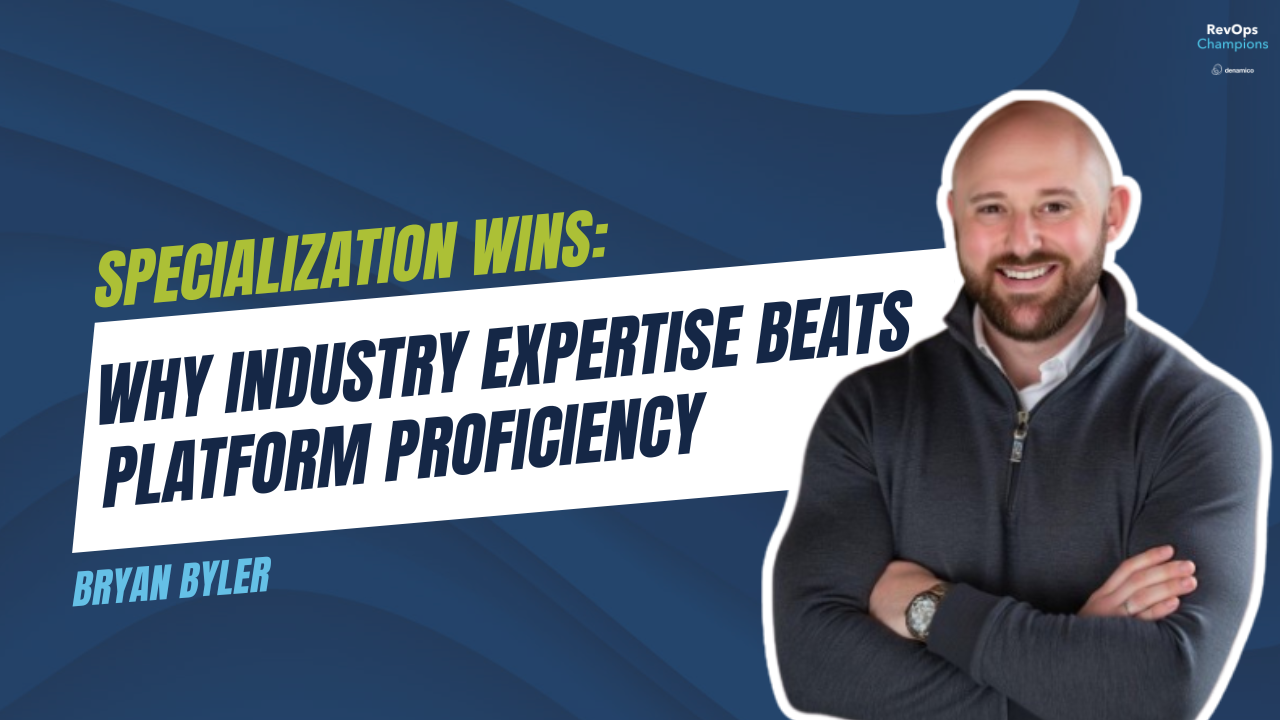
In this episode of the RevOps Champions Podcast, host Brendon Dennewill sits down with Bryan Byler, a revenue operations leader and go-to-market strategist with more than 15 years of experience building scalable revenue engines across healthcare, SaaS, and technology organizations. Brian, who now leads GTM strategy at 4CAST GTM after serving as CRO and COO at Aptitude 8, explores why growth doesn't create problems, it exposes them, and why leadership alignment often matters more than any single technology decision.
Throughout the conversation, Bryan shares real examples from healthcare, including how EMR systems fail to support patient engagement and why HubSpot's native Epic integration is reshaping what's possible for medical practices. He and Brendon compare the franchise and healthcare industries side by side, agreeing that people, process, data, and technology must evolve together, and that industry specialization, not just platform expertise, is what earns buyer trust in an AI-driven market. This episode is a must-listen for RevOps professionals, healthcare and franchise executives, and B2B growth leaders building revenue systems that scale without losing the people running them.
What You'll Learn
- Why alignment beats a perfect strategy
- The real trigger for a CRM upgrade
- How to build process without bureaucracy
- Setting quotas your team can actually hit
- Why industry specialization now wins deals
- What AI means for implementation risk
- The "but why" test for adoption
- When Excel finally becomes a liability
Resources Mentioned
- HubSpot
- Salesforce
- Clay
- Zoho
- Monday.com
- Claude, ChatGPT, Gemini
- Excel / Google Sheets
- 4CAST GTM
- Aptitude 8
Listen
About the Guest
|
|
Bryan Byler | Chief Growth Officer at 4CAST GTM
Bryan Byler is Chief Growth Officer at 4CAST, where he leads HubSpot strategy for healthcare organizations navigating the shift from legacy systems to scalable, patient-centered revenue operations. He brings more than 15 years of progressive experience managing people and processes, including prior executive roles as Chief Revenue Officer and Chief Operating Officer at Aptitude 8, where he helped scale the firm's HubSpot consulting practice. Earlier in his career, Brian held global and principal-level onboarding roles at HubSpot itself, giving him a rare vantage point on the platform from both the vendor and implementation-partner sides. Known for building go-to-market systems that drive sustainable, repeatable growth, Brian now specializes in the specific operational nuances of healthcare, from patient acquisition workflows to EMR-to-CRM integration strategy. |

Episode Transcript
Introduction
Brendon Dennewill: Hello and welcome back. Today I'm joined by Bryan Byler, a revenue operations leader, go-to-market strategist, and business operator who has spent more than fifteen years helping organizations build scalable revenue engines through stronger systems, leadership alignment, and operational discipline. Throughout his career, Bryan has worked at the intersection of CRM strategy, revenue operations, and organizational growth.
He has held executive leadership roles, including Chief Revenue Officer and Chief Operating Officer at Aptitude 8, helping companies align marketing, sales, and customer success around shared processes, trusted data, and measurable outcomes. What makes Bryan's perspective especially valuable is his belief that growth doesn't create problems, it exposes them. As organizations scale, leadership alignment, process discipline, and cross-functional collaboration become increasingly important. Bryan has seen firsthand how misalignment can slow growth, and how simple, well-executed systems can transform performance. Bryan, welcome to the RevOps Champions Podcast.
Bryan Byler: Thanks for having me, Brendon. Really excited for a conversation today.
Brendon Dennewill: Awesome. As I was getting ready and reading what drives you, I was so excited about this conversation because there's so much overlap between what you believe and how you operate, and what we believe and how we operate. So I'm really looking forward to this. I know your focus now is very much under the umbrella of the healthcare industry, and ours is very much in the franchise space. There's potentially some overlap there, but I think how we approach things is so similar, and I know our audience is going to learn a lot from this conversation today.
So, Bryan, you've spent your career helping companies build scalable revenue systems. What originally pulled you into the world of revenue operations and go-to-market strategy?
What Drew Bryan Into Revenue Operations
Bryan Byler: That's a good question, Brendon Dennewill. Being in consulting for most of my formative years, early on and on the road, I think it's probably one of the biggest problems we saw again and again at organizations across industries. I did a lot of work in the construction technology industry, where it was pretty glaring, and during my time at HubSpot, I got to see a lot of different industries where it's a problem that a lot of organizations may not even realize they have. Everything is fine until suddenly it's not. I think many businesses outscale their technology and their application needs before they even know it.
The solution to that became really intriguing to me, and the technology could fill that gap. That's when I decided, about five or seven years ago, to really build a career around HubSpot, because I think it's the best tool on the market to solve these revenue operations problems and opportunities that we see across industries.
Why Alignment Matters as Organizations Grow
Brendon Dennewill: Right. And I know that you say technology ultimately doesn't solve any business problems on its own. So let's get back to the things I know you deal with, and the things we deal with, when it comes to successfully setting up a revenue engine for a business, whether they're in healthcare, franchise, or anywhere else.
I know you and I are both very passionate about the importance of alignment, and I think you've said alignment eats strategy for breakfast. Why do you believe leadership alignment becomes so critical as organizations grow?
Bryan Byler: It's just so necessary. The converse is probably the more useful way to think about it: a lack of alignment is extremely detrimental, and that's why alignment is so beneficial. But what actually helps isn't just being aligned, it's the process leadership teams go through to become aligned. That means requesting dissent: let's disagree and have a conversation about it. You share your point of view, I'll share mine, they'll share theirs. It's the discussion that helps a group reach consensus and alignment. That's why it's so valuable. When we're all in agreement, that should indicate that the necessary discussions have happened to get there.
Compare that to a CEO saying, "Here's the strategy, go execute it," without group alignment and without everyone's perspective. That's much more likely to fail. I've seen the best strategies go awry as a result of a lack of alignment, where not everyone is on board with the plan. And sometimes a strategy that isn't perfect, when it's iterated on and discussed among the right people in the right room, works out fine. If we're all aligned and all committed, even an imperfect strategy is good enough.
Brendon Dennewill: Yeah, and you actually just get to work and at least test it. If it doesn't work, you can go back and change the strategy. But it's a lot easier to do when you have alignment. Really good.
Where Revenue Teams Break Down First
Brendon Dennewill: So, Bryan, you and I have both seen this in multiple industries we've built systems for. No matter what industry a company is in, they break through these ceilings of complexity, and the reason they end up speaking to either you or our team is because they've outgrown their technology systems. But we also know there are other things that have to be in place or aligned before we can actually build a new system for them.
So let's dig into this: when organizations begin to scale, where do you most often see revenue teams break down first, and what are the warning signs leaders should watch for?
Bryan Byler: The things that go wrong initially that you need to be vigilant about start with a hard realization many founders have to go through: the folks you started the business with are probably different from the people you'll exit the business with. There are a lot of reasons for that along the way, but at different growth junctures, it always starts with the people. Do I have the right people on the bus? Is this the right team at this growth juncture?
Your first salesperson, who was great at selling in a certain segment and was very scrappy in early go-to-market stages, is probably not the same kind of person who's going to be a scaled revenue leader who can run a team of five or ten account executives and put up millions of dollars in revenue. It's possible someone progresses like that in their career, but as executive teams, you've got to frequently assess the people you have and confirm everyone's still in the right role. That doesn't mean they don't work in the organization anymore, maybe you shift roles internally, but you've got to have the right people before you fix the process.
If we're sure we've got the right people in the right places, then it's time to assess the process, and that leads to technology decisions from there. Are we going about things the right way? Does our methodology need to change? The market is dynamic and always changing, and organizations fail when they don't adapt. How we sell in 2026 is very different from how we sold in 2019, and that's different from the early 2000s. Organizations that evolve look at people first, then process and methodology, and only then look at technology through that lens. Are people supported by the right technology? Do we have a CRM in place at all? Maybe we've outscaled Google Sheets.
Excel is probably the number one CRM in the world. It'll get you pretty far, but at a certain growth juncture, you've got to reevaluate your technology needs. Organizations that do that consistently every three to five years continue to grow and scale and have success, in healthcare and elsewhere. Those that stick with the status quo, particularly in this era of AI, are going to have a hard time growing. They'll stagnate, and people will ultimately leave those organizations.
Outgrowing Spreadsheets: The Compelling Event
Brendon Dennewill: Yeah, and as you were talking there, the reason scaling businesses eventually outgrow Excel or Google Sheets, which again, full credit, are incredibly powerful tools, is that as you scale and grow, you're adding people. When you're adding people, your processes need to change.
Bryan Byler: Complexity.
Brendon Dennewill: Exactly, and you're not just adding people, you're adding layers of people, adding management layers. And as soon as you add complexity, eventually a spreadsheet is going to break. Then it's time to assess what gets you to the next stage. To your point, it's not just that the people who got you here won't get you to where you're going, it's your processes and systems too. And you could argue the metrics or KPIs you're measuring at each of these stages evolve as well.
Bryan Byler: True. It's often a compelling event, Brendon. At some point we identify, hey, we missed a revenue number, or we're not getting enough leads. In our healthcare world, maybe we hired a new provider and need more patients, or we've identified from the data that our patients aren't returning, they're going elsewhere. There's usually a compelling event that says, we need something to better capture and document this.
A convergence we see pretty often on the healthcare provider side is that so many medical practices have an EMR, an electronic medical record system, or a practice management system, where the doctor puts all of your medical information into the computer. They'll have a charting system to keep records, and technically that's probably all you need to run a medical practice, that and email. But what's missing is that system isn't going to help you nurture your existing patients. There's no real ability to do patient engagement or follow-up.
In healthcare, we talk a lot about creating meaningful, lasting relationships instead of transactional ones, because healthcare by definition is typically transactional. We don't want to go to the doctor, we need to. If I'm going to the dentist, I'm going for a particular reason and that's it. I don't want to hang out there the way I might at a mall.
These are all compelling events where something has happened, a data point is missed, a KPI was missed, we've reached a growth juncture, and we need to look at the market to see what tools are available to solve the problem. What many organizations find, across all industries, is that a CRM is usually that first big investment, along with marketing automation platforms. Those are two big steps up in maturity, and all roads typically lead to HubSpot, or Salesforce if that's the route you decide to go.
Brendon Dennewill: Right. One of the other things Dynamico was born out of is the belief that technology, like so many other things, is going to continue to change. As business leaders, we have to be dynamic in realizing that and setting the expectation that the systems we build now aren't going to last forever. The other way we've evolved is treating a system not as something you build once and it's done, but as a practice. We use a yoga analogy: you don't just do yoga for a month and get the benefits for life. It's a practice you do weekly, or more frequently. We see the same thing with the systems we build.
A really good example is the Epic-HubSpot integration, which I'm sure is life-changing for so many businesses in the health and medical space. That wasn't an option before, so it was a limitation and an obstacle for more businesses in that industry to use HubSpot. Now, with a native integration, that changes everything, and the opportunity to have a more operationally efficient and scalable business becomes real. Technology doesn't necessarily solve your business problems on its own, but once you've identified what the problems are, bringing in the right technology to streamline what you're doing can be life-changing.
Bryan Byler: Certainly. We see it every day, and that's why we're in the business we're in. Technology in the hands of the right people saves time, saves money, and ultimately improves people's quality of life. It's an enabler of productivity when we're doing it right. A lot of the discussions we have with clients start with, "I know I need a tool, but I don't know what I need it to do," or "these are the problems we're having, what tools are available to help us solve this?" People rarely say, "I need to buy a CRM today." It's usually, "we've got these problems, we think a CRM is what we need," and there's always a good discussion around whether a CRM is really what they need or something different.
From our point of view, tools generally fall into three or four segments. Some organizations need more lead generation or demand gen, so maybe you just need a marketing automation platform, a marketing hub, not necessarily a full CRM. Or maybe sales and marketing are fine, but you can't service your existing customers, so you need a customer support or service solution. That's a different problem set. We see it with ERP systems too: having a hard time managing inventory, or your sales team writing quotes, so you look at CPQ or ERP. There are these buckets of technology all tied back to solving individual problems.
But to your point, Brendon Dennewill, having technology itself isn't going to solve the problem. It can, if implemented correctly by the right team, and more importantly, adopted by your team. The technology investment is the first piece. The implementation is the second piece. And the continuous "yoga" of adoption and continuous improvement is the third. You really need all three.
The Power of Industry Specialization
Brendon Dennewill: Absolutely. One of the other things we have in common between Forecast and Dynamico is that we both eventually realized the power and importance of specialization. You've gone deep into healthcare, we've gone deep into franchise, because we both realized that just implementing the HubSpot CRM isn't enough. There are hundreds of partners who can stand up a HubSpot CRM and integrate it with other technology, but it's the architecture that matters. You have to understand the complexities of, in our case, a two-tier franchise system with corporate and hundreds of franchisees. In your case, the complexities and differences in healthcare. The consulting, advice, and architecture we bring is really what's critical, because you cannot just build the technology, it has to be customized specifically for that business.
Bryan Byler: That's right. We see it often. As we look at more highly specialized industries like franchise, healthcare, logistics, or manufacturing, people go to school and earn entire degrees to become experts in the industry. Your average consultant could be the best HubSpot consultant or CRM consultant, but generalize across industries, and they're not going to have that same level of subject matter expertise. They just can't acquire it. Most partners across CRM consulting firms work with clients in multiple different industries where the technology is the same. But in more specialized industries, implementation looks completely different, and there's no shortcut. You're not going to push a button and implement HubSpot well for a medical practice, because there's just so much nuance and context.
How a laboratory association, a medical equipment manufacturer, an optometrist, or a surgical practice uses HubSpot is going to be completely different. There's no real shortcut to doing this well. For us, we're owned and operated by active, licensed, practicing nurses, and that helps a lot. Clients don't necessarily want to hear from me, they want to hear from someone who's worked in hospitals for twenty years, has that career experience, and has done this exact thing many times. That type of expert knowledge is becoming more and more valuable, especially in the age of AI, where anyone can throw something into Claude. Claude isn't going to become an industry expert on its own. It isn't going to replace that know-how.
In your firm's case, a lot of partners have implemented a franchise or two, but you all have done it dozens and dozens of times. There's a lot of value in those repetitions. You avoid mistakes, you know how to look at systems across multiple disparate franchises and come up with a scalable integration plan, and you're not missing things because you've already learned from those mistakes in the past. We see that in healthcare all the time too. Here's how you make a mistake: go into a sales call with a medical practice and ask, "What's your sales team like?" It doesn't exist. It's patient acquisition. Technically, it's sales, but how you architect a CRM for new patient acquisition is very different from B2B or B2C sales. It's little nuances like that most generalist firms wouldn't know, and that's fine, but it certainly creates opportunities for organizations to double down and triple down in these industries and become the best at that particular thing.
Building Process Without Bureaucracy
Brendon Dennewill: So, Bryan, we've touched on this already multiple times, and you talk often about the importance of process. How do you build enough structure to create accountability and scale, without creating bureaucracy that slows teams down?
Bryan Byler: Tough one. By any definition, installing a new process requires more rigor. This is an unpopular opinion, I guess, but I like to elicit feedback from the users of the process. Revolutionary, I know. Many organizations I've consulted with have a leadership team with the best intentions and the best data that prescribes a new policy or procedure, and it doesn't get adopted well for one of many reasons. If it's not ultimately helping people or solving a clear purpose, it's not going to help your teams move faster. Some processes exist for the benefit of the business, to be more compliant, more effective, or more profitable, but everyone needs to understand why. I see a lot of leaders just saying, "this is how we do it now," and if the team lacks context and doesn't understand why, there's going to be resistance and friction.
That's a key part of it: communicating around it. And once the process is live and implemented, we'd be foolish to think we're going to get it right every time in the design room. It looks good on a whiteboard, but in practice it's a little different. Coming back to the yoga analogy, every time we roll out a new process, give it a few weeks or months, then take a look. Is it working as we intended? If so, great, maybe we nailed it. If not, let's tweak it. It's rare that we get it a hundred percent right out of the box.
The easiest telltale sign that you need to revisit a process is inconsistency in quality, when projects are being delivered differently by different consultants, or a particular type of work is completed with varying levels of deliverable quality. If you see variance in what should be your standard product, that's where you really need to look at the process and procedure.
Change Management and Adoption
Brendon Dennewill: Yeah, and as you were talking there, it goes back to the fact that processes have to change because the organization is growing. You're adding people, and when you add levels of people, your processes have to change. The other piece of it brings back the importance of communication.
One of the things I know you're familiar with from your experience over the last five to seven years, and something that separated firms like ours from many others, is the change management component. You just gave a perfect example: when you're rolling out a new process, the communication needs to be, "this is new, it's not cast in stone, we're going to try it for a few weeks and iterate as we go." The way you communicate that is so important, and knowing that users feel they have the training and support means the process and the tools that changed within it are going to be adopted and used more successfully.
I know this is something else you and I agree on: adoption is the ultimate measure of a successful implementation, whether it's a process or a technology. If it's not adopted, it doesn't really mean much. So the basic question is, what do we need to do to achieve adoption? And that comes down to communication and the change management piece, which touches on the importance of the people who have to navigate that change.
Bryan Byler: Agreed. I'd bring it down to what I'll call a toddler level. I've got a toddler at home who's in that "but why, dad, but why?" stage. Go clean your room. But why? Go get your shoes. But why? If leaders can just answer the "but why" question, I think new processes and procedures turn adults into a little bit of a toddler sometimes, myself included. But it's okay if it benefits the business, or benefits you, or benefits our clients. If there's a benefit in one of those three areas, people understand why the change happened, and adoption is going to be much smoother, with less pushback and resistance. But a surprising number of leaders can't offer that, or don't offer it, or roll something out prematurely without thinking through the "but why."
Brendon Dennewill: Yeah. One of my coaches uses the alternative phrase "so that." You say something, and he says, "well, so that…" and you peel the onion to make sure you're getting closer to the actual solution or root cause. If you don't ask that question at least three times, like your toddler does, you might be skipping a lot of important value.
Turning Data Into Decisions
Brendon Dennewill: So, Bryan, let's move on to how we measure all of this. All businesses, assuming they're growing and trying to be more efficient and scalable, are dealing with an even bigger spotlight than usual around data, whether you call it KPIs, metrics, or OKRs. Every organization has some form of data they're measuring to ensure they're making progress. One of the things we hear about a lot is that companies in all industries are collecting enormous amounts of data but still struggling to act on it. What separates organizations that simply look at data from those that actually make business decisions because of it?
Bryan Byler: Good question. There's certainly no shortage of data in 2026, but a surprising number of organizations aren't using their data to the best of their abilities. I'd come back to people here. It takes a savvy financial, revenue, or marketing leader to sit down with the business and come up with the KPIs and metrics that are relevant, and to track them, because by doing so you're volunteering to hold yourself accountable to those same metrics. Some people fear that. Revenue forecasting is hard and stressful for all businesses. It's stressful to commit to a revenue number for the quarter or year based on what you think will happen.
The advice I give people developing these metrics for the first time is that your best predictor of the future is history. Look at quarterly trends, overlay your P&L over years, and look at your competitors and similarly sized organizations. What kind of numbers are they putting up? You'd be surprised, if you get on a call with a competitor, they may share some numbers with you. I've been privileged to hear things like, "we're running at this run rate," and compare notes. Peers are a great resource, historicals are a great resource, and I'd come back to alignment here too. If the leadership team all thinks it's probably the right data, it's probably the right data. What's not the right data is when the CEO or CFO says, "this is your number," without seeking input from the people actually delivering the work.
That's also a great way to lose your sales and marketing team, prescribing numbers that the ivory tower thinks are correct. Behind every metric, you've got to have a good reason why it's set, and be able to defend it. Most of the time, when I talk to sales reps who've missed quota for one reason or another and ask where the quota came from, they say, "that's just what they told us." I think about managers or directors who don't have input into that number, and that's really challenging.
Getting the number right the first time, using the data, is probably half the battle. I look at quota like this: satisfactory performance should hit the number, exceptional performance should exceed it, and unsatisfactory performance shouldn't hit it. You're going to have all three levels in an organization. Nobody's hitting 120 percent all the time. But if the team is consistently not hitting quota, you've failed your team by setting an incorrect metric to begin with. Likewise, if your team is hitting it 150 percent every month, it's probably set too low. Continuous review, adjustment, and benchmarking is how you get it right.
The People, Process, Data, Technology Model
Brendon Dennewill: Right. So, Bryan, we're on the downstretch here, starting to wrap up. We've touched on all these things already in this conversation, and I haven't mentioned it yet in this episode, though I typically mention it at least once every episode: our model for revenue operations, and the four pillars we use at Denamico, which are people, process, data, and technology. We've touched on all four in different ways, which I love, because they're all connected. To your point, it starts with people. If you don't have the right people, the right culture, the right direction, and the right communication, it's going to be really hard to do anything downstream from there. It's going to be hard to establish and evolve the correct processes as the business grows, hard to understand the correct metrics or KPIs, and hard to build the technology tools you need to drive results.
So, do you have a variation of that model? I know you think about revenue operations a lot yourself. What's your model?
Bryan Byler: I'd say very similar. We talk a lot about people and process, those are certainly the big pieces. Personally, data is really big for me. Technology, in the models I've talked about or prescribed, is certainly assumed under data, but it's people and process that I come back to again and again. If you have the right people in the right room, I think you'll go pretty far.
Looking at it through the lens of revenue operations, I'd say it almost follows that order, Brendon Dennewill. Assuming you have the right people on the team, process is probably the next thing to look at. I'd bundle technology and data together, because technology is what ultimately results in the data, and without the technology, it's really hard to access the data. But ultimately, it's the people who determine the correct process. Those two things, some combination thereof, dictate the correct technology, because that's different on a per-firm basis. HubSpot's not a great fit for every organization, though I think it probably is for most. You'll talk to organizations that are fine using Zoho, or Monday.com, but many wouldn't be. It depends on how your business operates.
There are so many technologies nowadays. A good litmus test is the emergence of hundreds, thousands, of really great AI point solutions. It's pretty interesting to see how that pans out, because in revenue operations we had point solutions, then we moved away from them toward consolidated tools, which we liked. Now we're seeing a reconvergence of point solutions coming back into the market. It used to be, "I've got HubSpot, I'm good," or "I've got Salesforce, I'm good." Now it's, "I use HubSpot for this, and this AI point solution for that, and this one for something else." So I'd pose this back to you, Brendon Dennewill: how does that impact the model? We're seeing a major technology pivot, AI is coming in, and what we consolidated over the last five years is starting to break up again. How do you tackle that through the lens of people, process, data, technology?
AI, Point Solutions, and the Future of the Tech Stack
Brendon Dennewill: Yeah, well, I think two ways. One, I guess we probably have to put a disclaimer out there, you and I both drink a lot of orange Kool-Aid, but it's because of the culture HubSpot has created beyond the incredible product itself, which fits into that people piece and informs their processes and why they do things, solving for the customer.
The other reason we have confidence building our solutions on the HubSpot platform is that they're leading the race toward AI. It was the first CRM to essentially connect to all the major LLMs, which is how we, and all our clients, current and future, will use HubSpot. It's going to be somehow connected to, let's say, Claude, through MCPs, connecting all their tools through an LLM. But you still need the CRM to do what CRMs do, especially for the types of organizations we work with. They're not going to build a CRM by coding it over the weekend, because there's just too much at stake. We're talking about hundred-million, three-hundred-million, five-hundred-million-dollar, or billion-dollar organizations. They're never going to just replace their CRM, but as the technology evolves, part of our job is helping them.
Our mission is to help the companies we work with, those leadership teams, always harness technology to stay in touch with their customers, or in your case, patients, and how they manage that relationship or that care. You always need to do that. What's interesting, and part of why I think we've separated data a bit, is that the data layer is the one thing that's shifting. For the longest time, HubSpot was the single source of truth for pretty much all our clients. That might evolve now, and I think HubSpot accepts that, as does everybody else. We just have to figure out what the next best solution is. Maybe it's not one single source of truth any longer, but a data layer sitting on top of your technology that makes your processes possible and gives your people the tools they need to be the best at their jobs, and to tell their family and friends at a barbecue on a Sunday that they have better tools and processes, working at a better company, and maybe they should consider coming to work there too.
Bryan Byler: Love it.
Brendon Dennewill: Which comes back to something you touched on: it all comes down to employee experience. Whether you're working in a hospital, an optometrist's office, or a home services franchise, you have a job, and you want a job that's more than just a job. You want to believe in where the company is going, its vision and mission, and you want the tools to do the best job you possibly can. Those employees, of course, also need to step up and change as change happens, because if they don't, then, going back to your earlier point, the people who got you here aren't going to get you to where you're going. Change is part of growth, both personally and in business.
Bryan Byler: True. An example of changing with the times, following the pace of technology: a former colleague of mine was in a marketing role, and the team identified they would benefit from GTM engineering, so they adopted Clay. This person had never used Clay before, and they were kind of forced into a decision: either become good at this and adopt these new tools and become a more modern marketer, or reevaluate their career. They chose to adopt the technology, became very proficient at it, and learned a tool that a year or two ago certainly wasn't on their mental roadmap. As technologies change and evolve, the team has to be open to adopting them.
Even with HubSpot as a container, it feels like there are hundreds of new releases every quarter, and it takes intentional effort to keep up with all the enhancements they're making, which is a great problem to have, and quite a luxury. We're fortunate they're continuously improving, but it puts the onus on our consultants and solution architects to stay current, so that when clients come to us and say, "we heard HubSpot has an MCP server that supports agents, can you help us with that?" we have to have already learned it. You've got to do some professional education and upskilling to remain relevant.
Brendon Dennewill: Yeah, and that's really good advice, for any person in any role, including the millions of people who will never listen to this episode. With all the opportunity AI brings right now, if you just focus on the things only you can do, that no machine will ever do, you'll always be able to add value in whatever work you do. It's hard, because most of us have been through a similar education process for anywhere from twelve to twenty years, essentially programmed to be machines. Now we have to unprogram all that learning, because there are now machines that can do better work than what we were trained to do. We need to reprogram ourselves to be better humans, and let the machines do the things they can do better. There's a lot of complexity that comes with that, and we don't have time to dig into all of it today.
Bryan Byler: It's a separate episode. Part two.
Why Industry Specialization Matters More Than Ever
Brendon Dennewill: So, Bryan, maybe as we wrap up. We already touched on this earlier, but as HubSpot continues expanding into different industries, and it's not an industry-specific solution, though who knows if it ever will be, you've argued that platform expertise alone isn't enough. Maybe talk a little more about why industry specialization is becoming increasingly important for consultants, agencies, and implementation partners.
Bryan Byler: Buyers are becoming more savvy. AI has many pros and cons for society, but a big pro, if you're a buyer, is that you don't have to rely on the salesperson anymore. Five or ten years ago, if I was buying new technology, sure, I could Google it and find some articles, probably paid for by somebody. Otherwise, I was at the mercy of the sales process, one vendor telling me their software is great, another telling me theirs is great, maybe I'd talk to friends and colleagues. Now I've got AI in my hands, and I can ask Gemini, Claude, and GPT, all three if I want, what's the best CRM for my type of business, or what questions I should ask in a software evaluation. Buyers now have tools that make them much more savvy and far more informed.
As we look at implementation partners, given that a buyer has chosen the right software, who's going to implement it? Buyers know more now than ever how important that is, because five years ago they bought a technology and the implementation went poorly. People get fired over that. Or the implementation went well, and they want that to happen again. Most technology leaders who've been around a while have seen one or more implementations go poorly. It costs the team time and money, and there's a lot of risk. Buyers know now that a lot of the risk relies on the implementation partner you choose. That's probably as important a decision as investing in the right software.
As we evaluate different partners, if I've got three partners I like, I can narrow it down based on how well they run their sales process and my confidence in their ability to get the job done. That's half the battle. I always tell people, we sell trust and confidence, those are the two things we sell. Do you trust that my team knows what we're doing, and that this is the right solution? Do you have confidence that we'll actually be able to execute the solution we've demonstrated? Subject matter expertise and industry specialization are becoming more and more important. A lot of buyers tell us they're choosing to work with Forecast because of our healthcare specialization and subject matter expertise. We don't have to explain the hundreds of acronyms, or how hospital operations work, because our team already knows that.
I think it's similar in your world at Denamico. If I have two partners who are otherwise similar, but one's worked with franchises hundreds of times and one's done two or twenty, I have more confidence that the one who's done it more times is going to do a better job. I might even like the other partner more as a person, but ultimately it comes down to who I have the most confidence in, who I want to work with, and who I think will set this up most effectively for my team. That's always been important, but as buyers become more informed, it's becoming more and more important. I hope that across all software technologies, more implementation vendors take that route, because I think it's going to be helpful and necessary.
Advice for Organizations on Legacy Systems
Brendon Dennewill: I totally agree. So, maybe one last question. A lot of the folks listening, whether in healthcare, medical, franchise, or otherwise, are sitting on legacy systems. What advice do you have for the leadership teams of those organizations that might give them permission to look at replacing their legacy systems?
Bryan Byler: That's a tough one, as far as when to make that decision or when to evaluate it.
Brendon Dennewill: Or when to know that your legacy system is likely holding back your growth or scalability.
Bryan Byler: Easy answer: if you're using Excel. If it's 2026 and you're still running your business operations out of Excel or Google Sheets, it's time for maturation. It's time to upgrade and invest in technology, and I mean that in seriousness as much as anything else. What I'd say is, as soon as revenue substantiates the ability to make the investment, that's probably when you should do it. You can get by for a few years with beginner-level tools, Google Sheets, email, and a website is probably all you need to get started. Your next growth juncture is going to need a starter CRM, which is one of the reasons I'm so bullish on HubSpot. It can be your starter CRM. You can get the starter suite for thirty-five dollars a month and run a multi-million-dollar business on it. We have clients who do it. I know people who do it, using the same technology and scaling it to five, ten, twenty-five million dollars without having to migrate off or switch. That's a very unique model.
So the advice is to invest in a set of tools as early as you can afford it, ideally a tool that can grow with you. HubSpot is, in our view, usually the best investment for those businesses. When you reach twenty-five million in revenue, maybe then evaluate whether you need an ERP or more of a back-end solution. But on the CRM, marketing automation, and service side, that gets you very, very far.
Brendon Dennewill: Yeah, and again, adding to that, we know the technology scales, HubSpot scales from literally a one-person business to two thousand employees and more. But going back to what you were saying about industry specialization, make sure you're working with someone who's guiding you through the different stages of growth, beyond just what the technology can do, because the technology still has to be implemented and integrated according to your evolving needs.
Bryan Byler: Right. And the last point I'd make in closing, Brendon, is beware of that as well. AI can be used for good and bad, and we've had to fix a number of projects this year where somebody bought HubSpot with good intentions, worked with a partner they chose with good intentions, and that partner just used some AI application to zip out the implementation and said, "we're done." The clients are like, no, we're not done, this isn't implemented the way we need it to be, maybe it is in the way you think it is. As you're evaluating implementation vendors, no matter what tool it is, make sure you understand what you're actually getting out of an implementation. We should all be using AI to be faster and more productive for our clients, but if we're using it as a shortcut, you can't shortcut a good implementation. You just can't, and it's going to cause problems and create a lot of risk for the client.
So pressure-test your partners and understand how they're using AI, hopefully to benefit you, instead of just doing the work for them. The worst thing is for someone to pay twenty thousand dollars for an implementation, have somebody vibe-code it or throw it into a tool, get it done in eight or ten hours, and charge that full amount. We're seeing that as a trend across all technologies, and it's something buyers should be aware of.
Closing
Brendon Dennewill: That's really good advice. Bryan, thanks again so much for joining me today. I really enjoyed the conversation, the crossovers and similarities between what we're both dealing with in completely different industries, and the fact that we both feel really confident about the platform we've chosen to help our clients scale from relatively small businesses to multi-billion-dollar businesses. Thanks for joining me.
Bryan Byler: Thanks for having me.