
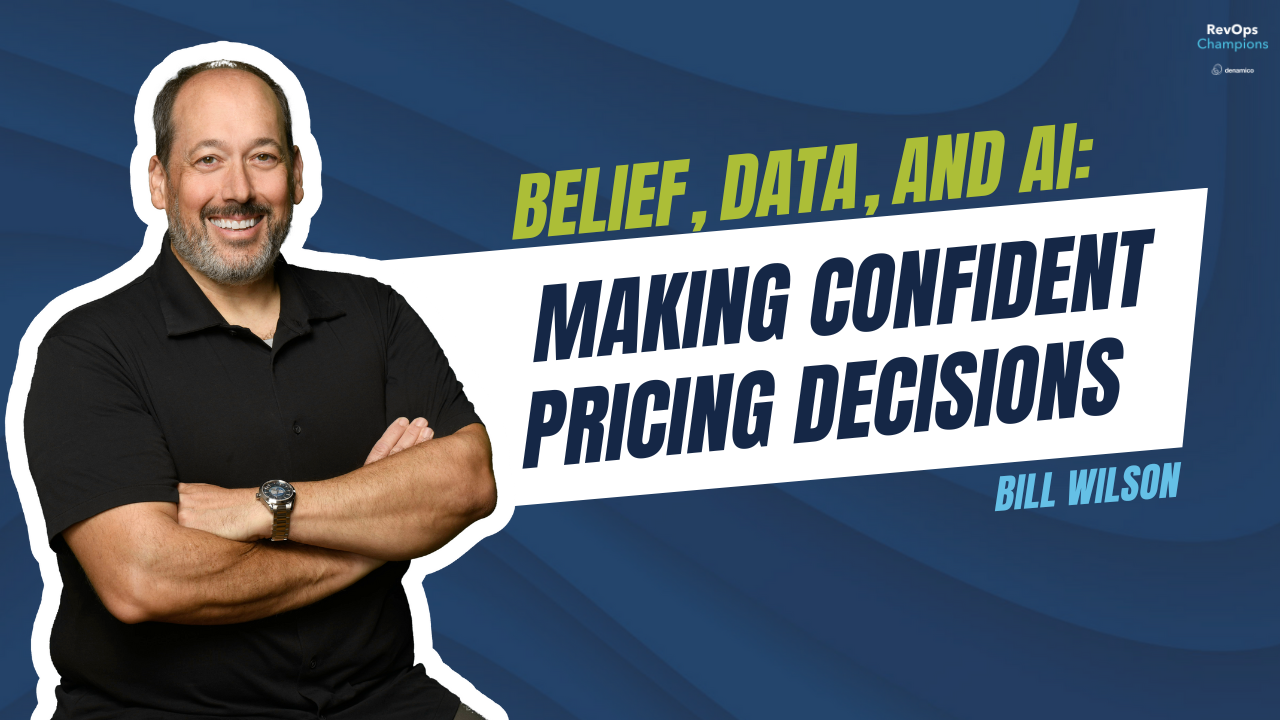
In this episode, host Brendon Dennewill sits down with Bill Wilson, Founder and CEO of Pace Pricing and three-time software entrepreneur with over 20 years building and scaling SaaS companies. Bill shares how he evolved from software developer to pricing strategist after recognizing the deep anxiety founders face around pricing decisions. Through his work guiding hundreds of SaaS teams, he's discovered that pricing isn't just a numbers game—it's about alignment, belief, and understanding the jobs customers hire products to do.
The conversation explores why pricing, product, and positioning cannot be separated, and how misalignment at the leadership level cascades throughout organizations, leaving money on the table. Bill unpacks his PACE framework (Profile, Architect, Calibrate, Execute) and explains why he shifted from pure data-driven decisions to building belief through iterative validation. He also tackles how AI is fundamentally reshaping SaaS business models, from enabling outcome-based pricing to introducing new cost structures that challenge traditional economies of scale.
This episode is essential for SaaS founders, RevOps leaders, product executives, and B2B growth teams looking to unlock revenue through strategic pricing, eliminate cross-functional friction, and prepare their business models for an AI-driven future.
What You’ll Learn
- Why pricing misalignment at the leadership level quietly becomes a company-wide problem
- How the PACE framework brings structure and repeatability to pricing decisions
- The difference between solving a problem vs. executing a job to be done
- Why belief, not data, is the true catalyst for pricing changes and adoption
- How AI is accelerating the shift toward outcome-based pricing models
- Why product, pricing, and positioning can’t be separated, and what happens when they are
- The single most impactful action a founder can take if pricing hasn’t been reviewed in a year
Resources Mentioned
Listen
About the Host
|
|
Bill Wilson | CEO & Founder of Pace Pricing
Bill Wilson is a three-time founder with more than two decades of experience in SaaS, product development, and pricing strategy. He began his career as a software developer and discovered his passion for pricing while building SalesRight (acquired by FastSpring), where he saw firsthand how powerful well-designed pricing can be for growth. Today, as Founder & CEO of Pace Pricing, Bill helps SaaS founders turn pricing into a clear, strategic advantage. He has coached hundreds of SaaS teams on value-based pricing, data-driven decision-making, and the emotional side of pricing—where fear, belief, and internal alignment often matter as much as the numbers. Known for blending analytical rigor with practical founder empathy, Bill helps companies align leadership teams, connect pricing and product strategy, design scalable offers, and build monetization models that actually unlock growth. A trusted SaaS coach and community leader, he champions openness, community, and celebrating others’ wins as core ingredients of sustainable success. |

Episode transcript
From Software Developer to Pricing Strategist
Brendon Dennewill: Bill, you've been a three-time founder and operator in software and product for more than 20 years. What led you specifically toward pricing as the focus of your work?
Bill Wilson: It's an interesting question. I'm a software developer at heart. I've been writing code for a very long time. When I got tired of the rat race of writing software for enterprise companies, I decided to build my own company, and I very quickly realized that selling by the hour wasn't great. That was my first real taste of pricing: trying to figure out what to charge for our services.
I decided to productize the service because I was used to working in product. We started selling in a flat-fee approach, and along the way we developed a small internal software tool that allowed us to present pricing to customers. It was very good-better-best, like the SaaS model, with our three productized service offerings. I had it connected to HubSpot so prospects could fill out a form and land on a page personalized to them with options they could choose.
We were selling to a lot of B2B SaaS companies at the time, helping them build companion apps, and many of them would say, 'This is a really cool tool. Where did you get it?' I'd say we just built it internally. My head of sales, Taylor Bond, was very adamant that we push it further. So we built a company called SalesRite, built entirely around that technology for presenting pricing to B2B SaaS companies.
The long answer is: I got into pricing by being forced into it. Through trying to sell our own software, I realized how much anxiety and fear surrounds pricing in general. Almost every single prospect call would end with them asking, 'What do you think of our pricing?' I ended up doing consulting on those calls for a long time. After we were acquired, I've been 100% focused on helping B2B SaaS founders get unlocked on pricing.
Brendon Dennewill: It sounds like one of those things where you're so good at something, you don't realize not everybody else has the same skill. You assumed everybody knew how to do this, and then you realized that wasn't the case. That's a really cool story.
The Cost of Pricing Misalignment Across the Organization
Brendon Dennewill: You often talk about alignment challenges among product, sales, CS, and leadership. What experiences showed you how costly misalignment can be?
Bill Wilson: Misalignment can show up in lots of different ways. The first tell I get when starting with a company is sitting down with the executive leadership team and realizing it's the very first time they've all talked about pricing together. That tells me there's misalignment on how they deliver value to customers. If they haven't had the conversation about how they price, they're probably not having full value conversations across the organization.
We often get brought in as argument settlers. One side of the house thinks one way, the other side thinks another, and they want the experts to settle it. Misalignment at that level is incredibly costly. If you're not aligned on how your customers get value and how you package and deliver it, you're leaving money on the table. Untold amounts of it, depending on the size of the company, are just being dropped because of misalignment.
That's why I like using research methods that get everyone on the same page, looking at value through the same lens. Once we have alignment on that, we can start the hard work of figuring out how to capture value and package it up.
Brendon Dennewill: As I think back on my experience with this, it's almost like a pyramid. If there's misalignment at the leadership level, the further down the organization you go, the bigger the misalignment becomes. Most leaders are more familiar with talking about misalignment further down the org, whether it's between sales and marketing or sales and delivery. But that downstream misalignment typically traces back to the top.
Bill Wilson: Almost certainly. There are classic misalignments you see all the time: sales and delivery, product and marketing, product and sales. In a SaaS company, you can almost draw a line with product and engineering on one side and CS on one side, and sales, operations, and finance on the other.
Brendon Dennewill: Exactly. Which is just another proof point that the more aligned you are at the leadership level, the easier you make it for everybody else.
Bill Wilson: Absolutely. It trickles down.
Building the PACE Framework: Profile, Architect, Calibrate, Execute
Brendon Dennewill: You developed a structured pricing system at Pace. What moment or insight pushed you to formalize your approach into a repeatable framework?
Bill Wilson: Part of it is built into me. I like to productize services and think of things in terms of product. But what really drove me to it was knowing that these projects can go on forever if you let them. Research and trying to capture lightning can just expand and expand. Having a structured approach helps these engagements avoid scope creep.
Honestly, the bigger driver was a feeling in my bones that there was a natural three-stage process to doing this: package it up, figure out the price point, and validate it all. But there was something missing at the beginning, so it eventually became a four-phase process. That fourth phase is what I call Profile, where we go extremely deep on everything, including your customer, how they perceive value, and how they buy.
Ultimately, I wanted to build something I could repeat and refine. I'd taken bespoke work in the past, and every time you do that, you're reinventing the wheel. I decided early on to help B2B SaaS firms of a certain size with similar challenges, and I optimized for those.
Brendon Dennewill: So essentially you built it for your own scalability at Pace. And as you started using it, you realized every client was being satisfied by the productized model.
Bill Wilson: Yes. It gave us a baseline to iterate from. It was definitely built out of my own desire for scalability, but it was also grounded in what clients needed. Which reminds me of another lesson: never automate something until you've actually done it a few times.
Brendon Dennewill: So the name PACE, that actually comes directly from the framework?
Bill Wilson: Yes. PACE stands for Profile, Architect, Calibrate, and Execute. You profile everything, including your customer and how they perceive value and buy. Then you architect the packaging, pricing, and offers. You calibrate against the market and your internal impact analysis so you understand what changes will do for the business. Then you execute, which means validating with real customers, starting with existing ones and then moving to new ones.
I think about every project through all four stages, whether it's the full Pace Pricing System, the Pace Fast Track workshop, or a pricing strategy review. The company used to be called something else. I changed the name once I locked in on this framework. And, not to mention, there was another company with a very similar name that I hadn't caught when I first launched, so I had to change it anyway.
Brendon Dennewill: That seems like a lot of work, having to change the name of a company. It's a bit like renaming a child.
Bill Wilson: It was. Still haunts me. Don't rename your children.
Is the PACE Framework Transferable Beyond SaaS?
Brendon Dennewill: You focus on helping SaaS businesses, even though Pace itself is a services business. How transferable is your pricing framework to other industries?
Bill Wilson: For a long time, I didn't think it was super transferable. But the more I talked to people outside of SaaS, the more those conversations would naturally evolve into discussions about value exchange and offers, and it all lined up. That's when I realized it was fully transferable.
Of course it is, because in B2B, people are trying to make progress against something in their business. Every other business selling to businesses is trying to help them do the same. If we can align around that, the framework works. I haven't met a company yet where I couldn't have a good conversation about value and watch a few aha moments show up in the founder's eyes.
Jobs to Be Done: A Framework for Value, Triggers, and Positioning
Brendon Dennewill: You emphasize the jobs customers hire a product to do. How should founders use the jobs-to-be-done lens when building pricing, product, and positioning?
Bill Wilson: The interesting thing about jobs to be done is the semantic difference it carries. It's not just identifying a problem. It's asking: what is someone actually going to hire something to do? I need my grass cut. That's a problem I have. But I may not be willing to pay someone to solve it until there's enough pressure to make me act. When that moment comes, I'll hire someone or something, whether it's the kid down the street or a robotic mower.
The reason I like jobs to be done is that monetization is inherently built in. A job is something you're willing to pay to have done. A problem might just be something you tolerate. That's the first lens. The second is that it recognizes a trigger moment where someone has to make a decision to buy. Nobody grows into pain. You hire someone to do something because it's finally too much for you to deal with.
If founders can truly understand the motivations behind someone switching from whatever they're doing today to something new, they can set up positioning so it acts like a tractor beam, pulling prospects in by using that same language back at them. That's the push and the pull, which is a framework from Bob Mesta, who does a lot of jobs-to-be-done research.
As founders, we're always thinking about the product itself: the features, the things it does. But what you should be thinking about is what your customer is actually trying to do in their business, one layer above your solution, and how your solution helps them make progress on that job. Stay in the problem space, not the solution space.
For example, if you're trying to sell butter, you can talk about unsalted versus salted, but the real job to be done is helping people consume healthy fats. Butter is just one solution. If you think only about unsalted butter, you're too deep in the solution space. Stay in the problem space, and then figure out how you help customers make progress on the job to be done, over and over again.
Brendon Dennewill: So essentially, if you do the jobs to be done, you solve the problem. It's the other side of the same coin. Most of us ask, 'What is the problem to be solved?' The flip side is, 'What are the jobs we need to do to solve it?'
Bill Wilson: Sort of. It's less about the problem and more about what the customer is trying to accomplish. And we can never fully do the entire job for them. I try to drive that into founders' brains. Saying 'We'll increase your revenue by 80%' is almost never accurate. Your product may help make progress toward more revenue, but you're unlikely to be the sole generator of that outcome.
In B2B, we can really only move two things: time and money. I can save you time, which saves you money, or I can make you money. But you can't go to market with 'my value prop is to save you time.' There's likely something more specific the customer is trying to achieve, and the time savings is the outcome of that, not the goal itself.
The beautiful thing about jobs to be done is that once you solve a big portion of someone's job, there are two natural ways to expand. First, look at all the areas of that job where you don't yet participate. Second, ask: what's the next job to be done after this one? That's a natural progression for expanding your service line.
Brendon Dennewill: That connects to the theory of constraints: to make progress, you have to identify and remove the obstacles. Does that come into your thinking?
Bill Wilson: Absolutely. Where is the friction in what they're doing today? Identifying friction points is central to this. There are emotional jobs and social jobs layered into jobs to be done as well: what's the deep anxiety, what's actually feeding some of this, and how can we help resolve those? The functional friction points are the underlying constraint. There's a reason we're not all flying around in flying cars.
Beyond Data: Why Belief Drives Pricing Decisions
Brendon Dennewill: I've sensed that you've shifted your thinking about data over the years. You used to be very data-driven. What changed?
Bill Wilson: Data is incredibly powerful. It can tell you exactly what you want to know, and you can torture it into telling you almost anything. But data is just one piece. I used to say 'price with confidence,' and I believed data is what gives you confidence. I've realized that's not entirely true.
Confidence usually comes from belief, and belief sometimes has to be backed up by doing. I've seen incredibly well-designed pricing models, including some of mine, never get off the ground because the team simply isn't committed to the idea that it's going to work. No amount of data can overcome that.
What I've realized is that everyone needs to get on the same page with some level of belief in the system. Jobs to be done is part of that because it's a unifier. Every department can think about it the same way. But if a key group doesn't believe, it probably won't launch.
So how do you build belief? Through iteration and validation. The first layer is just asking: could this work? If the answer is yes, you move to the next layer: let's go test it with existing customers. Share what you're doing, run what I call a purchase simulation where they walk through the process of rebuying the software, and gather feedback. Those small experiments and feedback loops are what build belief. I'd rather be directionally accurate than precisely wrong. Get enough data to make quality decisions, then dip your toe in the water. Belief is built, not bestowed.
Pricing, Product, and Positioning Cannot Be Separated
Brendon Dennewill: I've heard you say that pricing, product, and positioning cannot be separated. How do you explain that?
Bill Wilson: However you decide to position in the market is going to dictate what you build and how you price it. If you start with pricing, it will impact what you build. If you decide to be the budget, best-bang-for-your-buck option, you're going to build something tighter, go after higher volume, and position differently in market. If you start with the product, you have to be thinking about pricing and positioning at the same time. Otherwise, how are you deciding what to build and how?
To me, that connective tissue is obvious now, similar to how a CRO sits between sales, marketing, and product organizations to ensure a holistic revenue engine. When I get brought in to solve a pricing problem, it often ends up impacting the product, sometimes significantly. And certainly the positioning will change, because the jobs-to-be-done research almost always surfaces a better understanding of the value proposition.
Clients often come to me with dollar-sign anxiety: am I charging too little, too much? I tell them it's far less important how much you charge than it is how you charge. That's where pricing, product, and positioning all live together.
How AI Is Reshaping SaaS Pricing and the Path to Outcome-Based Models
Brendon Dennewill: You embraced AI early in your own workflows. How do you think AI will change how SaaS companies design products, pricing, and operations?
Bill Wilson: Whatever we say here will change completely in the next 30 minutes. That said, the biggest shift I'm seeing in the SaaS world is an obsession with outcome-driven pricing. For those of us who have been in pricing a long time, this is what we've always been after. We just haven't had a good way to do it.
The goal has always been to price as close to the value delivered as possible, as close to the actual outcome your product creates. But we've defaulted to charging per seat, which is really charging for access: paying at the door before knowing if it's a good party. The continuum runs from charging for access to charging for outcomes, and the closer we get to outcomes, the better.
What AI has allowed is for products to actually deliver outcomes, often without significant human intervention. The poster child for this is support ticket software. A problem comes in, the AI handles the chat, resolves the issue, and you pay 99 cents per resolution. I'd rather pay for a resolution than staff a whole team to answer questions with variable success rates. That's true outcome-based pricing.
There are still challenges. I've heard arguments even on the support side about who really solved the problem. These things get tricky. But the trend is clear: as SaaS companies add more AI, they'll get closer and closer to value-based pricing.
The other big shift is cost structure. For the first time in a long time, the more people use your AI-powered product, the more it costs you. That's almost counter to the traditional SaaS model, which is built on economies of scale: build it once, sell it to everybody. Now you have inference costs every time someone interacts with your AI. That's a big adjustment for companies used to 85% margins.
The third shift is AI-first software companies that aren't carrying legacy SaaS thinking. They're thinking in terms of roles and responsibilities, not tools someone else uses. They're asking how to accomplish a process nearly end to end. What people call employee replacement, or role replacement, or function replacement. Some of the best companies out there are solving really hard problems that look an awful lot like replacing a person in a seat. And now pricing gets benchmarked against: what would it cost you to do this the traditional way?
Brendon Dennewill: That's the hard part. There's a massive shift that has to start at the leadership level of every organization. Looking at HubSpot as an example, their customer service agent is getting the most traction within the product, but they're navigating that same pricing model challenge. And with over 7,000 global partners and 1,200-plus internal reps all trying to deliver a consistent message, the change management component is enormous.
Bill Wilson: Especially with something this new, where a lot of people still carry significant anxiety around AI.
Brendon Dennewill: And this connects to what I've been calling 'results as a service,' which replaces software as a service as the destination. Even if we know that's where we're headed, how do you shift from where you are today to that, especially in complex ecosystems? All of which circles back and reaffirms the jobs-to-be-done model. Of the jobs that need to be done, which ones need to be done by humans, and which ones can and will be done by agents?
Bill Wilson: Exactly. And then there's the middle ground: the augmented human, what some call the cyborg model, where much of the work is done by an agent but a human is still in an oversight capacity. That's the human-in-the-loop approach.
And in that context, one of the biggest moats in any business, especially in the age of AI, is trust. Delivery costs as low as possible and customer acquisition costs as low as possible: those have always been defensible moats. But trust is the new one that gets missed. Every time someone interacts with your AI, your agent, whatever you've built, you're only as good as your last output. We might tolerate a few mistakes, but if it keeps messing up, we stop trusting it entirely. And that trust is very hard to win back.
I experienced this in my own workflows. I built an automation that distills my thoughts from a pricing strategy review call into a deck I can send to a client. Something that used to take two hours now takes two minutes. I was anxious about it for the first five or six runs, but eventually I trusted it. I still review it, I still make sure it captured what I was actually discussing, but I trust it. I've even gotten to the point where I don't want to change the model running it because I've built that trust and I don't want to start over.
Positioning as a Blue Ocean Strategy
Brendon Dennewill: How often, when advising a client, do you see that their positioning is so solid that if you get the pricing right to fit the product and the positioning, they're going to be off to the races because they have no real competition?
Bill Wilson: More often, what I see after doing customer research is that there's a different positioning available that would let the company sail down a very short river into a blue ocean and out of the red sea they're currently in. But it's the same idea. Positioning can completely reshape your thinking about the business you're building.
The first time I got seriously interested in positioning was through April Dunford's work. Before that, I thought of positioning as just messaging and marketing. But it's really about what you believe and how you echo that back to the market, essentially saying: if you believe this too, then you should work with us. You often need to name an enemy at some level, to say, 'This is what has worked for years, but here is the problem we see. If you're already thinking that way, come work with us.'
She has a great example about selling databases in the late 80s or early 90s. They switched the category from database to data warehouse because they were constantly being compared against something they weren't. The repositioning changed everything. The product underneath was essentially the same, but now they were speaking to a market that was disenchanted with databases and wanted something different. That's what I mean by positioning.
One Action Founders Can Take This Week on Pricing
Brendon Dennewill: If a founder listening today hasn't reviewed pricing recently, what is the one action they can take this week to create real movement and confidence?
Bill Wilson: If it's been a long time since they've looked at pricing, get whoever needs to be involved, probably your executive team, in a room and start talking about the fact that it hasn't changed and what it should be. That's the closest thing to real movement you can create.
The more immediate action: if you haven't changed your prices in over a year, you should probably raise them by 10 to 15%. You're already losing ground relative to last year. Your customers want you to succeed. They want you to have strong pricing. I don't condone raising prices just for the sake of it, but if it's been a long time, you're not giving yourself enough oxygen to stay competitive.
Beyond the number, the real goal is to see if your understanding of what customers are struggling with, in terms of positioning, product, and pricing, actually matches what's in the room. That's where everything starts.
Brendon Dennewill: And what should the founder or leader not do in that room to make sure they get the best outcome from that discussion?
Bill Wilson: A lot of decisions are driven by fear. I would say: do your best to take the 'our customers are all going to quit and churn' mentality off the table, and just truly talk about how you deliver value and whether the way you're capturing it makes sense.
Also understand that changing your pricing doesn't necessarily mean changing the actual price. It could be changing the structure slightly, adjusting limits across plans, or other levers that affect perceived price without touching the dollar sign itself.
And don't shut down creative ideas. Everyone in that room has their own lens. Sales will say don't raise prices, it's hard enough to sell as it is. Marketing will worry about redoing all the messaging. CS will worry about telling customers. Product will wonder what changes are coming. Everyone has internal anxieties and their own view of how customers get value. As a leader, your job is to circle all of those people around one shared question: what progress are we trying to make for our customer?
The very first thing I do in these sessions is a hopes and fears exercise, something I learned from my friend Joel Smith. Put yourself in a time machine, a year from now: we did the pricing work, what do you hope happened? Then flip it: it went terribly, what are you afraid of? Get it all on the table, have the conversation, and it clears the air. I'd start there every time.
Brendon Dennewill: Bill, thanks so much for joining me today. I know we could have gone in many different directions, and I look forward to the next conversation.
Bill Wilson: Thank you so much for having me. This was great